How to arrange fruit trees on a plot: determining the garden layout
The placement of fruit trees on a plot should be carefully considered – this will ensure a beautiful landscape and create optimal conditions for the plants. There are a number of rules that must be considered during the planting stage.
Content
How to create a tree planting plan
When creating a plan for the placement of fruit trees, you need to be guided by several points:
- area of the site;
- form;
- degree of illumination.
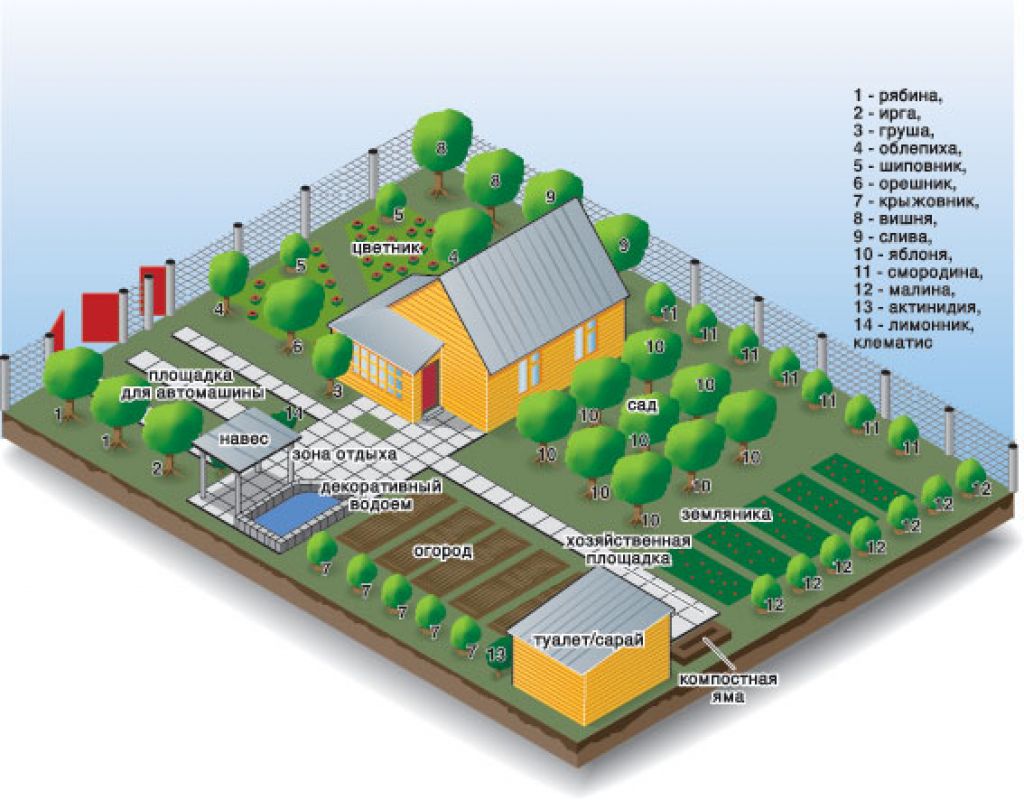
Before planting an orchard, it's a good idea to draw at least a rough plan for the tree placement. Gardeners often sketch out their plans on pieces of paper, imagining how the plot will look in the future. They choose between a landscape or formal layout. In the latter case, the garden beds are rectangular or square, separated by straight paths. This option is ideal for those who appreciate precise geometry and orderly forms. Such plantings are easier to maintain.
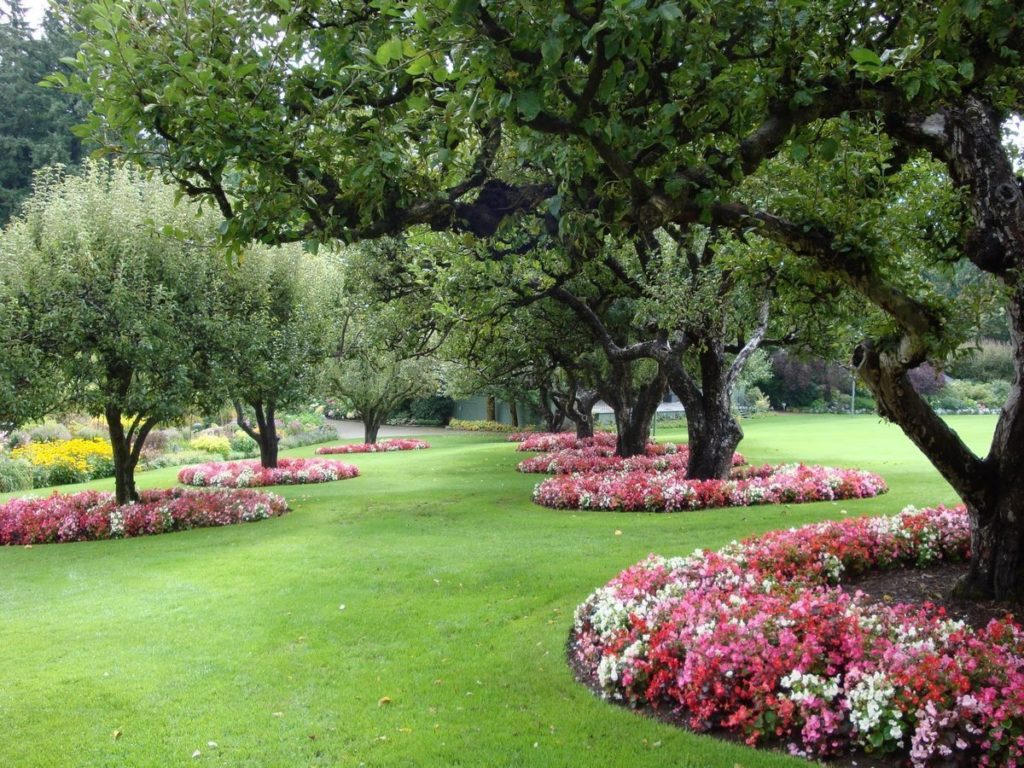
Landscape planning, also known as free-form gardening, is closely aligned with natural style. Trees are placed according to a pre-planned design, not in a strict order, but in groups. Landscape design is often complemented by ornamental plants. Creating such a garden requires a creative approach.
Choosing a location

Designing a garden is a challenging task, but it's possible to tackle it yourself without the help of specialists. First, you need to inspect the site and decide how much space will be allocated for planting.
It's best to plant a garden on level ground; a sunny south- or east-facing slope is also ideal. It's best to avoid planting fruit trees in low-lying areas, as they will be exposed to low temperatures, which will negatively impact fruit production and flavor. Late spring frosts are also a risk, as they can cause fruit drop and a reduced or completely lost harvest.
If possible, allocate a terrace located at the top of the slope for an orchard.
Soil composition
When planting fruit trees in your garden, consider the soil composition. Choose fertile soil with good water retention (absorbing and retaining moisture, preventing its rapid evaporation) and allowing for free air circulation.
Complete soil replacement is unlikely, so large holes are dug for planting trees, filling them with imported black soil. Mature trees have powerful roots that extend deep into the ground. To prevent them from becoming waterlogged, the groundwater level should be taken into account. If the groundwater level is close to the ground surface, it is advisable to drain the planting holes, and even better, the entire site.
Regularly blowing winds prevent normal pollination of plants, dry out the soil during warmer months, and lead to frostbite of young branches. If trees grow on the windward side, they should be protected, for example, by creating a tall hedge or installing a solid fence.
Garden styles
Before planting trees, it's important to decide on the style of the garden. Choose between a formal or landscaped design. In the former, trees are arranged to form symmetrical shapes. You can arrange them in a row, then create straight paths between them. A staggered arrangement is also acceptable to allow more light to reach them.
If the site is located on a hill, trees are planted across the slope.
The landscape style looks more natural, as vegetation is placed randomly, taking into account individual preferences and the compatibility of different species.
Compatibility of plants in the garden
Every gardener should know how to plant fruit trees on their property. There's a common misconception that stone fruits and pome fruits are incompatible and shouldn't be planted close together. In reality, fruit trees aren't particularly demanding when it comes to planting. Plant compatibility is a relative term; the key is to follow proper agricultural practices.
For example, two large apple trees of the same species planted two meters apart will be cramped. An apple tree and an apricot or cherry tree should be spaced four or five meters apart. This will provide them with enough space to grow normally. Intertwining branches is detrimental, negatively impacting yield, reducing annual branch growth, and causing them to dry out.
At what distance should trees and bushes be planted?
Many beginning gardeners ask: what distance should be kept between fruit trees? A 3-meter gap from fences and buildings is recommended. It's recommended to plant apple and pear trees at a distance from them.
The spacing between rows of trees grafted onto low-growing rootstocks is approximately 5–6 m. Within rows, the distance between crops should be 4–5 m. Closer spacing can lead to premature branch elongation, reducing productivity and yield.
What trees to plant
There is a classic set of fruit trees that are cultivated in the climatic conditions of a particular region.
Apple trees
Apple trees are considered the most popular variety of fruit trees. To extend the harvest period, it's recommended to plant several varieties whose fruits ripen at different times. This will allow you to enjoy apples both in summer and fall, and preserve them for the winter.
Pears
Pears require a lot of space, so they are planted at the edge of a plot, away from buildings. Mature trees have a voluminous crown, and there are summer, fall, and winter varieties. Summer pears don't store well, ripening in 2-3 weeks. Late-ripening varieties, such as 'Rogneda' and 'Gera', can be stored for 3 to 5 months. They are picked from the branches before they reach full ripeness and stored in a cellar to ripen.
Cherries
When it comes to cherries, it's best to plant early varieties to prevent the berries from becoming infected with fruit rot and wormy. For a family of four, one tree is sufficient. The berries ripen almost simultaneously, so many gardeners grow not only early varieties but also mid-season and late varieties.
Cherries
Almost all gardeners grow cherry trees on their plots. If the plot is small, preference is given to bush-type varieties with compact crowns. These trees are considered frost-resistant and serve as a windbreak.
They require "partners" for pollination, so they are not grown alone.
Plums
Plums tolerate low temperatures less well than cherries and should be planted in wind-free areas. The varieties "Russian Plum" and "Chinese Plum" are ideal for the Moscow region.
Plum and cherry trees produce numerous root shoots that are difficult to control, so it is recommended to plant them not in the center of the plot, but on the periphery so that they do not interfere with other plantings.
When to plant trees – in autumn or spring
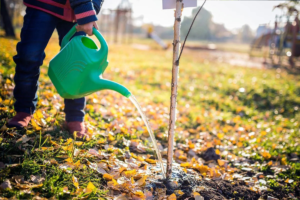 Fruit trees can be planted in both fall and spring, but not in summer, as the growing season is in full swing. During this period, young trees should not be disturbed, as this can cause them to become diseased and even die.
Planting time largely depends on the climatic conditions of a particular zone.
In southern latitudes, fruit trees are planted in the fall. If planted in the spring, they may not have time to establish themselves before the hot weather sets in. This increases the risk of bark burn and death from soil moisture deprivation.
Tree planting in the central regions is carried out in both fall and spring. The results will be approximately the same, with fruit trees taking root successfully.
In northern latitudes, planting is planned for spring. Summers in these regions are cool, meaning the trees will have time to adapt well. Conversely, trees planted in the fall will not have time to acclimate and will die with the arrival of frost.
How many trees should I plant in my garden?
The number of trees planted in a garden is determined individually. It depends on the size of the plot and personal preferences. For a family of 3-4 people, the following will be sufficient:
- 3 winter apple trees;
- 2 autumn apple trees;
- 2 summer apple trees;
- 2 pears;
- 4 cherries;
- 4 plums.
A proper fruit tree garden layout will ensure a good harvest.