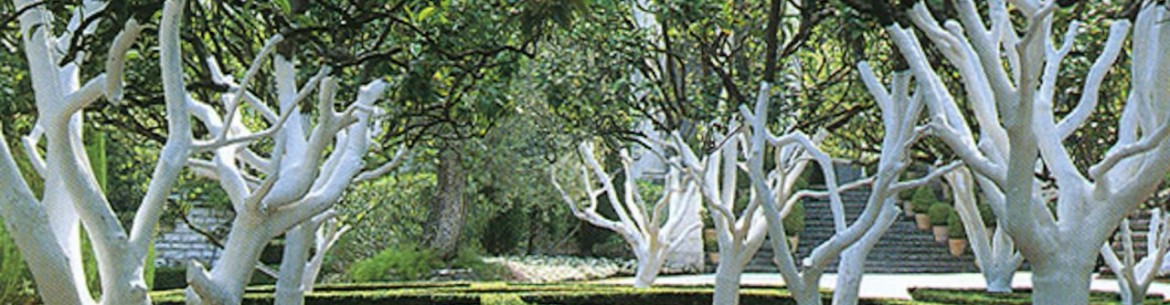
When to whitewash trees in the garden in spring: dealing with bias
Content
Why do you need whitewashing at all?
Many gardeners cannot explain why they whitewash their garden trees and why it is necessary.
Tree bark protects the inner layers of the trunk from various influences. It shields the plant from sunburn, frost, and wind, and also protects it from pests and rodents. As the tree matures, it becomes less able to withstand these harmful influences.
Over the years, tree bark becomes rough, cracked, and scabby. This reduces the crop's protection. Whitewashing can help address many of these issues.
How much whitewash does a garden need?
 Some gardeners consider whitewashing a decorative task and postpone it until the May holidays. However, it is an important maintenance procedure that should be performed more than once a year. Years of experience show that whitewashing should be done three times a year. Twice a year is sufficient, provided a special leave-in solution is used.
- The main whitewashing is in autumn, which is usually carried out after the leaves have fallen and the onset of stable cold weather (in October-November).
- In spring, whitewashing must be repeated before the buds open, or more precisely, before the stable spring equinox (after February 15 – in March, in colder regions – until approximately April 10–15).
- Although the third summer whitewashing is also necessary to protect against parasites (egg laying, the appearance of various larvae) and diseases, it is an additional procedure and is not always performed.
Is spring whitewashing necessary?
Many summer residents are interested in whether it is necessary to whitewash fruit trees in the spring.
In spring, as soon as bright sunny days arrive, bare trunks and branches begin to warm up to 10-12°C, and at this temperature, sap flow usually begins. Night frosts will cause the sap to freeze, which can cause internal trunk tissue to rupture, causing cracks in the bark.
The whitewash's white color beautifully reflects the hot sun's rays and reduces heat. Plants will continue to dormant. They'll begin to develop and bloom a little later, thereby preserving their health and harvest. So, when should you whitewash your garden trees in the spring?
If it is not possible to whitewash the trees in February-March, the procedure can be carried out in the first ten days of April.
Which trees cannot be whitewashed?
Although whitewashing has many advantages, this protection method is not always used. There are trees for which this procedure is contraindicated.
- Young specimens They have fairly thin bark, so whitewashing them is not recommended. The first whitewashing can be done when the tree is three years old.
- Damaged plants Whitewashing is not recommended. Lime or other components in the mixture can cause chemical burns to the trees.
- Sick trees are also not whitewashed. In areas of severe damage, the whitewash solution may cause a burn.
- Ornamental crops They usually don't whitewash it. This increases the risk of pest infestation.
What is the best way to whitewash trees?
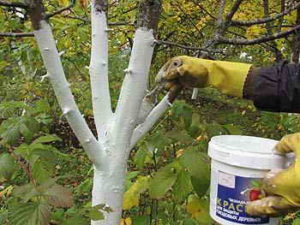
There are many different whitewashes. But let's talk about what to use for whitewashing fruit trees in the spring. It's best to use chalk or lime at this time. Of course, the initial solution will wash off after the first rain. But if you prepare a whitewash using lime, copper sulfate, and glue, you'll immediately protect your trees from diseases, infections, and pests. Moreover, the solution will adhere firmly to the tree bark.

Self-preparation of whitewash solutions
You can make your own garden whitewash for trees. The mixture should consist of chalk or lime and an adhesive (clay, casein glue, or paste). Fungicidal agents can be added as an additional ingredient.
Options for preparing mixtures:
- Dissolve slaked lime (3 kg) in liquid (10 l), add copper sulfate (500 g) and casein glue or PVA (100 g). Mix the ingredients thoroughly and let the solution sit.
- Mix copper sulfate (250 grams) with water (10 liters), add slaked lime (2 kg), manure (2 kg) and plastic clay (1 kg), mix and let the solution sit for 2–3 hours.
- Mix lime with liquid (1:1). To ensure the whitewash adheres well, add water-based paint to the solution at a ratio of ½ bucket of solution per 5 liters of paint. Mix and apply to the trees.
Professional whitewashing solutions
To whitewash trees, you can use ready-made solutions that contain the necessary components, including adhesives, as well as various disinfectants.
The most popular ones include:
- "Water-based garden paint for trees";
- "Gardener".
The most stable compositions:
- GreenSquare;
- acrylic paint for trees.
Preparing fruit trees for whitewashing
 Before whitewashing fruit crops, the following preparatory work must be carried out:
- Clear the soil from debris around the crown of the plant.
- Cover the soil surface under the tree's crown with plastic sheeting. This will prevent damaged bark, lichens, and overwintering pests from reaching the ground.
- Use wooden or plastic scrapers to remove old, dead bark and moss from the trunk and branches. Avoid using metal tools to avoid accidentally damaging the wood.
- If cracks are visible in the bark, smooth them out with a rounded-end stick. Then seal the hole with RanNet paste or prepared garden varnish.
- Check the trunk and branches for cracks and holes, and trim the crown if necessary.
- Take the oilcloth out of the area and burn it.
After completing the work, disinfect the cleaned surfaces. Choose a dry day for disinfection. Repeat the procedure if it rains after the disinfection is complete.
For spraying, use a fine-mesh sprayer.
After disinfection, do not begin whitewashing for at least 1–3 days, so that the solution can be absorbed into the tree bark.
Rules for whitewashing fruit trees
- The prepared solution should have a consistency similar to sour cream, so that the whitewash does not flow down the trunk onto the ground.
- Apply whitewash in two layers. Apply the second coat as soon as the first layer has dried.
- Move the brush from top to bottom, being careful not to miss any scratches or cracks.
- You can use a spray gun when painting.
- Before whitewashing, remove soil from the base of the tree trunk to a depth of 4–6 cm. After the procedure, replace the soil.
- The whitewash should be snow-white so that the sun's rays are better reflected.
- On mature trees, paint the entire trunk and 1/3 of the lower branches. Branches cleared of moss or lichen are especially in need of whitewashing.
 At what age is it best to start spring whitewashing?
Beginning gardeners often wonder when to whitewash fruit trees, or rather, at what age young trees can be whitewashed. Saplings have delicate, thin bark, and whitewashing agents can burn the young bark.
Young trees can be whitewashed using water-based paints "For garden work".
When to whitewash in spring
The timing of this procedure depends on the local climate. In warmer regions, it is performed in late March, provided spring has arrived early. In northern regions, it is performed in late April.
Trees begin to color as soon as their growing season begins. But this work must be done before pests have a chance to attack the plant.
Step-by-step whitewashing procedure
First, prepare the mixture and the necessary tools, and begin whitewashing. Work at temperatures no lower than +3°C. Here's the sequence of actions:
- The solution should be prepared and left to soak for at least two hours. When whitewashing with the prepared paint, simply open the can.
- Observe safety precautions: wear protective clothing, gloves, and, if necessary, a respirator when working.
- There should be no unmixed lumps in the solution.
- Remove a layer of soil (4–5 cm) from the tree trunk circle.
- How to whitewash trees in the garden correctly in spring? The height of the whitewash should be from the ground level to one and a half to two meters. Apply the paint evenly to the trunk. Paint skeletal branches from the junction with the trunk to a distance of up to 20 cm.
After the solution has dried, return the excavated soil around the trunk to its place.
Helpful tips
- Young trees can be whitewashed with ready-made paint - it will not cause any harm.
- Don't apply whitewash in a thick layer. The recommended thickness is no more than 2–3 mm.
- Stir the solution until it reaches a uniform consistency. Once dry, the resulting coating should be snow-white.
- A more lasting effect will be achieved by using garden paints.
- You can add copper sulfate to the homemade solution as an antiseptic.