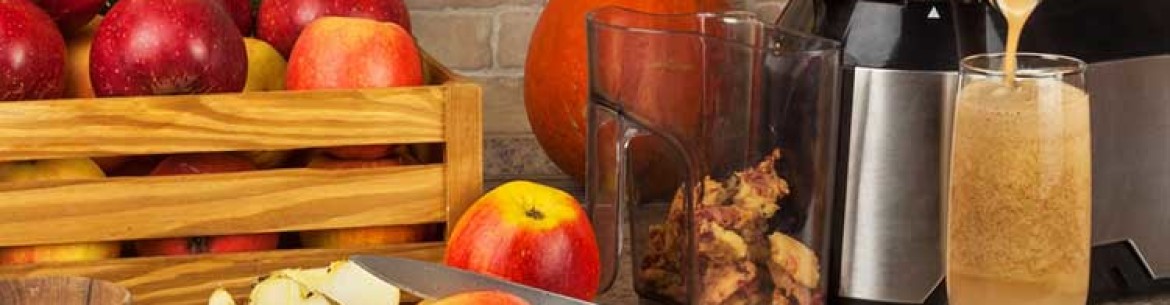
How to choose a juicer for fruits and vegetables
Among the ever-expanding range of household kitchen appliances, juicers have long held a firm and secure position. This article explains how to choose the most suitable model from the wide variety available and what features to consider.
Content
How to choose a juicer for fruits and vegetables
To make the right choice and purchase the equipment that is ideal for specific tasks, it is necessary to familiarize yourself with the design features of the models and their characteristics.
Type of construction
Depending on their purpose and operating principle, there are several types of devices designed for juice extraction, which differ from each other in design.
Combination juicers offer the capabilities of several types at once, but such equipment is not particularly popular among consumers.
Centrifugal juicers

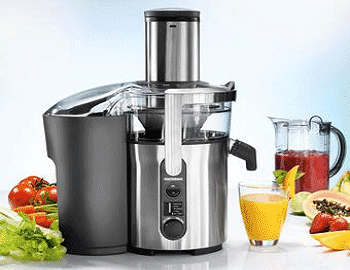 The core component of this type of device is a centrifuge with a rotating grater and a mesh separator. The device grinds the ingredients and, using centrifugal force, forces the liquid out through the mesh. The juice flows into one container, and the pulp into another.
Powerful centrifugal equipment ensures high pressing speed and is capable of processing large volumes of fruits and vegetables.
Disadvantages of the design:
- insufficient pressing of hard fruits;
- clogging of the grill with fibrous products.
A special feature of centrifugal juicers is that the finished juice comes out with a lot of foam.
Auger
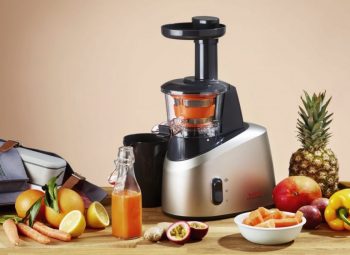 Units equipped with a screw mechanism ensure high-quality pressing at a relatively low speed, leaving the pulp almost dry.
A rotating auger presses the fruit pieces inside the cone, squeezing out the liquid, and the pulp is automatically ejected through a separate tray. The result is juice with a high pulp content.
To prevent pieces of processed products from stopping the rotation of the auger mechanism, they must be thoroughly crushed before loading into the juicer.
There are several types of auger equipment:
- with one auger;
- with two;
- with a vertical screw mechanism;
- with horizontal.
Vertical augers
In terms of processing speed, vertical auger units are practically equal to average-quality centrifugal units. The mechanism automatically grips and crushes the loaded fruit, with almost no pusher.
These models fit compactly on the table, but are quite tall.
Horizontal augers
Machines with a horizontal auger operate more slowly than those with a vertical auger and require finer pre-cutting of products due to the narrow neck and active use of the pusher.
The height of such equipment is relatively small, but the length of the model takes up significant space.
Twin-screw
The twin-auger design allows for high processing speeds on all types of fruit, including hard and fibrous ones, and ensures excellent end product quality.
The presence of two screw mechanisms makes it possible to quickly handle large volumes of processed products.
Citrus juicers
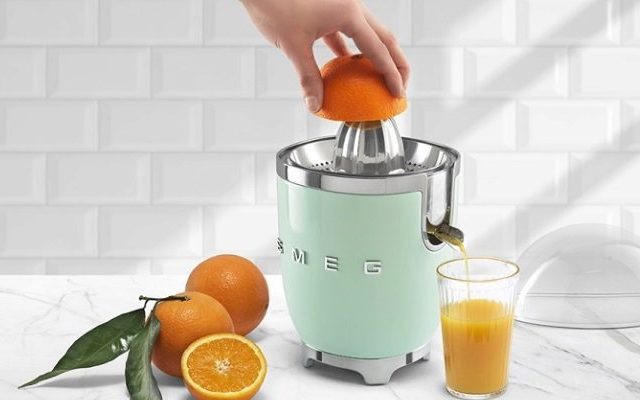 The equipment consists of a housing containing a vertically mounted motor with a rotating, cone-shaped, ribbed attachment. To extract juice from grapefruit, lemon, tangerine, lime, or orange:
- cut the fruit in half;
- put the half on the cone;
- hold with your hand, pressing down.
After a few turns of the cone, the juice squeezed out of the slices will collect in the bowl below.
An alternative to an electric citrus juicer is a mechanical model, which:
- does not depend on the availability of electricity;
- reliable and efficient.
Only a mechanical citrus juicer is suitable for extracting high-quality juice from a pomegranate.
The disadvantage of this type of equipment is its low processing speed and inability to handle large volumes.
Juice presses
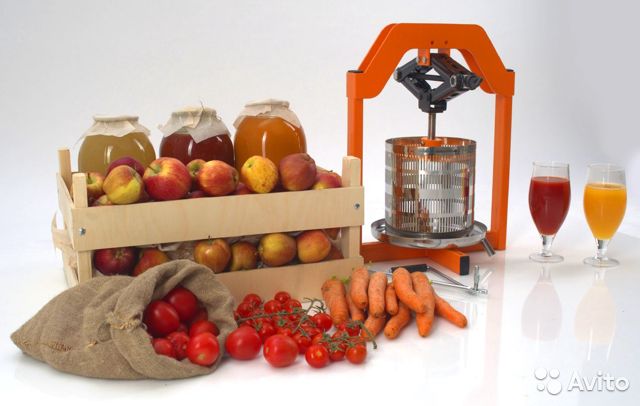 Mechanical juice extraction by squeezing the product using a special press is not popular with consumers due to the labor-intensive and time-consuming process, as well as the bulkiness of the equipment.
This method also has its advantages:
- independence from energy sources;
- the ability to process any type of fruit.
Performance and efficiency of home juicers
When using the unit for family needs, such a parameter as productivity (the ability to process a certain amount of raw material per unit of time) is not particularly important, since the preparation of vegetables and fruits takes much longer than the processing process itself.
A much more important indicator is equipment efficiency.
The efficiency of a juicer shows how much juice can be obtained from 1 kg of raw material.
The most reliable way to find out how effective a unit is is to read user reviews.
Productivity is important if you are faced with the task of processing the same apples on an industrial scale, when we are talking about tens and hundreds of kilograms.
Opening hours
When purchasing equipment, you should inquire about this parameter in the instructions. This will help you determine how long the device can operate continuously without overheating, after which it will need a break.
Power
The engine power rating will help determine the class of the unit, but will say almost nothing about the quality of its operation.
Auger designs of juicers are quite efficient even at low power.
Frequency of use and ease of care
Depending on how often the device is planned to be used, the importance of such factors as ease of pre-preparation of fruits and equipment maintenance increases:
- the larger the size of the loading neck, the larger the pieces can be cut;
- Reviews from those who have already purchased and used similar equipment will help you determine how easy it is to disassemble, clean, and reassemble the structure.
Availability of additional functions
The special attachments included in the kit expand the capabilities of the units, providing a number of additional functions:
- slicing or shredding fruits;
- squeezing out noodle dough;
- preparing paste from frozen fruits (sorbet).
Price
When looking at the price of a model, it's important to consider some factors that increase it, not directly related to the quality of the product:
- positioning the equipment as environmentally friendly;
- a markup associated with belonging to a well-known brand.
By choosing a juicer with similar characteristics and choosing the one that costs less, you can save a significant amount of money.
Performance coefficient
This indicator allows you to evaluate the capabilities of each model and perform a comparative analysis.
The productivity coefficient is determined experimentally by sequentially processing 4 types of products on each unit, while recording the amount of time required to process 1 kg of each of them, and measuring the juice yield.
The data obtained helps us understand how quickly and efficiently a particular type of equipment operates compared to others.
Thus, with the overall high speed of centrifugal devices and the high juice yield of screw devices, a good indicator for the first type would be obtaining more than 0.5 kg of liquid from 1 kg of raw material, and for the second, the processing time of 1 kg would be less than 3 minutes.
Which juicer should I choose?
 Before choosing one of the models, you should consider the advantages and disadvantages of each type and decide on:
- types of products for which the unit is purchased for processing;
- expected frequency of equipment operation;
- planned volumes;
- the need for additional functions and attachments.
To squeeze citrus fruits, specialized juicers are used, designed exclusively for this type of product, either electric or mechanical, and the use of the latter type is the only way to squeeze a pomegranate without peeling it.
For a single consumer, an inexpensive mechanical device is suitable, but for a family, it is better to choose an electric model.
The power of the electrical equipment should not be too low to prevent the motor from stalling when applying too much pressure to the attachment. The use of different attachments is recommended:
- small - for small fruits;
- large - for more voluminous ones.
Centrifugal models are the optimal option for processing large volumes of products., excluding hard vegetables and fibrous stems. Pay special attention to the centrifuge's speed and power: these parameters must be sufficiently high.
Choosing a centrifugal juicer that can handle whole small fruits will save you time and effort on pre-grinding.
Horizontal auger devices are considered the most prestigious and, as a rule, are more expensive compared to other types. However, the speed of such models is often lower than that of vertical ones, and the ingredients must be thoroughly chopped beforehand. An additional advantage is the included attachments for squeezing oil from nuts and seeds.
Vertical auger juicers are versatile equipment, which successfully processes fruits, hard vegetables, and fibrous plant stems. The only drawback is that they cannot handle large volumes. However, for everyday home use, these models are perfect.
An important feature of auger equipment is that the juice obtained with its help can be canned.
Stop your choice on mechanical press It is only worth it in cases where it matters independence from electricity, which is important when processing large quantities of fruit.
When choosing a juicer for your home, it's important to consider the specific purpose of the appliance. A wise approach to choosing equipment, including careful consideration of the design and all parameters, as well as the price-quality ratio, will help you acquire a reliable appliance that will meet all your needs.