Propagating apple trees by air layering: rooting a branch on a tree
Every gardener has a favorite apple tree, the variety name of which has long since been lost, but whose fruit is so delicious that you want to keep it alive for a long time. The plant is aging, and grafting onto rootstock is not the easiest task, and not everyone succeeds. In this situation, another proven method—air layering—is appropriate. This method relies on the mother tree's ability to develop a root system from cambium tissue.
Even if a young tree grown from an aerial shoot dies, the shoot remaining in the ground does not require grafting; it already has all the characteristic features of the chosen variety.
Content
The right time to propagate apple trees by air layering
The most suitable conditions for propagating apple trees by air layering can be found in early spring, immediately after the snow meltsThe leaves haven't yet unfurled, sap flow in the shoots is still inactive, and the growing season hasn't yet begun. This usually happens in the second ten days of March. Planting in the ground is timed for early September.
The propagation method consists of the following stages:
- Preparing cuttings.
- Storing them (if necessary).
- Rooting.
- Planting in the ground.
The most suitable materials for retaining moisture
To propagate an apple tree in this unusual way, you need to prepare the following materials in advance:
- 1.5 liter plastic bottle;
- thick plastic bag;
- special substrate.
The soil mixture for air layering can vary. It is made from:
- sawdust, garden soil, moss and ready-made compost;
- humus and rotted manure;
- from garden soil and vermiculite, which retains moisture well;
- sphagnum moss, which should be regularly moistened.
Step-by-step instructions for propagating apple trees using air layering
An air layer is a section of a fruiting branch that is specifically stimulated to encourage the growth of new roots in a specific location surrounded by moist soil. Typically, within a season, this shoot will develop an independent root system and can be transplanted into the soil as a cultivar.
Fruits on such a seedling usually appear in the 3rd-4th year of life.
A characteristic feature of propagating fruit trees by air layering is that you don't need to bend the branch to the ground; instead, you lift the soil toward the crown. This method of propagation is suitable for absolutely all apple tree varieties, even columnar ones.
Formation of air layers
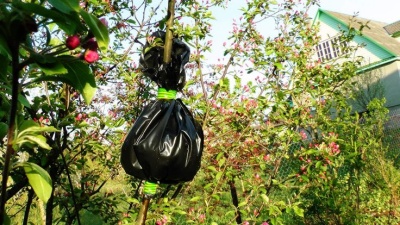
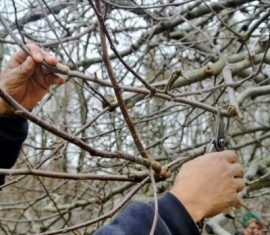
 First, you need to decide which branch of the fruit tree will become the future seedling. To do this, in the second ten days of March, select a healthy, fruit-bearing, sunlit branch from the tree's crown that is free of branches.
Stop your choice on that one parts of the crown that are about 3 years old, it is half-woody and has already acquired new growth, which will be greener in color. The diameter of the future seedling should be identical the thickness of a regular pencilIdeally, the branch should be located on the south, southeast, or southwest side of the tree.
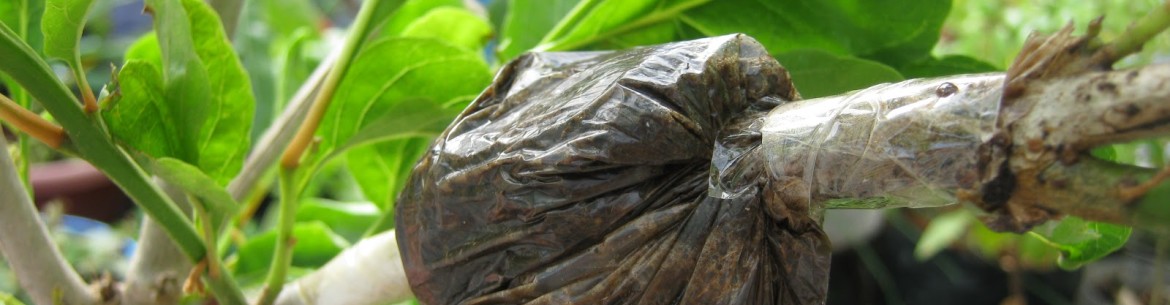
After the snow cover has melted, use the guy line to move it to a vertical position, if it is tilted, then cover the selected branch with a sleeve made of transparent polyethylene film up to 40 cm longWrap it tightly with electrical tape or duct tape on both ends.
This needs to be done in order to soften the bark in May-June by creating a greenhouse effect.
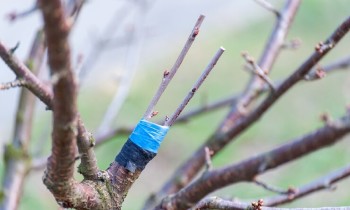
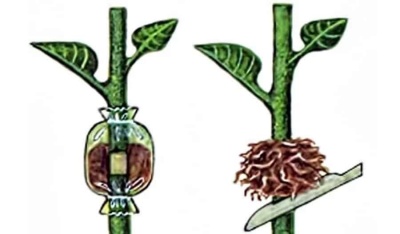
At the end of the first month of summer, remove the plastic sleeve and inspect the branch for last year's growth. This area will be a different color from the older, greenish-brown section. Step back 10 cm from it, closer to the tree trunk, and make 2 circular cuts to the wood at a distance of 1.5–2 cm from each other, then remove the ring of bark between the cuts. Cover this area with electrical tape. Then, from this point upward, make 2-3 more vertical cuts, 1 mm deep, toward the trunk.
An alternative is to make small diagonal cuts along the entire radius of the branch rather than remove part of the covering. This method is more acceptable because it avoids interrupting the supply of nutrients to the selected shoot where the root system is planned. Next, proceed as follows:
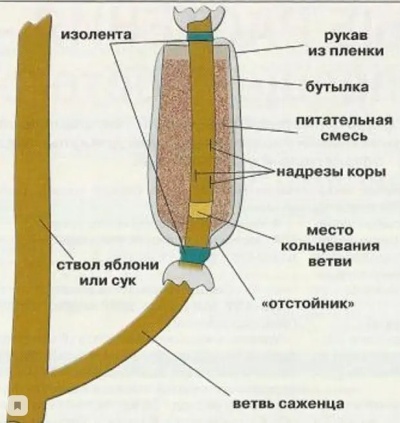
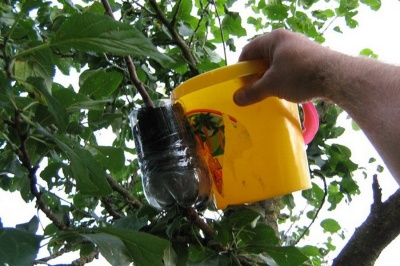
- Take a plastic bottle (1.5 l) and cut off the bottom.
- We put a new sleeve made of polyethylene film on the branch, wrapping the part that is closer to the trunk with electrical tape.
- Place the bottle so that the neck is facing down. The ring cut should be located 1/3 from the bottom of the bottle, and the stem of the shoot should be in the center.
- Secure the branch so that it points vertically upward.
- Cover the bottle with film and wrap it tightly with electrical tape.
- Pour a solution of “Kornevin” inside (1 teaspoon of powder per 1 liter of water) for 3 days.
- After the time has passed, drain it by piercing a tiny hole at the bottom of the sleeve with a pin.
- Pour 2 cups of pre-prepared substrate inside.
- Secure the film and bottle by wrapping them in newspapers.
The procedure should be carried out at a temperature of at least +19 degrees.
In hot weather, the substrate is watered once every 2 days., and in rainy weather, no more than once a week. For this purpose, use settled rainwater. Most fruit trees readily root, but this is definitely not the case with apple trees. They are often capricious. The larger the fruit, the less willing it is to accept air layering. A dedicated section of the branch may remain in the ground until the end of summer, but still fail to develop a sooty rooting system.
Don't worry if the air layering doesn't develop full roots by the time you repot, only some small bumps. Transplanting into soil will accelerate root development.
Regularly replenish the substrate moisture level.
Rooting of the obtained cuttings
To ensure that the cutting cut in the fall does not draw out too many nutrients and does not grow instead of developing a full root system, remove the top part of the layer by half its lengthAnd after 7 days, cut it off with a sharp garden tool along the bottom of the sleeve.
A month before air layering, you need to prepare the hole. Immediately before planting, it should be water and place the cutting there so that the soil it grew in moves with it. This will promote faster and more positive adaptation of the plant to the open ground.
Growing ready-made seedlings
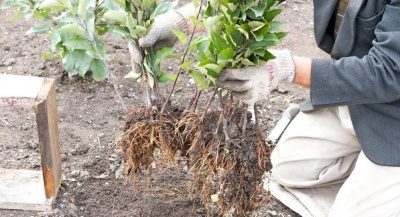
Rooted cuttings obtained from air layering can be planted in September or dug in until March. This will depend on the region of the country. If you live in the south, it's best to plant them in the fall. If you live in the north, then in the spring. For the winter, the seedling needs to be temporarily planted in a large pot., filling it with equal parts sand, peat, and garden soil. Don't forget to move the young plant to the basement and water it regularly as the soil dries out.
By spring, the cutting will be quite strong and have a well-branched rhizome. It can be safely transplanted to its permanent location.
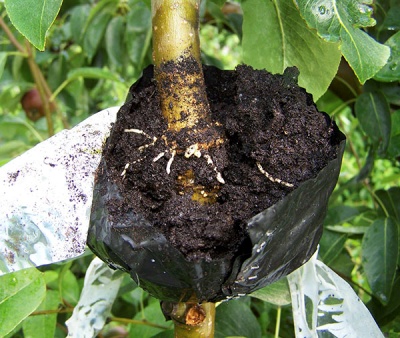
Air layers lack a root collar, so they need to be planted in open ground at an angle to allow more space for the system to develop.
Conclusion
Air-layering apple trees is one of the best ways to obtain varietal material without grafting. It significantly reduces the time required to develop the desired variety. This method can produce a well-developed seedling of the desired size from virtually any garden plant within just one year.