Making Apple Tree Supports Yourself: The Best Options for Protecting Against Splinters
As the fragrant fruit begins to ripen in orchards, apple trees sag lower and lower under the weight. This can easily lead to branches cracking and breaking. To avoid such an unfortunate incident, it's important to take care of them promptly.
Content
Types of DIY Apple Tree Supports
To ensure the branches are protected, it's time to begin installing various supports for your apple trees in August. Various boards, pipes, poles, and even sticks are all used. Preventative measures will help your fruit trees successfully survive the fruitful year.
A support with a forked stick
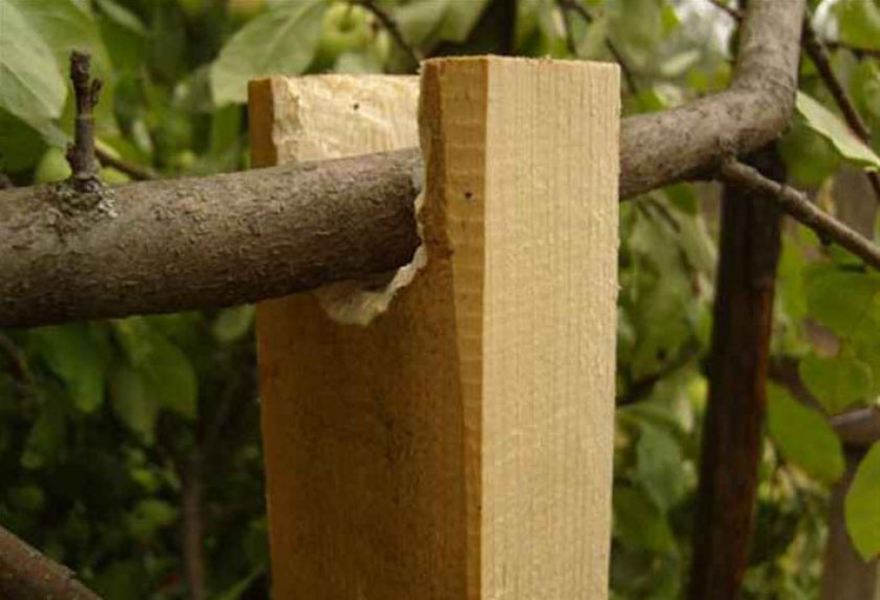
 The simplest version of this stand can be assembled from a common "horned" branch and improvised attachments made from an old garden hose or bicycle tire. The latter is necessary to protect the apple tree bark from mechanical damage.
An improved structure is assembled from a plank and a wooden forked piece. The first piece is secured at the bottom, and the second piece is placed on top. The overloaded branch is then placed on top. The forked piece is screwed to the base, preventing the larger area from sinking into the ground. It is recommended to wrap the top of the structure with rubber.
To ease the tree's burden, it is recommended to shake off some of the apples.
Umbrella chatalovka
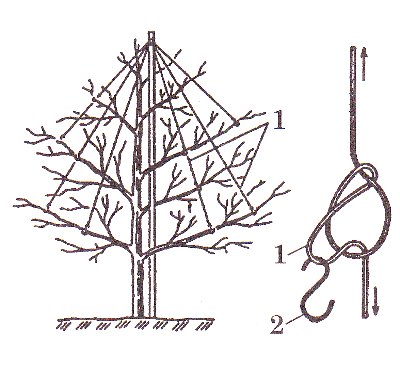 Another structure that can prevent an apple tree from becoming overloaded with fruit is called an umbrella-shaped truss. To construct it, a support pole or pipe must be dug in next to the trunk, extending 30–40 cm above the top of the tree's crown. Steel or plastic supports are then inserted through the top of the tree's crown, with the edges recommended to be fitted with cushioning pads. These will later be used to tie down the apple tree's branches.
The following can be used as protective gaskets:
- rubber bandage;
- bicycle inner tubes;
- pieces of hose;
- tires from a moped or scooter.
This structure can remain in place even after the harvest is complete, as it is multifunctional.
A stepladder-shaped support
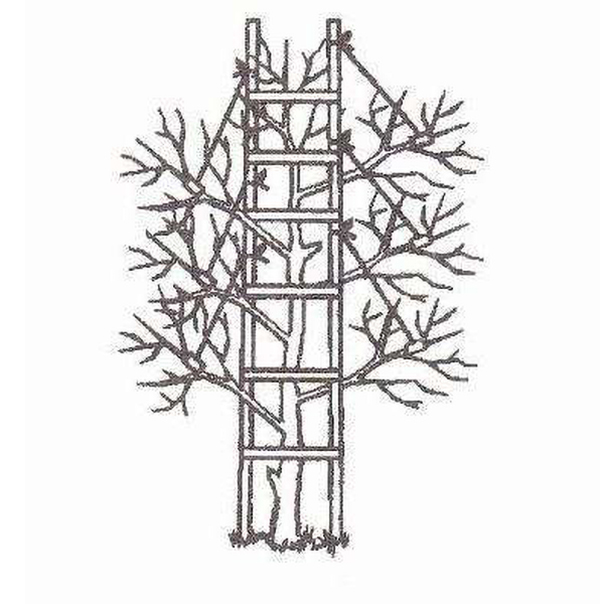 To support an apple tree, you can construct a structure resembling a stepladder. To do this, install poles of equal length on either side of the tree's trunk, driving them 15 cm into the ground. They are then connected at several points with parallel crossbars to form a ladder. Branches in different directions, attached to the poles, act as guy wires. Therefore, the structure requires no additional reinforcement.
Instead of two, three or four poles can be used. This design is more suitable for mature trees.
Telescopic support
To make a telescopic support, you should purchase metal-plastic or plastic water pipes of various diameters in advance. Place one pipe inside the other, and drill holes along the entire length, spaced up to 1 cm apart.
After adjusting the desired height by sliding the thinner pipe inside the wider one, bolts are inserted through the holes to secure the structure. Plastic sections, bent into a C shape and glued with a softening material, are attached to the upper thin edge. The resulting structure is installed under the branches.
T-shaped construction
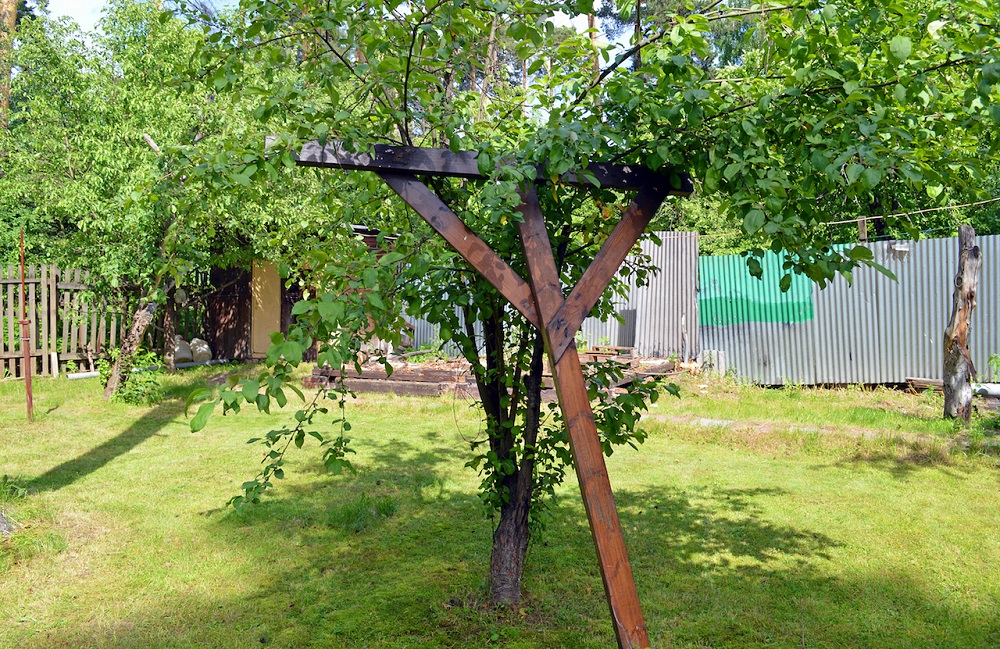
This support resembles an old-fashioned wooden mop. A shorter board is nailed onto a longer pole. It is then reinforced on both sides with two more sticks to form an inverted triangle, divided in half. The structure is placed in a hole at least 15 cm deep and buried. Branches with fruit are placed on top. If necessary, the support can be reinforced with more boards.
A similar design, reminiscent of quadrangular pyramids, is created by placing two pairs of trapezoids opposite each other, with their upper parts fastened together. These pyramids can be used to unload apple trees at any height.
Metal supports for apple trees
Metal supports for fruit trees are considered the strongest and most durable. You can make them yourself using pipes of any diameter. The assembly principle is similar to that of telescopic supports. The end of the thinner pipe is inserted into the wider one and secured with a nail through a pre-drilled hole. A rubberized "fork" is installed on the top edge. The main drawback of this design is the high cost of the material.
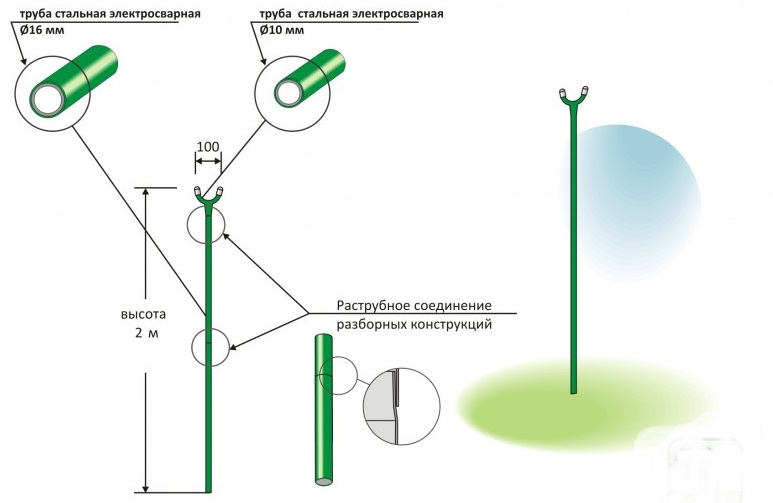
The installation of such a support should begin from the upper branches, gradually moving to the lower ones.
Saving a fallen apple tree
Support structures in the garden are essential not only for a bountiful apple harvest. If your garden is caught in the middle of a storm and damaged trees are left behind, homemade structures can also help solve the problem.
If less than 3 hours have passed since the apple tree fell, you can try to revive it. To do this:
- The tree is raised to its maximum possible previous height.
- On all sides they are reinforced with supports, which can be obtained on the site at that time.
- Sprinkle the exposed roots with highly nutritious loose soil.
- Fence the area with shields to prevent soil erosion by rain.
- Regularly water fertilizers intended for young seedlings and characterized by easy digestibility.
- After determining that the apple tree is actively growing, dismantle any unnecessary structures.
An oddly shaped apple tree is always better than the death of a fruitful tree.
Preventing the appearance of splits
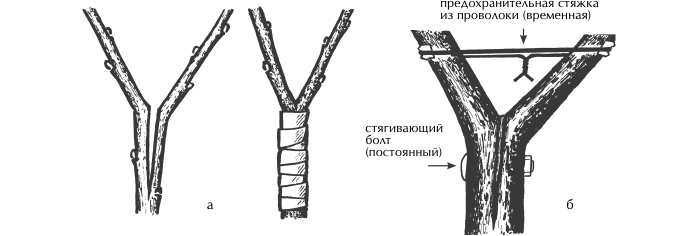 On the condition of the trees not have the best effectNatural factors such as abundant fruiting, hurricane-force winds, and snowy winters often lead to the formation of branch splits. A few simple steps can help prevent this.
Protective rings
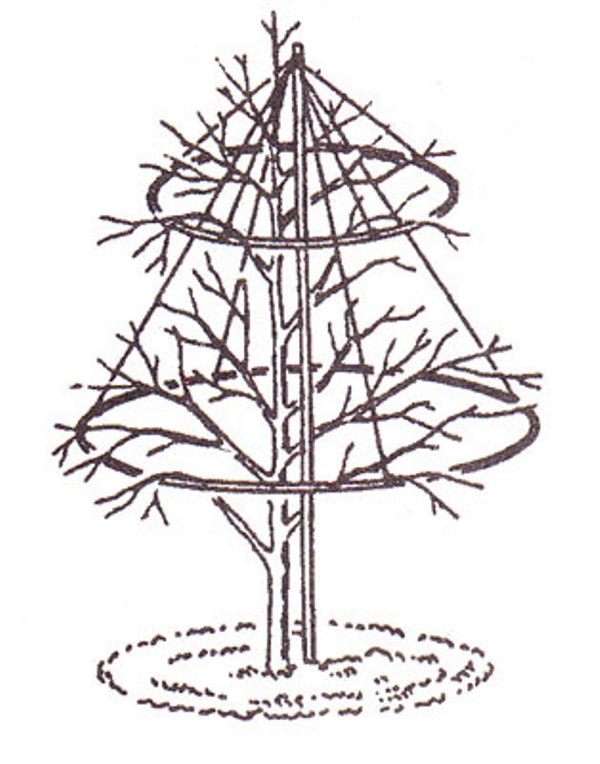 Protective rings, made from a strong iron hoop secured with a bolt, will help prevent apple trees from splitting. They should be tightened in the spring before the buds in the center of the crown open. To prevent damage to the bark, it is recommended to cover the ring with a rope or cloth where it contacts the branches.
Arc support
A bountiful harvest can cause the tree's branches to snap, unable to withstand the weight. To avoid this problem, experienced gardeners recommend installing arched supports in the crown. This requires cutting several pieces of thick rubber (such as from tractor tires) and securing them to and between the branches. This creates a kind of "cocoon" made from the material and apple tree branches.
Never support branches only at their edges or bases. When lifting, do not disturb their original position relative to the trunk.
Trellis and ring rim
Colony apple trees and dwarf varieties may suffer from the following problems due to the specific selection process:
- breakage of branches;
- splits;
- thickening of the crown;
- low resistance to heavy rain and snowfall.
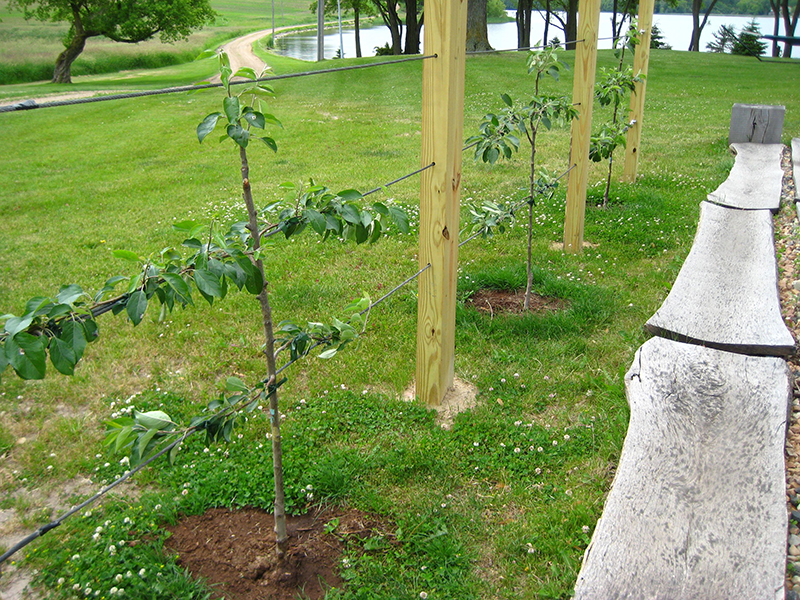
All these difficulties can be solved by using a trellis staking system. The structure is made of thick wire, which is secured to posts at the ends of the row. The apple tree branches are tied to the trellis using natural twine or plastic rings.
A bicycle wheel rim, secured to four pegs under the tree's crown, makes an excellent support for spreading and dwarf apple trees. To prevent damage to the bark, use foam rubber sealant wrapped around the base.
Heavy harvests, strong winds, and wet snowfalls during freezing temperatures are often the main causes of broken and split apple tree branches. Properly placed tree supports can prevent this problem.