Pruning young apple trees in spring and fall: instructions for beginning gardeners
To ensure a healthy apple tree, it requires regular care: watering, fertilizing, and treating it against diseases and pests. This includes pruning, which at first glance seems pointless. However, a number of factors point to the importance of this procedure. It's recommended to familiarize yourself with the technique before undertaking it.
Content
Reasons for pruning
Pruning young apple trees is a complex agricultural procedure that requires a responsible approach. After all, proper pruning determines the tree's future yield and appearance. A properly shaped crown significantly increases the likelihood of high fertility and high-quality fruit.
Failure to prune or pruning at the right time will result in branch breakage due to overload. This will negatively impact the fruiting frequency, apple quality, and winter hardiness of the tree itself.
Necessary tools
To carry out the event you will need the following tools:
- garden knife;
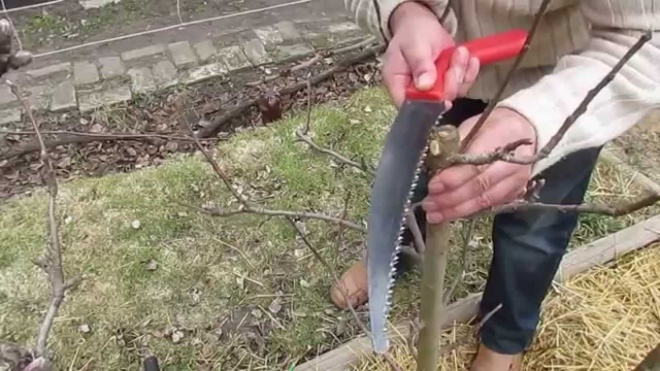
- saw;
- pruning shears.
When choosing a tool, take into account the thickness of the shoots being cut.
It is unacceptable to use a construction saw for pruning, as it seriously damages the trees.
Pruning shears are used to trim the ends of branches during formative pruning. A saw and a pruning knife are used to remove thick shoots. The finer the saw teeth, the less risk of damaging the garden plant.
Before pruning, all tools must be well sharpened and treated with an antiseptic, for example:
- alcohol;
- formalin solution (5%);
- vodka.
Subtleties of the procedure
Although pruning isn't a complicated operation, it requires proper preparation. First, inspect the crown and select branches to remove. These include shoots that cover the central conductor during growth or interfere with the development of scaffold branches. It's also important to remove weak, broken, or frost-damaged branches.
Ring cutting
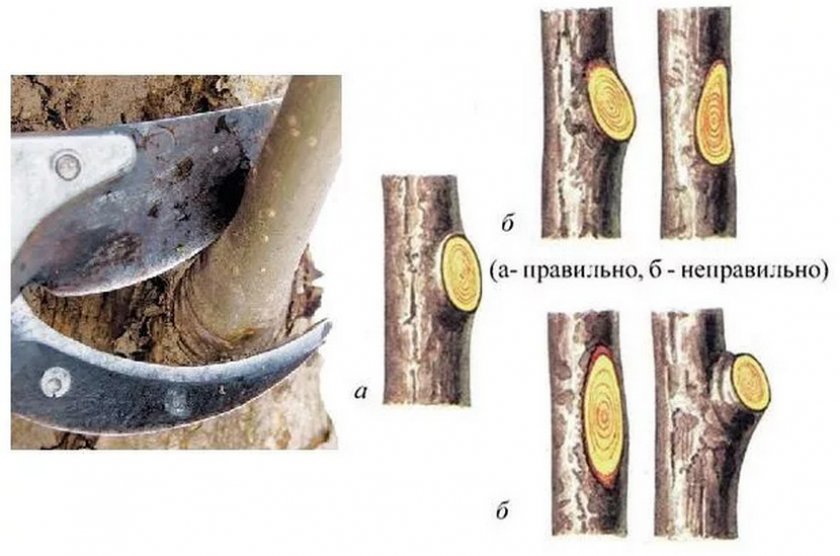
When using this technique, the branch is completely removed (usually used to remove diseased shoots). At its base, there is a small thickening called a "ring."
The cut is made at an angle directly below this growth. Large branches are first shortened, and then the stump is trimmed along the top edge of the ring.
On saw cut There should be no nicks left, otherwise the wound will take a long time to heal. The resulting after the procedure cut treated with special compounds.
When pruning trees "to the ring," the wound heals much faster due to the accumulation of rapidly dividing cells in this area.
Pruning to the bud
This method is used to stimulate branching and involves two ways of shortening the shoot:
 On the outer bud. This is usually used to thin out an overly dense crown. The cut is made above the bud facing outward.
- On an inner bud. This method is used for spreading crowns to strengthen the center. In this case, the bud faces the center of the crown.
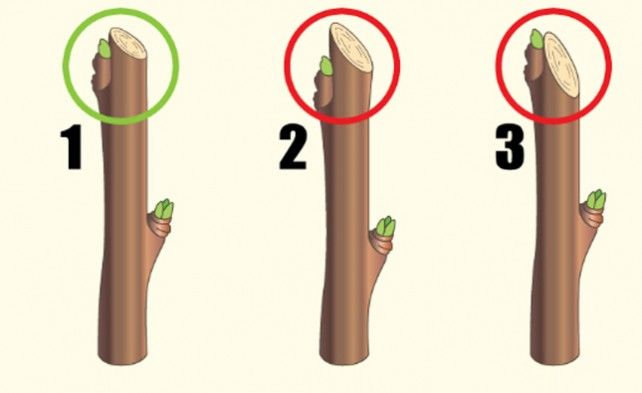 On the outer bud. This is usually used to thin out an overly dense crown. The cut is made above the bud facing outward.
The cut should be made at an angle just above the bud (approximately 0.5 cm). Leaving a long stump will delay wound healing, and a cut too close to the bud can damage it.
In some cases inside cut If brown wood can be observed, then the branch is cut down to healthy tissue.
Pruning principles depending on tree age
When pruning trees at any age, gardeners pursue specific goals. Therefore, this procedure has its own specifics for older trees, fruit-bearing apple trees, or saplings.
One-year-old apple tree
 At this age, pruning is necessary to shape the crown and establish the base of the skeletal branches. Furthermore, pruning stimulates the appearance of lateral branches in the one-year-old seedling, which will later bear fruit.
The algorithm of the operation is as follows:
- to encourage the growth of lateral shoots this year, the top of the main trunk is cut at a height of 80 cm;
- The existing side branches are trimmed, leaving them 25 cm long and with 3–5 buds.
Shoots growing at an acute angle interfere with the formation of a voluminous crown with a regular shape, so they are cut off completely.
Two-year-old apple tree
Trees at this age already have a strong trunk and a number of skeletal branches, as well as numerous new shoots. Before pruning, it's important to select and leave 3 to 5 branches growing at a right angle to the trunk. These will later form the base of the crown. All other shoots are cut back. Side branches are trimmed back by 30 cm. Crown shaping is performed according to the following principle: the length of branches from the lower tier should be 30 cm longer than those from the upper part of the apple tree.
The remaining branches, which form an acute angle with the trunk, are deflected and secured with special spacers.
Three-year-old apple tree
Typically, by the age of three, an apple tree already has a fully formed crown and begins to bear fruit. The goal of pruning at this time is to remove damaged, diseased, and overcrowded branches. This procedure is important for the overall health of the fruit tree, as it ensures adequate light and airflow.
When pruning, it is unacceptable to remove most of the branches, as this will weaken the apple tree and negatively affect future yields.
The main task is to completely remove shoots growing within the crown. In the spring, all branches of three-year-old trees are pruned back by approximately 30 cm.
The right time for pruning
 The exact timing of pruning is determined by several factors:
- the specific climate of a particular region;
- soil type;
- varietal characteristics;
- location of apple trees.
In general, fruit crops are pruned three times a year: in spring, summer and autumn.
Peculiarities of pruning young apple trees in spring
The right time to carry out the spring procedure must meet two conditions:
- Lack of sap flow. During this period, trees are still dormant and better able to withstand branch pruning.
- Complete melting of snow, presence of established positive air temperature.
In the spring, after pruning, apple trees still have a lot of strength left to form new shoots.
Shortening branches is not allowed after the buds have swollen, as this will negatively affect fruiting.
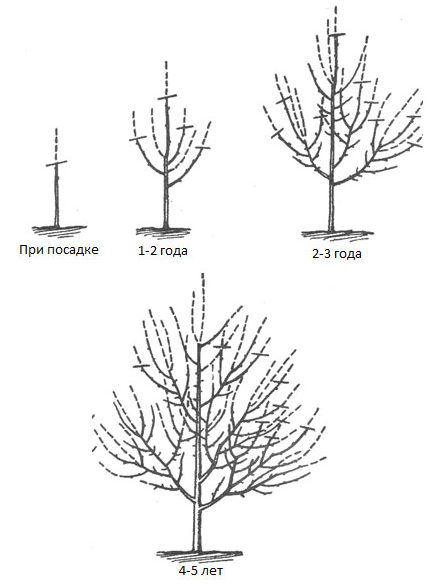
Experienced gardeners recommend carrying out spring pruning, adhering to the following scheme:
- in the first year, shorten the seedlings to 3 growth buds; 3 shoots will grow from them over the course of the season;
- In the second year of the tree's life, prune the branches using the same algorithm, leaving only 3 growth buds; by the end of summer, 9 shoots will have grown on the seedling;
- In the third year, pruning is carried out in a similar manner: each of the 9 shoots is cut off by 3 buds, as a result, by the end of the season, 27 branches of the same length can be seen on the apple tree;
- In the following 2 springs, all fruit buds are left on each of the 27 shoots, and at the same time no more than one growth bud.
This technology will allow you to get a harvest earlier than usual, and it will be of very high quality.
Furthermore, the apple tree's symmetrical crown will quickly recover from frost damage. The tree's height will eventually reach up to 3.5 meters.
Principles of summer pruning
The main goal of this procedure is to shape the crown of a young tree. During pruning, a small number of branches formed during the apple tree's intensive growth are removed. If performed correctly, fruiting can begin within a year.
To achieve the desired result, you need to follow the following instructions:
- Monitor the length of the two shoots: the lateral and central ones. If the side branches are longer than the main trunk, they are pruned.
- For one-year-old seedlings, leave no more than four skeletal branches. These will later serve as the main crown. When pruning again, it's acceptable to leave five branches.
- The central shoot shortened in the first year should not be touched in the following two years.
Young apple trees produce a large number of flowers; to reduce the load on the tree, some of them need to be removed.
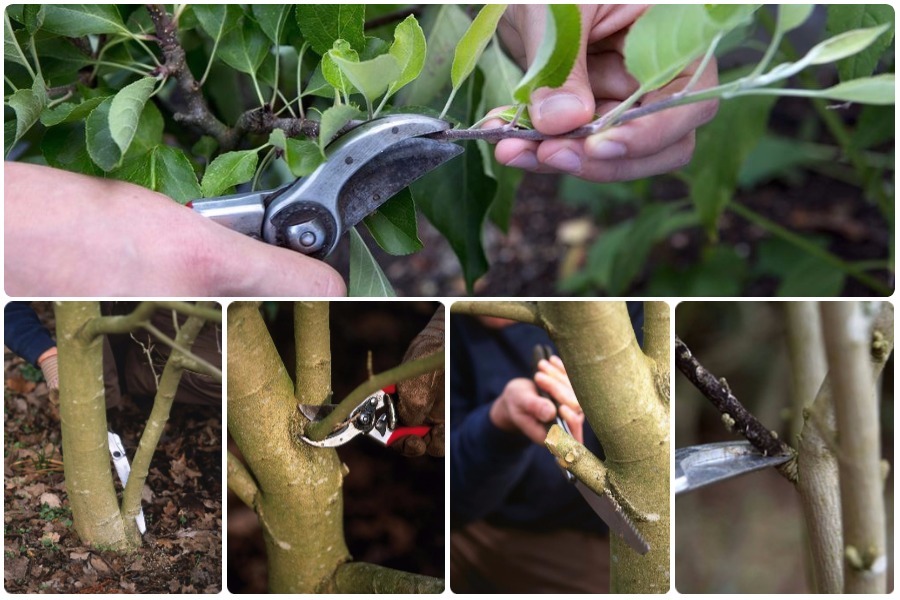
When performing summer sanitary pruning on a young tree, it is necessary to remove affected branches, otherwise harmful microorganisms will spread throughout the entire seedling.
Autumn pruning scheme
In the fall, pruning is done after all the leaves have fallen. However, it should be done 20 days before the first frost to allow the apple tree's wounds time to fully heal.
There are 3 types of pruning young apple trees in autumn:
- weak;
- strong;
- average.
Light pruning is suitable for apple trees up to five years old: branches grown during the season are cut back by one-quarter. In the spring, the pruned branches will produce new shoots, which will form a properly shaped crown. Medium pruning is performed on apple trees that have reached five years of age. The purpose of this procedure is to shape the crown and increase the number of fruit-bearing branches. To achieve this, mature branches are shortened by one-third. Heavy pruning is necessary for thinning branches; in this case, they are cut back by half.
In the fall, dead branches are removed, preparing the trees for winter. This involves cutting the branch back to the point where the first bud forms, then sawing off the remaining stump so that the cut slopes away from the trunk in the direction of the removed branch. Thin shoots are trimmed with pruning shears.
Rules for pruning young columnar apple trees
The crown formed around the trunk is the main difference between columnar apple trees and regular apple trees, which have a spreading crown. These fruit trees resemble columns in appearance, hence their name. While occupying minimal space, columnar apple trees produce abundant fruit.
One of the factors that increases their yield is considered to be proper pruning, carried out according to the following scheme:
- 1st year – cut off all lateral shoots and shorten the trunk;
- 2nd year – pinch off shoots longer than 30 cm, but leave the topmost branch alone: it will become an extension of the trunk;
- 3rd year – the branches located on the side are made a little shorter, and the upper shoot is pinched at a height of 25 cm;
- 4th year – thin out the crown, get rid of incorrectly growing and weak shoots.
In the fifth year of life, the top of the apple tree is trimmed, thereby stopping its growth.
In subsequent years, pruning of columnar crops is carried out for sanitary purposes.
Care after pruning
After the procedure, the cut sites are treated with one of the following agents:
- solvent-free oil paint;
- garden var;
- a mixture of lime and copper sulfate (in a ratio of 10:1);
- a mixture of cow dung and clay (in a 1:1 ratio);
- Zhukovsky's var.
After pruning, the trees are inspected for lichen and moss. If colonies of these organisms are found, they are removed immediately. The removal is performed using a piece of plastic, and the affected areas are then treated with garden pitch or copper sulfate.
Possible mistakes when trimming
Not all gardeners know how to prune fruit trees properly. The most common mistakes are:
- Incorrect timing. If the procedure is performed during a period of intense sap flow, the cut will not heal properly for a long time. Due to the loss of sap, the shortened branches will dry out.
- A poorly chosen tool leaves behind cut "bullies".
- Cutting the thickening of the tree "at the ring" during pruning results in a hollow and the death of the apple tree. Pruning 4–5 cm above the ring is also harmful. The dried, remaining stump becomes a breeding ground for infection, which then spreads throughout the tree.
- Delaying the procedure. Work should be carried out in the apple tree's first year, as the thinness of young branches makes pruning much easier. As the tree ages, a neglected crown will be much more difficult to shape.
- Using wood burning compounds as putty.
- Leaving shoots on an apple tree growing at an acute angle to each other will inevitably cause the trunk to crack where the branches meet.
- Ignoring the cleaning of something done incorrectly saw cutIn this case, the wound will heal very slowly.
Recommendations from experts
Beginner gardeners are advised to follow several rules when pruning:
- When planting, trim the side branches and the central stem of the seedling, leaving it 20 cm tall. This will make the tree easier to harvest.
- Completely remove branches growing at an acute angle to the trunk.
- Cut shoots that are at a right angle, leaving 3–5 buds.
- For two-year-old apple trees, leave 4-5 of the strongest lateral branches located at a right angle to the trunk, and remove all the rest.
- Shorten the main conductor so that its length exceeds the length of the lateral shoots by 20 cm.
- Intensively growing lateral branches should be trimmed in the spring, making the crown shape rounded.
Pruning young fruit trees has a positive effect on their health and ensures a high yield in the future. However, when performing the procedure, it is important to study the procedure and strictly adhere to all rules and recommendations.