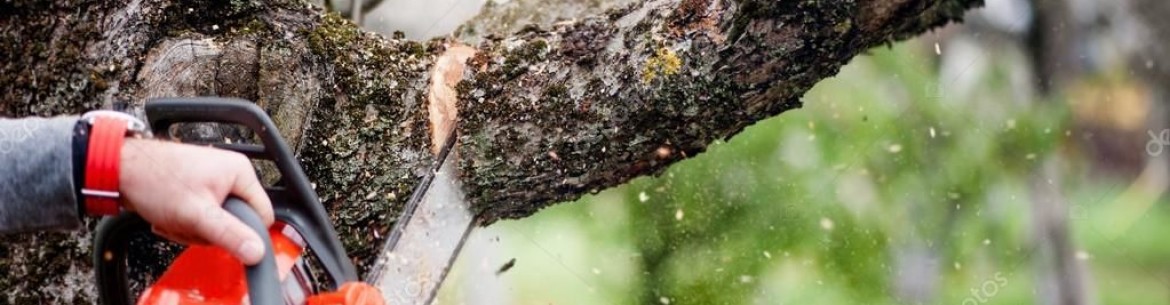
Processing cuts: how to seal cut apple tree branches without consequences
Any damage to the bark or wood damages the tree. This creates a wound (cut) that takes a long time to heal, impacts the tree's development and fruit yield, and serves as a gateway for infections, bacteria, and pests. For this reason, all cuts are sealed. This article will explain how and with what best to do this.
Content
Reasons for the formation of cuts
Cuts are created by removing branches. The reasons for their removal vary:
- Crown formationThe apple tree is shaped to ensure good fruit production. This involves removing excess shoots and unnecessary branches. This will cause defects to appear on the bark.
- Pruning branches. Often crown The tree can become dense and sunlight cannot penetrate. Old branches and suckers are removed. Thinning improves ventilation of the fruit.
- UpdateOld branches are cut down to allow new shoots to emerge. The apple tree is rejuvenated.
Reducing the damage from pruning
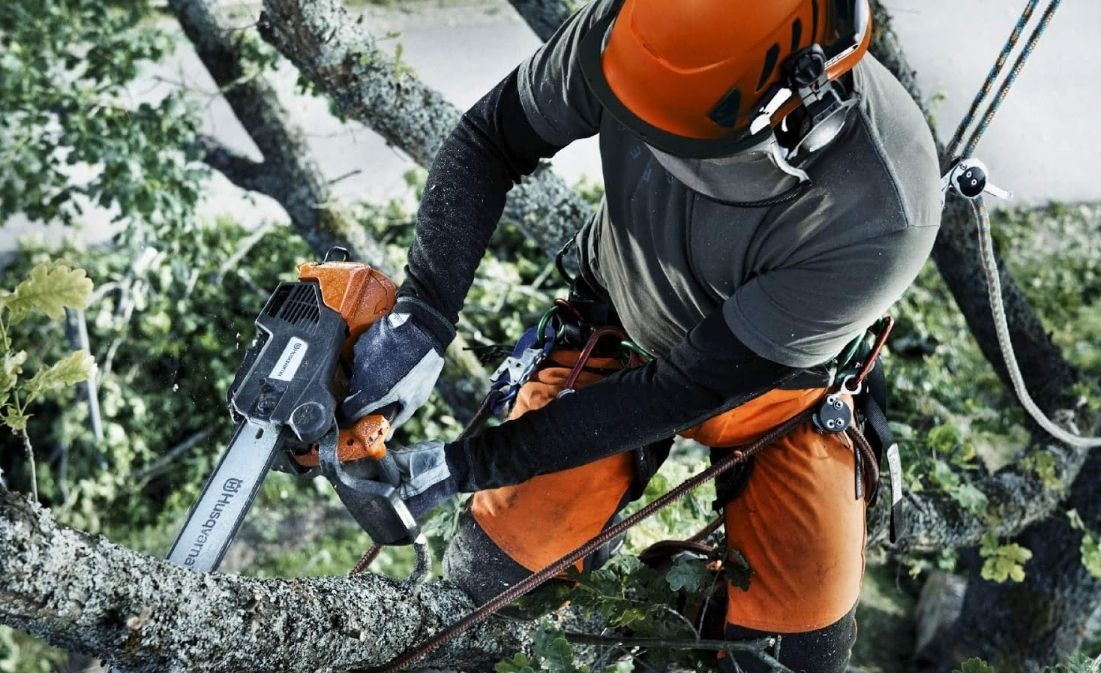 To reduce the damage from pruning, you need to:
- It is advisable not to prune trees in the summer; it is better to do this in February after severe frosts;
- shape the crown while the branches are young; regular pruning of thin shoots will not require cutting down thick branches for a long time;
- carry out pruning in dry weather;
- make the cut area smooth;
- the pruned branch with old bark should be thoroughly cleaned;
- During the harvest season, place supports under weak branches;
- remove sawdust from the cut before processing.
Processing depending on the season
The time it takes to process cuts depends on the season, weather conditions, and the period when sap stops flowing:
- Autumn – a favorable time for pruning. The tree is dormant, and the cuts take up to 10 days to dry due to high humidity. They heal poorly in low temperatures.
- Winter Low temperatures are unfavorable for wound healing. It is advisable to avoid treatment; treat damaged bark in the spring.
- Summer – time to remove young shoots that do not require processing.
- In the spring Damage treatment is carried out at temperatures above 0°C in dry weather. The cut will dry out within 2 days.
Don't disinfect the wounds immediately after pruning. They should be allowed to dry for 5 to 10 days.
Treatment with protective agents depends on the size of the cut:
- diameter less than 1 cm – do not process;
- diameter less than 2.5 cm – only disinfect;
- diameter over 3 cm – disinfect, after drying, seal with special agents.
What kind of sealant should I use to cover cuts and how should I do it correctly?
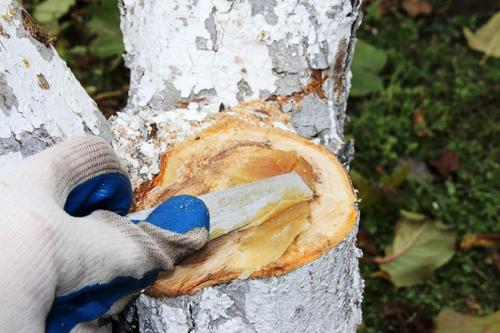 Treatment compounds are divided according to their intended purpose:
- disinfectants;
- for rapid healing of wounds.
Depending on the method of application, they can be used to:
- spray;
- lubricate;
- cover up.
Branches are treated if sap does not flow from the wounds. For stumps larger than 3 cm, proceed as follows:
- the surface is leveled with a sharp knife or chisel, burrs are removed;
- coat with a brush or spray with a disinfectant;
- dry for several days:
- use putty.
For spraying and lubrication
Disinfection solutions are sprayed and applied to wounds. These are used for all types of damage to bark and wood.
Compositions with potassium permanganate are produced copper sulfate:
- 50 g copper sulfate placed in 1 liter of hot water;
- Potassium permanganate is added to warm water until it turns light pink.
Preparation of Bordeaux mixture:
- 30 g of copper sulfate is poured into half a liter of warm water;
- 30 g of lime is poured into half a liter of warm water;
- The copper sulfate solution is poured into the lime in small portions and mixed.
The compounds are applied with a brush or sprayed. Wear protective gloves during this procedure in windless weather.
To disinfect damaged wood, balms with fungicides are purchased in specialized stores.
For covering
After cleaning and disinfecting the cut, they begin sealing. The sealant is applied to seal the cut and prevent it from drying out. The open cut disrupts sap flow and allows moisture to evaporate.
The putties are:
- garden var;
- oil and water-based paints;
- chatterbox;
- cement mortar.
Only exposed wood is covered with putty. The bark is left bare.
Clay mash
 The mixture is prepared from clay, mullein, straw or hay:
- 1 part of mullein is combined with 2 parts of clay;
- add a little hay or straw:
- dilute with water until it reaches the consistency of sour cream.
Cement mortar
The solution is suitable for sealing deep cracks and wounds:
- mix one part cement with three parts fine sand:
- dilute with water;
- add drying oil.
Garden var
Garden pitch can be purchased ready-made or made at home. To prepare the product, you'll need fat, wax, and rosin:
- Wax has hermetic and water-repellent properties. Turpentine can be used instead.
- Rosin firmly bonds the putty to the wood.
- Fat makes the mixture flexible in any weather. Use unsalted fat. Replace it with natural drying oil or vegetable oil.
Several cooking recipes:
- Melt 1 part rosin and 1 part fat, 2 parts wax without mixing, then combine. Pour the mixture into cold water to cool.
- Paraffin, drying oil, and rosin are mixed in a ratio of 20:1:4.
- The oil and rosin are heated and combined in a ratio of 2:1.5, and some turpentine is added.
- Mix wax, rosin, and oil in a ratio of 2:2:1.
Garden varnish is applied warm in a thin layer. A thick layer retains moisture and causes wood rot.
Adviсe
What to do if sap flows after cutting a branch
The appearance of sap from small cuts indicates the beginning of sap flow. The pruning was done too late. The wounds haven't had time to heal. All the damaged areas are treated with a liquid clay slurry.
Juice from large cuts indicates a leak in the seal. You should:
- clean the surface again;
- cover with thick clay slurry;
- secure on top with cotton fabric.
If the cut on the branch turns black
Blackening (darkening) indicates infection with apple cancer and cytosporosisThe pathogens that cause these diseases appear on untreated cuts. The disease spreads to neighboring branches and can destroy the entire orchard.
The treatment is carried out as follows:
- cut off the infected wood, capturing adjacent healthy areas;
- treated with 3% Bordeaux mixture or 1%, depending on the end of the growing season or development;
- after drying, cover garden pitch or chatterbox.
The entire tree is treated, not just the wounds.
What to do if the apple tree cut is rotting
Rotting is caused by spores of the polypore fungus. An open cut collects microbes and bacteria, serving as a breeding ground for infection. Disease control involves removing the infected parts. There are no specific treatments.
The branch is cut off. Light-colored wood on the cut surface indicates that the disease has not spread to the rest of the tree. The branch is burned, and the cut surface is treated with a disinfectant and garden pitch.
If the cut is dark, the apple tree is dying. It is cut down and burned.
Video: Treating tree trunk wounds after pruning and cutting branches
Conclusions
Trees should be pruned regularly, taking into account the timing and extent of damage. To speed up the healing of cuts, use disinfectants and special sealants. Cuts heal quickly on young shoots, while larger cuts require greater force.