

What to do with water sprouts on an apple tree: get rid of them or re-graft them?
The apple tree's survival instinct manifests itself through the growth of cambium cells, creating strong, rapidly growing shoots. Unwanted vegetation thickens the crown, thereby promoting disease. To properly shape the tree's skeletal branches, it's important to know what to do with these shoots and whether they can be beneficial.
Content
What is a spinning top?
An apple tree sucker is a vegetative (fattening) branch. Its primary purpose is to restore an old or damaged tree. It grows from dormant buds that are formed annually in the cambium and awaken in emergencies. Suckling branches grow very quickly, but absorb most of the nutrients supplied through the roots, which negatively impacts fruiting and crop quality.

Reasons for occurrence
It's important to remember that suckers not only steal nutrients, but also perform a key function: restoring the tree's crown. Therefore, they most often appear when the apple tree is severely damaged:
- when the leader or first-order skeletal branches freeze out;
- when the tree bark is damaged by pests;
- in case of mechanical damage to the leader or large branches;
- in case of sunburn of a tree.
Signs of the wolf branch
The wolf branch has several significant features:
- grows strictly in a vertical direction from the mother branch;
- shoot – strong, internodes – long;
- leaves - large, darker in color;
- fruit buds are absent;
- are characterized by rapid growth;
- In the first season of development they reach a length of up to 2 m.

In addition, water sprouts appear in case of violation of agricultural practices:
- when the apple tree is pruned incorrectly;
- with excessive saturation with nitrogen fertilizers;
- in case of excessive watering;
- in case of violation of the technology of pruning branches to the ring.
Water sprouts should not be left to grow in their natural state, as they absorb beneficial micronutrients from the soil, significantly reducing the apple tree's yield. Therefore, the decision to prune should be made immediately after their appearance.
Removing the tops
 Spinning tops are subject to mandatory removal in the following cases:
- if they grow directly on the central conductor;
- in case of thickening of the crown;
- if they are in contact with skeletal branches of any order.
The following methods are used to remove water gulls:
- Blinding (removal) of swollen buds. The least traumatic method. This is done manually by pinching.
- Green operation. Performed in the spring to remove young shoots. It is performed using a sharp knife, pruning shears, or a small hoe.
- Summer pruning. This is done in early June, when the sucker branches have already grown. This helps determine whether the sucker is suitable for further tree development. After cutting the branch with a hacksaw or pruning with pruning shears, cuts larger than 1 cm in diameter should be treated. garden pitch or white oil paint.
Trimming technology

Water suckers should be pruned early in the morning or in cloudy weather. To completely remove the branch, use a ring pruning procedure.
A ring is a rounded growth of bark at the base of a branch that contains dormant cells that awaken when damaged and heal the wound. cut a new top will not appear.
Pruning should be carried out according to the following rules:
- Pruning to the ring is carried out along the closest edge of the bark growth to the branch being cut.
- You can't leave a stump above the ring. cut If the cambium heals poorly, the stump dries out, cracks, and fungal diseases develop. Furthermore, the dry cambium becomes a breeding ground for pests, which can reproduce and overwinter.
- Do not cut off the ring. This will damage the tree's bark and cambium, which can lead to the death of the entire skeletal branch.
- Large shoots should be sawed off, leaving a stump 2–3 cm long, and then removed to the ring with a sharp knife.
It is important to remember that improper pruning damages the tree and leads to the appearance of even more water sprouts.
Formation of a crown from a water sprout
With proper apple tree care, sucker branches grow back in the event of severe damage and are intended to save the dying tree. Therefore, such branches should be left in the following cases:
- if an old tree needs rejuvenation;
- when the central leader freezes out;
- if the top appeared in close proximity to a broken branch;
- when planning the grafting of a new variety.
In any case, you should leave only those branches that do not thicken the crown and do not intersect with skeletal branches.
Formation of a skeletal branch or leader
Shaping is accomplished by bending and securing branches. The desired direction is achieved by hanging weights, installing struts, or tightening them. The process consists of several stages:

- Pruning branches to 1/3 of their full height is necessary to promote further development and the emergence of new shoots that form the secondary and subsequent skeletal branches.
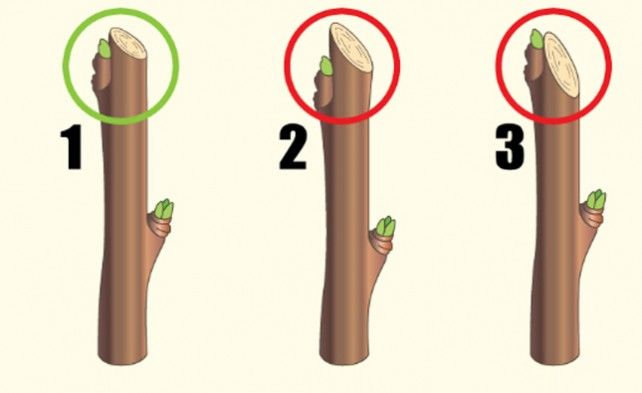
Pruning is carried out above the bud using the following technology:
- the bud under the cut should be directed in such a way that the branch obtained from it is horizontal or grows upward;
- the cut should be made at an angle of 45O;
- the lower edge of the cut should be at the level of the upper side of the bud;
- the upper part of the cut is 1–1.5 mm above the bud.
Care must be taken not to damage the bud's membrane, as this will lead to its death. A large stump left over the bud will dry out, weakening the branch tissue and causing it to die.
- Tops with a diameter greater than 2 cm should be bent gradually in the desired direction to prevent them from breaking. To achieve this, increase the weight of the load or the length of the spacers every 10–14 days.

Further annual pruning is carried out in accordance with the general rules for crown formation.
Formation of the fruiting branch
The fruit branch is formed as follows:
- the water sprout should be cut to 2-3 lower buds using the skeletal branch formation technology;
- The branches obtained from the remaining buds are growth branches – they form the crown and produce fruiting shoots.
The resulting branches will begin to bear fruit within the next 2–4 years.
Grafting a new variety
Grafting is used to fill gaps in the crown or to produce a fruiting branch of a different variety. This method is the most reliable, as all the strength and nutrients are directed to the sucker. The resulting branches are more resistant to fungal and viral diseases and produce larger fruits.

Grafting can be done using any known method, but the diameter of the rootstock must be taken into account.
Using a cut rootstock as a graft
A scion taken from a strong sucker branch has a high survival rate. It produces strong skeletal branches, and the resulting fruit boasts excellent flavor.
Conclusion
A sucker branch isn't just a succulent shoot that disrupts the tree's development; it can also be a lifesaver for an old or damaged apple tree. The appearance of unwanted suckers can be prevented by following proper agricultural practices and crown pruning techniques. And the shoot that emerges from a skeletal branch broken by the wind can be transformed into a young, strong, and fruit-bearing branch.





