How to use garden pitch to treat trees when pruning
Any damage to trees requires not only immediate disinfection but also subsequent protection against viruses and fungal spores. Garden varnish, designed for treating various plants, is typically used for this purpose. This environmentally friendly product can be purchased at the store or made at home.
Content
General characteristics
Garden varnish is a paste used for first aid on trees and shrubs. Treatment with this product disinfects cut or damaged area, prevents the entry of fungal spores and the leakage of sap. Garden pitch is used to treat damage and for scheduled pruning.
Disinfecting plant wounds is a complex process with numerous biological properties. A brew made from natural ingredients stimulates the healing of wounds of any depth and complexity.
Composition of the product
Garden varnish, like other disinfectants, is sold in specialty stores, but homemade putty is considered the most effective. All the ingredients included in the recipe are readily available to every gardener, namely:
 beeswax;
- animal and vegetable oils;
- drying oil;
- alcohol;
- antifreeze;
- rosin;
- paraffin.
 beeswax;
Garden pitch can be cold-resistant, melting under high temperatures, or liquid.
Advantages and disadvantages
Garden pitch not only protects the wound from moisture penetration but also prevents its evaporation from within. However, along with its advantages, this remedy also has several disadvantages.
- ecological cleanliness, preventing hazardous chemicals from getting under the bark of trees;
- water-repellent properties;
- ease of use;
- the opportunity to cook on your own;
- affordable price.
- creating a complete seal, which causes wood to rot due to lack of air;
- cannot be used at low temperatures;
- fragility;
- difficulties in processing large areas.
When purchasing garden varnish in a store, it is necessary to carefully read the instructions, as the composition may contain chemical additives that cause tree burns.
Rules of application
Treatment with garden pitch is necessary after every pruning, regardless of the reason or timing. When applied to the wound, the product promotes rapid recovery of trees and shrubs, allowing them to focus their energy directly on fruiting rather than on recuperating from the resulting wound. There are several principles for using this putty.
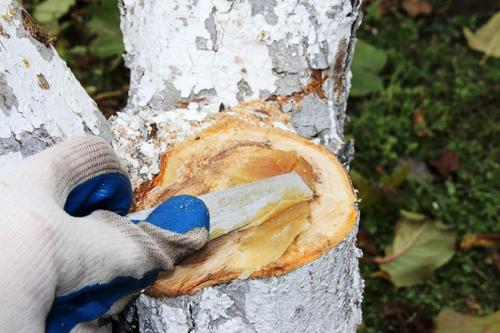 Before using the drug, you should familiarize yourself with some features:
- Only living areas of wood should be treated; damaged, dry and diseased fragments must be removed;
- cuts and wounds should be smooth; uneven areas and growths can be removed using sandpaper;
- Before treatment, the wound must be washed with clean, warm water, and the instruments used must be disinfected;
- the right time for treatment is spring or summer, as a rule, the layer is renewed throughout the season;
- When sealing hollows, preliminary treatment with alcohol or copper sulfate.
Instructions for using garden var:
- Heat the mixture to 40°C. To do this, place the jar containing the mixture in hot water for several minutes.
- Apply the product to the damaged wood with gloves and a special tool (spoon or spatula). Despite the natural nature of the varnish, some of its components may cause an allergic reaction or burn.
- Using a tool, apply the compound to the damaged area, spreading it into an even layer (approximately 2 mm thick). Applying a thicker layer will cause the compound to crack and allow moisture to pass through.
- Before treatment, be sure to clean out all cracks, frost cracks and old wounds on the bark, and then disinfect with copper sulfate.
- After finishing the work, wrap the treated area with a suitable material, such as rags or matting.
A dry and cool day is preferable for working with garden pitch.
Experienced gardeners recommend heat-treating the garden varnish immediately after application to improve its adhesion to the surface. The heated mixture will be absorbed into the wood, filling all imperfections and cracks. The baked-on top layer of the varnish will create a reliable protective barrier. Heat treatment can be performed using a heat gun, a gasoline or gas torch, or a heat gun. This procedure must be performed with extreme caution to avoid harming the plant.
Features of aerosol garden var
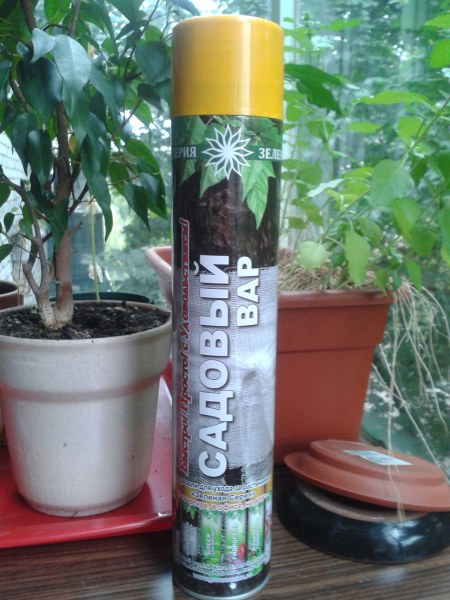
Today, manufacturers offer a cutting-edge plant treatment product, available in aerosol form. This formulation not only significantly speeds up the treatment process but also makes it as sterile as possible. Since the product has only recently been available, it hasn't yet received a significant number of reviews. However, several advantages of its use are already evident:
- excellent adhesion to wood surfaces;
- ability to fill even microscopic gaps and cracks;
- acquisition of a solid film state after drying, creating excellent protection for the treated wound;
- ease of use: when treating large surfaces with aerosol garden pitch, the use of additional dressings is not required.
 excellent adhesion to wood surfaces;
The disadvantages of an aerosol product are as follows:
- relatively high cost for small capacity;
- content of chemicals and preservatives;
- flammability.
Keeping the aerosol preparation near fire is unacceptable.
Using garden pitch when grafting
Healing putty is essential for treating wounds when grafting garden crops. After the procedure, apply the preparation to the damaged area and wrap it with tape. Garden pitch is ideal for the following grafting methods: budding, behind the bark, ablactation.
When performing the procedure, it is important not to allow the var to get between the scion and the rootstock, otherwise the fusion will be crooked and slow, and the process of rejection cannot be ruled out.
Rules for preparing garden varnish yourself
The medicinal composition does not necessarily need to be purchased from the store, as it is easily prepared at home. There are many various recipes for creating garden varnish, allowing you to select the most suitable option for a specific situation and weather conditions.
Paraffin based
The composition obtained according to this recipe will include the following components:
- 2 kg of paraffin;
- 1 kg of rosin;
- 0.75 l of oil (vegetable or mineral).
Cooking algorithm:
- crush the rosin into flour;
- melt the paraffin;
- combine the ingredients, mix thoroughly and bring to a boil over low heat;
- pour oil into the mixture and then boil for 30 minutes;
- Pour the prepared mixture into a container and allow to cool.
When creating a paraffin-based disinfectant, the amount of components can be increased or decreased, as long as the proportions are strictly maintained.
Based on nigrol
To make garden var according to this recipe you will need:
- 1 kg of paraffin;
- 1 kg of rosin;
- 1 kg of nigrol.
The ingredients must first be heated, then mixed well together and placed in a jar.
With the addition of drying oil
The recipe includes:
- 5 kg of paraffin;
- 0.25 l of drying oil;
- 1 kg of rosin.
The melted rosin is combined with drying oil, after which the mixture is poured into hot paraffin. The components are thoroughly mixed and transferred to a suitable container.
Varnish prepared with drying oil should be stored at room temperature.
Based on beeswax
To obtain a medicinal ointment you will need the following components:
- 2 kg of rosin;
- 1 kg of beeswax;
- ½ kg of visceral fat.
Cooking process:
- melt the wax:
- add rosin and visceral fat to the hot wax mass;
- cook the mixture for 30 minutes;
- pour into a container and leave to cool;
- After the mixture has cooled to a warm temperature, knead it with your hands to obtain a homogeneous consistency.
The beeswax recipe can be varied by combining it with propolis, lard, unsalted fat, and turpentine. The mixture can be cooled in cold water, and once it has curdled, it can be shaped. Garden varnish prepared this way is recommended to be stored in oiled paper and used only on warm days.
To prevent bees and wasps from attracting the treated area, it should be covered with a cloth. The use of film in this case is unacceptable, as it will prevent the putty from drying.
With the addition of propolis
The recipe includes the following components:
- 1.5 kg of wax;
- ½ kg turpentine;
- 1 kg of propolis;
- 3 kg of rosin.
Method of preparation:
- melt rosin, wax and propolis using a water bath, then cool;
- Pour turpentine into the cooled mixture and stir.
Before each use, the mixture prepared according to this recipe must be thoroughly kneaded in your hands.
Possible alternative to garden varnish
Pruning trees and shrubs is an important procedure that requires utmost care. Neglecting to properly treat cuts can result in the death of the crop. If you don't have garden pitch on hand, you can use one of the following options:
- oil paint - during application it is simply used to cover damaged areas or fresh cuts;
- natural drying oil - applied to a slightly dried cut (can be in several layers), unlike var, drying oil does not melt on hot days;
- clay - mixed with hay and mullein, and after obtaining the consistency of the dough, it is used to treat wounds;
- wet earth - slightly moistened with water, applied to the affected area, then wrapped in cloth and secured;
- bovine manure;
- a regular cellophane bandage.
In some cases, ordinary children's play dough or glue stick are used to treat wounds, applying a thin layer to the wood surface. This prevents bacteria and moisture from penetrating the wound.
Paints prepared with oils such as camelina, hemp or mineral oil are considered an ideal replacement for garden pitch.
Replacing garden pitch during grafting
When grafting, the following agents can be used as an alternative to garden pitch:
- A mixture made from melted wax and vegetable oil. Even wax from a melted candle can be used for this purpose.
- A putty made from clay mixed with resin, mullein, and water. Before treating trees, the clay mixture is thoroughly kneaded.
- A paraffin-based composition diluted with natural drying oil and rosin. All components are melted together to seal the wounds.
- Chatterbox from mullein, water, and clay, brought to the consistency of sour cream. Before applying this putty, the wound is treated with copper sulfate.
Minor damage can simply be washed with potassium permanganate or copper sulfate, and then wrapped in a plastic bag.
Tips and recommendations
Hardened garden pitch can be softened in several ways:
- knead in hands;
- leave in a warm place for a while;
- resort to the help of a water bath.
The oil and wax contained in the product prevent it from being washed off quickly. It's best to remove the product that has cracked at low temperatures using a rubber spatula.
When treating garden crops, wear gloves. However, if the varnish does get on your hands, you can remove it with gasoline or white spirit, then rinse with room-temperature water. In this case, it is not recommended to use highly concentrated solutions.
Garden varnish is reliable An environmentally friendly and safe solution for treating damaged plants. There are many different ways to prepare this product, so buying ready-made versions from the store doesn't make sense.