What is the best way to feed an apple tree in spring?
Fertilizing apple trees in spring is crucial for caring for fruit trees. Since young apple trees grow for a long time, they require high-quality nutrition. How can you avoid negative consequences and nourish the soil with the necessary components to enhance fruit production? Let's find out.
Content
- Why is it necessary to fertilize an apple tree?
- Why fertilize an apple tree in spring?
- What fertilizer to use for apple trees in spring: optimal timing
- What fertilizer to apply to an apple tree in spring: types of fertilizers
- Dosage of apple tree fertilizers
- List of rules for spring fertilization of apple trees
- Spring apple tree fertilization plan: tips on how to fertilize an apple tree in the spring for a better harvest
Why is it necessary to fertilize an apple tree?
Fertilizing fruit trees, particularly apple trees, is essential for the plant to obtain the necessary nutrients. This procedure positively impacts fruit production. Gardeners who want a good harvest fertilize their apple trees every season, replenishing any nutrient deficiencies.
Fertilizing apple trees is necessary for many reasons, but the following are noted as positive effects:
- obtaining useful substances from the soil;
- acquisition of immunity to fungal diseases;
- increase in crop yield;
- improving the taste of fruits;
- activation of ovary formation.
High-quality fertilizers for apple trees will accelerate metabolic processes and increase the productivity of garden crops.
Why fertilize an apple tree in spring?
In spring, fruit trees require complex nutrition, so the soil needs proper fertilization. For a healthy growing season, apple trees require nitrogen for active crown growth, phosphorus to strengthen the system itself, and potassium to promote proper carbohydrate metabolism, which influences the rate of fruit ripening.
Please note that phosphorus and potassium are beneficial for apple trees at any stage of the growing season, both in autumn and spring, so choose a fertilizer that contains these components and will quickly process nitrogen nitrates.
What fertilizer to use for apple trees in spring: optimal timing
In spring, apple tree fertilization follows a specific schedule. To properly administer fertilizer, it's important to understand the appropriate timeframe. Gardeners distinguish several stages of apple tree growth and development:
- at the beginning of spring, when the buds have not yet begun to blossom;
- before the flowers appear, in mid-April;
- after flowering, at the end of May.
Different types of fertilizers are used at different stages of growth, depending on the required micronutrients at that time. There are both rapidly soluble and slowly absorbed substances, such as potassium sulfate, which should be applied in early spring. Nitrogen fertilization can be applied anytime from April to June, as this element quickly dissolves in the soil and nourishes it with essential nutrients.
What fertilizer to apply to an apple tree in spring: types of fertilizers
For any plant, including apple trees, there are two types of fertilizers: root and foliar. They are applied at different times. Root feeding is recommended in early spring, and foliar feeding is recommended later in the season.
Root feeding
Root feeding involves applying fertilizers containing beneficial substances under the roots of the trees, around the trunk, at a distance of 60 to 100 centimeters from the trunk. Some gardeners use a long-term feeding method, digging small holes up to 40 centimeters deep. The furrows are filled with 500 grams of potassium sulfate or superphosphate and covered with soil. This long-term feeding method lasts for 5-7 years.
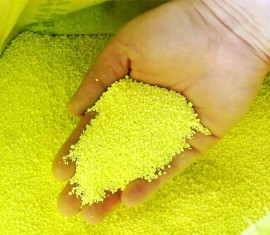
When using the liquid method, the substances are diluted with water and sprayed onto the roots, and when using the dry method, the granules are sprinkled with soil so that during rain they slowly dissolve and saturate the soil with the necessary elements.
It is recommended to fertilize young trees with liquid preparations to more quickly saturate the soil with microelements.
Foliar feeding
The foliar fertilizer concentration is several times weaker, so the mixture is diluted with water and sprayed on the leaves. The effectiveness of the nutrients will depend directly on weather conditions. It's best to apply the fertilizer early in the morning or in the evening, when there are no strong winds or rain. The air temperature should not exceed 25 degrees Celsius.
Foliar feeding is carried out at a time when the appearance of plants deteriorates and the trees need missing microelements.
Foliar feeding does not replace root feeding, and vice versa, since each of them is necessary for plants.
Fertilizing apple trees in spring: the difference between feeding young and mature apple trees
Young apple trees planted last spring are not recommended for fertilizing, as proper planting will have already provided the correct amount of nutrients in the hole. Fertilizing should only be done after a few years, as the soil eventually becomes depleted and lacks nutrients.
Before applying liquid fertilizer, water the soil generously a few days beforehand. This will protect the root system from possible burns.
Dosage of apple tree fertilizers
When considering the best spring fertilizer for apple trees, gardeners carefully read the dosage requirements. Organic matter should be applied at least once every two years at a rate of 30–40 t/ha, while mineral fertilizers require a different rate: 60 to 240 kg/ha annually, depending on the soil's nutrient status.
Before applying fertilizer to your apple orchard, carefully read the package instructions. This will not only allow you to select the correct dosage but also avoid any serious errors.
List of rules for spring fertilization of apple trees
Experienced gardeners gave useful tips on caring for apple trees:
- You can tell that there is an apple tree deficiency by the appearance of the trees;
- When carrying out any type of feeding, it is important to maintain distance and safety rules;
- Please note that single-component mixtures may not be compatible with other substances, so read the instructions;
- If the root ball gets onto green shoots and leaves, it is necessary to wash this part of the tree with water to avoid a negative reaction;
- dry and granular compositions are best dissolved in hot water, since in cold water the activation of particles will be very slow;
- During dry seasons, it is recommended to use liquid fertilizer; in rainy weather, dry components are needed;
- The optimal method of fertilizing is pitting.
Spring apple tree fertilization plan: tips on how to fertilize an apple tree in the spring for a better harvest
The success and effectiveness of spring fertilization for a good harvest depend on the right fertilizer selection. Both liquid and dry fertilizers can be used. Organic manure is used instead of manure, as it also contains nitrogen but has a longer shelf life. For liquid fertilizer, use 10 liters of water and dilute 150 grams of superphosphate for treatment. For older trees, it's better to use wood ash at a rate of 250 grams of material per 10 liters of water per square meter. Apply the fertilizer before flowering begins.
The second feeding is done in mid-May after the first leaves emerge. The mineral-organic fertilizer is applied according to the following schedule:
- potassium sulfate - 800 grams;
- superphosphate - 1 kg;
- urea - 0.5 kg;
- water - 200 liters.
The prepared solution is added to the soil and left to sit, then you can use ready-made store-bought mixtures.
Fertilizing apple trees in the spring will not only allow them to bear fruit abundantly but also help them resist pest attacks, so this procedure should not be ignored. It's important to follow all timing and select the right ingredients, so gardeners can reap juicy and delicious apples.