Powdery mildew on apple trees: how to combat the disease and how to treat trees in the garden
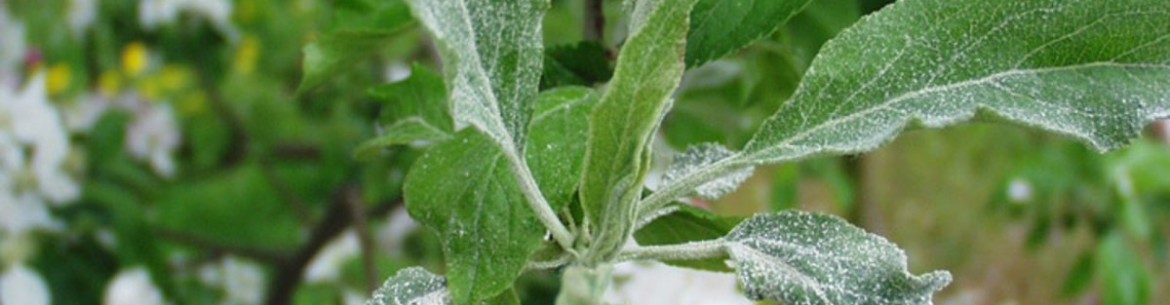
A white coating on the leaves and young shoots of an apple tree is a clear sign of disease. Downy or powdery mildew spreads quickly and affects the entire orchard. It's important to understand the differences between these diseases to successfully combat powdery mildew on apple trees, choose the right treatment, and save the harvest.
Content
What is powdery mildew?
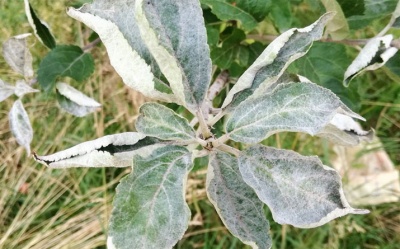
Powdery mildew (powdery mildew) is a disease caused by the mycelium of the microscopic fungus Erysiphe umbelliferarum, which parasitizes the surface of the above-ground parts of the tree—leaves, young shoots, ovaries, and fruits. It inhibits tree growth, suppresses photosynthesis, reduces yield by up to 50%, and decreases frost resistance.
Powdery mildew thrives in high humidity (80–95%) and relatively low air temperatures (up to 16°C), meaning a cool, wet spring favors fungal growth. It is characterized by rapid reproduction and spread across the landscape.
The development cycle and course of the disease
The development and maturation of fungal mycelium occurs in several stages, each of which is visually reflected on the apple tree crown:
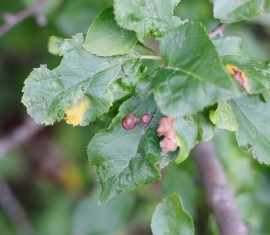
- Infestation most often begins at the base of the crown; overwintering spores attach to the surface of the leaves, covering them with a white, powdery coating. This coating is easily wiped off by hand, but reappears within minutes.
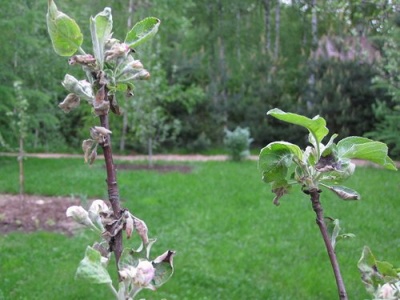
- After the fungal spores mature, liquid droplets form on the mycelium—this phenomenon gives the disease its name, powdery mildew. Spread by wind, rain, and insects, the entire crown becomes infected, with a white coating covering young shoots, flowers, and ovaries, and developing leaves appearing stunted.
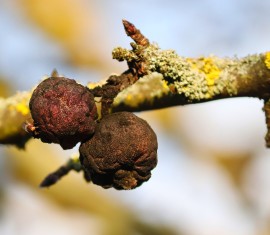
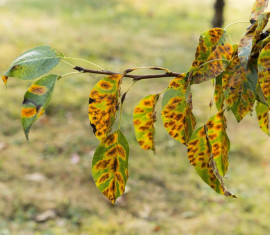
- Mature mycelium darkens, becoming light brown, brown, or black. Affected leaves and shoots dry up and die.
- Damaged fruits may grow, but they don't fully ripen; they crack, rot, and fall off significantly prematurely. A cured tree produces fruit with a net-like skin; such apples have a shelf life of no more than a month.
- In autumn, spores form cleistothecia, which overwinter in buds or fallen leaves.
The incubation period for powdery mildew is 3–5 days. Therefore, 12–15 generations of the fungus can develop over the course of a season.
Causes of infection
There may be several reasons for powdery mildew infection:
- unharvested leaves and remains of last year's harvest;
- the presence of weeds in the tree trunk circle;
- cool damp weather;
- overwatering;
- oversaturation of soil and plants with nitrogen;
- dense plantings;
- inconsistency of the apple tree variety with the climatic conditions;
- lack of formative pruning;
- infection from other plants through wind, rain, garden tools or gloves;
- the presence of pests - ants, aphids and other flying insects.
Methods of combating powdery mildew
At the first sign of disease, immediately prune away all affected parts and destroy them by burning them in a metal container. Then remove all weeds and fallen leaves from the tree's trunk area. Dig over the soil to a depth of 5 cm and begin treatment.
Folk remedies
Treatment with folk remedies is effective only in the early stages of the disease. The tree and surrounding area should be treated 3-4 times, 7-10 days apart, with one of the following solutions:
- Soda solutionDissolve 70–100 g of laundry soap in 5 liters of warm water and add 5 tbsp. of baking soda.
- Potassium permanganate solutionDilute a light pink solution of potassium permanganate, add 1 drop of iodine.
- Onion peel infusionPour 3 liters of boiling water over 2 cups of peel, cool, and spray on the affected leaves. For a stronger effect, you can add 20 g of mustard powder, but in this case, increase the solution volume to 5 liters.
- Garlic infusionChop 1–2 medium heads of garlic, add 1 liter of warm water, and place in a dark place for 24 hours. Strain to make a final volume of three liters.
- Serum solutionDilute whey with water 1:10 and thoroughly soak the tree's leaves and shoots. This treatment will form a film on the affected areas, preventing fungi from developing and killing them.
- Ash solutionMix 1 kg of wood ash with 10 liters of warm water and add 100 g of laundry soap. Stir the solution before rinsing and watering to ensure the ash particles settle on the leaves.
- Penicillin solution. For 1 liter of water 4–5 ml of the preparation.
- Soap solutionDissolve 30 g of laundry soap in 1 liter of water and wash the leaves thoroughly by hand. This treatment is only effective if the affected area is small.
Treatment should be carried out in the evening.
The soap added to the product creates a film on the leaves, which prevents the development of fungus and does not allow pests to gain a foothold.
Chemicals for powdery mildew on apple trees
If the disease is at an advanced stage or there is a large area affected by the fungus, treatment should be started immediately with fungicides prepared according to the instructions included with them:
- colloidal sulfur – ineffective at air temperatures above +25 °C;
- copper sulfate;
- Bordeaux mixture;
- "Fundazol";
- "Terramycin";
- "Topaz";
- "Hom"
- "Forecast";
- "Previkur";
- "Skor";
- "Vitaros".
As a therapeutic and prophylactic measure against the appearance of fungal diseases and insect pests, you can use a self-prepared solution.
Dissolve 5 g in 200 ml of warm water copper sulfateIn another container, dissolve 100 g of laundry soap in 5 liters of hot water. Slowly pour the copper sulfate solution into the soapy solution, stirring constantly. Spray the tree three times, 7-10 days apart.
Prevention
 Preventive measures against powdery mildew on apple trees include:
- cultivation of disease-resistant varieties;
- Applying nitrogen fertilizers only in spring and until mid-June – excess nitrogen weakens the tree’s immune system;
- application of phosphorus and potassium fertilizers to improve immunity after flowering and after harvesting;
- timely removal of pests from the garden;
- destruction of weeds from the tree trunk circle;
- pruning and burning affected leaves, shoots or branches;
- timely destruction of last year's leaves and fallen fruits;
- annual digging of the soil around the tree trunk;
- Mandatory three-time preventative treatment of trees with Bordeaux mixture in the spring, before the sap begins to flow, and in the fall, after harvesting.
- treatment with biological preparations "Fitosporin" or "Baikal" once a month during the season.
Apple varieties resistant to powdery mildew
The following varieties are immune to the disease:
- Gloucester;
- Dawn;
- Kupala;
- Golden summer;
- Linda;
- Prestige;
- Fontanelle.
Downy mildew
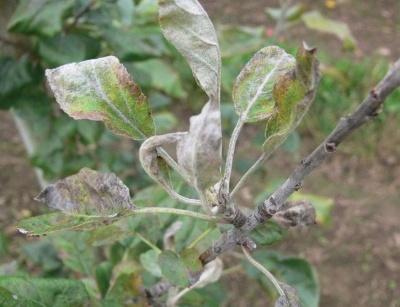
Downy mildew is a general term for diseases caused by fungal-like terrestrial parasites of the family Peronosporaceae, of which there are over 250 species. The common name for this disease is peronosporosis.
Signs and course of the disease
The development of downy mildew occurs in several stages:
- Affects the above-ground part of the tree.
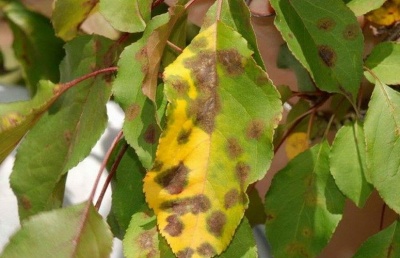
- The growth of microorganisms begins on the lower part of the leaf, and is characterized by the appearance of yellow or whitish spots on its upper part.
- As the disease progresses, the yellow spots grow, covering the entire leaf.
- At the next stage of the disease's development, the leaf turns brown and dries out, while a white powdery coating forms on its underside, on young shoots and skeletal branches of the second and third order.
- Later, the plaque darkens, turns grey, the leaves fall off, and young shoots dry out completely.
Downy mildew develops rapidly; without treatment, the apple tree can dry out and die within 3–4 months.
Causes of downy mildew infection
The main causes of infection:
- weeds in the tree trunk circle;
- high humidity (more than 85%) at high temperature (more than +30 °C);
- infected planting material;
- lack of boron in the soil;
- Uncollected remains of leaves and last year's harvest;
- watering with cold water in hot weather.
Chemical control
Downy mildew is not a fungal disease, and therefore biological treatments are ineffective. The disease can only be suppressed with chemical preparations prepared according to the instructions:
- Bordeaux mixture;
- Quadris SK;
- "Oxychom";
- "Hom";
- Vitaplan;
- "Strobie";
- Azofos.
With each spraying, the soil in the tree trunk circle must also be treated with Bordeaux mixture.
Treatment of downy mildew with folk remedies does not bring results!
Disease prevention
In addition to measures to prevent powdery mildew infection, the following steps must be taken:
- annual application of boron to the soil;
- digging up the tree trunk circle with the addition of wood ash in early spring;
- watering with a solution prepared at the rate of 1 ml of boric acid per 1 liter of water once every 30–40 days.
Apple varieties resistant to downy mildew
The following varieties are immune to the disease:
- Florina;
- Brown striped;
- In memory of Syubarova;
- Antonovka;
- Melba;
- White filling;
- Apple Savior.
Conclusion
White bloom on an apple tree may seem harmless at first glance, but it can quickly kill the tree. To maintain a healthy orchard, don't ignore preventative measures and necessary agricultural practices—this will not only save you unnecessary hassle but also allow you to enjoy a juicy harvest.