Apples rotting on the tree: causes and treatment
Many gardeners have encountered the problem of apples starting to rot right on the tree. To eliminate this problem, it's important to identify the exact cause and select the appropriate treatments.
Content
Causes of decay
The rotting process is caused by a fungal disease affecting apple trees, which damages not only the fruit, but also the leaves and young shoots.
Stone fruit trees are typically susceptible to this disease. Fungal spores are easily carried by wind and rain from one tree to another, destroying all parts of them.
Characteristic signs of fungal disease
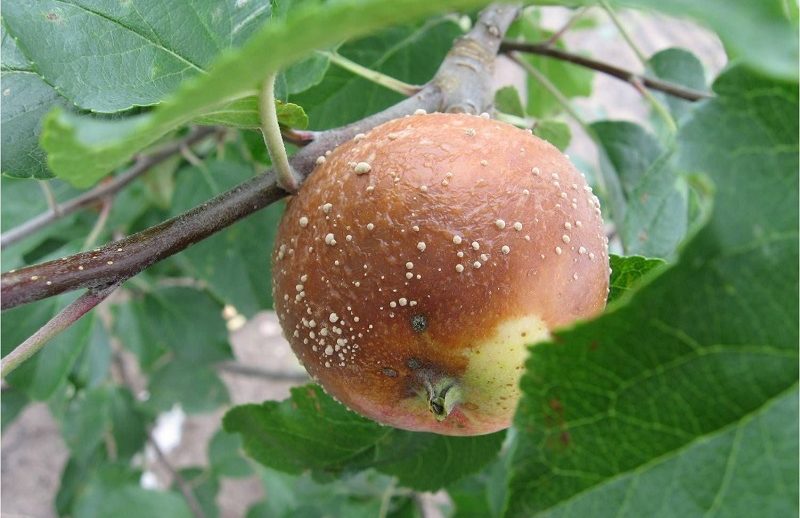 The main symptom of apple tree fungal infection is the presence of brown spots on the fruit, rapidly spreading across the entire surface. Other signs include the following:
- cessation of fruit growth, presence of numerous worm damages;
- loss of elasticity of the pulp;
- the appearance of small brown spots that increase in size over time;
- the appearance of grey conidia on the surface of rotting apples.
Infection penetrates the fruit pulp through damage caused by harmful insects, birds and wasps.
Apple rot can be caused by one of the following diseases:
- moniliosis;
- chlorosis;
- flycatcher;
- scab.
Moniliosis
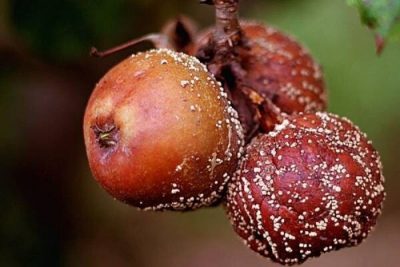
 Monilial burn And fruit rot This is a fungal disease caused by the ascomycete Monilia. It is particularly common in regions with temperate climates and prolonged cold springs. Trees are typically infected during the flowering stage. After penetrating the tree bark, the infection undergoes an incubation period of up to 14 days, after which the flowers and leaves turn brown, dry out, and die.
In warm, damp weather, fungal spores appear as a white coating on the stems and undersides of leaves. The mycelium then spreads throughout the garden, carried by wind or pests. Brown spots form on the fruit of infected trees, gradually affecting the entire surface.
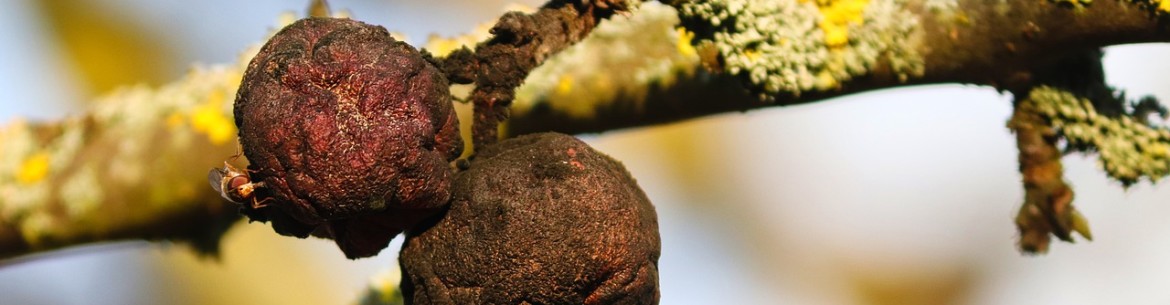
As a result, the apple flesh becomes loose, turns brown, and acquires a wine-like, alcoholic flavor. Ten days after the infection, miniature cream-colored pads—sporodochia—appear on the fruit's surface. Apples infected with the fungus often mummify and remain on the tree until the end of winter.
Ideal conditions for development fruit rot – high humidity (up to 90%) and moderate temperature (from +15 to +20 °C).
Chlorosis
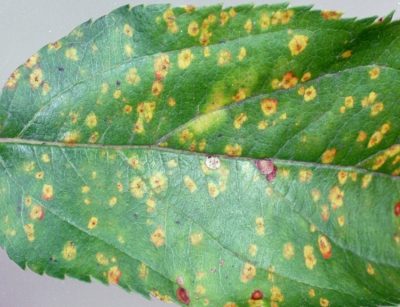 This disease is characterized by a disruption in chlorophyll production in leaves and a decrease in photosynthesis. Chlorosis is usually caused by viral or fungal infections. Pathogens are carried by wind or harmful insects. Non-infectious chlorosis develops as a result of poor agricultural practices, as well as unfavorable soil and climate conditions.
The main symptoms of the disease:
- premature yellowing of young leaf blades, while their veins do not change color, remaining green;
- slow growth of leaves, resulting in their size becoming smaller than usual;
- curling of leaves at the edges;
- drying up and falling off of flowers and leaf blades;
- deformation of buds;
- gradual dying off of the root system;
- decreased fruiting, damage and rotting of fruits.
Non-infectious chlorosis is easily treated by replenishing the microelement that the tree is lacking.
Scab
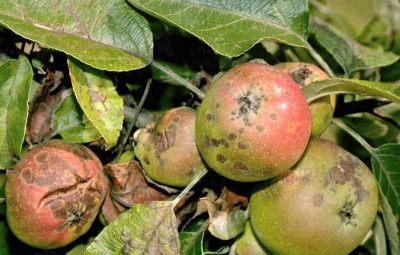 Apple scab is a disease caused by the fungus Venturia inaequalis. The infection attacks the leaves and fruit of apple trees, significantly reducing the yield and quality of the harvest. The pathogen, in the pseudothecium stage, overwinters in the fruit and fallen leaves. Fungal spores disperse as young shoots begin to develop.
Apple trees are primarily infected with scab during bud swelling, bud formation and coloring, flowering, and petal shedding. Fungal spores settle on the underside of leaf blades, and with increasing humidity, they begin to germinate in the skin. After 2-3 weeks, the conidial stage occurs, when the microorganisms, transformed into conidia, re-infect the leaves of the crown. The favorable air temperature for this process is 18 to 20°C.
After the affected ovaries and leaves fall off mushroom The scab continues to develop, forming pseudothecia that become active at the beginning of the following season. Thus, the cycle is complete. During fruit ripening, scab causes cracks, hard spots, and brownish-brown spots to form on the skin.
As a result, the apples become deformed, stop filling out, and become small. Without timely treatment, the fruit rots and dies.
As a rule, scab is common in areas with rainy summers; in arid regions, this disease manifests itself much less frequently.
Fly Hedgehog
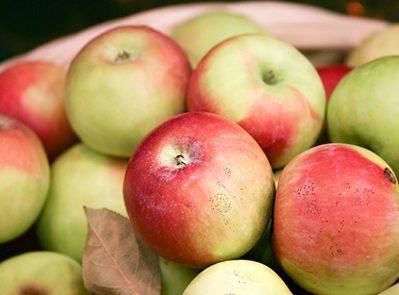 The disease occurs when fungal spores penetrate the fruit. The presence of these microorganisms poses no danger to humans. Affected fruits are perfectly edible: their original taste and shelf life remain unchanged. The only thing that reduces the commercial value of the apples is their appearance—a surface covered with small dark spots resembling fly droppings.
These spots allow spores to mature, allowing the fungus to multiply and infect new trees. The fly lice are especially active in damp conditions, such as rainy weather or after dew. Infestation occurs most rapidly in dense plantings or in low-lying orchards with virtually no ventilation.
Prevention of fly lice includes several procedures:
- timely removal of weeds;
- cultivation of varieties resistant to various infections;
- removal and destruction of damaged fruits;
- long-term storage of only high-quality crops.
Methods of combating diseases
There are several known methods to eliminate the problem of fruit rot, namely:
- systematic implementation of preventive measures;
- digging up the soil followed by treatment with a solution of copper sulfate;
- compliance with the feeding regime;
- treatment of apple trees with special preparations;
- planting seedlings taking into account diagrams and recommendations.
When the first signs of an infectious disease appear, it is necessary to take appropriate measures without delay, otherwise the apple tree may die.
Elimination of rotten fruits
Apples showing signs of damage are immediately removed and destroyed outside the orchard to prevent the infection from spreading to other trees.
Preventive procedures
Treating many fungal diseases is challenging, so it's best to take timely measures to prevent the development of putrefactive processes. To achieve this, a number of measures and basic rules are recommended:
- Pruning damaged branches and fallen leaves and then burning them.
- Whitewashing tree trunks with a mixture of lime and fungicides. This procedure is particularly effective in early spring.
- Strict adherence to the required distance between seedlings when planting, ensuring air circulation between the trees.
- Timely processing of apple trees garden pitch when they inflict injuries of various kinds.
- Removing a small amount of healthy tissue when pruning infected branches.
- Removing all rotten fruits from apple trees and preventing them from overwintering.
- Regular spraying of the garden for preventive purposes.
- Mandatory autumn digging of the soil in tree trunk circles with simultaneous application of fertilizers before winter.
Tree pruning should only be performed using tools that have been pre-treated with disinfectants.
Use of special drugs
To prevent various diseases and pest attacks, it is recommended to periodically treat the apple orchard with chemicals. The first spraying is done in early spring, before flowering.
For this purpose, the following are used:
- Horus;
- Fludioxonil;
- Ferovit;
- Bordeaux mixture;
- Phytoflavin;
- Mikosan-V;
- Raek;
- Meters;
- Agricola;
- Vectra;
- colloidal sulfur;
- Abiga Peak;
- Strobe.
Immediately after flowering, the next treatment is carried out using the same products. This procedure is then repeated in July. In the fall, after the harvest, the trees are sprayed with a copper-containing Bordeaux mixture.
Disease-resistant varieties
Breeders have not yet developed varieties that are completely immune to fungal infections. However, several are known to be relatively resistant to moniliosis.
For example, varieties resistant to moniliosis:
- Jonathan;
- Welsey;
- Ontario;
- Mutsu;
- Freiberg;
- Idared.
Less susceptible to chlorosis the following varieties:
- Moscow necklace;
- Dialogue;
- Andryushka;
- Vasyugan;
- Currency;
- Day.
Scab-resistant varieties:
- Orpheus;
- Lungwort;
- Margot;
- Delight;
- Star;
- Saffron pepin;
- Orlinka.
Resistant to fly lice such varieties of apple trees as:
- Purple Aldenham;
- Blood red;
- Siebold;
- Abundantly flowering;
- Manchurian.
Tree planting rules
To protect apple trees from infections and pests, it is important to follow planting rules, namely: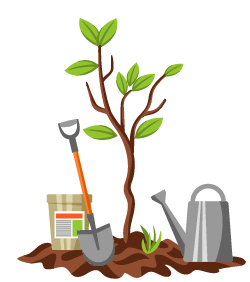
- Plant seedlings at the appropriate time - early spring or the second half of autumn.
- Maintain the required distance between seedlings – from 3 to 5 m. This will prevent air stagnation.
- Purchase planting material with a closed lump of soil to prevent damage to the tree.
- Planting should only be done in pre-prepared holes: for fall planting, they should be prepared in the spring, and vice versa. The site should be on a sunny side of the plot, with groundwater levels at least 2 meters away.
For apple trees to thrive, they require loose, nutrient-rich soil with a low acidity level.
Only by following all the rules for planting and growing fruit crops can you get a healthy and abundant harvest every year.
Early detection of fruit rot signs, proper treatment, and preventative measures taken over several years will help completely eliminate this infection.