
How to preserve seedlings purchased in the fall until spring planting: storing indoors and outdoors
Sometimes, the planned fall planting of seedlings is impossible due to personal reasons, unfavorable weather conditions, or perhaps a package containing the plants took a long time to arrive. Or, you may only be able to purchase seedlings in winter because gardening companies don't start selling planting material until February. Don't worry; it's perfectly possible to preserve any plants until spring.
Garden centers sell plants in and out of containers. Plants in containers are easier to store. Simply place them in a basement where the temperature is maintained between zero and four degrees Celsius, after removing all leaves. Plants with exposed roots require some effort to preserve.
Content
On the street
The best way to store purchased plants is in your garden or yard. Don't worry about them; they'll survive the winter without freezing. There are two options for storing them in your garden: burying them and covering them with snow.
Storing seedlings in a trench
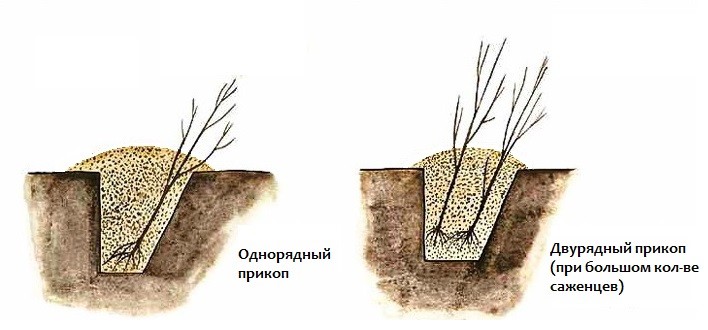 A trench is a place where plants are stored in open ground until spring, preventing seedlings from taking root and freezing before being planted in their permanent location. This method of preserving planting material is used by all experienced gardeners and dacha owners. While this method requires a lot of time and effort, it also creates excellent conditions for overwintering seedlings. This method is suitable for seedlings of all winter-hardy and frost-resistant plants.
The planting material needs to be dug in in the fall, before the frost sets in.
Sequence of actions:
- Choose a spot in your garden or plot to plant the seedlings. The site should be dry and protected from drafts. It shouldn't collect water from spring runoff or groundwater, otherwise the seedlings will quickly rot and their roots will freeze. If such a spot isn't available, use empty beds left over from various vegetables and potatoes. You can also plant the seedlings in the same spot where you'll be digging the planting hole next year.
- Dig a trench. The width of the trench should be up to half a meter, and the depth up to seventy centimeters, depending on the size of the planting material. The length of the trench depends on the number of seedlings. When calculating the length, keep in mind that twenty centimeters of space should be allocated for each seedling. Dig the trench so that the north side has a steep wall at an angle of ninety degrees, and the south side has a gently sloping wall at an angle of forty-five degrees. The excavated soil should be piled on the north side to make it easier to plant the seedlings later. It is recommended to place a fifteen-centimeter layer of pine branches, sawdust, or moss on the bottom of the dug trench. The soil from the trench should be mixed with peat and sand to soil It became lighter and did not damage the young plants over the winter.
- Carefully inspect all planting material, remove leaves, and trim off any damaged branches and roots. Then, soak the plants with their roots in clean water for several hours to ensure they are fully hydrated. After this process, remove the seedlings from the water and dry them. If the plant has many branches, it may need to be tied up a bit.
- The planting material should be carefully placed in the trench so that the roots of the plants face north and the branches face south, on the flatter side of the trench. This will protect the seedlings from the north wind. Carefully and gently spread the roots and cover them with the prepared soil to a height of twenty centimeters. Be careful not to create voids in the soil, as this is very dangerous for the delicate bark, which can rot. Then, water the soil with clean water to settle the soil.
- After the autumn frosts, the trench should be completely filled with soil, creating a mound from which the branches of the seedlings can be seen slightly protruding. When severe frosts arrive, it's recommended to cover the tops of the plants with soil, sawdust, collected leaves, and spruce branches or sedge. This will also protect the planting material from rodents. You can also lay out thorny branches of barberry or rose hips, or purchase special rodent bait. After the snow falls, some gardeners pile a large snowdrift over the burial site and clear a meter-wide strip around the trench. This also protects the seedlings from rodents.
With the arrival of spring, it's time to gradually uncover the seedlings. Don't delay, otherwise the bark in the trench will begin to rot. But starting in April, when the soil begins to thaw and warm up, you can carefully dig out the soil from the trench, section by section, and gradually uncover the young plants. Uncovering all the plants at once can damage the newly formed roots. This will make it much more difficult for the seedlings to adapt to their new location.
Storing seedlings by covering them with snow
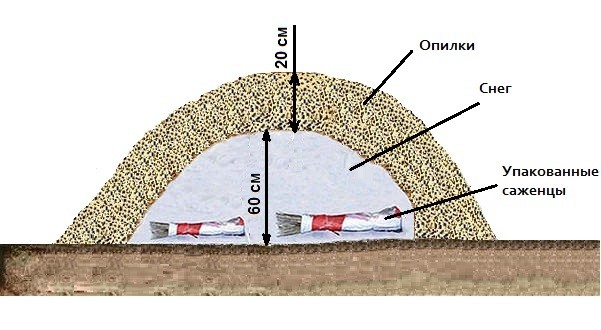 This method of preserving seedlings until spring is suitable for most ornamental and fruit crops, as well as all types of roses. Storing seedlings under snow is only possible if the garden plot has a stable snow cover of fifteen centimeters or more.
Sequence of actions:
- Before storing, fruit tree seedlings need to be prepared in advance. To do this, soak them in water for several hours, removing all leaves first.
- Next, you need to choose a place on the garden plot where there is the most snow, and dig a hole there right down to the ground.
- Next, take the soaked seedlings and wrap them in plastic film. After this, place the plants in the prepared hole, cover with soil, and cover with non-woven material.
- A thick layer of snow is placed on top of the shelter, followed by a ten-centimeter layer of sawdust. This is necessary to protect the seedlings from temperature fluctuations and snow melt.
At home
If time has passed and it is no longer possible to plant seedlings in the garden, you can try preserving the planting material at home.
On the balcony
 It's best to store seedlings on a glazed balcony or loggia. Winter sun is very harmful to seedlings, as it can significantly increase the temperature inside a glazed balcony. Therefore, it's best to overwinter seedlings on a balcony on the north side of the house.
If the balcony isn't glazed, the seedlings should be placed close to the wall of the house and covered with some kind of shelter, such as a cardboard box. During severe frosts, the plants can be insulated with several layers of non-woven material. Avoid bringing the seedlings into a warm room, as temperature and humidity fluctuations are harmful to the plants.
In the basement
Planting material is best stored in cool, unheated basements. In warm basements, plants will likely die and not survive until spring. For comfortable storage, the basement temperature should not exceed 5 degrees Celsius, and the humidity should always be maintained at around 80%.
The planting material should be laid out in rows on the floor, and the roots should be covered with damp river sand. During storage, check the sand's moisture content regularly. If it has dried out, moisten it slightly, but avoid overwatering, as this can be very dangerous for the roots. The basement is recommended for storing seedlings of various ornamental and fruit shrubs and trees, as well as grape seedlings.
In the cellar
This location provides excellent wintering conditions for seedlings. It's always cool, dark, and humid, with temperatures ranging from zero to twenty degrees Celsius.
Seedlings should be placed in boxes or large pots, and the roots should be covered with moist soil. Care should be taken to ensure the soil does not dry out, but is also not too wet. All types of seedlings can be stored in a cellar.
In the apartment
Storing planting material indoors is highly undesirable. The plants will likely wake up and begin to sprout leaves. Alternatively, the seedling may dry out due to excessively high temperatures and near-zero humidity.
If other storage methods are simply not possible, the seedlings should be planted in containers with potting soil and placed in a dark, dark room with a temperature of up to fifteen degrees Celsius. Be sure to monitor the soil moisture.
If stored indoors, seedlings will use up all their nutrients and will have difficulty rooting when planted in the spring.
In the refrigerator
Before putting the plants in fridge, it is necessary to prepare them in advance for long-term storage:
- You need to purchase a separate plastic bag for each plant.
- Then you should place the seedling in a bag and gradually fill the entire space with wet peat, soil, wood shavings, or a special nutrient substrate for seedlings.
- The bag needs to be tied tightly and several small holes need to be pierced in it.
- After completing all these procedures, it is recommended to place the bags with plants on one of the lower shelves of the refrigerator, where the temperature is always slightly above zero.
With this storage method, the plants must be small in size so that they can fit in the refrigerator.
Helpful tips
To preserve seedlings purchased in the fall until spring, it is recommended to follow some tips for subsequent planting in the winter:
- It is best to bury the plants with a light soil mixture; in the spring it will be easier to dig them out of the ground without damaging the roots.
- You can hydrate seedlings before planting them for the winter by tying the young plants together and lowering them into a barrel of water. To keep the plants from floating and the roots completely submerged, tie something heavy, such as a brick or stone, to the bundle.
- When burying the planting material in the trench, create a spot nearby where the seedling won't be located. In the spring, you can safely check the soil thaw rate in this spot without damaging the plants in the trench.
- When storing by burying the plants, do not cover the above-ground parts with roofing felt or plastic, as this will cause heat buildup. This may cause the seedlings to wake up prematurely, causing nutrients to flow from the roots to the buds, and weakening the plant's immunity.
- If you're planting conifers, be sure to check the soil's moisture level periodically and, if it's too dry, moisten it. Dry soil is very harmful to conifers.
- If the seedlings' buds have started to grow, they can still be dug in. Nothing bad will happen to them. This often happens in warm autumns.
- Before spring planting, the seedlings can be buried in a greenhouse. Be sure to monitor the temperature in the greenhouse, as the seedlings may begin to grow even in winter when it's warm. Sun.
- If your cellar is dry, it's detrimental to plant storage. To increase the humidity in your cellar, lightly mist the floors with water.
- If a seedling is affected by mold, there's no point in trying to preserve it until spring. By spring, the plant will be completely infested.
- In the spring, before planting outdoors, it's recommended to allow the seedlings to acclimate to the light. To do this, move them to a lightly shaded location for a couple of days. This will prevent the plants from getting sunburned when they're planted in the ground.
Conclusion
By familiarizing yourself with all the options for storing fruit and ornamental plant material until spring, you can choose the method that works best for you. By strictly following all storage requirements, your plants will comfortably survive the winter frosts. And in the spring, you'll have strong, healthy seedlings.



Comments
One fall, I picked up some apple tree saplings from a nursery. The trees were already dormant, and they didn't recommend planting them right away, suggesting just digging them in and planting them in the spring. I did just that, of course. I didn't dig trenches; I buried them lying down, oriented north to south, so the roots would be in the ground. As they say here, I didn't water the soil, though I did cover it with pine branches to keep rodents out, and then in the winter, I piled snow on it. In the spring, as soon as the soil allowed, I carefully dug up the saplings and planted them in the spot I'd prepared in the fall. All the saplings took root beautifully and are still growing. I just don't understand why they say this method is labor-intensive; it's so simple, but storing them in an apartment or basement is more of a hassle, and there's no guarantee you'll survive.
If the loggia is glazed, but the temperature is the same as outside, can I store seedlings on the loggia, packed and wrapped? I just sent them apple and pear seedlings. What's the maximum freezing temperature that can be tolerated on the balcony? Should I check the root system? It's packed in a peat mixture and wrapped in a bag. Thank you.
The best storage temperature is between 0 and 5 degrees Celsius. If you cover the seedlings, they can survive a light frost. However, if the temperature on the balcony drops below -5 degrees Celsius, it can be dangerous.