Sunny Apple Tree: Variety Features and Care
| Color | Reds , Striped |
|---|---|
| Ripening season | Autumn |
| Size of apples | Average |
| Taste | Sweet and sour |
| Crown type | Average tree height , Dwarf |
| Shelf life | Average shelf life |
| Application | Fresh , For recycling |
| Winter hardiness | High winter hardiness |
| Fruiting age |
 History of origin and regions of growth
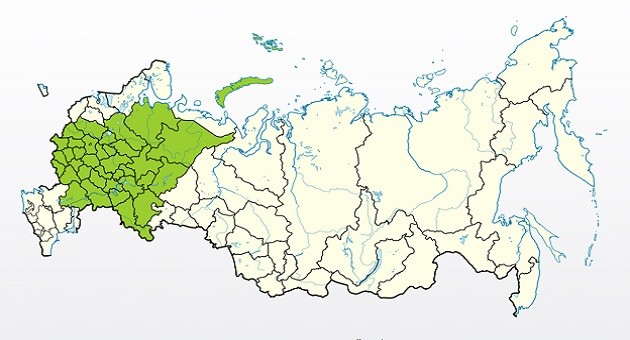
Growing regions
- Lower Volga.
- Volga region.
- Central Black Earth.
- Komi.
- Arkhangelsk region.
- Vologda Oblast.
*Dwarf and creeping rootstocks can be used for cultivation in the Far East and Siberia.
Origin
The seeds of the Solnyshko variety were initially selected back in 1981 at the experimental station of the All-Russian Research Institute of Fruit Crop Breeding. A whole group of breeders worked on its development, including such renowned experts as E. A. Dolmatov, E. N. Sedov, and V. V. Zhdanov.
After 8-9 years, the seedlings began to bear fruit, and by 1993, the variety was classified as elite due to its high consumer and commercial qualities. In 1998, the variety was sent for testing, and in 2001, it was officially zoned for the first time.
Content
Description of the Solnyshko apple tree variety
 In the second half of the twentieth century, breeders' primary goal was to develop a variety resistant to apple diseases, particularly scab. The new late-season variety Solnyshko possesses precisely these qualities, boasting enviable frost resistance, the ability to be grown on various rootstocks, ease of maintenance, high yields, and attractive, tasty, and aromatic fruits.
Apples: color, size, weight
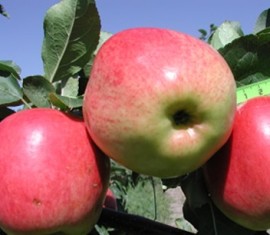
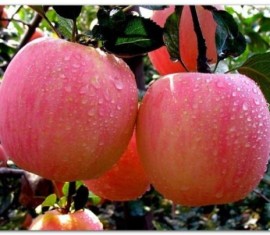
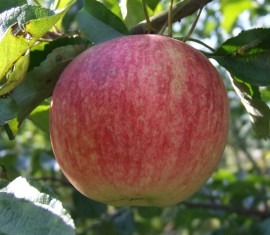
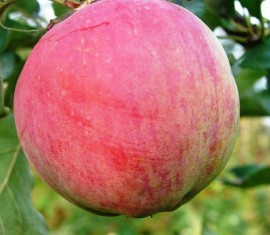
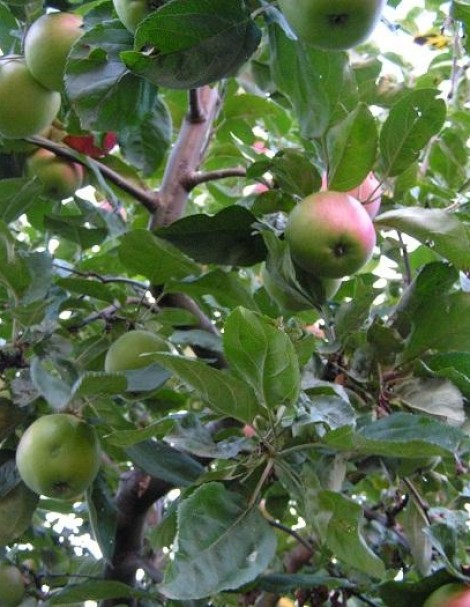
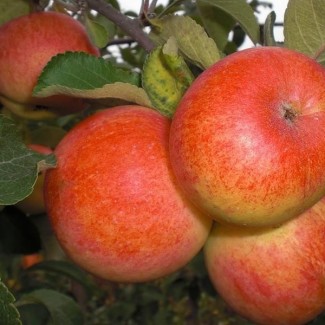
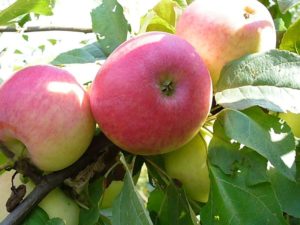 The Solnyshko apple tree produces medium-sized fruits (120-150 grams). They are typically round, tapered, and broadly ribbed. The skin is firm and green, turning yellow-green as it ripens, developing a bright, solid blush of a beautiful crimson color and a slight oily sheen. Large, numerous whitish spots are clearly visible beneath the skin. The chemical composition is characterized by the following indicators per 100 grams of product:
- Ascorbic acid (vitamin C) – 7.1-7.4 milligrams.
- P-active substances – 124-128 milligrams.
- Total sugars (fructose) – 7.9-8.2%.
- Titratable acids – 0.87%.
The flesh is very firm when green, becoming white and fine-grained when ripe, crisp and juicy. It has a sweet and sour taste that gradually becomes more tart, as well as a pleasant, distinctive aroma. It scores 4.3 on a five-point scale, while its appearance is a solid 4.8.
Sunny Apple Tree: Characteristics
Crown and root system
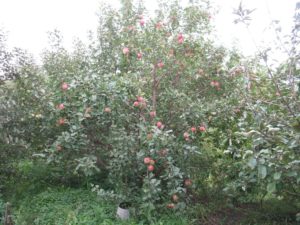 Trees of the Solnyshko variety are considered medium to below average in height, but much depends on the rootstock they are grown on. Height can be directly related to the growing region. However, this variety usually does not grow more than 3-3.5 meters, and with proper and timely pruning, good yields can be achieved even on shorter specimens (2.5-3 meters).. Crown It has a spherical shape and grows to no more than 3.5-4 meters in diameter, which allows you to save space when planting.
The 'Solnyshko' ('Sunny') tree has relatively thick branches that can be strongly geniculate and drooping. The bark on young shoots is greenish-brown, turning brown or brown with age. The leaves are slightly elongated and oval, widening toward the base, with a serrated margin. The root system is typically highly branched, with the presence of a central taproot depending entirely on the rootstock.
Productivity and pollination
This variety is quite productive, even compared to true leaders like Antonovka (300 kilograms), yielding up to 180-210 kilograms of apples. On an industrial scale, one hectare of orchard can yield at least 120 centners of aromatic fruit.
This variety is self-sterile, so if there are no suitable trees of other varieties within reach of pollinating insects (150-200 meters), no harvest will be possible. Therefore, Solnyshko is usually planted near other apple trees that have the same flowering season.
Winter hardiness and disease resistance
This variety was bred specifically for northern regions, so it has exceptional winter hardiness. Trees easily withstand temperatures as low as -38-40°C. Even in more severe frosts, only a few shoots are damaged, and the apple tree may lose some fruit. However, it quickly recovers during the summer and produces a decent harvest within a year.
Through selective breeding, Solnyshko apple trees have developed a special resistance to scab, so they are not susceptible to this disease due to the presence of a special Vf gene. They are also less susceptible to other apple diseases, but the tree has no immunity to insect pests.
Subspecies and rootstocks
There are several options for growing the Solnyshko variety on different rootstocks.
| Subspecies | Description |
| Orlovskoye | All apple varieties immune to scab are commonly referred to as "Orlov" apple varieties for convenience. Therefore, when referring to the Orlovskoye Solnyshko variety, it's a regular apple tree grown on a vegetative rootstock. |
| Dwarf and semi-dwarf | These apple trees are primarily grown by grafting onto these rootstocks. For dwarf varieties, the most commonly used are 134 and 3-17-38, which can later be used to create so-called intensive orchards. These trees begin bearing fruit as early as three or four years old, and grow to a height of no more than two meters. |
| Columnar | Contrary to popular belief, there are no columnar type Solnyshko apple trees, where the lateral skeletal branches are practically absent or poorly defined. |
Features of growing Solnyshko
Not enough time has passed since the Solnyshko variety's creation for it to gain the widespread and popular popularity it deserves. Gardeners still view it with caution, unsure of the care and conditions it requires. However, even with minimal effort, impressive results can be achieved.
 Landing
 Landing
Despite its unpretentiousness and winter hardiness, some points must be taken into account when growing this variety.
Key Features
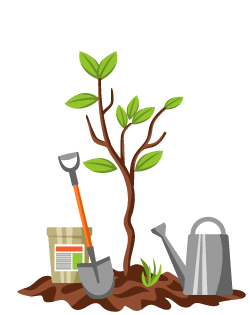
- Wood thrives in any soil except clay and similar heavy, heavily clogged soils. However, even in such cases, a solution can be found by adding sand in a 1:3 ratio.
- You need to choose sunny, well-ventilated areas, but make sure that there are no drafts from trees or building walls.
- It's best to prepare the holes in advance, at least two weeks before planting. They should be at least 70 centimeters deep and 1 meter in diameter. Add a small amount of soil, humus, and superphosphate to the bottom, then add 20 liters of water and leave to soak until the desired time.
- If the seedlings have dried out slightly during transportation, it is better to remove the damaged branches and soak the roots in a bucket of water for 4-8 hours.
- Stake saplings are immediately planted in the ground to support the seedlings. It's best to position them on the north side of the trees. Stake saplings should not be removed until 3-4 years after rooting.
- The seedling is planted so that the root collar is raised 4-6 centimeters above the soil surface.
- Between apple trees and other vigorous trees, you need to leave a gap of 5-6 meters, and from the same seedlings, it is enough to make holes 4-5 meters away, so they will not interfere with each other's development and growth.
- The root system is carefully straightened out, covered with soil without compacting, and watered with 20-30 liters of water without additives.
It is best to plant not one-year-old or two-year-old seedlings, but strong and tall three-year-old ones.
Landing dates
Depending on the region, apple trees can be planted in either spring or fall. In southern regions, Solnyshko apple trees can be planted in October, after the leaves have fallen, when frost is at least 2-3 weeks away.
For more northern locations, spring planting is best to allow the apple trees to establish roots over the summer. This is best done in April, before the buds begin to open. However, in this case, it's best to prepare the holes for the seedlings in advance in the fall.
Protection from frost and rodents
You won't need to take any special measures to protect apple trees from frost. They tolerate any frosts well, even well below 30 degrees Celsius. However, if you only have one-year-old seedlings, it's best to cover the root zone with spruce branches, straw, or simply wrap them in nylon tights.
In the fall, skeletal branches and trunks should be regularly whitewashed with lime to kill insect pests. To repel rodents, trees are coated with lard or grease.
Tree care
 Tree care
Loosening the soil, watering: proper agricultural technology
In dry years, when there's no rain for 10 or more days, apple trees need watering. However, it's important not to overdo it, as the Sun's root system is very sensitive to excess moisture. Therefore, it's best to water the trees in small amounts, but frequently—once or twice a week.
During particularly heavy natural precipitation, you can not only loosen the soil, which should be done periodically (2-4 times a year), but also create drainage channels to drain excess water. Don't forget to regularly mulch the soil around the tree trunks, as well as remove weeds, root suckers, and shoots from other trees.
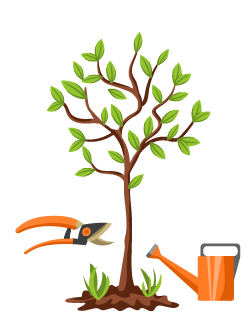
Pruning: simple crown shaping
This is a very important event, which is necessary to form the correct crown and maintain the tree in good condition for many years.
- FormativeThe first pruning of this type is carried out in the first year. The central trunk is cut back by a third to allow the lateral scaffold branches to develop more quickly. It's important to ensure that they are spaced far apart, preferably in tiers. The central shoot should be the tallest, and all the mature shoots should follow in height, gradually becoming shorter.
- SupportiveThis is done in the spring to ensure proper thinning of branches that may break off during heavy harvests. In this case, at least one branch in three is removed.
- SanitaryThis should be done every year in the fall. All diseased, damaged, or dead branches are pruned.
- RejuvenatingThis type of pruning can be performed after the apple tree has been growing for 8-10 years. Two or three mature shoots are then pruned to allow more freedom for the young shoots.
Never remove more than a quarter of the tree's branches at a time. Otherwise, the tree will become severely stressed and may cease bearing fruit in the coming years or even die.
Reproduction
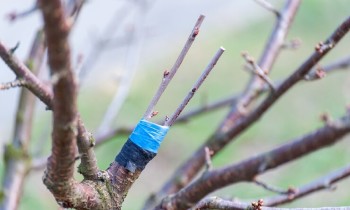
- Grafting (rootstock) by buds or cuttings.
- Growing from seeds.
- Clones (layering).
Diseases and pests
- Blackleg.
- Apple tree codling moth.
- Leafhopper.
- Copperhead.
- Red tick
- Leaf roller.
Ripening and fruiting of the Solnyshko apple trees
The beginning of fruiting
 The beginning of fruiting
Some consider it a significant drawback that Solnyshko apple trees generally don't begin bearing fruit until their seventh or eighth year. However, the dwarf rootstock typically produces fruit earlier, so particularly impatient gardeners may want to consider this option. However, in the first few years, you can harvest at least 10-20 kilograms of fragrant, beautiful fruit.
Flowering time
Apple trees of this variety, like most others, bloom in the second half of May. They produce large, single-layered flowers with five fleshy petals and numerous stamens. They are white with a slight golden hue.
Fruiting and growth
In most cases, fruiting occurs annually in equal quantities. The average lifespan is believed to be around 25-30 years, but this data has not yet been officially confirmed.
Apple trees grow quite rapidly each year, reaching 15-25 centimeters even in the early stages. Therefore, regular pruning for both formative and maintenance is essential for this variety.
Top dressing
- Humus.
- Urea.
- Superphosphate.
- Ammonium nitrate.
- Nitrogen and potassium fertilizers.
What to do if it doesn't bloom or bear fruit
- Check for diseases or pests.
- Transplant to a drier area (at a young age).
- Trim.
- Stop watering.
Why do apples fall?
- Excess moisture.
- Natural phenomena (rain, wind, hail).
- Excessive thickening of the crown.
- Pests.
- Diseases.
Please share your feedback about Solnyshko so that every gardener can grow strong, fruit-bearing apple trees in their garden.