
How to plant an apple tree in the Urals in spring and fall: from choosing a variety to care instructions
The Urals region has a rather harsh climate, so when growing apple trees, it's crucial to select the right variety, choose a site, and adhere to all agricultural practices. This comprehensive approach will ensure a high-quality and abundant harvest.
Content
Suitable varieties for the Urals
It is better to grow winter-hardy varieties that bear fruit in autumn, summer or winter.
- Antonovka. This variety is highly frost-resistant. A mature tree reaches 5 m in height and has a broad, pyramidal crown. Apple weights range from 100 to 200 g. The skin is yellow with a green sheen. The flesh is white and very juicy. The fruit has a sweet and sour flavor. The first harvest can be in September. However, it's best to pick the apples for storage in October. Antonovka apples can be stored for 2-3 months.
- White filling. It's worth choosing the Ural-bred White Naliv variety. This variety is not suitable for winter storage, however, as the fruits lose their marketable appearance after just two weeks.
A mature tree grows up to 3 m. Crown Compact in size and oval in shape, the ripe fruit weighs 100 g and has green skin and a rounded shape. The harvest can begin in early August, with up to 130 kg of apples harvested from a single tree. - Fetch. This variety is renowned for its large fruits, weighing between 300 and 900 grams. The harvest ripens in late autumn or early winter. The shelf life is 2-4 months. Ripe apples have glossy skin with a yellowish or greenish tint. The flavor is excellent, with a wine-like aftertaste. The variety's advantage lies in its resistance to scab.
- Melba. This variety is frost-hardy and mid-early. The tree grows to 2-3 m tall, with an elongated crown. The ripe fruit is light green and weighs 200 g. Melba's distinctive feature is its delicious, sweet flesh with a caramel aroma.
The harvested crop can be stored for up to 5 months, and it can be harvested in August. One tree yields approximately 130-170 kg. - Arkaim. This variety is columnar. Its main advantages are frost resistance, high yield, and early maturity. The tree blooms within a year of planting. An 8-year-old plant produces up to 6-8 buckets of apples. All of them are delicious, sweet with a distinct tartness.
- Folder. This variety is ideal for the Urals, as it boasts high frost resistance. The fruits reach maturity in August, but will only remain marketable until October.
The tree has a dense, pyramidal crown and reaches a height of 4 meters. Ripe apples can be recognized by their yellow-green skin and round shape. The fruit weighs 100-120 g. A single tree produces approximately 200 kg of apples.If you decide to plant Papirovka, then be prepared that the “neighbor” must be a pollinator apple tree (Welsey Can).
- Welsey. This variety is classified as dwarf, and was bred by American specialists. The fruit ripens in late September. The tree has a pyramidal crown, oval-shaped fruits, and weighs 100 grams. The harvest has a long shelf life—until January. The variety's drawbacks include low yields and average frost resistance.
Selecting a site for planting
 A south-facing site with plenty of sunlight is ideal for planting an apple tree. However, the tree needs to be protected from drafts and cold air masses. It's best to choose a slope to prevent moisture accumulation. Planting the tree in a low-lying area can lead to root rot due to the accumulation of cold air and moisture.
Apple trees should be planted in fertile loam or sandy loam soil with a neutral pH. If the site has heavy clay, it's worth adding sand before planting. Acidic soil can be neutralized with lime.
During the active growing season, it's a good idea to add phosphorus, nitrogen, and potassium to the soil. These nutrients will ensure a high yield.
When planting apple trees, choose a site with a low water table. For tall varieties, the water table should be 7 m, while for short varieties, it should be 3-4 m.
Preparing for transplanting seedlings
It's best to plant several apple tree varieties in a single plot. For example, two summer-ripening, two fall-ripening, and six winter-ripening. Pollinator varieties with different growing seasons, flowering times, and apple ripening times should be nearby. Frost resistance should also vary.
This approach will allow the trees to withstand severe frosts and still preserve the harvest.
Only local seedlings should be selected, as they thrive. The planting material must be healthy. Saplings with growths on the trunk, thickening, or rot on the roots are unsuitable. The roots are up to 30 cm long. Trees 1-2 years old are suitable for planting in the Urals, as they thrive better than mature plants.
Preparing a hole for planting an apple tree
To prepare a planting hole, you need to:
- Dig a hole 2-3 months before planting. Its diameter should be 70-100 cm.
- Place polyethylene on both sides.
- Loosen the bottom of the hole with a crowbar.
- Add soil mixed with humus (2-3 buckets), ready-made compost, nitroammophoska (1 kg), and wood ash (0.8 kg) to the hole.
- Compact the resulting mixture tightly.
Landing
The procedure for spring planting is as follows:
- Drive a stake into the prepared hole and place the planting material inside. Spread the roots and fill with soil, compacting it well. Make sure the root collar is about 5 cm above the soil surface.
- Secure the seedling to the stake. Do this carefully to avoid damaging the tree's bark. Use a soft material for tying.
- Water the seedling with warm water (20-30 l).
- Place a layer of mulch around the tree trunk circle using peat or humus.
Planting diagram
When planting in the spring, avoid planting apple trees too close together. These trees prefer to grow in open spaces for adequate aeration and better light.
The following recommendations will help you avoid mistakes during spring planting:
- the distance between tall varieties should be 5-6 m, and between medium-sized ones – 4 m;
- low-growing trees should be planted at a distance of 2.5-3 m;
- Columnar varieties develop actively when a distance of 0.5 m is maintained.
Care
 Caring for apple trees in the Urals is not difficult, but following proper agricultural practices is the key to a high yield.
Watering
High-quality watering is only possible if the following rules are observed:
- Moisten the soil only with warm water. Cold water will cause root deformation.
- It is recommended to water young trees twice a week.
- Mature plants should be watered only in summer. For one tree, 20 liters of warm water is sufficient.
- Three days after watering, loosen the soil around the tree trunk. This improves aeration of the root system.
- Mulching the root zone is essential. This will help retain moisture in the soil longer.
Fertilizers
The first time you should feed your apple tree is the year after planting. This should be done in the fall and spring. If the summer in the Urals is hot, you can apply nitrogen fertilizer once a season. Before flowering, the tree requires mineral fertilizers. Ammonium nitrate is suitable – 4 g per 6 liters of water.
The apple tree needs its second feeding in September, seven days before harvest. Use humus or potassium (4 g of organic matter or 200 g of mineral nutrients per tree).
To increase yield, water the above-ground portion of the apple tree with nutrients 7 days before harvest. Mix 400 g of a complex fertilizer (Kemira or Azofoska) with a bucket of water. 3 liters of solution is sufficient for one plant.
Trimming
Since planting was done in the spring, the main shoot must be removed. However, this should not be done in the fall, otherwise the plant will die from frost. In the first year of planting, all blossoms should be removed. This will allow the apple tree to conserve energy during winter frosts.
Sanitary pruning is required in the spring. All diseased and damaged branches should be removed. This has a positive effect on the development of the young plant. Rejuvenation pruning is performed in the fall every 2-3 years.
When pruning, it's important to shape the crown. This will ensure the apple tree remains beautiful and healthy. Perform this procedure for the first time in the second year after planting. Most of the shoots should be removed to encourage active branch development.
Graft
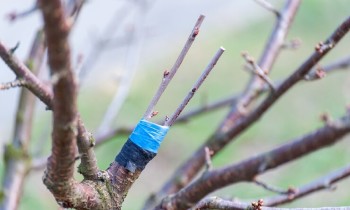
This should be done in late July. Early varieties are grafted first, followed by mid-early and late varieties. This method is most commonly used. budding - for the bark.
Procedure:
- Remove all leaves from the cuttings, leaving the petioles.
- Insert cutting into a T-shaped incision located on the rootstock.
- Wrap the fixation site with film without touching the bud.
- Treat the cut with garden pitch, which will prevent strong evaporation.
Protection from diseases and pests
 Careful care of an apple tree involves protecting the plant from diseases and pests. The most common of these pests is codling mothIf not eliminated, it will cause severe damage to the crop even at the stage of ovary formation.
Preventive measures include promptly removing fallen leaves and digging up the area around the tree trunk. To combat the pest, use Bordeaux mixture, which is dissolved (100 g) in a bucket of water. Spray the apple tree with the resulting solution.
Of the diseases, the most dangerous is scabThe following solutions are effective in combating it:
- Copper sulfate – 200 g per 10 l of water.
- Onion peel – 500 g per 5 liters of water.
The prepared solution should be used to treat plants once every 2 weeks.
Planting an apple tree in the Urals is a simple, yet responsible task. Only proper preparation and careful care will ensure a strong and fruitful tree.

Comments
Last year, my apple tree died—a typical crab apple, but very tasty and sweet. A few years ago, it started drying up, producing few leaves, and barely yielding a harvest. And last year, it fell during a thunderstorm. Could this have been due to old age? Or is it a disease? I'm planning to plant an apple tree sapling this year. Can I replant it in the same spot, or should I plant it somewhere else to avoid the risk of infection?
Were there any other symptoms? Plaque, spots, or anything like that?
I've been wanting my own apple orchard for ages. No matter how many times we planted them, they never bore fruit or grew, but it turns out we were just doing everything wrong. Now we'll know. I'm just confused about pollination, which trees should I plant, or should I just plant more varieties? And about winter care, I'm also unclear whether I need to cover them or not, and how, if the frosty winter will surely freeze them. I live in the Kudymkarsky District of Perm Krai.
Each variety has its own pollinators. Look for information about them on the pages for each variety you have in your garden.
As for whether or not to cover them, young apple trees (up to 7 years old) need to be covered, while mature trees can withstand frosts without assistance. The main thing is to choose frost-resistant varieties suitable for your region.