Fertilizing apple trees in spring for a good harvest
Spring marks the time for gardeners to perform one of the most important agricultural procedures: fertilizing apple trees, which largely determines the quality and abundance of the future harvest. The success and effectiveness of this procedure directly depend on the correct selection of fertilizers and their application method.
Content
Types of fertilizers and the specifics of their application
Every fruit tree requires nutrients to accelerate its development and ensure regular fruiting. Apple trees are no exception. The most important nutrients for this type of fruit tree are phosphorus, nitrogen, and potassium.
They contribute to:
 acceleration of root growth;
- strengthening the immune system;
- increase in foliage mass;
- development of young shoots;
- increasing crop yields.
 acceleration of root growth;
Fertilizer complexes containing these elements are divided into organic and inorganic.
The second group in turn includes:
- potassium sulfate and its salts;
- ammonium nitrate;
- ammonium sulfate;
- urea;
- superphosphates;
- nitrophos;
- ammophoska.
During the spring soil fertilization period, apple tree feeding should include the annual rate of nitrogen, as well as 2/3 of the rate of phosphorus and potassium.
Fertilizing trees with nitrogen during the summer leads to a metamorphosis in their behavior—instead of increasing yield, they begin to actively increase leaf mass. Their frost resistance also decreases, and apples develop higher levels of nitrates.
Nutrient complexes with high levels of phosphorus and potassium promote accelerated nitrogen nitrate utilization. However, it should be remembered that their use in large quantities is undesirable as it can trigger the development of diseases.
When choosing spring fertilizer it is necessary to focus on the soil type, where apple trees grow. For example, sandy and sandy loam soils require the addition of nitrogen-containing compounds. Clayey soils, humus, and compost are also helpful. Clayey soils and loamy soils don't require much nitrogen. Furthermore, it should be alternated with potassium and phosphorus. Clayey soils and compost are also needed for loosening the soil.
Nitrogen-rich black soil should be treated without additional application of this fertilizer. Instead, it requires loosening, which can be achieved by mulching with sawdust or sand. Peat is also good for this purpose, but it should be used sparingly, as it increases the pH. Calcareous soils should be enriched with organic matter and potassium.
In spring, it is worth alkalizing the soil by adding dolomite or bone meal.
Recommended standards
Mineral concentrates purchased from specialized stores are used for fertilization according to the instructions published on the packaging. However, organic fertilizers have specific standards. Per 1 m2 Up to 8 kg of the substance is required for the trunk circle. The dosage for liquid compounds is approximately four buckets per tree.
In no case should you exceed the recommended feeding rate, as this may cause burn root system or provoke the development of tree diseases.
Timing and schedule of feedings
Seasonal phases of tree development are used as guidelines for feeding apple trees, which can be adjusted in accordance with weather and climate conditions.
First spring feeding
Once the snow melts, the first spring fertilizing of apple trees begins. This event should usually be scheduled for the period of time between pruning and bud break.
During this period, you can fertilize your apple orchard with both dry and liquid fertilizers. The approximate basic composition for the first feeding is as follows:
- dry fertilizer containing nitroammophoska (35 g), urea (550 g), ammonium nitrate (45 g), humus (40 kg);
- liquid fertilizer, including 10 liters of water, 150 g of superphosphate, 65 g of potassium sulfate, 2 liters of prepared chicken manure, 10 kg manure, 300 g urea.
Instead of manure, it's preferable to use organic matter, as it's a similar nitrogen fertilizer, only longer-acting. It should be applied, like compost, as mulch.
Old apple trees (over 15 years old) need to be fed with the following composition:
- 35 liters of water;
- 35 g urea;
- 4 kg mullein;
- 25 g potassium sulfate;
- 45 g of superphosphate in granules.
The given proportions are calculated for one tree.
As a replacement for potassium, you can use wood ash at the rate of 250 g of substance per 10 liters of water per 1 m2.
Second spring feeding
In mid-to-late May It's time for the second spring feeding of apple trees. This period is marked by the emergence of the first leaves. The mineral and organic "menu" for this period looks like this:
- potassium sulfate – 800 g;
- superphosphate – 1 kg;
- bird droppings – 5 kg (equivalent replacement – 10 kg of mullein);
- urea – 0.5 kg;
- water – 200 l.
All ingredients are mixed in a barrel and left to steep for a week. The prepared solution is applied to the soil under the trees, no more than half a meter from the trunk. For a mature apple tree, use 40 liters of fertilizer; for a young one, up to 30 liters.
For the second spring feeding, you can use ready-made store-bought preparations.
Nutrient delivery methods
 In addition to choosing the correct proportions of nutrients and taking into account soil characteristics, it's important to know how to apply fertilizers so that trees can fully utilize them. Typically, root and foliar feeding are applied alternately.
Application under the roots
In this case, soil enrichment is carried out in the tree trunk circle at a distance of no more than 2 m relative to the tree crown. You can use liquid mixtures and dry fertilizers..
To prevent the mixture from spreading, it is necessary to prepare a circular trench in advance, the depth and width of which should not exceed 40 cm. Furrows for dwarf varieties can be made smaller.
This method is not suitable for columnar apple trees due to the shallow root system.
The ditches can be replaced with deep holes that reach 50 cm per 1 m2 No more than three holes are required. Granular fertilizers are first dissolved in warm water. To avoid root burn, each tree should be watered with three buckets of liquid before applying liquid fertilizer.
Before applying dry fertilizers the soil around the apple tree trunks is watered generouslyAfter this, the prepared mixture is poured around the tree trunk and moistened again.
If precipitation is forecast for the near future, then secondary watering is not required.
Some gardeners use a focal fertilization method. To do this, dig 10 holes up to 50 cm deep around the perimeter of the crown. Add 0.5 kg of superphosphate and potassium sulfate to each hole and cover with soil. One application lasts up to 7 years.
After completing the procedure, it is necessary to regularly loosen the soil to ensure complete absorption of fertilizers by the tree.
Foliar feeding
Foliar spraying is used as an additional method of fertilizing apple trees after the foliage has emerged. It is used when a deficiency of a particular element is detected. The tree should be treated before 6 a.m. in complete calm weather.Or after 8 p.m. under similar conditions. Before applying the solution, it is recommended to test it on a separate branch and evaluate the results after 24 hours. If any negative effects are detected, reduce the concentration of the solution. For foliar spraying, use urea (30 g of the substance per 10 liters of water) or ash (250 g per 10 liters).
This procedure will not only help strengthen the plant, but also destroy pests.
In addition to purchased preparations, you can use the following complex composition:
- 2% magnesium sulfate;
- 0.1% zinc sulfate;
- 0.1% iron sulfate;
- 0.2% sodium tetraborate;
- 0.1% manganese sulfate;
- 0.05% copper sulfate.
Never add liquid fertilizers to Bordeaux mixture.
How to fertilize apple trees of different ages
If during landing soil the wells were properly supplied with the necessary nutrients, then During the first 2 years, spring fertilization is not necessaryStimulating root development will be sufficient. It's best to avoid nitrogen fertilizers altogether during this period.
For young, non-fruit-bearing apple trees, applying up to 70% of the total fertilizer rate is sufficient. It's best to apply the fertilizer in liquid form. Older trees (over 15 years old) should be fully fertilized, even in fertile soils. Otherwise, downtime can lead to a loss of fruiting.
Potential negative consequences of overfeeding
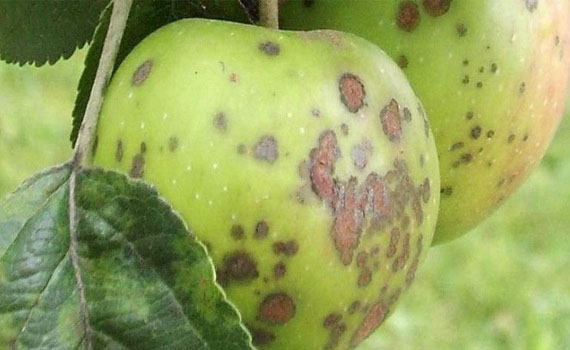 Regular feeding of apple trees, in addition to the desired benefits, can also cause significant harm. This procedure may increase the risk of developing a physiological tree disease called bitter pit.It appears as small dents on the skin of the fruit, the flesh underneath which becomes loose and bitter.
This defect develops due to an unjustified increase in magnesium, nitrogen, and potassium levels in the soil. This conglomerate causes a decrease in calcium content in the fruit pulp.
Bitter pit disease has become widespread during periods of intensive nitrogen-potassium fertilization. Therefore, it's important not only to strictly adhere to the spring fertilization schedule but also to consider factors such as soil composition and the susceptibility of the cultivated varieties to disease.
The risk of developing this physiological disorder can be reduced by spraying the apple tree's foliage with a solution of calcium nitrate and calcium chloride. The first treatment should be carried out two weeks after flowering. The frequency of spraying should be two applications, separated by 14 days.
Conclusion
Fertilizing apple trees in the spring will not only help them produce abundant fruit but also resist pests and diseases. It's important to apply fertilizer at the right time and with the right type. Following the recommendations and application rates will help you achieve a good harvest of fragrant and delicious apples.