What to do if an apple tree branch breaks: repair, strengthen, and seal
Sometimes fruit-bearing trees can break under the weight of their fruit, from lightning strikes, strong winds, or in winter under the weight of snow. This is especially true for rare apple trees. What should you do in such cases? Is it possible to save a damaged tree? Let's take a closer look at what to do in such cases.
Content
An apple tree branch broke off: what to do
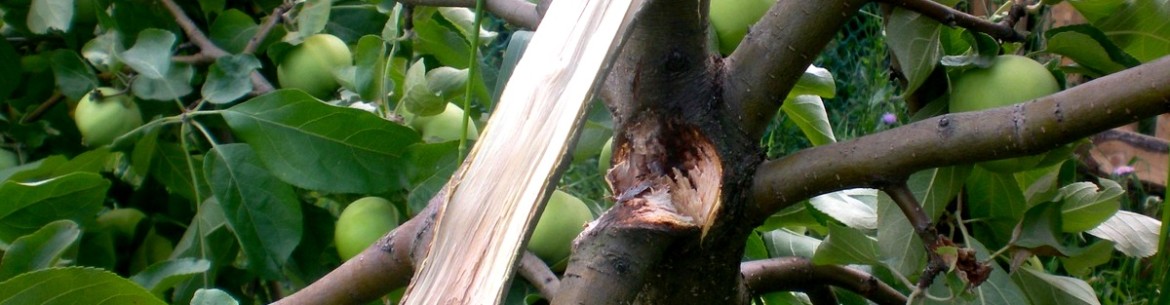
 Even thick, seemingly strong branches can break due to inclement weather or the weight of fruit. This most often happens to mature, old trees—their branches become brittle due to a natural decrease in metabolism and the thinning and aging of vascular tissues.
Branch breakage leads to stunted growth, reduced yields, and reduced flowering if the break occurs in the spring. But the most dangerous thing is the entry of pathogens—bacteria, fungi, or viruses—into the wound. Less commonly, insect larvae can penetrate the tree tissue through the break. Therefore, the wound requires immediate treatment.
If the wound is not treated, there is a risk of infection and the complete death of the entire tree.
The fracture site is processed as follows:
- The wound is cleaned with a sharp knife.
- The broken area is disinfected with a solution copper sulfate (100 g per 10 l of water) or ferrous sulfate (0.5 kg per 10 l of water). Treatment with a light pink solution of potassium permanganate is also permitted.
- The treated wound is given time to dry.
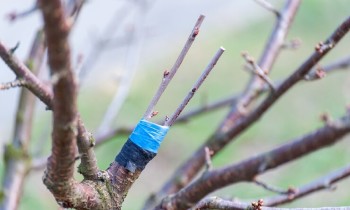
- They're covering up the wound. garden pitch or wrap them with special tape to protect the trees.
The branch with fruits broke
Another unpleasant situation is when branches break during the fruiting period under the weight of the fruit. This can happen both during ripening and harvest, and during the apples' growth. If a broken branch containing apples is discovered, all the fruit must be harvested immediately.
Unripe apples can be used to make pectin, and ripe, but already dried apples can be used to make jam or dry their.
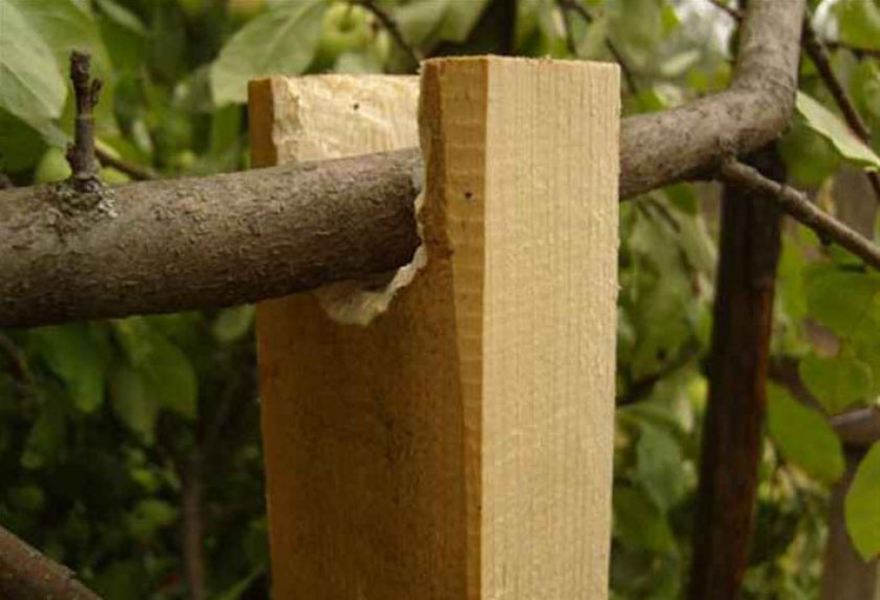
If the branch is only broken, but not completely broken, you can try to reattach it. Recovery will take several years. The broken branch is propped up with a fork above the break, and the break is pre-treated with a solution of copper or iron sulfate to prevent infection. After the edges of the wound are joined, the break itself is sealed with a thin layer of sealant. garden var and wrap it with tree tape or a strip of fabric.
A large branch broke off
Breaking a large branch leaves a large wound on the tree trunk. Any wound is an entry point for infection. Furthermore, it weakens the tree, reduces fruiting, and, if left untreated, can easily lead to the death of the entire apple tree. The broken area is stripped of bark, and deeper layers of wood are often damaged. Branches above the broken area are deprived of nutrition and may die.
First, the wound should be disinfected and treated with garden pitch, drying oil paint, or Bugorkov's balsam. If the wound is large, you can try growing bark over the wound using a bridge grafting technique.
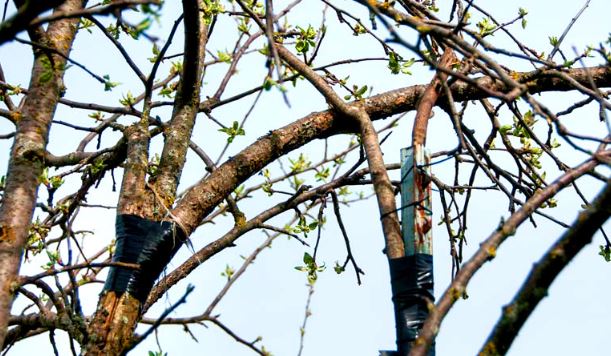
Additionally, the wound can be sealed with a mixture of Kornevin, Immunocytophyte and BF-6 glue:
- "Kornevin", "Fundazol" and wood ash are mixed in equal proportions.
- A crushed tablet of Immunocytophyte is added to the mixture.
- The resulting mixture is brought to the consistency of thick sour cream by adding BF-6 glue.
- The resulting composition is generously applied to the wound, capturing part of the undamaged bark.
The composition cannot be stored and must be used immediately after preparation.
Apple tree trunk broken: how to save the tree
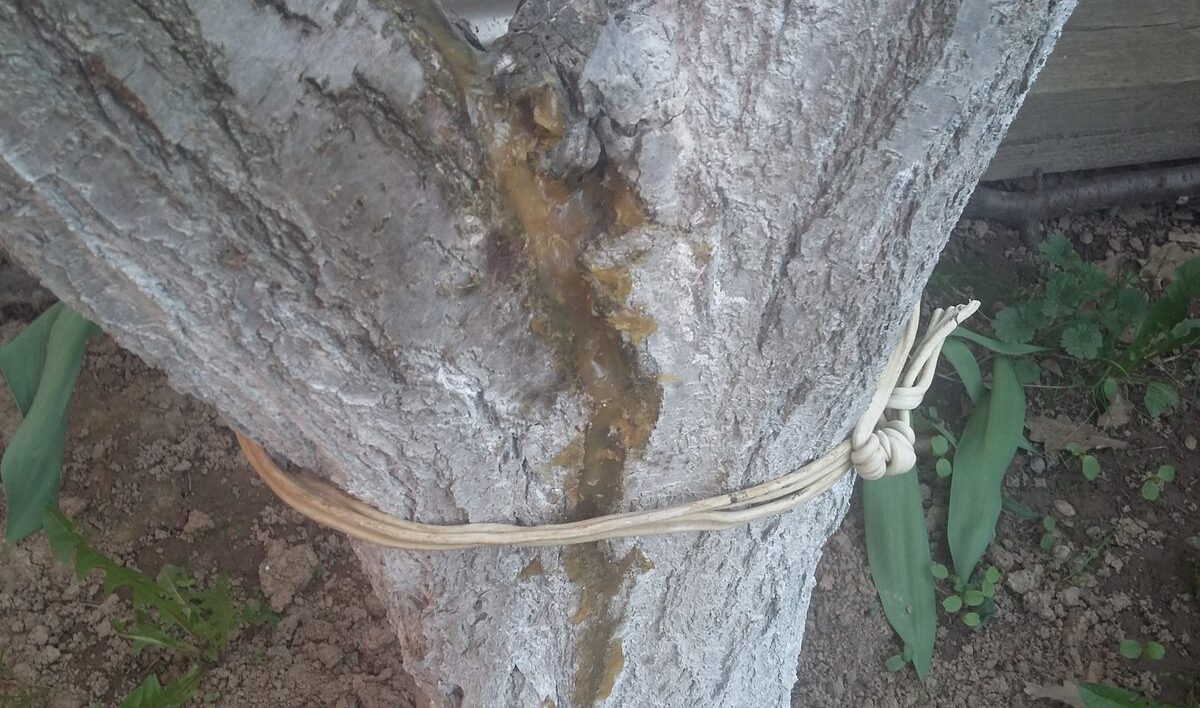
A broken trunk is usually a reason to uproot an apple tree. However, there are attempts to save the tree. To do this, use a knife, spatula, or wire brush to remove the damaged bark and some of the wood at the break.
The wound is then disinfected with copper or iron sulfate, or a pale pink solution of potassium permanganate. The joints of the trunk are then joined and secured with a bandage or a screwdriver and putty.
If a large branch breaks off, damaging the trunk, and there is no way to secure it, the wound is treated in the same way and sealed with garden pitch or a homemade mixture.
Splitting of large branches, trunks, or shoots is a more complex and damaging problem than a break. Splits can cause the tree to stop bearing fruit, take a long time to recover, and cause bruises to form. hollow and frost cracks.
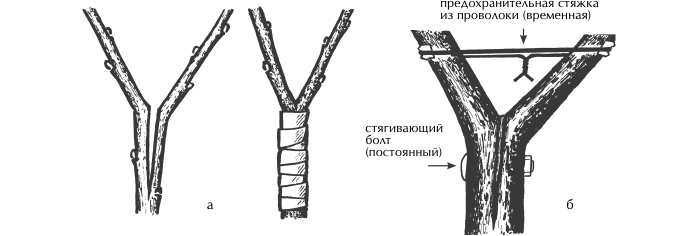
You can try to return the split branch to its original position and secure it with bandages and garden pitch. There's a chance it will grow back and bear fruit again. However, this must be done immediately after the split. If some time has passed and the wound has dried out, the cells in the area will die and fusion will not occur.
The split can be repaired using blocks or planks. To do this, they are secured to the branch, first placing rubber or burlap underneath them. The blocks are then secured with wire.
Is it possible to restore a broken apple tree?
If a fruit-bearing tree is damaged, you can try to restore it. To do this, you need to create a bandage:
- A wire with a diameter of 3–5 mm or a thick rope is wrapped around the broken place of the trunk.
- To avoid damaging the bark, place a lining under the bandage - foam rubber, polystyrene foam, thick fabric, burlap or rubber.
- Tightly twist or wrap the bandage so that it holds the fracture site.
You can try connecting the trunk with screws, then coat the trunk with garden pitch, garden putty, or a clay-based mixture. After this, wrap the trunk with gauze or a medical bandage and repeat the coating process. By winter, remove the bandage and putty, seal the crack with melted garden pitch, and whitewash it.
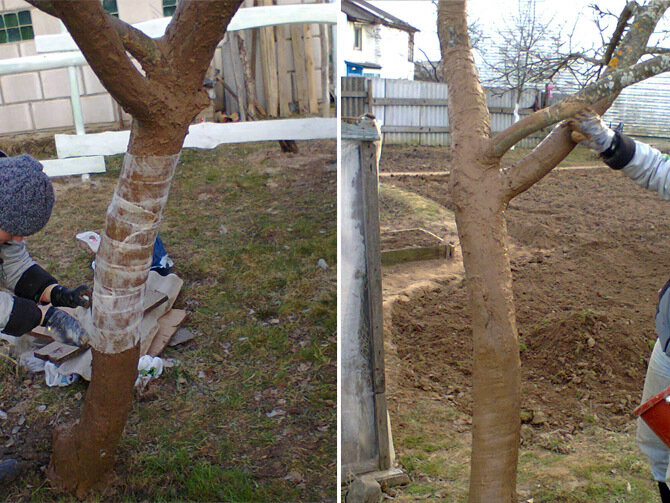
Compounds for patching a broken branch
The fracture site can be treated with garden pitch, after disinfecting the wound. Special paste "RanNet" or putty "Blagosad" contain it in their composition. copper sulfate, so there's no need to disinfect the wound when using them. If these products aren't available, you can prepare clay- or fat-based putties.
Special garden var from unsalted fat and rosin is prepared according to the following recipe:
- Heat 60 g of rosin.
- 200 g of wax is grated and added to the rosin, mixed.
- After the wax has melted in warm rosin, add 100 g of fat, preferably mutton.
- The mixture is cooled slightly and 50 ml of ethyl alcohol is added.
This mixture does not require warming before use. It can be used, including in winter, to seal frost cracks and crevices.
Based on fatty clay, you can prepare the following composition, which has disinfectant properties:
- Fat clay, mullein and copper or iron sulfate are mixed in a ratio of 6:3:1.
- Add 1–2 tablespoons of wood ash to the mixture.
- The mixture is brought to the consistency of toothpaste or sour cream with water and the wounds are treated with it.
Under no circumstances should wounds be treated with oil, tar or kerosene!
Tips from experienced gardeners: how to avoid the problem
To prevent apple tree branches from breaking or snapping, experienced gardeners recommend the following:
- In winter, if possible, shake snow off the branches.
- It is best to place forks or supports under large branches - they are placed under the middle of the branch.
- On a broken branch, reconnected to the trunk, it is necessary to break off the ovary or fruits and keep it sterile for two years after the injury.
- In autumn, phosphorus-potassium fertilizers are added to the tree trunk circle to ensure better tree recovery.
- It is essential to take measures to save the tree immediately – the sooner treatment begins, the greater the tree's chance of recovery, and if an attempt is made to fuse the branch and trunk, the greater the chance of growth.
Conclusion
A broken or fractured branch isn't a death sentence for a tree. You can always try to restore it. The faster you take steps to restore the apple tree, the greater the chance of successful healing and healing. All wounds must be cleaned and disinfected to prevent infection of the entire tree. In the fall, the apple tree should be fed with phosphorus-potassium fertilizers—these promote rapid tissue regeneration.