How to bury seedlings for the winter before planting in the spring so they don't die
Burying seedlings is a necessary procedure for protecting the plant's root system from freezing. Fruit trees and shrubs planted in their permanent locations in the fall remain viable and do not die from frost in 55-65% of cases, while those planted in a burrow survive 100% of the time. It's important to know when it's okay to plant a tree, when it's necessary to burrow seedlings for the winter, and how to do it correctly.
Content
What to choose: planting or digging in the ground
Plants can be transplanted to their permanent location one month before the onset of frost. During this time, the seedling's root system has time to adapt to the new conditions, and the tree overwinters without significant losses. Planting later often results in frost damage. Only 30% of frost-hardy fruit trees survive this process, and they become completely vulnerable to diseases and pests.
Plants can be planted in a permanent location until mid-October or until the temperature reaches 0…+2 °C in cases where the seedling: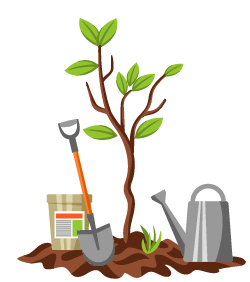
- purchased with a closed root system;
- strong, well developed, 3-4 years old;
- frost-resistant variety.
Replanting a tree is a lot of stress, but winter burying procedures cannot be avoided in the following cases:
- late acquisition of planting material;
- absence or unavailability of a place for permanent accommodation;
- if the plant is weak - has few branches or an undeveloped root system;
- If the plant is heat-loving, such species can only be planted in a permanent location in early spring.
Preservation of the root system of the buried plant is ensured by the greater thickness of the soil.
Choosing a location
The place for planting seedlings should be chosen based on the following parameters:
- the area must be dry, level and protected from the wind;
- It is important to eliminate the possibility of flooding the seedling - you should avoid lowlands where rain or melt water can accumulate;
- To avoid freezing, do not bury trees in elevated areas;
- Avoid areas close to a house, garage, or shed, as well as near a compost heap or lawn, as these are often places where rodents spend the winter.
Process technology
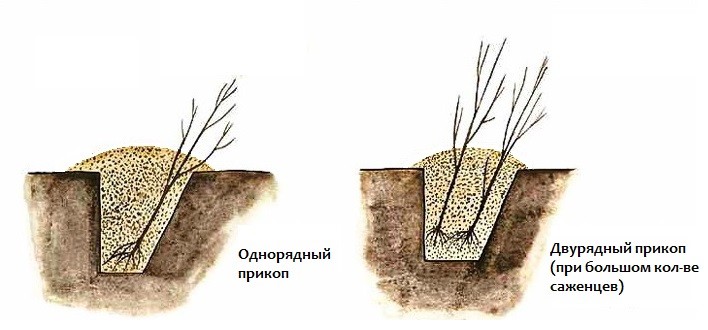 The process of burying a seedling for the winter consists of several stages, and compliance with the requirements for each of them guarantees the preservation of the plant's viability.
 Preparing a ditch
The trench for the trench must meet the following requirements:
- hole width – 30–60 cm per plant, depending on the size of the root system;
- to plant several seedlings, the width of the trench should be calculated at 25–45 cm per plant, with the length direction being from east to west;
- the depth should be 35–60 cm depending on the length of the seedling – 2/3 of its part should fit into the trench;
- The northern side of the ditch should be vertical, the southern side – at an angle of 40–45O in relation to the horizon.
Preparing seedlings
The preparation of seedlings consists of several stages:
- Inspection of the plantIf you find wounds, cracks or broken branches on the bark of a seedling, you should carefully clean the damaged area with a sharp knife and cover it up. garden pitch or white oil paint.
- Leaf pruningMost often, the leaves of autumn seedlings fall off when lightly pressed on cuttingIf this doesn't happen, don't force them out; instead, trim them with pruning shears, 1–2 mm from the stem. This procedure preserves moisture in the plant tissue and increases frost resistance.
- Moisturizing and disinfecting rootsThis is necessary to saturate the seedling's trunk with moisture and protect it from rot. To do this, soak the plant's roots in water for 2-3 hours, then in a pink solution of potassium permanganate (manganese) for 20-30 minutes.
- Preparing and trimming rootsBefore planting the seedling, inspect the moistened root system for damage. Dry, broken, or rotten roots should be carefully trimmed with pruning shears and then sprinkled with wood ash.
If you plan to plant seedlings of several varieties of fruit trees until spring, you should make plastic tags to identify and differentiate them and attach them to the trunk with wire.
Seedlings with a closed root system should be placed in a trench with an intact lump of earth, while it is necessary to inspect the trunk and trim the leaves.
Soil preparation
The soil for planting the seedling should be fertile, loose, and light. To create the desired consistency, mix soil dug from the ditch with equal parts well-rotted compost and river sand.
Instillation
The process of digging looks like this:
- Prepared seedlings should be placed in a ditch at a distance of 25–30 cm The roots should be facing north, and the trunk should rest on a gently sloping south-facing wall. This arrangement reduces the risk of trunk burn.
- Cover the roots with prepared soil, water Warm water to fill air pockets. It's important to avoid overwatering—the soil should dry out before the first frost.
- Fill the ditch with soil to ground level, while it is important to ensure that the tree trunk is covered with soil 15–20 cm above the grafting site.
- Compact the soil in the ditch, pour a mound 7–10 cm high.
In regions with harsh climates (in Siberia, in the Urals and in the north), the trench should be filled 15–25 cm above ground level. The resulting mound protects the roots from freezing.
There's no need to remove 1/3 of the seedling's central core before planting. This pruning should be done when planting the tree in its permanent location in the spring.
Protection from frost and pests
Insulation of buried seedlings should be carried out after the ambient temperature drops to -5 to -7°C. For this purpose, it is best to use a special material such as spunbond or lutrasil. In winters with little snow, the burial site should be additionally insulated by adding and compacting snow.
To protect against rodents, you should use:
- covering the protruding part of the seedling with spruce branches;
- Mandatory compaction of the snow cover around the perimeter of the ditch and at the digging site.
More tips: How to preserve seedlings purchased in the fall until spring
Spring processing
Saplings should be removed from their buried locations in early spring, immediately after the snow melts. Delaying replanting is essential, as the sap flow begins to stimulate the development of new roots, which are damaged during digging and subsequently have difficulty establishing in their permanent location.
The process of spring preparation of a seedling dug in in the fall looks like this:
- To prevent the seedling from rotting, snow should be raked away from its exposed part at the end of March.
- When the temperature remains stable at -5…-7 °C, remove the covering insulating material.
- In early April, or when temperatures reach a stable level of 5 to 10°C, the trench should be carefully dug. To do this, first remove the top layer of soil, then dig under the seedling with a shovel. It's important not to damage the roots or trunk of the tree.
- Remove the seedling and its root ball from the trench. Do not pull it out or try to remove it by rocking it, as this will damage the graft.
- Inspect the seedling's trunk. If there is any damage, carefully trim the bark with a sharp knife and seal it with garden pitch.
- Inspect the roots. Remove any rotted or weak shoots. Soak in a solution of Kornevin, diluted according to the instructions.
- Add fertile soil to the hole prepared in the spring humus or rotted compost, water with warm water.
- Trim 1/3 of the central conductor and plant the plant in a permanent location.
Possible errors
When burying seedlings, it is necessary to avoid mistakes that can lead to the death of the plant:
- Excessive watering or moistening the trunk of the seedlingWhen the temperature drops sharply, moisture turns into ice chunks, which can freeze the root or damage the trunk.
- A small ditchThe main conditions for determining the hole depth are to bury the seedling at least 2/3 of its full size and to dig in the grafting site and the rootstock.
- Absence glaze when instilledThis leads to the formation of voids in which the root system rots when properly insulated, and freezes out in severe frosts.
- Using sawdust as insulationShredded wood readily absorbs moisture, which solidifies when the temperature drops. Therefore, the solidified sawdust that coats an unburied tree trunk damages the bark, leading to its freezing. Furthermore, such compressed material takes a long time to thaw in the spring, which contributes to the seedling's rotting.
- Using dry leaves or straw as insulationRodents that can completely destroy a young seedling overwinter in such places.
- Early insulation with covering material. Leads to damping off of young trees.
Conclusion
In some cases, burying a seedling for the winter is necessary to preserve the plant's life. By following the proper procedure, you can plant a strong and healthy tree or shrub in its permanent location in the spring.