Pruning a Columnar Apple Tree: Diagram and Rules for Tree Shaping for Beginners
Columnar apple trees are an ideal solution for small plots. They take up little space, have virtually no side shoots and a large crown, and their yields can sometimes exceed those of traditional fruit trees. However, even these trees require regular pruning, both for shaping and maintenance.
Content
Correct formation of a columnar apple tree: why is it necessary?
There's a common misconception among gardeners that columnar apple trees don't need pruning because they lack side shoots. However, if that were the case, pruning wouldn't even be an issue. A proper columnar apple tree has a straight, upright trunk with shortened shoots, also called runners. They are positioned at an acute angle to the main trunk. Forming the runners is necessary to prevent the tree from becoming a typical dwarf apple tree with a standard crown.
Incorrectly formed columnar apple trees, the yield drops significantly.
Pruning a columnar apple tree is necessary not only to maintain its aesthetic appearance, but also to prevent branches from becoming tangled, increase fruit yield, rejuvenate the tree, and strengthen young branches.
General scheme for pruning a columnar apple tree
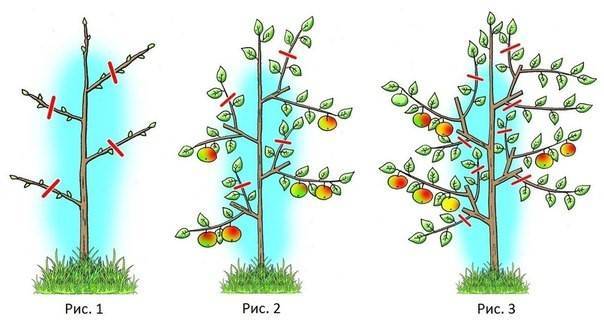 First, it's important to understand the general structure of a columnar apple tree. The central shoot, also known as the trunk, is not subject to pruning or shortening, as it plays a pivotal role for the entire tree. From this central shoot, lateral shoots of the first and second order extend. The first-order shoots are primarily horizontal, while the second-order shoots extend vertically upward and downward.
Vertical shoots of the first order may also extend from the main trunk.
The pruning scheme for a columnar apple tree is as follows:
- In the first year of planting, all shoots are pruned back to two buds. This strengthens the branches and stimulates their further growth and flowering.
- In the second year, first-order shoots are pruned by 30–35 cm. Second-order vertical shoots are left untouched, leaving them for further fruiting.
- In the third and subsequent years of life, the second year pruning is repeated, and shoots that bore fruit in the previous year are also subject to removal.
The central shoot is limited in growth by pinching the top only if its height exceeds 2.5–3 m.
A mature tree in its 5th or 6th year doesn't require further extensive pruning. It will only require maintaining the crown, preventing branches from intertwining, and regular sanitary pruning, removing diseased, old, and spent shoots.
Pruning times
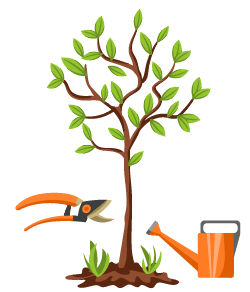 The pruning timing for these apple trees is determined by the variety, the regional climate, and the current year's climate. Apple tree crown shaping can be done in four stages—one stage for each season.
Pruning a columnar apple tree in winter
 Winter pruning is considered the most important part of caring for a columnar apple tree. It's best done in late February, if possible. At this time, all the branches and shoots from the previous year are clearly visible. Due to the apple tree's shape, the lower branches receive insufficient light in the spring and summer.
In winter, fruiting zones are formed by removing the lower branches, leaving the upper tiers for apples. At the same time, old, broken branches and weak shoots are removed, as these weaken the tree and reduce subsequent flowering.
Spring pruning scheme
Spring pruning is carried out before the sap begins to flow during the period of active snowmelt. After winter and spring pruning, columnar apple trees grow faster, and the number of flowers and fruit sets increases.
It's recommended to leave 4-5 buds on each shoot, which will produce the same number of new shoots. This type of pruning is called pinching, and its main purpose is to encourage the emergence of fruiting shoots.
Also in the spring, branches that have frozen over the winter are removed, which contributes to the overall health of the tree and increases its resistance to disease and pest attacks.
In late spring and early summer, growing lateral shoots are removed to regulate the number of branches in the crown. This is necessary to ensure that nutrients are used for fruit formation rather than for the growth of empty, non-flowering shoots.
Summer pruning scheme
During the summer, only new, mature but unneeded green shoots that have not yet formed flowers or ovaries are pruned. These shoots most often grow on the central trunk. These shoots are simply plucked out, as their trunks are very thin and don't require pruning.
Summer pinching or step-sonning of a columnar apple tree must be carried out with care so as not to damage the bark of the main trunk and first-order shoots.
Pruning columnar apple trees in autumn
Autumn pruning is performed to shape the tree's few strongest shoots. At this time, dry, crossed branches, broken shoots, and shoots showing signs of infection or pest damage are removed. Removing this dead wood will help the tree survive the winter more easily. In the fall, new growth that appeared in the summer after the summer side shoots were removed is also removed.
It is recommended to carry out autumn pruning after the sap flow has stopped, not forgetting to treat large wounds. garden pitch.
There are several simple rules for sanitary pruning:
- All shoots that are subject to pruning are removed almost to the base, leaving 0.5 cm from the trunk.
- The cut areas are covered with garden pitch or oil paint.
- Pruning is carried out using disinfected instruments.
Features of pruning
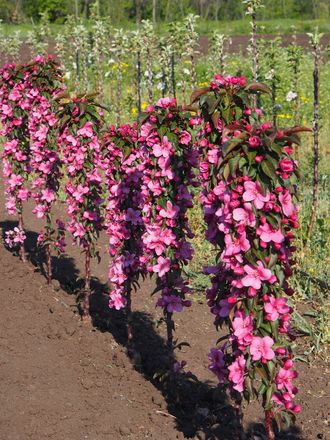 Columnar apple trees should be trained from the first year of planting and continued throughout the season. The older the tree gets, the less frequently it needs this treatment. In young trees, it's important to preserve the apical or terminal bud, which is responsible for the growth of the central trunk.
Damage from frost or pests will stifle the growth of the apple tree's core by young shoots and subsequent buds. The apical bud can only be removed from mature trees that reach a height of 2.5–3.5 m.
If the apical bud does freeze, it's necessary to identify the branch that will become the trunk's continuation. To do this, remove the portion of the main trunk containing the dead bud right up to the new shoot. The remaining branches, level with the new central shoot, are shortened to two buds.
The main mistakes made when pruning columnar apple trees are:
- too long or too short stump after cut escape;
- use of blunt instruments that damage the bark and wood;
- using untreated tools after pruning diseased trees;
- failure to treat large wounds with disinfectant and neglect of putty garden var.
To achieve the perfect cut, you should follow a few simple rules:
- The direction of the cut is from the base to the top and in the opposite direction from the bud.
- Cut is carried out two fingers above the kidney.
- The cut must be smooth, without burrs or nicks in the bark, for which only well-sharpened tools are used.