Ant and other insect trapping belt: protecting garden trees from pests
In spring, not only the buds awaken, but also the larvae and pupae of harmful insects that have overwintered in the soil. With the arrival of warmer weather, they awaken and move to the buds—their main source of nutrition. A pest infestation can leave a tree completely bare of leaves. How can you protect your tree from these uninvited guests? Make a trapping belt.
The larvae of many insect pests overwinter in the soil and fallen leaves, and in the spring, after pupation, they climb back up the tree trunk. Therefore, it's necessary to create a barrier to insect movement. This is the basis for the development of special trapping belts to protect fruit trees from pests.
Content
How and when to make trapping belts
Trapping belts can be purchased in stores or made at home. The traps are set in early spring, in March, and in some regions, in the last ten days of February, before the average daily temperature reaches above zero. Warm weather awakens buds, the primary food source for many pests that overwinter in the soil, so it's important to set the traps before the insects reach their food source.
The traps are removed after the first ground frost. Leaving them on the trees over winter is not recommended, as they can damage the trees.
It is permissible to leave the belt on in regions with very warm and almost snowless winters.
Types and instructions for making
There are many types of trapping belts. They can generally be divided into three broad groups: dry, sticky, and poisonous.
Before securing the belt, it is necessary to remove dry bark from the tree.
Dry
The most popular type of belt is one that creates a mechanical barrier to insect movement. These belts are often constructed using readily available materials, such as plastic bottles, paper, or thick cardboard. The most popular designs include a collar, a funnel, and a double-ended funnel.
Funnel
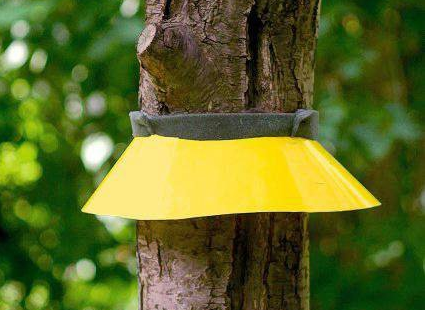 The funnel belt is the simplest, yet most effective, design. It resembles a skirt or a funnel. Insects moving upward crawl into it and are unable to escape. This trap is easy to make:
- A "skirt" with an extension is made from cardboard, paper or a plastic bottle to fit the circumference of the tree.
- The top, narrow part is tightly secured to the tree trunk. For a tighter fit, you can use foam rubber, fiberglass, or polystyrene foam.
Gate
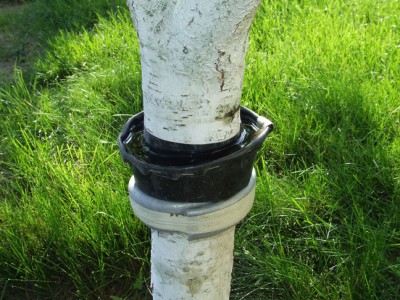 A type of belt designed for descending insects. It is made from a 4-5 mm thick rubber strip slightly longer than the trunk's circumference at a height of 40-50 cm from the ground.
- The rubber band is secured to the barrel, with the edges bent upwards to form a cup or collar.
- The ends of the rubber strip are glued together using glue.
- Any sunflower oil is added inside the collar.
Insects trapped in this trap are unable to escape. Furthermore, the rubber "collar" expands as the tree grows. The trap requires careful attention—insects must be removed promptly and oil must be added regularly.
Double-sided funnel
A double-sided funnel is convenient for its versatility: it traps both ascending and descending insects. It is made from strips of burlap, agricultural fabric, or paper impregnated with insecticide solutions. The belt width should be at least 30 cm.
- The workpiece is wrapped around the belt and tied tightly in the center.
- The top and bottom of the trap are straightened to form a “skirt” and a “collar”.
- The bottom and top of the traps are filled with clay.
Sticky
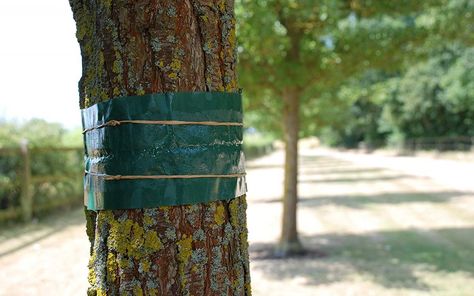 Sticky belts are made using a special adhesive applied to fabric, paper, burlap, or any non-woven material. The adhesive can also be applied directly to bark. The mechanism of these traps is very simple: the adhesive's stickiness and viscosity cause insects to become stuck.
The adhesive retains its properties for a long time thanks to its special formula and polymer base. It is available in tubes, cans, and aerosols. The latter is considered the most convenient, as it ensures an even application of the adhesive onto the bark or substrate. In the case of bark, the aerosol fills all the cracks through which pests can move.
Making the belt is very simple:
- Take a strip of paper, fabric or non-woven material 20 cm wide and slightly longer than the trunk's circumference.
- Apply a 0.2–0.5 cm layer of glue trap to the workpiece and let it dry slightly.
- The finished belt is wrapped around the trunk, overlapping the edges.
A separate type is the oil trap against antsThese insects don't like to travel through oily trails. To create such a belt, fabric or burlap is soaked in any sunflower or industrial oil and secured with twine to the tree trunk.
Poisonous
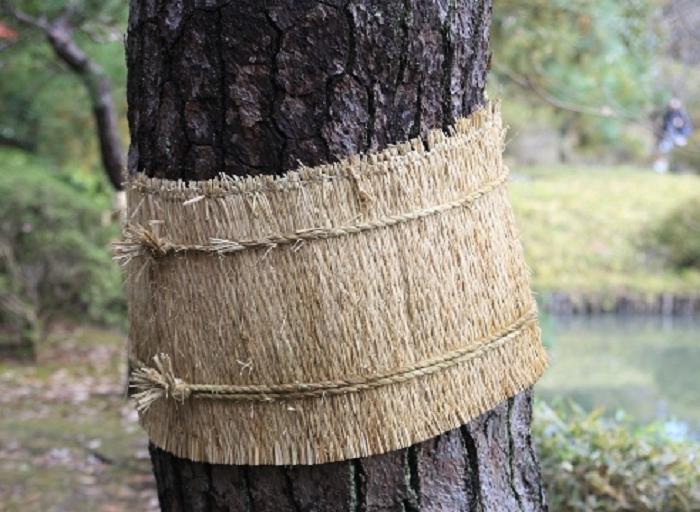 Poison traps contain chemicals—insecticides and acaricides—that negatively impact the vital functions of insects that crawl on them, causing their death. They are effective against many types of apple trees. caterpillars.
- A piece of burlap, fabric or other absorbent material 20–30 cm wide is soaked in a solution of any insecticide.
- The poison belt is fixed half a meter from the ground.
- The upper part is wrapped with any film to ensure minimal evaporation of the substance.
Additionally, a layer of film can be applied under the flap.
How to Use Trapping Belts – Tips from Gardeners
 Experienced gardeners recommend:
- The belts should be secured at a height of 35–55 cm from the base. If the tree's first branching is at this level, the height should be 5–10 cm below it.
- Traps must be inspected at least once every two days, insects removed from them and destroyed.
- Trapping belts are changed as needed, especially adhesive belts: insects quickly stick to the glue, and it loses its sticky properties.
- It is better to combine traps and create two belts - dry and sticky or poisonous in case the insects manage to overcome the first "line of defense".
Advantages and disadvantages of trapping belts
Traps, like any method, have their advantages and disadvantages.
The advantages include:
- environmental safety – traps do not harm the tree or the environment, including poisonous ones, since the substance does not penetrate the bark and is not sprayed into the air;
- ease of manufacture – any belt can be made from available materials in a few minutes;
- high efficiency, especially when creating combined or alternating traps.
The disadvantages include:
- the need to periodically check traps and update them;
- other insects that are beneficial to the tree may die – ladybugs, bees;
- do not help against flying pests - beetles, butterflies, aphids.
Related videos
Conclusions
Trapping belts are a simple and environmentally friendly way to protect trees from insects that overwinter in the soil. There are three main groups of trapping belts: dry, sticky, and poisonous. They cause virtually no harm to the environment; the exception is sticky belts, which can accidentally trap bees, ladybugs, and other beneficial insects.
Unfortunately, such traps only protect against tree-crawling pests and do not protect against aerial invaders such as butterflies, aphids, and flying beetles. Furthermore, the traps themselves are time-consuming and labor-intensive: they must be regularly checked, cleaned of trapped insects, and replaced as needed. However, they are easy to make and inexpensive, making them a popular means of protecting fruit trees from tree-crawling pests and their larvae.