Apple bark beetle and its control
Bark beetle infestation poses a serious threat to orchards. By gnawing through the wood and sapwood, the insect's larvae deprive the apple tree of sap, destroy the trunk, and infect it with pathogenic microorganisms. As a result, the weakened tree stunts growth and ceases to bear fruit. Ignoring this problem will result in a complete loss of the harvest.
Content
Characteristics of the insect
The apple bark beetle is a serious pest that causes damage to orchards. During a peak season, the beetles can completely destroy a mature tree in 1.5 to 2 months.
Biological description
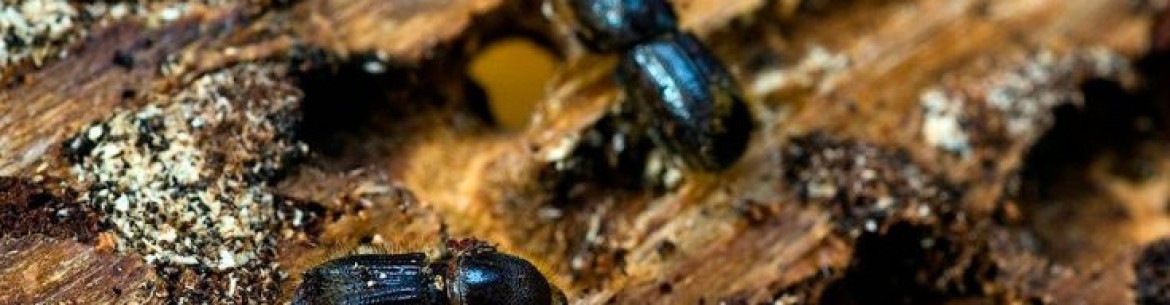
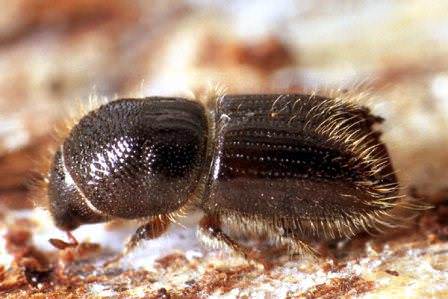 The apple bark beetle (fruit bark beetle) is a small, brown insect closely related to weevils. Its body length does not exceed 4 mm, and its antennae and legs are dark brown. Parallel grooves are visible on its hard elytra.
Having burrowed deep into the bark, the female beetles create numerous tunnels where they lay their eggs. The small white larvae are characterized by a powerful jaw, but lack eyes and legs. The larvae reproduce throughout the year; by the beginning of the following season, they transform into pupae, and by summer, they become fully fledged adults. Throughout this period, they tunnel through the trees, sucking out the sap.
Bark beetles typically infest diseased and weakened apple trees, regardless of their age: they feed on both young and old trees. These pests spend almost their entire lives within the wood, making control difficult.
Life cycle
There are 4 stages of development of the apple bark beetle:
egg -> larva -> pupa -> imago (adult).
The stages of development of the apple bark beetle have the following duration (in days):
- egg – 10–14;
- larva – 15–20;
- doll – 10–14.
 Under favorable conditions, one or two young generations may emerge that same summer. If the pupa fails to mature into an adult by the end of summer, it remains in the tree overwintering and produces its own offspring the following season. Thus, the apple bark beetle can increase its population several hundredfold in a single summer season.
Area of distribution
The geographic distribution of apple bark beetles is closely tied to the territorial characteristics of apple tree growth. The bark beetle is attracted by the smell of freshly cut wood, so the beetle seeks to find newly cut wood. cropped Trees. To prevent pest infestations, promptly remove plant debris after pruning and follow recommendations when treating cuts.
Signs of tree damage
Since the bark beetle primarily inhabits under tree bark, its presence can be difficult to detect immediately. Larvae and adults can only be detected by careful inspection of the tree. However, there are several signs that indicate a tree is infested with bark beetles:
 the appearance of small oval or round holes in the surface of the bark, with a diameter of 2 mm;
- accumulation of a powdery coating of a whitish or brown color at the base;
- drying of individual branches and withering of leaves on them;
- delay in the development of a young tree, absence of new shoots;
- formation of underdeveloped ovaries, cessation of fruiting;
- the presence on the trunk of a large amount of a resinous substance (gum), which has an external resemblance to hardened glue;
- a gathering of birds in the garden, especially woodpeckers.
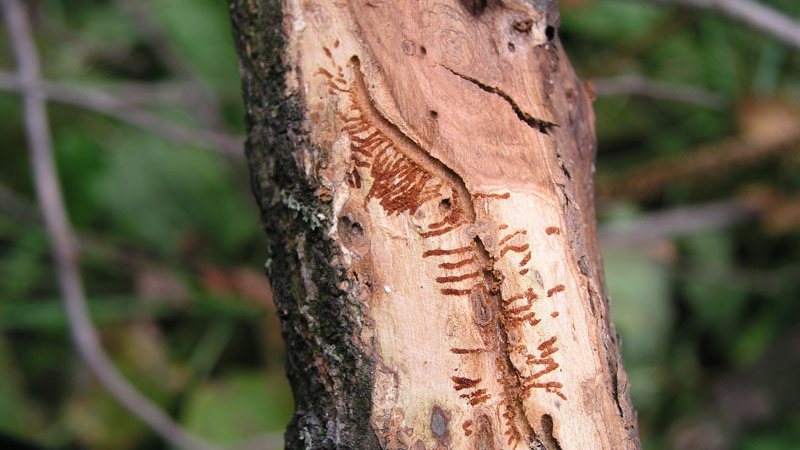 the appearance of small oval or round holes in the surface of the bark, with a diameter of 2 mm;
Signs of apple bark beetle infestation can be seen by making a puncture in the surface of the bark with a sharp object.
The danger presented
The presence of bark beetles on apple trees disrupts sap circulation, which not only inhibits the growth and development of orchard crops but also leads to their death. Adults consume the inner layer of bark before laying eggs. Furthermore, the insect, hatching in a tree infected with fungal diseases, subsequently spreads spores throughout the orchard.
Apple tree varieties resistant to bark beetle infestation
Currently, there are no apple tree varieties resistant to bark beetle infestations. Since the pests prefer trees with weakened immune systems, proper care, including maintenance and pruning, is essential to prevent such attacks.
Methods of combating bark beetles
 Given the insect's lifestyle, controlling it is no easy task. There are several methods for getting rid of the apple bark beetle. The effectiveness of each method depends on the extent of damage to the fruit tree, which can be judged by the color of the mealy masses expelled by the beetles. Specifically:
- A brown coating indicates damage to only the top layers of wood. In this case, any method that kills not only adult beetles but also their larvae can be used to eliminate the problem.
- The formation of a white coating during the bark beetle's life cycle indicates that only the soft layers are damaged. At this stage of the disease, attempts to save the tree are usually unsuccessful, as it is already extremely weakened and exhausted. The optimal solution is its complete destruction: cutting down and uprooting the stump, followed by burning.
If there is a chance of saving the apple tree, they treat it with pesticides, install various repellents and traps, and also use folk remedies to combat the bark beetle.
Use of chemicals
The main advantage of systemic insecticides is their ability to penetrate deeply into wood tissue. To achieve the desired results, they should be used only after the apple trees have finished blooming—the beetle's flight season begins. Experienced gardeners recommend several products that are particularly effective:
- Confidor Extra is resistant to high temperatures and rain washout, has a prolonged action, and is effective against hidden beetles. A drawback of this formula is its toxicity, posing a threat to pollinating insects and humans.
- "Calypso" is characterized by long-lasting action and destroys pests in a short time.
- Pirinex is effective against all forms of bark beetle: adults, eggs, and larvae. It is resistant to high temperatures and is not washed off by rainwater.
- "Arrivo" has a systemic contact effect.
- Bitoxibacillin is harmless to humans and pollinating insects. It effectively kills both adults and larvae.
Rules and sequence of processing
The procedure of spraying with chemicals must be carried out only with the availability of personal protective equipment, which includes:
- gloves;
- special clothing;
- respirator (preferably gas-dust protection);
- protective glasses or mask.
The preparations are diluted in water, following the manufacturer's recommended dosage. The application is carried out in dry, windless weather using a volumetric sprayer equipped with a telescopic wand.
During treatment, apply the insecticide solution generously to the bark of the trunk and branches of fruit trees, paying particular attention to areas with obvious signs of bark damage.
The procedure is repeated after two weeks.
Processing times
To completely rid an orchard of the bark beetle population, it is necessary to carry out all relevant measures in a timely manner.
Before the flowering period
 In early spring, pruning and disposal of damaged branches is recommended. Garden crops also need to be feed diammophoska and whitewash their trunks. Insecticide treatments are not performed at this time.
Caring for faded apple trees
After flowering, the branches and trunks of fruit trees are sprayed with powerful insecticides: this is when the bark beetle begins its flight cycle. If necessary, repeat the procedure after two weeks.
During fruit ripening
During this period, spraying fruit trees with chemicals is prohibited. If previous treatments have not yielded maximum results, cleaning and sealing the air passages with garden pitch, as well as spraying with pesticides, are recommended.
Deadlines in autumn
In the fall, the bark beetle goes into hibernation. After the harvest and leaf fall, sanitary pruning of damaged branches is carried out. whitewash Skeletal branches and trunks. Leaves and branches are to be burned. The trunk circle is treated with "NV-101" to stimulate growth and boost immunity.
At the end August The use of pesticides will be effective, since the pest could produce a second generation during the summer.
How often to spray
The frequency of tree treatments depends on the severity of the infestation, the variety, and the age of the crops. In the spring, spraying is carried out according to basic guidelines. The number of such treatments per season can vary from 2 to 4 times, depending on the air temperature, humidity, and the presence of infestations.
Processing features in different regions
Due to the climate of each region, the formation of green cones and inflorescences on trees occurs at different times. Therefore, bark beetle control measures are carried out at different times in each region, depending on the growing season of fruit crops.
Methods of combating bark beetles without the use of pesticides
Bark beetle control isn't limited to chemicals. There are other simple methods that are safe for humans and the environment.
Traps and repellents
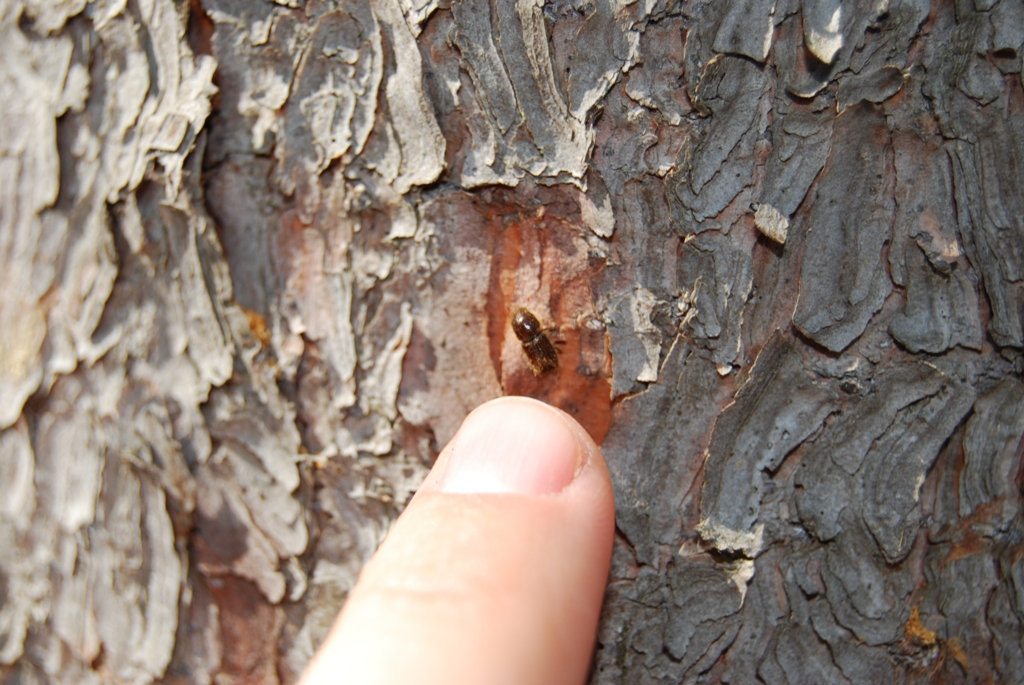 Catching pests during the flight is an effective solution, providing additional protection for apple trees. Traps made from branches left over from pruning are typically used for this purpose. While searching for a home, the insects settle not on living trees, but on dead wood, attracted by the smell of cut wood. After the beetles' flight is over, the traps are burned.
Anti-pheromone repellents, which are tablets impregnated with special substances, are quite effective. These repellents are hung out 7-10 days before the mass flight; the unpleasant odor they emit will repel pests from the garden. These repellents pose no harm to humans or the environment.
The use of pheromone traps is recommended for gardens with an area of at least 5 hectares, otherwise serious damage to trees can occur.
Barrel lubricating
Once the bark beetle has penetrated the wood, spraying and traps are no longer effective. In this case, pest control is achieved by injecting specialized insecticides into the insects' entry holes. This procedure requires a medical syringe and an insecticide such as Confidor Maxi, Calypso, or Tanrek. Afterward, the holes are sealed with garden pitch.
To destroy bark beetles on valuable varieties of fruit trees, it is best to use a professional intra-trunk injection.
Boosting immunity
Since bark beetles prefer to settle on weakened and weakened garden crops, one method of combating them is to boost immunity. To do this, follow a few rules:
- prevent damage to trees;
- perform competent processing of fresh cuts and sections using garden var;
- apply fertilizer regularly;
- provide abundant watering on hot days;
- get rid of weeds growing near apple trees in a timely manner;
- periodically cultivate the soil in the tree trunk circles.
Folk remedies
As an additional pest control measure, homemade solutions can be used; this solution allows for faster results. The following are considered the most popular:
- Carbolic acid (400 g) mixed with soap (400 g) and water (5 l). The resulting mixture is further diluted with water in a ratio of 1:4 and used to spray the garden before and immediately after flowering.
- Oil paint – liberally coat the affected areas with this material. Whitewash works well as an alternative.
A bark beetle infestation in an orchard can lead not only to crop loss but also to the death of the trees. To prevent this, treatment must begin immediately upon detection.