How to choose an apple tree seedling for planting in spring or fall
Choosing an apple tree sapling is crucial. Its quality will determine not only the subsequent development of the tree, but also its survival rate and fruiting. health and much more. Experienced gardeners advise paying attention to young seedlings, as they thrive best in a new location, but this purchase shouldn't be spontaneous. Carefully consider all the details of the purchase, evaluate the planting material according to several important criteria, and choose a suitable planting site. But first things first.
Content
Choosing an apple tree seedling: what to look for
So, you've decided to plant a couple of apple trees in your garden. What could be simpler: go to the store, choose a sapling, and plant it. But, of course, it's not that simple. Choosing an apple tree sapling requires careful consideration, as poor-quality planting material will, at best, fail to thrive, and, at worst, die in its prime, even after all your investment in its health and proper development.
Important factors when choosing planting material:
 Learn the theory and find out which apple varieties are suitable for growing in your region.Many beginners overlook this point when purchasing fruit tree seedlings. A tree unsuited to a particular climate may die before fruiting even begins. In this case, you'll simply be throwing away all your money and resources. If you don't have any experienced gardening contacts, contact any local gardening organization or nursery. All addresses and reference information are freely available online, so you won't get lost. If you're looking for a nursery online, take the time to read customer reviews to ensure you're choosing the right organization.
- Pay attention to the appearance of the seedlingDiseased trees are visible almost immediately upon closer inspection. Look at the foliage, the root system, the condition of the trunk and bark – none of these should show any defects, spots, deformations, or signs of disease. What healthy seedlings look like is discussed below.
- Buy seedlings that are suitable for your garden plotThis is also an important point that many new gardeners ignore. The developmental characteristics of the tree's trunk and root system must be taken into account when planting an apple tree. The choice of planting material depends on the size and layout of your garden.
 Learn the theory and find out which apple varieties are suitable for growing in your region.Many beginners overlook this point when purchasing fruit tree seedlings. A tree unsuited to a particular climate may die before fruiting even begins. In this case, you'll simply be throwing away all your money and resources. If you don't have any experienced gardening contacts, contact any local gardening organization or nursery. All addresses and reference information are freely available online, so you won't get lost. If you're looking for a nursery online, take the time to read customer reviews to ensure you're choosing the right organization.
There are several types of apple trees:
- vigorous (they have powerful roots that lie deep in the ground; mature trees reach 7–8 meters in height, so they will feel most comfortable when the groundwater is at a depth of 3 meters or more);
- semi-dwarf (they grow up to 4-5 meters, they should be planted in areas where groundwater lies at a depth of 2-2.5 meters);
- dwarf (the shortest varieties of fruit trees, which reach a height of 2–2.5 meters in adulthood, an ideal choice for areas with close groundwater flow).
If you see thorns on an apple tree sapling, it's best to refuse the purchase. The seller is likely trying to pass off the wild apple as a cultivar.
Inspection of the rhizome
When inspecting apple tree seedlings in detail before purchasing, pay attention to the rhizome: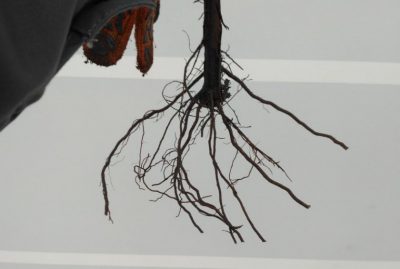
- When cut, the roots should be white. If the color is brown, tan, or black, this is a sure sign of a fungal or viral disease.
- There should be no frozen, dried or deformed elements on the rhizome.
- The root system must be developed and reach at least 30 cm in length.
- There should be no growths or swellings on the plant's roots or stems. If such abnormalities are present, it indicates the plant is suffering from cancer.
Before purchasing, be sure to find out how deep the groundwater is in your area. The seedling's root system should not come into contact with the groundwater, as this can lead to disease, weakening of the plant, and a poor harvest.
We select by age
The age of the seedling is equally important. Young trees thrive best in their new location. So, pay attention to this factor when purchasing and don't delay planting.
Optimal age of a seedling
Most experienced gardeners agree that the ideal age for an apple tree sapling is 1–2 years. Youth is often the key to health and good establishment in a new location. It's best to choose planting material of this age.
We visually determine the age of the seedling
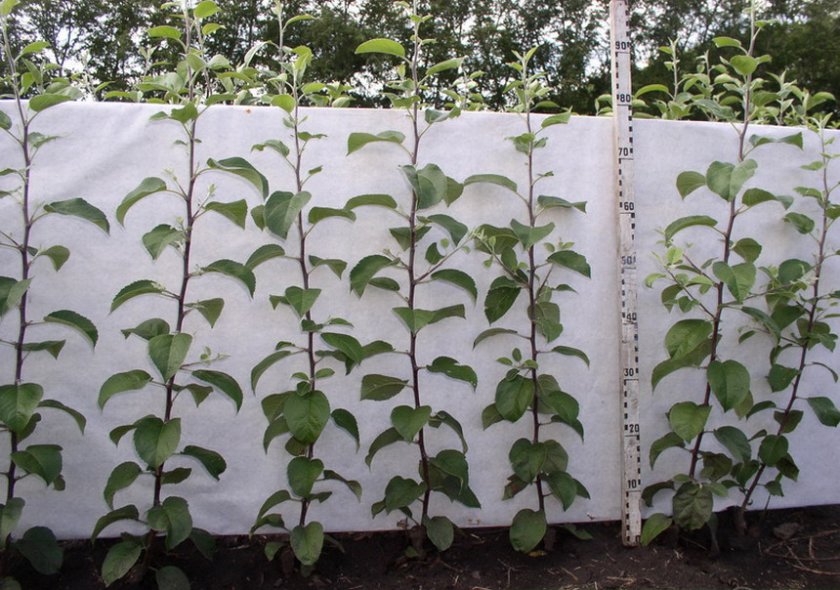
If you've never purchased fruit tree seedlings from a private seller or nursery before and don't know how to determine their age based on external characteristics, consider the following:
Apple tree seedlings that are approximately 1 year old do not yet have any developed branches.
Two-year-old planting stock should already have several additional branches (about 2-3). The branches should grow at different angles.
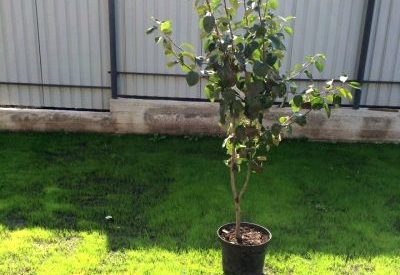
Three-year-old seedlings already have a noticeably developed rootstock, which will need to be severely pruned when digging. Clearly, such a pruning will not be to the apple tree's liking, so when replanting in a new location, the risk of disease, weakening, or even death increases.
External signs of good planting material
Before purchasing an apple tree sapling, you should thoroughly inspect it. It's a good idea to immediately confirm with the seller the exact height and diameter of the trunk.
The height is measured from the ground level to the top of the tree (a regular tape measure or ruler will do the trick). The diameter is measured 50 mm above the graft, so it's best to use a tape measure or calipers.
Healthy and young planting material has a number of characteristics that indicate its quality:
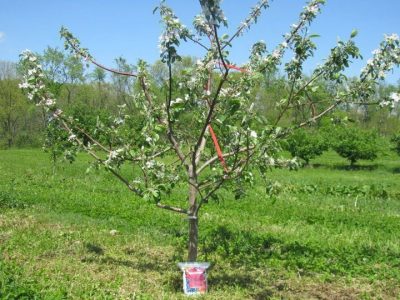
- There should be no growths or damage on the trunk (this applies to both the bark and the wood).
- The rhizome must be developed and healthy, it should not have any dried or rotten elements, spots or other damage.
- The lower branches should be at a height of 40–60 cm.
- If a seedling has an open root system, it should be grown in open ground and dug up only just before delivery to the buyer. Such plants allow you to immediately visually determine the condition of the roots: they should be strong, slightly moist, branched, and elastic. To determine the quality of the roots, simply pull on one. Does it come off easily? This means the rhizome is slightly rotted. Seedlings with open roots should not have leaves upon purchase.
- Planting material with closed root system It takes root better than the previous variety. It should be grown in special containers. When purchasing, pay attention to the rhizome: it should be well protected and show no signs of damage. This seedling will be planted using the transshipment method (i.e., directly with the root ball). Before purchasing, lift and shake the plant slightly: if the container stays in place, this means the rhizome has already grown around it and developed normally.
How to tell if a tree is healthy
Visual signs of a healthy apple tree seedling:
- The rhizome is well-developed, containing at least three large roots and numerous smaller ones. The root system is free of any growths, frost cracks, ulcers, spots, or other defects or damage.
- The tree's leaf blades are green and show no signs of pests or infection.
- The bark throughout the entire seedling is the same shade and does not have any swelling or damage.
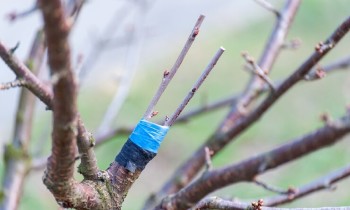
- The seedling must be grafted according to all the rules. The grafting site must be clearly visible.
- The trunk must be free of defects, swelling, growths and other external damage.
Briefly about columnar apple tree seedlings
While everything is more or less clear with classic apple varieties, it's worth taking a closer look at columnar apple trees, as they are somewhat different from standard seedlings.
Columnar apple trees are varieties whose branches are positioned at an acute angle to the trunk. The shoots are so closely pressed against the tree's trunk that the shape of the tree resembles a column (hence the name) or a pyramidal poplar.
We select seedlings of columnar apple trees:
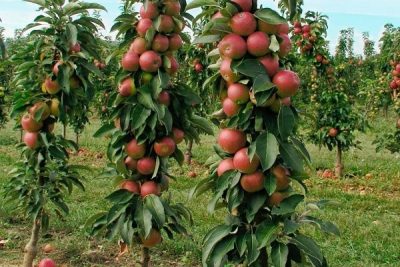
- the age of the cutting should not exceed 1 year;
- the bark of the plant should be absolutely smooth, 5 buds should form on the trunk;
- A graft must be carried out, the trace of which must be clearly visible (a noticeable thickening should be visible in the lower half of the cutting).
It's best to choose varieties with closed root systems for planting. These columnar seedlings are much more resilient to transplant stress and quickly adapt to their new location.
If you decide to go with an open root system, be sure to wrap the seedling in damp burlap when transporting it. When planting, be sure to place it in such a place. cutting in a humid environment for a couple of hours to allow the plant to overcome stress.
Features of columnar apple tree varieties:
- HeightThis figure will directly depend on the specific rootstock used to grow the planting material. Currently, more and more breeders prefer to choose semi-dwarf or dwarf rootstocks for columnar plants. On average, a mature tree reaches 2–2.5 meters in height. Lateral branch growth in such varieties begins only at 3–4 years of age.
- FertilityOne such apple tree can easily yield up to 15 kg of apples. A hectare can yield up to 140 kg of apples.
- Fruiting periodPeak yield occurs at 4-5 years of age. However, the downside is that the plant produces a rich harvest but quickly becomes depleted. By 15 years of age, such apple trees reach a stage where the harvest becomes extremely meager.
- Rhizome. The rootstock has a fibrous rhizome that lies at a relatively shallow depth in the soil. This is why columnar varieties require frequent and abundant watering. water.
How not to confuse an apple tree seedling with other crops
Even experienced breeders can sometimes confuse an apple tree with a pear, plum, cherry, etc.:
- Distinguish You can separate a pear from an apple tree by its buds (since the bark color matches). Pear buds are more pointed, seemingly sticking out, while apple buds are rounder, larger, and more closely adherent to the base.
- Distinguish cherry and apple tree It will be a bit more difficult, since here we will also have to compare it with the wild apple tree. The apple tree has a thicker and more abundant fluff, and also more large budsCherry trees have rounded buds that extend only slightly from the trunk. In this case, the bark color is only worth considering if the cultivar is expected to be light in color. Wild cherry trees have brick-brown bark, and their branches extend from the trunk at a 90-degree angle.
- Distinguish apple tree from plum tree you can the presence of a fringe and more tightly adjacent to the base of the kidney in the first one.
What is the difference between a cultivated seedling and a wild plant?
There are several key characteristics that can be used to distinguish a cultivar from a wild tree. Most of these involve examining the mother tree. The seedlings themselves wild plants have characteristic spines, which are not present in varietal species. However, if you need a more precise definition, please review the three characteristics below.
Along the fork in the tree
 One of the most important signs that indicates that the gardener has a wild plant in front of him is absence of a standardInstead, in the lower part (directly from the ground) there are 2-3 trunks at once (sometimes a cluster of 4-5 trunks can be observed at the same time).
Varietal apple trees have a clearly defined trunk, which develops throughout their growth. If you can't see it, it's either dead or been cut down.
Instead of a single trunk, shoots began to form just below the graft. These usually transform into full-fledged trees very quickly, so some gardeners don't even notice the change.
Following the trail of the "old" tree
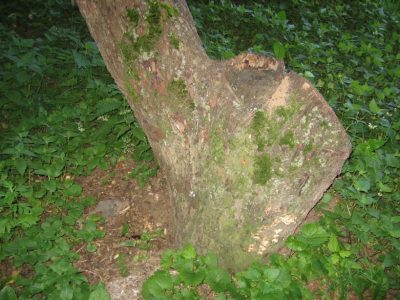 You can also tell if you're looking at a wild apple tree by its remaining stump. If an apple tree trunk grows from under such a stump, it means a rootstock has long since sprouted below the graft.
The stump was likely a cultivar, but when it was cut down, new shoots began to grow underneath. So before digging up the seedling, take a look at the parent tree.
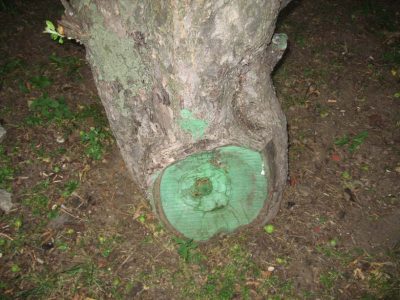
On a single-stemmed wild tree
Sometimes a tree grows as a single trunk, with all its skeletal branches and trunk perfectly aligned, yet it is still essentially a wild tree. This occurs when, after pruning, only one shoot remains from several basal shoots. This single shoot becomes the standard tree.
In order to quickly determine the quality of the apples from such a tree, it is necessary to prune it heavily.
Conclusion
Choosing an apple tree sapling for planting can be challenging, especially if you're new to choosing suitable planting material. Don't rush to the nearest nursery; instead, read the relevant literature, consult with more experienced gardeners, and carefully examine the appearance of the saplings you're looking for. The health and productivity of your future fruit tree will depend on their quality.