When to plant fruit tree seedlings
For every gardener, the cherished dream is their own beautiful and fruitful garden. And it goes without saying how difficult it is to create such a garden in a short time. If you've set this goal, it's important to understand from the outset that all fruit trees and shrubs are perennials, meaning they will only produce a full harvest after 3-5 years of systematic cultivation and care.
It is important to take everything into account here: When to plant fruit tree seedlings, what to feed them with, how to protect them for the winter, and what to treat them with in case of disease. It's worth starting with choosing the planting time. Planning will help you visualize exactly what your garden will look like by the time the first serious harvest arrives.
Content
How to properly plant fruit tree seedlings
Planting fruit seedlings is extremely important. Only careful site selection and proper planting procedures guarantee the plant's proper establishment and subsequent growth and development.
Preliminary preparation of the planting hole
The diameter of the planting hole will directly depend on the specific plant you're planting. If the seedling has a developed rhizome (and the roots will branch out later), you'll need a larger hole and a decent amount of space around it.
The skeletal roots of some fruit crops will eventually begin to extend deeper into the soil. Some can grow as deep as 5–6 meters. However, the fine roots, which are responsible for supplying nutrients and moisture, are located in the upper soil layers. Therefore, the planting hole should be wider than its depth.
How to prepare the landing site:
- Remove the top layer of soil and set it aside.
- Dig out the remaining soil from the hole and remove it from the area.
- Mix the top layer of soil with humus and compost.
- If the mixture isn't light and loose enough, add a little sand. If the plant prefers acidic soil, add a little peat.
- All ingredients are thoroughly mixed and poured into the planting hole.
This procedure should be carried out several weeks before planting the seedlings. This will allow the soil mixture in the hole to settle, ensuring the plant rhizomes will remain at the desired depth rather than being absorbed by the soil.
If the groundwater level in your area is too close to the surface, place a drainage layer at the bottom of the planting hole.
The process of planting seedlings
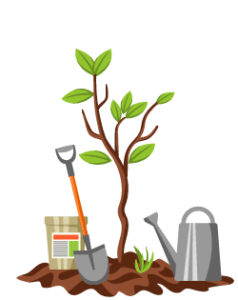 The process of planting seedlings:
- First, a mound of soil is piled up. If necessary, a stake can be installed at this stage.
- The seedling is placed in the center of the hole, the roots are spread out. Next, the rhizome is covered with soil on all sides. The trunk is tied to a stake.
- The soil mixture is compacted so that there are no voids.
- Next, the planted plant needs to be watered generously, and the trunk circle should be covered with mulch.
What is the best time to plant fruit tree seedlings?
The timing of planting fruit trees depends on several important factors. First, the plant variety. Second, the age of the tree is crucial. Third, environmental conditions, such as soil quality, weather, climate, etc., play a role. Fruit tree seedlings are typically planted in spring or fall. Both periods have their advantages and disadvantages, which should be considered.
Spring planting
Spring planting is usually the method of choice for those gardeners living in cold regions. Most seedlings suitable for this climate will have time to establish themselves in the five to seven months of warm weather before the onset of winter frosts.
Planting can only begin after positive temperatures have been established in the region.
Most crops should be planted in the ground before their buds begin to open. This will speed up establishment. Planting later increases the risk of delayed fruiting and slower plant development.
Benefits of Planting Trees in Spring
 Planting seedlings in spring has many advantages:
- Non-winter-hardy crops have time to establish roots during the warmer months, so they won't be at risk of freezing in the harsh winter.
- The gardener will be able to harvest the first crop a year earlier.
- Spring planting of seedlings always proceeds at a leisurely pace, as most gardeners manage to draw up a detailed planting plan during the winter.
- Whether the seedlings have taken root or not will become apparent within a couple of weeks. You don't have to wait the entire fall and winter to find out whether the plants survived.
Disadvantages of spring planting
But spring planting also has its drawbacks, which should also be taken into account:
- The selection of fruit crops is limited, as most plants go on sale in the fall.
- You'll have to spend some time carefully caring for the planted plants. For example, you'll have to water them generously. water, since the root system of some crops may simply dry out.
- The planting window is extremely short. You'll need to plant everything you want when the weather is consistently warm, but the plant tissues haven't yet begun to actively sap.
Which seedlings take root in spring?
Stone fruits take the longest to establish themselves. That's why cherries, sour cherries, apricots, and plums should be planted in the spring. Furthermore, there are a number of non-winter-hardy pear varieties that are only suitable for spring planting.
Some gardeners plant other fruit crops at this time, especially if the soil on the plot is heavy.
Spring planting dates
You can calculate when to plant fruit tree seedlings in the spring based on the characteristics of the specific variety, as well as the regional climate. Don't be late, and don't plant too early either (they could simply freeze during a sudden cold snap).
It's best to choose a period when the warmth has finally overcome the winter cold, but the plants have not yet begun to grow. This is usually the time when soil has already thawed enough. Choose seedlings for planting with closed root system - they take root faster than anyone else.
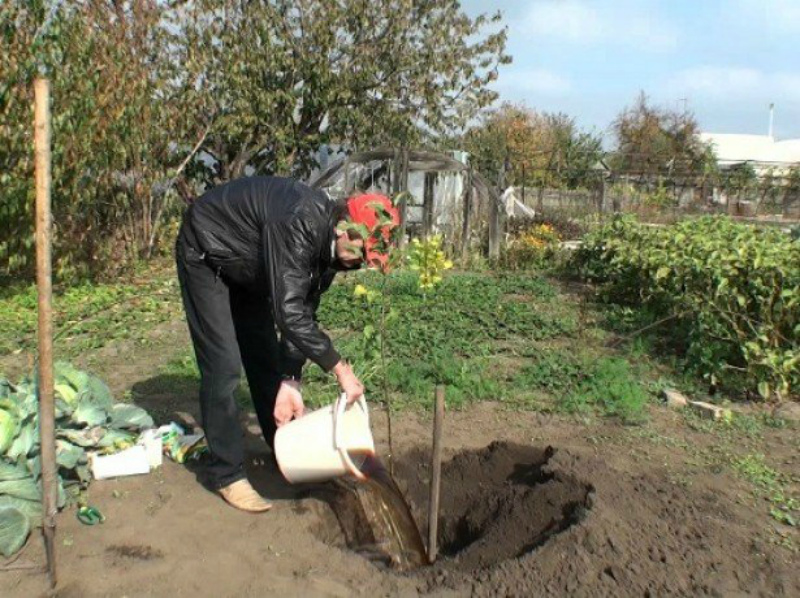
Autumn
Gardeners living in warmer regions typically choose autumn for planting fruit crops. Winters there are typically mild, without any sudden temperature fluctuations or frosts, so even the most frost-sensitive crops will thrive.
Benefits of planting seedlings in autumn
Autumn planting has many advantages:
- A wide selection of seedlings in nurseries.
- You can immediately assess the appearance of the planting material. Leaves remain on it, and the root system is clearly visible.
- The seedlings don't require any special care. It's enough to simply watering and that's all.
- With the arrival of spring warmth in the region, plants will begin developing immediately. They don't need time to adapt, as they have already adapted during the fall and winter.
Disadvantages of autumn planting
Autumn planting also has its significant disadvantages:
- Even in the warmest southern regions, winter can play a cruel joke, bringing frost and snow. Such climate changes will lead to seedlings simply freezing.
- Young plants can be damaged by rodents.
- Many summer residents leave for the city in the fall, so unscrupulous neighbors can simply steal their seedlings.
Which seedlings take root in autumn?
Winter- and frost-resistant crops, as well as those specifically bred for a particular region, thrive best in the fall. Therefore, when purchasing, be sure to check whether a particular crop is suitable for fall planting in your region.
Autumn planting dates
It's best to plant fruit tree seedlings 3-4 weeks before the onset of winter frosts. This will allow the seedlings time to adapt to their new location and establish sufficient roots. In the fall, the rhizomes of the plants continue to grow and develop until the soil temperature reaches 4°C (39°F).
Missed planting time: How to save a seedling until spring
Sometimes, gardeners simply don't have time to plant all their desired plants in the fall, so the seedlings are left to wait until spring. It's important to preserve the plants intact until spring planting. To do this, take the following steps:
- Place the seedlings in a cellar. The temperature in the cellar should be between 0 and 10 degrees Celsius. Be sure to moisten the plant's rhizomes and place them in a bucket of sawdust. Water the seedlings once a week.
- If you don't have a cellar, you can bury the seedlings. To do this, dig a hole 50–60 cm deep and then place the seedling in it at a 45-degree angle. Position the trunk on the south side and the root system on the north side.
- If heavy winter precipitation is normal in your region, you can preserve seedlings in the snow. Wrap the plants in spunbond, then in plastic film. Place the planting material on the ground and cover it with at least 15 cm of snow.
- Seedlings can also overwinter on a glazed balcony or loggia. To do this, place them in a box and cover them with a blanket. Maintain a stable temperature on the balcony (no higher than 10 degrees Celsius).
Choosing the right time to plant fruit crops depends on many factors. Consider the plant variety, the regional climate, the soil quality, and the weather. Only proper planting at the right time will guarantee the plant's survival and normal development.