Apple tree rejuvenation for high yields: rules for rejuvenating pruning for beginners
Apple trees, like any other fruit tree, have a lifespan. With proper care, this can reach 50 years. The tree can continue to grow and bear fruit without problems for up to 25-30 years. When this period comes to an end, the plant stops growing, its fruiting shoots die, and its yield significantly decreases. However, this is not a reason to get rid of the tree. The life of an apple tree can be extended by rejuvenating pruning, which consists of several stages evenly spaced over 2-3 years.
Content
Characteristic features of apple tree aging
Premature apple tree death can be caused not only by drought or frost, but also by improper care, leading to premature aging of the tree. Under such conditions, the first signs of the process appear as early as 25 years of age.
The main signs of apple tree aging:
- Due to the loss of fruiting shoots, skeletal branches begin to become exposed, gradually dying from the center of the crown outward. This immediately affects fruiting.
- The second sign of aging is a decrease in the growth of young shoots. The tree either stops growing completely or grows at a minimal rate.
- At this time, the top of the crown dries out completely.
- Mass dying off of leaf and fruit shoots begins.
- The size of apples decreases and their taste quality deteriorates.
- The appearance of multiple branches on the skeletal branches increases the load on the annual growth, where nutrients are produced. This increased load causes them to shorten and the fruiting branches to dry out.
- The tree is attacked by parasitic fungi and lichens.
Crown treatment and harvesting of apple trees that have undergone premature aging are difficult due to the peculiarities of the fruit placement, which begin to form only on the side or top.
Timing of pruning fruit trees
Since any pruning is stressful for an apple tree, it's important to choose the right time for it. Frosty weather will cause branches to become brittle, and in summer, trees in pruned areas will continue to bleed sap for a long time. the spring and autumn seasons are rightfully recognized as the times with suitable conditions.
Proper pruning before the tree awakens and sap begins to flow will prevent the apple tree from expending much energy on recovery. The wounds inflicted will heal fairly quickly, meaning it will enter the winter season in a renewed state. Autumn pruning should be carried out after the leaves have fallen., which also minimizes the risks to the tree.
Tools for apple tree rejuvenation
Before starting rejuvenating pruning, you need to prepare the following tools:
- Manual hedge trimmer – for thin and medium branches.
- Pruning shears with long handles – for branches with a diameter of no more than 5 cm.
- Folding saw – for branches thicker than 6 cm.
- Pruning shears with telescopic handles – for pruning at height.
Don't forget a small stepladder, a stool, garden pitch and bedding material.
Before starting work, all tools must be thoroughly treated with a concentrated solution of manganese or medical alcohol.
Garden tool cutting edges should be sharpened. Otherwise, the cut edges will be jagged, which will cause the wounds to take a very long time to heal. After finishing work, treat all cut areas with oil paint or garden pitchAnd large branches are additionally wrapped in fabric.
Scheme of rejuvenating pruning of an old apple tree
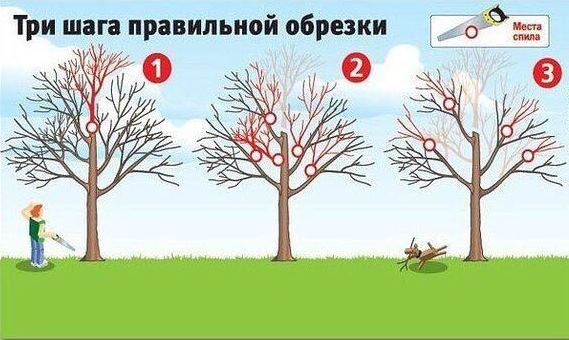 When preparing for pruning, the first step is to inspect the tree for wide cracks, signs of shrinkage or rot, and large hollows. If any are found, rejuvenation is pointless, as a tree with such damage cannot be restored. It would be wiser to remove the damaged tree and plant a new sapling. If the apple tree doesn't have any critical damage, one of three rejuvenation methods can be used.
Step-by-step trimming
The crown structure of an old tree should be renewed over the course of three years in several stages. Each stage should not exceed 30% of the total branch mass. Each year, rejuvenation work is distributed seasonally.
Going beyond these limits can lead to the death of the apple tree.
Autumn rejuvenation of the first season
 In the fall of the first year, all dried and damaged branches within the cut limit are pruned. The resulting cuts must be treated with garden pitch or paint. If the upper limit is not reached, shoots with spots and damaged bark can also be removed. This should be done as close to healthy wood as possible, maintaining a smooth finish. cutOtherwise, rotting is guaranteed to begin in this area in the near future.
The removal of large branches occurs as follows:
- first they are freed from escapes;
- after reducing the mass, they produce saw cut by a third of the thickness at a distance of 1 cm from the trunk;
- completely remove the branch on the ring;
- They select a vertical shoot closer to the trunk and remove the old conductor.
During the entire stage, no more than 3 large branches are allowed to be removed.
Spring pruning of the second year
In early March of the following year, apple tree rejuvenation continues by removing long shoots growing vertically upward. They are pruned to the ring. Fruit can also be encouraged to appear on them. For this purpose, one shoot is left on each branch. top, bending it at an angle of 90° and securing it with wire.
Autumn pruning of the second year
At this time, crown rejuvenation is performed to reduce the intensity of its growth. To achieve this, scaffold branches are shortened on apple trees to improve the light penetration of the underlying branches. Shoot length can also be reduced, but by no more than a third.
After completing this stage, it can be considered that the apple tree rejuvenation has already been completed by 2/3.
Rejuvenation in the third year
At this stage, the remaining unnecessary branches are removed. This group includes large ones spinning tops, which were not adapted for fruiting in the previous stage. At the same time, sanitary pruning and bending of young trees should be carried out. spinning topsWith the arrival of the autumn season, all dried, damaged, and infected branches are finally removed.
Half-cut
This method of fruit tree rejuvenation allows you to remove unwanted branches from the apple tree within two years. During the first stage, the plant is shortened to 3 m, and its crown on the southern side is trimmed to a width of 2 m. The following year, the northern part is shaped in a similar manner.
The most developed shoots are left on the tree at a distance of 70 cm from each other. The cut areas are cleaned and sealed with tar or oil paint. Any cut wider than 5 cm is covered with dark plastic. The cuts are unwrapped only in the fall.
One-time pruning
An extreme method of apple tree rejuvenation, used only in extreme cases. It is also called shock pruning. During a single rejuvenation, do not remove more than half the branches, otherwise this could lead to the death of the tree. With maximum pruning, the apple tree is shortened to the desired height by removing the upper part of the central shoot. Then, all damaged and infected shoots are removed.
Shock rejuvenation is performed exclusively in the spring. Removing unwanted branches in this manner in the fall will inevitably kill the tree.
Sanitary pruning
Besides rejuvenation, there's another procedure that's equally important for apple tree health. This is sanitary pruning, which involves removing shoots that pose a potential threat to the tree's stable growth and fruiting. This procedure is recommended when an outbreak of infection is detected in the area or as a remedy for adverse weather conditions. In this case, the apple tree's crown is cleared of broken or diseased branches, even if their number exceeds the recommended limit.
Sanitary pruning is recommended for fruit trees of any age.
A deep clean of this type is recommended after a frosty winter. Frost-damaged and infected branches are removed down to healthy wood, and shoots are pruned to the ring. Plant debris is incinerated.
Pruning a neglected apple tree
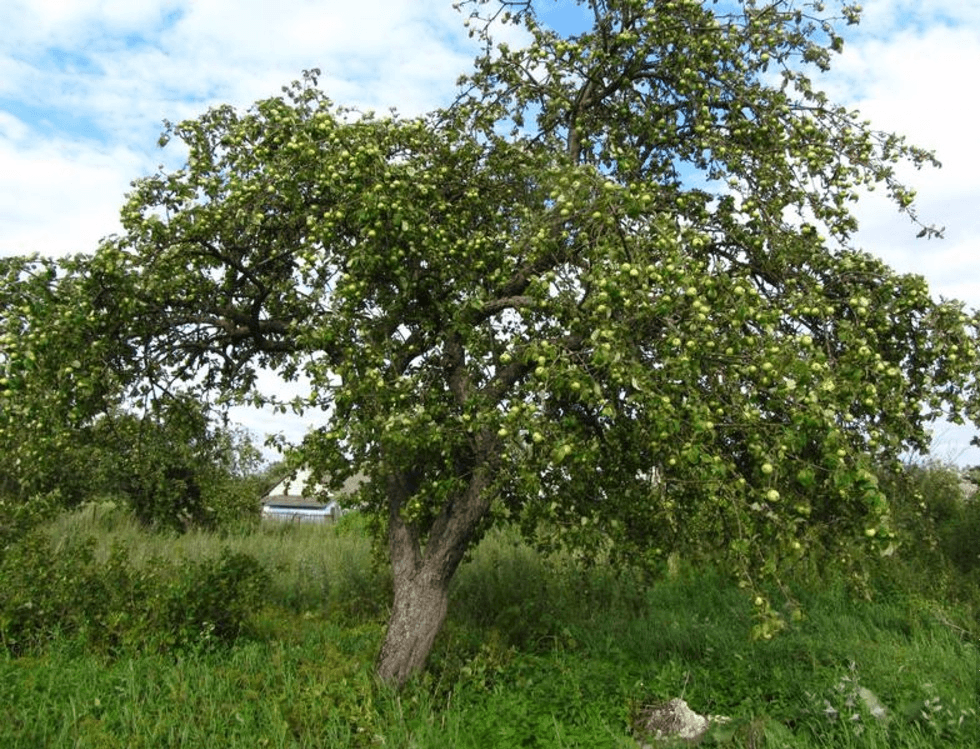 A rejuvenation method developed by European specialists involves renewing the fruit tree's root system. The desired result is achieved by evenly distributing shoots and fruit buds along the branches. At the same time, excess side shoots are removed, and the remaining ones are trimmed back by a third. A properly developed, neglected apple tree is pruned until a single central conductor remains. In weakened trees, only the upper part of the crown is removed.
Neglected apple trees can also be rejuvenated by pruning their fruiting branches. This process is aimed at stimulating the formation of fruiting branches in large numbers. To achieve this, buds are removed from the tops of first-year growth. The following season, these growths will develop lateral shoots, which will produce flower buds a year later.
Fruiting on such branches lasts no longer than six years. After that, they are pruned and transferred to autumn shoots.
Proper rejuvenation of apple trees can extend their lifespan by several years. A tree refreshed in this way becomes more resistant to infection and continues to bear fruit actively.