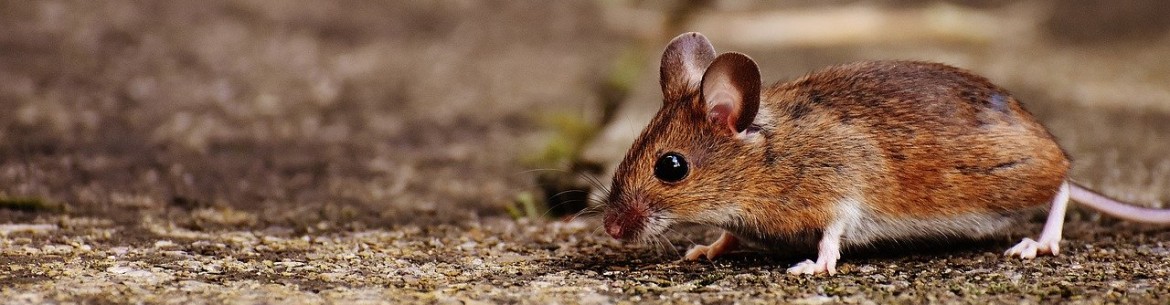
How to save an apple tree if the bark has been eaten by mice: treating the bark and trunk
In the spring, after the snow melts, gnaw marks can be found on the bark of young apple trees – traces of feeding by mouse-like rodents and haresSuch damage causes significant damage to plants and can lead to the tree's death. How can such an apple tree be treated, and can future rodent problems be avoided?
Voles, mice, and other rodents are a common problem in gardens and vegetable plots. Vole and house mouse infestations most often occur in areas with residential buildings, as well as in areas adjacent to fields or forests. Their food supply is severely depleted in winter, prompting them to migrate to orchards, where they actively consume the thin, fragrant bark of young apple trees, causing significant damage to the plants. What should you do if you discover evidence of rodent activity on your trees in the spring, and can the plants be saved?
Content
How to cure a tree
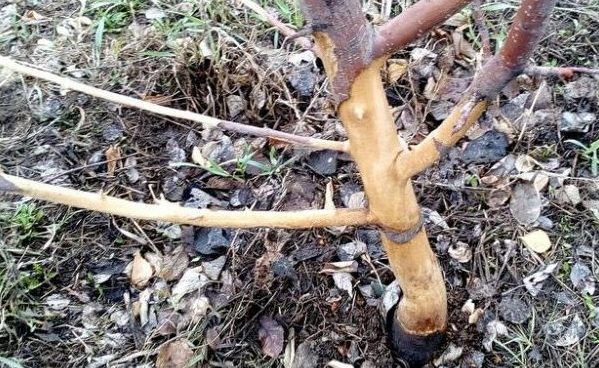 Damage to the bark can be detected immediately after the snow melts. And don't ignore it—even small wounds and gnaws can lead to the death of the entire tree, as they provide entry points for various fungal and bacterial infections. Furthermore, during cold snaps, the bark will crack, and the wounds will increase in size.
If you discover even the slightest evidence of mice infestation on your apple tree, you should immediately treat the tree. The method chosen depends on the gardener's preferences, the extent of the damage, and the age of the tree.
The bark not only serves to protect the inner layers of the trunk, it also performs a conductive function, transporting nutrients through the vessels from the roots to the crown.
Using bandages
Bandages are effective for minor injuries where bark wounds do not heal well on their own and do not affect the inner layers of the trunk. The damaged area is covered with the working compound and wrapped with cotton material or special agrofibre. Beforehand, the wound must be treated to prevent the entry and development of pathogenic microflora and fungi.
Damage caused by mice is often accompanied by fungal infections of the wound, which is why gnaws on the bark require treatment with fungicides.
 It has a good healing effect. clay mashIt's easy to prepare and use, requires no special care, and falls off the wound on its own as the bark grows. To prepare it, you'll need:
- dry clay – 0.5 bucket;
- water.
The clay is poured with water until it is covered by at least 2–3 cm and left for 2 hours until it swells. The clay is stirred periodically until a suspension forms. The mixture is then applied to the wounds with a spatula or brush and bandaged with pieces of cotton cloth or agrotextile.
Small wounds on the trunks can be treated linden decoctionIt will serve as both a healing and disinfectant agent. To prepare it, you will need:
- dry linden bark – 200 g;
- cold water – 1 l.
The bark is finely chopped and covered with water, then brought to a boil and simmered for 40–50 minutes. The infusion is then strained, allowed to cool slightly, and applied to the trunk. Damaged areas are covered with burlap and secured with twine.
Another good remedy is heteroauxin ointment and garden varThe ointment is readily available at most specialty stores. Apply a small amount to the wound, cover with garden pitch, and wrap with a clean cloth. To prevent moisture from getting in, you can additionally wrap the wound with plastic wrap.
There is a special RanNet wound-fighting agent A product for fruit tree bark that also helps with frost cracks and crevices. It promotes healing and rapid healing of wounds on apple tree bark. The product is applied with a small brush and left uncovered, as it forms a thin, water-resistant crust.
A cheap and simple way to treat bites is to treat 3% solution of copper sulfateThe wound is thoroughly soaked in the solution and covered with a plastic film bandage, which is removed only after the first frost.
Bridge grafting
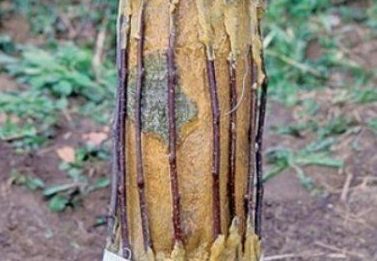 Wound grafting is suitable if the tree trunk has been gnawed all the way around. The sooner the damage is noticed and the sooner the grafting is performed, the more effective the treatment will be.
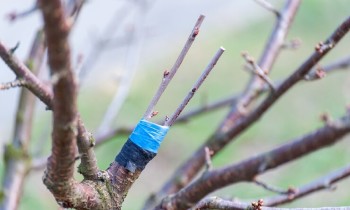
To perform a bridge graft, you'll need root suckers or thin young branches to serve as scions. Before the procedure, the wound is treated with a 1% copper sulfate solution to prevent fungal and bacterial infections. The scion is cut at an acute angle at both ends, and buds are removed from the entire length of the scion. T-shaped cuts are made above and below the damaged bark on the trunk, into which the sharp ends of the scions are inserted.
A young tree may require 2-3 cuttings, an adult tree – 5 or more.
The graft is secured with fabric or agrotextile. Gradually expanding, these graft bridges form a new layer of bark on the trunk.
Grafting of a bark patch
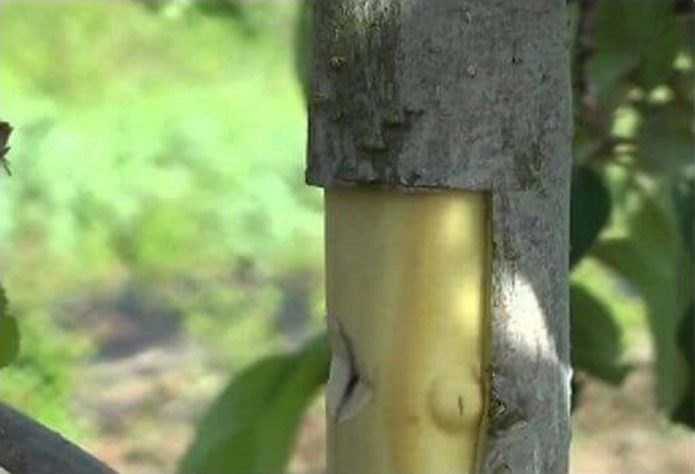 Bark grafting is a complex restoration method and is used when a significant area of not only the upper bark layer but also the subcortical cambium has been damaged. Most often, such damage leaves haresTo create a "patch," you'll need a donor tree from which to cut off some of the bark.
On the selected tree, mark a section of bark slightly larger than the damaged area. Carefully trim the bark with a sharp knife and apply it to the damaged area, securing it with electrical tape.
Correct cut Applying bark to a patch requires a certain skill - it is necessary to capture not only the outer layer, but also part of the inner layer from which cell regeneration will occur.
After removing the bark, the donor site is treated with a 1% solution of copper sulfate and sealed with garden pitch.
Reverse growth cut
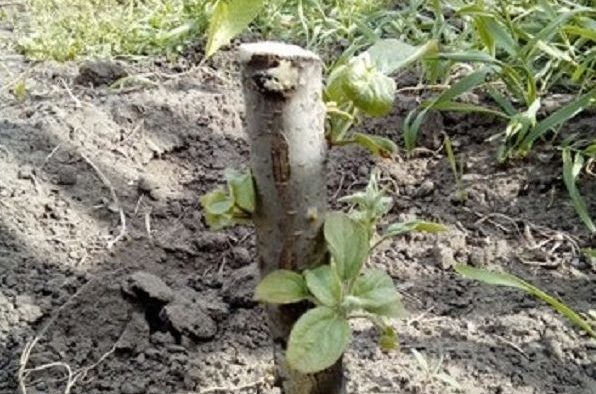 This method is extremely radical when the trunk is damaged beyond repair and at least the root system must be preserved. It is only suitable for trees over six years old, as young plants lack sufficient root strength.
The trunk is cut off below the damage and above the lower bud. saw cut The stump is covered with a thick layer of garden pitch. Once the sap begins to flow, the lower lateral buds will begin to emerge, from which the strongest shoot is selected. The remaining shoots are removed. The new shoot will give rise to a new trunk. The main drawback of this method is that it will take time for the new tree to grow. The second drawback is that the new main trunk will grow slightly to the side of the stump.
The procedure is carried out before the sap starts to flow!
Preventive and protective measures for fruit crops
Of course, the problem of apple tree trunks being gnawed by mice and other rodents It's better to address problems at the preventative stage than to treat the consequences of a pest infestation. Apple tree recovery from damage is very slow and is invariably accompanied by a decrease in yield not only in the year of damage but also in subsequent years.
- First of all it is necessary create unfavorable conditions for mice Throughout the entire area. For this purpose, fallen leaves are removed, as decomposing under the snow produces heat, which attracts rodents to nest and damage the bark. Compost piles are carefully covered, and their placement should be planned in advance, away from apple trees.
- In autumn it is desirable to cut the trunks whitewash lime mortar to a height of 130–150 cm. The lime taste on the bark is not to the taste of rodents. whitewashing It depends on the depth of the snow cover in the area, since mice can make passages in the snow, and hares can make their way to the tree on the crust.
- Tree trunk the soil needs to be dug up Within a 1-meter radius. After digging, do not level the soil, leaving large clods of soil to make it difficult for mice to move on and under the soil. The soil can be covered with sawdust soaked in Sanlizol, or elderberry branches can be placed on top.
- In addition to these odors, mice do not tolerate a mixture of the smell of mothballs and fish oilTo create a deterrent, cotton fabric is soaked in a solution consisting of 1 part naphthalene and 8 parts fish oil. Strips of fabric soaked in the solution are wrapped around the tree trunk or buried in the soil around the tree trunk. Some gardeners spray the trunk with the solution, but it quickly washes away in the rain.
- Can be used spraying with water-based paint or a copper sulfate solution (100 g of dry solution diluted in 10 liters of water). Mice do not tolerate Bordeaux mixture well; you can also treat the trunks with it, using a 1% solution.
- Young plantings can be stored for the winter cover or wrap with thick material – roofing felt, burlap, mineral wool. A mechanical barrier can be created using spruce branches, fine-mesh chain-link fencing, or plastic bottles. The protection should be installed high enough to accommodate the snow depth.
- For those who are not squeamish chemicals and poisonsSpecial poison traps are suitable for this purpose. However, they have a significant drawback: when wet, the poisonous substances easily leach into the soil, so the traps need to be protected from rain and snow.
Mice prefer the bark of cultivated trees only, so some gardeners resort to a trick. To protect their gardens from mice infestations, they graft cultivated branches onto the trunks of wild apple trees, whose bark is bitter and not a popular food source for most rodents.
Video
Conclusions
So, to save an apple tree damaged by mice, it's necessary to properly treat the damaged areas depending on the extent of the damage—its depth and area. In some cases, when the damage has reached deep into the trunk, drastic measures are resorted to, such as cut trunk to grow back.
Rodent problems can be avoided by taking preventative measures early. The trunk can be protected mechanically using coarse material, chain-link fencing, or plastic bottles, or treated with solutions containing unpleasant-tasting or odor-repellent substances. Clean the garden in the fall to create an unfavorable environment for these unwanted winter guests.
It's important to remember that garden protection measures must be taken in combination, as each method has its advantages and disadvantages. Tree treatment measures should be taken as early as possible to minimize damage from rodents.

Comments
Here's how to save a seedling gnawed by dogs
https://www.youtube.com/watch?v=hkusPUNKWM4