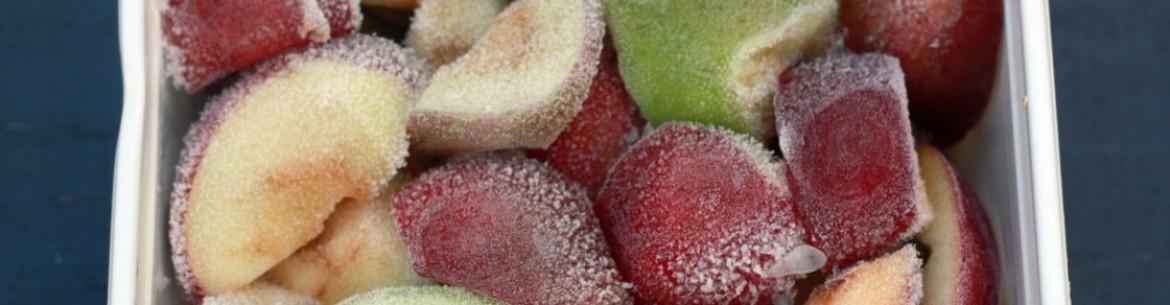
Freezing apples for the winter at home: rules and life hacks
Preserving fruits and vegetables for future use is an important part of preparing for winter. Every housewife strives to provide her family with delicious and healthy homemade produce year-round. Freezing offers a wealth of options for storing fruits and vegetables. By following the simple recommendations outlined in this article, you can delight your loved ones with delicious desserts and baked goods using frozen apples.
Content
Can you freeze apples?
Fruit is preserved for the winter in various ways, one of which is freezing. When certain technological requirements are met, freezing is a fairly effective storage method. However, improper freezing practices can lead to loss of nutritional properties and even spoilage.
Proper freezing preserves up to 90% of the vitamins in apples and helps to preserve all their beneficial properties.
Why freeze apples?
Frozen fruit allows home cooks to prepare a variety of desserts and compotes throughout the year, especially in winter, when our usual garden bounty is seasonally unavailable. Using such fruits is affordable, convenient, and environmentally friendly. Furthermore, towards the end of winter, when a significant vitamin deficiency occurs, even winter varieties of fresh apples begin to lose their vitamins. useful properties, which can't be said about frozen fruit. When exposed to cold, they retain all their vitamin potential, making them an excellent immune booster in late winter and early spring.
Which varieties are best suited?
Any sweet and sour fruit variety is suitable for freezing. After freezing and defrosting, some varieties significantly change their taste and texture. Therefore, if you need to preserve the shape of frozen fruit slices, it's best to use varieties such as Jonathan, Antonovka, Snow Calvin, Sinap, Kutuzovets and other late varieties.
To check if a variety is suitable for freezing, it's recommended to place a peeled apple on the middle shelf of the refrigerator for 10-20 minutes. If the apple begins to oxidize and darken, it's not suitable for freezing.
Required temperature
 Fresh apples are frozen using two freezing methods: dry and shock.
In the first method, the fruit is cold-treated in two stages:
- The sliced fruits are placed on trays and then placed in a freezer with a temperature of at least -23 O for 2–3 hours.
- The frozen pieces are transferred to a regular freezer, where they are stored at a temperature of at least -18 °C.
The second method involves ultra-fast freezing fruit slices in bags using the "Fast Freeze" setting. These fruit preserves can be kept frozen for about 10 months.
Low-capacity freezers are not recommended for freezing and storing apples.
Shelf life of frozen apples
If all storage instructions are followed, frozen apples can be kept in the freezer until the new season, preserving their flavor, nutrition, and health benefits. Furthermore, the shelf life depends on the freezing method and method. For example, at -18°C O Fruits can be stored for up to 9 months. Fruits treated with sugar syrup have a similar shelf life. Puréed fruit can be stored for up to 3 months. If your freezer is not very powerful, the shelf life of fruit is approximately 90 days.
The longest shelf life is for products that are pre-soaked in the solution.
How to freeze apples for the winter in the freezer
There are several methods of home freezing, depending on the future use of the product:
- entirely;
- slices;
- in the form of puree;
- in sugar syrup;
- in citric acid;
- in sugar with lemon.
Whole apples
 Frozen whole apples retain their flavor for up to six months in the freezer. To ensure the fruit is suitable for culinary use, follow these guidelines for freezing:
- The selected fruits are washed and dried, and the core is removed using a special device.
- Prepared fruits are dipped in a solution of ascorbic acid (1.5 g of acid per 50 g of water) for 3–4 minutes.
- The dried apples are placed in special bags intended for freezing, after first releasing the air from them.
- Bags of fruit are placed in the freezer.
In slices
Freezing in slices takes place in several stages:
- The washed and dried fruits are cut into slices, removing the core and stems.
- The sliced apples are laid out in a single layer on trays and then placed in the freezer for 2–3 hours.
- The frozen slices are carefully removed from the tray and packaged in prepared containers (containers or bags), laid out in small portions.
- The container is tightly closed to prevent air and moisture from entering.
- Containers with blanks are placed in the freezer.
Preparing puree
Homemade apple lovers can preserve the fruit for future use as a puree. To do this, wash the apples, peel them, and cut them into randomly shaped slices, removing the stems and cores. The resulting mixture is simmered for 15-20 minutes over low heat. Cool the resulting mixture, then puree it in a blender. Place the applesauce in jars or plastic containers. Store in refrigerator.
When preparing puree for baby food, you can do without using sugar.
Freezing whole
If you plan to bake apples in the oven, you can freeze them whole for the winter. To do this, remove the cores from clean, selected apples, soak them in an ascorbic acid solution for a few minutes, and then place them in airtight bags for storage. Place the whole frozen apples in the freezer.
In sugar syrup
To extend the shelf life of frozen apples, it is recommended to additionally treat them with sugar syrup.
- The washed fruits are cut into slices of any shape, the core with seeds is removed.
- Prepare a syrup from 750 g of water and 450 g of sugar with the addition of 1500 g of ascorbic acid.
- Fruit slices are soaked in cold syrup for 24 hours.
- The candied pieces are either doused with boiling water or blanched, then placed on baking sheets and cooled at low temperatures.
- The preparations are placed in bags and sealed hermetically, after removing excess air.
- Store in the freezer.
In citric acid
Citric acid is a good preservative that promotes longer shelf life. To freeze apples for the winter in citric acid, follow these steps:
- Wash and dry the fruit, cut it into quarters, carefully removing the stem and core.
- The prepared quarters are cut into slices of approximately the same thickness.
- Prepare a solution of citric acid at the rate of 5 g of powder per 1 liter of water.
- The fruit slices are dipped into the resulting solution for 15–20 minutes, after which they are dried on a paper towel.
- The slices are laid out on a tray (baking sheet) in one layer so that they do not touch each other.
- The blanks are placed in the freezer, set to quick freeze mode for 3 hours.
- Frozen slices are placed in bags or containers, which are carefully tied (closed) to prevent air from getting inside.
- Further storage takes place in the freezer.
In sugar with lemon
Fruit frozen this way can be eaten as a stand-alone dish or used as a filling for sweet pastries. Clean apples are sliced, dipped in a mixture made from 1 cup of sugar and the juice of 2 lemons, and gently mixed. The fruit is placed in containers and stored in a freezer, where it can be stored for about a year.
Frozen apples are a tasty and healthy product. When frozen correctly, they retain their nutritional properties year-round. This method of fruit preservation is convenient, affordable, and easy to prepare. It allows you to add variety to your daily diet during the cold season and provide it with essential vitamins.






Comments
If you freeze late varieties, then after freezing the apple will taste like a whole apple, as if it was baked and + juicy.