
Antonovka apple tree: characteristics of the variety and care
| Color | Yellow , Greens |
|---|---|
| Ripening season | Autumn |
| Size of apples | Large |
| Taste | Sweet and sour |
| Crown type | Tall tree , Average tree height |
| Shelf life | High shelf life |
| Application | Universal variety |
| Winter hardiness | High winter hardiness |
| Fruiting age | From 5 years old |
 History of origin and regions of growth
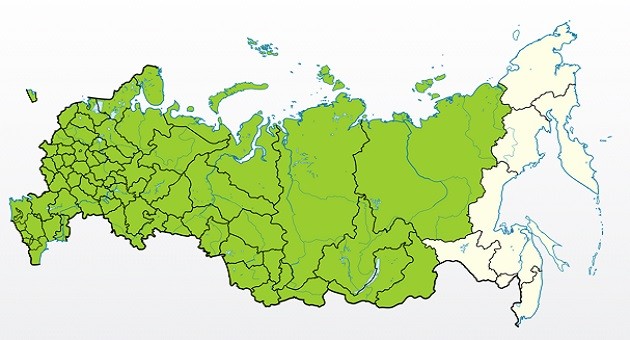
Growing regions
- All regions except some areas.
Origin
Antonovka is considered an ancient Russian variety, known to pomologists for over 300 years. Its origin is believed to be in the Kursk region (province). In fact, experts say it is an unplanned and unexpected hybrid between a common wild apple tree and an unknown cultivated variety, the history of which has been lost.
Legend has it that the variety's name derives from the gardener who first cultivated these apples during the reign of Tsar Ivan the Terrible. He was a "Latin" (most likely Roman) named Antonius. Today, the variety is listed in international registries under the name Antonovka.
The first mention of the variety appears in the book "Rules for Fruit Growing in Open Ground, Greenhouses, and Hothouses" by breeder Nikolai Alekseevich Krasnoglazov in 1848. However, there are also earlier references, for example, in church chronicles.
Content
Description of the apple tree variety Antonovka
 This variety is one of the most popular in our country. It is highly valued for its high yield, flavor, and fruit size, as well as its undemanding cultivation conditions. Antonovka apples account for over 60% of all canned apples and similar apple-containing products, and are actively grown on an industrial scale throughout virtually the entire country.
Apples: color, size, weight
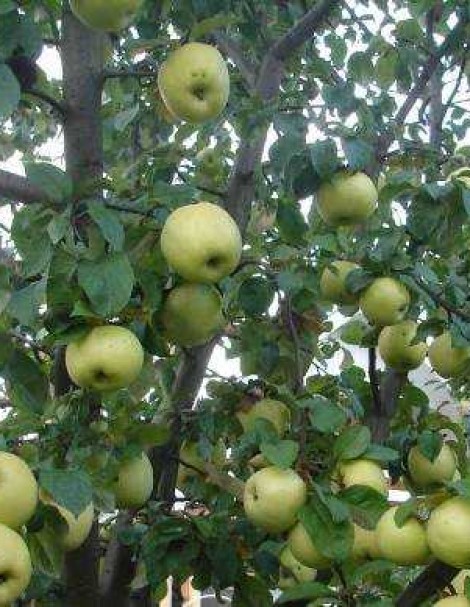
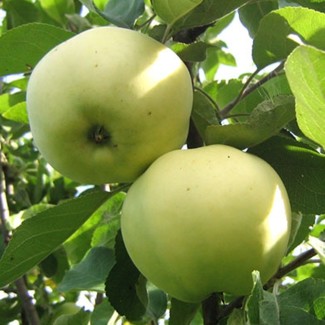
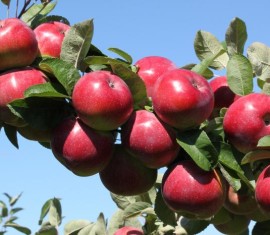
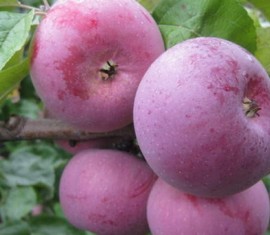
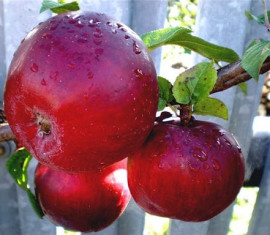
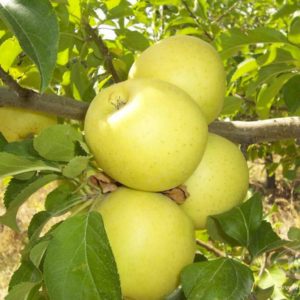 Antonovka apples are typically medium to large (150 to 300 grams) and round, sometimes slightly flattened. They are lightly ribbed, with the ribs clearly visible along their entire length. The Antonovka's skin is smooth, firm, and pleasantly green, turning yellow as it ripens, with little to no blush. The chemical composition is characterized by the following indicators per 100 grams of product:
- P-active substances – 327 milligrams.
- Ascorbic acid (vitamin C) – 17 milligrams.
- Tannins – 40-41 milligrams.
- Pectins (fiber) – 8-16%.
- Fructose (total sugars) – 9.22%.
- Titratable acids – 1%.
The fruit's flesh is dense, firm, juicy, and crunchy. It has a distinctive sweet-and-sour flavor and a very powerful aroma, which has earned the variety its exceptional reputation. The official tasting score is 5 out of 5.
Antonovka apple tree: characteristics
Crown and root system
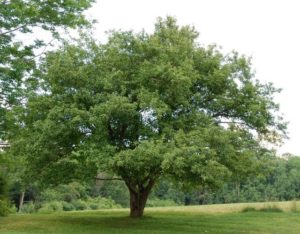 The average height of a tree is directly dependent on the rootstock on which it is grown. Crown It typically has a very vigorous, oval-shaped branch when young. Over the years, it becomes spherical and spreading. Its large, strong branches require no support, even with fairly large harvests. Some trees at maturity can occupy quite large areas up to 9-10 meters in diameter.
The shoots are predominantly geniculate with smooth, brownish bark that becomes rough and brown over time. The trunk can become very large in diameter, to the point that an adult cannot grasp it. The strength, depth, and branching of the rhizome depend on the rootstock. Particularly dense roots are observed at diameters up to 1.2 meters and depths of 60-70 centimeters. This ensures a long lifespan (up to 80-120 years) with consistent, abundant harvests. Scientists have found fruiting specimens 170 and even 200 years old.
Productivity and pollination
The variety is not considered self-sterile, meaning it doesn't require pollinators from other varieties to produce fruit. However, the harvest in this case is meager, so it's common to plant Antonovka apple trees in close proximity to apple trees with suitable flowering times. The fruits hold tightly to the branches even when very overripe. Careful attention must be paid to timely harvesting, otherwise the fruit may rot.
A mature apple tree can produce at least two hundred kilograms of fruit, and in some cases up to 450-500. The record is 1 ton, 200 kilograms, of apples harvested from Antonovka in one season.
Winter hardiness and disease resistance
If there's a paragon of winter hardiness among apple trees, it's definitely the Antonovka, as this tree easily copes with low temperatures. It survives even at temperatures as low as -50°C. That's why it's commonly grown throughout our country, including the Far East and Siberia.
When propagated by cloning, a variety passes on all its winter hardiness and productivity characteristics to clones, and sometimes even in an improved form.
Antonovka doesn't have any special immunity to scab or powdery mildew. However, many gardeners, especially beginners, claim the opposite. It's all about proper care and preventative measures that prevent the development of diseases. If done correctly and promptly, these and many other problems can be easily avoided. Moreover, the variety is much more resistant to garden rot.
Subspecies and rootstocks
In his work, Russian biologist Mikhail Vasilyevich Rytov describes seventeen subspecies of the Antonovka variety, and Michurin already gives designations for 26 species.
Subspecies
The state database of the "Commission of the Russian Federation for Testing and Protection of Selection Achievements" lists only 7 main subspecies, of which it makes sense to highlight three main ones.
| Subspecies | Description |
| Common, white or Mogilev | It produces medium to above-medium-sized fruits (120-200 grams). It is distinguished by its pointed crown and yellow fruits, sometimes covered with a light pinkish blush. It is very frost-resistant and stores well. |
| Dessert | Developed by Isaev from the Antonovka obyknovnaya and Pepin saffronny varieties, the apples are green, sweet, and large (up to 200 grams). They may have a reddish blush that occupies a small area of the fruit. They have excellent shelf life, but their tasting score is only 4.3 out of 5. They are less frost-resistant. |
| Golden, golden monk | This subspecies is considered early ripening, producing fruit as early as late summer. It lacks the rich flavor and aroma of the Antonovka apple, and also has a much shorter shelf life. However, this is more than compensated for by the size of the fruit, which averages 170-250 grams, and can reach as high as 270 grams. The apples have a beautiful golden-yellow hue, hence the name. |
Rootstocks
| Rootstocks | Peculiarities |
| Dwarf | Examples of such rootstocks include MM109, No. 25-111, and MM-106. These trees grow to 2-3 meters, significantly simplifying harvesting. Full yield is achieved between 8 and 15 years of age. |
| Semi-dwarf | This rootstock yields larger fruits, but the tree itself will also be much taller, reaching 3-5 meters. Harvesting begins in the 3rd or 4th year, with peak fruiting achieved by the age of 12. |
| Creeping or dwarf | With these options, you can achieve the lowest possible trees, which makes it possible to grow Antonovka in Siberia, in the Far East or UralsThe fruits are slightly smaller, only 80-120 grams, but this is more than compensated for by the apples' extreme frost resistance and shelf life, which retain their flavor and aroma until spring. |
Antonovka is not found on columnar rootstock, although pomologists continue to experiment.
Features of growing Antonovka
 Landing
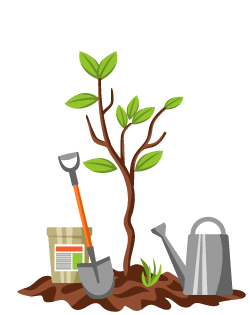 Landing
Basic conditions
- The site should be dry; the variety dislikes stagnant water. Groundwater levels less than 2.5 meters are also not ideal, as is the shore of an open body of water.
- For spring planting, the site must be prepared before winter, and for autumn planting, 1.5-2 months in advance.
- Dig holes 60-70 centimeters deep and 90-100 centimeters in diameter. Mix one-third of the soil with fertilizer, backfill, and add 2-3 buckets of water (20-30 liters). It's a good idea to add a little sand to clay soil when planting, and a small amount of clay to sandy soil.
- Leave at least 4-6 meters between trees, preferably alternating them with pollinators.
- Drive in stakes for tying immediately, which are removed approximately 2-3 years after planting.
- Place the seedlings in the holes, cover with soil, gently shaking to eliminate air pockets, and lightly compact the soil without packing it too hard. The root collar should protrude 5-7 centimeters above the surface.
- After planting, the trees are watered with 20 liters of water and mulched with manure, preferably horse manure.
Antonovka has a very useful property: it's undemanding of soil conditions and produces fruit well in almost any soil. However, loamy or sandy loam soils are best.
Landing dates
It's best to plant Antonovka in the fall, but you'll need to plan for at least 25-35 days before the first frost. Therefore, the best time to plant is late September or early October, depending on your climate zone. When planting in spring, the trees should be planted before the end of April, when most plants are still sapless.
Protection from frost and rodents
Antonovka is considered an extremely winter-hardy variety, so it requires virtually no frost protection. However, first-year plants, especially those planted in the fall, are best wrapped in burlap or surrounded by spruce branches.
Every fall, be sure to whitewash the trunks and lower skeletal branches with lime to protect them from fungi and pests. It's also a good idea to coat the trunks with lard or grease over the winter to prevent rodent damage.
Tree care
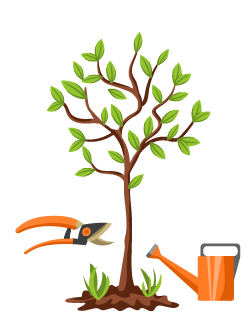 Tree care
Loosening the soil, watering: proper agricultural technology
Any cultivated plant requires soil loosening, but this variety requires significantly less attention than others. Simply digging around the trunk in the fall is sufficient. It's also a good idea to remove weeds or root suckers, and promptly remove fallen leaves and fruit.
Watering can be done depending on the weather, but it's crucial not to overwater. A good rule to follow is the so-called ten-day rule. It states that if it rains, there's no need to water the trees for the next ten days. If, however, natural moisture returns during this period, the watering schedule should be moved back another ten days.
Pruning: simple crown shaping
In the first year, seedlings don't need pruning, but in the second year, you'll need to shorten the main trunk by one-third and prune every third young branch. Train the crown so it doesn't become overly dense; this will ensure a faster, more abundant harvest.
Sanitary pruning is performed starting in the third year after planting the seedling in open ground. This involves removing all dead, diseased, dry, or damaged branches. This type of pruning can also help shape the crown as needed: palmette, prostrate, sparsely tiered, tiered, or spindle-shaped. It's a good idea to regularly perform rejuvenation pruning every 4-5 years, removing 2-4 mature branches.
Pollinator varieties
Reproduction
- Growing from seeds.
- Grafting (rootstock) by buds or cuttings.
- Layers (clones).
Diseases and pests
- Scab.
- Powdery mildew.
- Garden (fruit) rot.
- Green aphid.
- Fungal diseases.
- Codling moth.
Up to 95% of pests and pathogens can be destroyed by timely treatment with fungicides and insecticides in the spring, before flowering.
Ripening and fruiting of Antonovka apple trees
The beginning of fruiting
 The beginning of fruiting
Many sellers claim that seedlings begin to bear fruit in fairly large quantities as early as 3-4 years after planting, but this is a marketing ploy. Until approximately 6-8 years, you won't be able to harvest more than 4-15 kilograms of apples from a tree. Cloned apple trees begin bearing fruit earlier, while those grown from seed or on rootstocks begin to bear fruit a little later.
Flowering time
This variety, like others of its kind, blooms mid-late. It begins blooming in mid- to late May, but in some regions it can linger until early June. It produces large white flowers, sometimes with a pink or slightly purple hue, that exude a strong, distinctive fragrance.
Fruiting and growth
This apple tree's growth rate isn't very high; young saplings can grow only 6-8 centimeters per year. Full yields typically don't occur until ten years have passed. Even fairly old trees (50-60 years old) can produce over half a ton of flavorful apples. The apples can be stored until the next harvest.
Top dressing
- Urea is applied before the tree blooms, approximately in April or early May.
- It is better to apply nitrogen fertilizers to the soil during apple ripening.
- Phosphorus and potassium fertilizers are applied in the fall, only after the harvest has been fully collected.
What to do if it doesn't bloom or bear fruit
- Trim old, diseased or dry branches.
- Check for pests and diseases.
- Reduce watering.
- Transplant to a more fertile or drier area.
Why do apples fall?
- Excess moisture.
- Diseases.
- Pests.
- Natural phenomena.
Don't forget to leave your feedback on Antonovka in the comments to share your experience with other gardeners.





Comments
An excellent variety. My grandfather planted Antonovka apples, and I adore them. The apples themselves are delicious, firm, and juicy. They make delicious compotes, pastilles, and jam. You can even make a flavorful compote from the peels, tinted with wine. To prevent Antonovka apples from getting sick in the spring, I spray the leaves with a solution of 20 drops of iodine per 10 liters of water. I store them in thick paper, wrapping each apple in the paper.
One of the most undemanding and productive apple trees. We have a whole orchard of Antonovka apples. The apples are delicious on their own, plus they make excellent pastila. And this variety practically doesn't notice the cold of our temperate climate…
I currently have two trees of this variety. They have a sweet and sour taste, a pleasant aroma and scent, and when they're marinated in cabbage… you can't pull them away by the ears! They produce a good yield and store well. I'll now whitewash the trunks in the fall, as described above, to protect them from fungi and pests. Thanks for the info.
Antonovka is a wonderful variety for jam and compote—there's nothing better. It's one of the best varieties for processing.