
Apple tree Black Diamond: characteristics of the variety and care
| Color | Black |
|---|---|
| Ripening season | Autumn |
| Size of apples | Large |
| Taste | Sweet and sour |
| Crown type | Average tree height |
| Shelf life | Average shelf life |
| Application | Fresh |
| Winter hardiness | High winter hardiness |
| Fruiting age | From 5 years old |
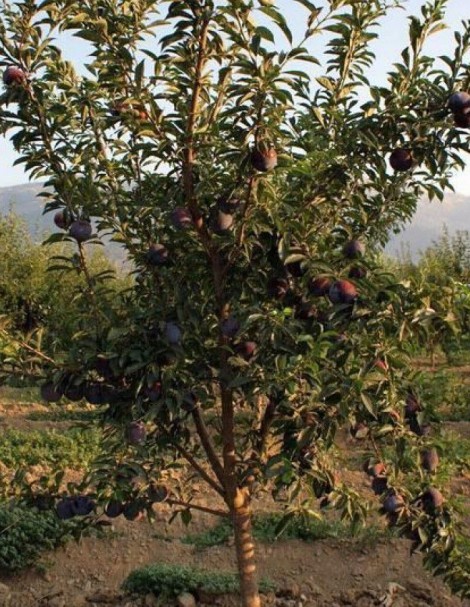
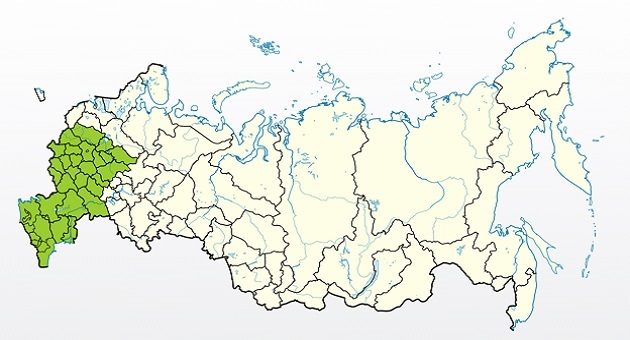 History of origin and regions of growth
Growing regions
This unique variety is grown almost exclusively in the Tibetan highlands. However, it is undemanding and frost-hardy, so it could easily be grown in many regions of our country.
- Middle zone.
- North Caucasus.
- Crimea.
- Some northern regions.
Origin
It is believed that the variety, known as Hua Niu or Hua Niu, was first imported to China from New Zealand around 2009 or 2010. The Tibetan apples were so unusual that they immediately caught the eye of consumers, causing quite a stir. Around the same time, a huge orchard was established in the mountains of Nyingchi Province, where the apple trees could receive ample warmth and light.
Around 2015, the amazing fruit first appeared on markets in the Chinese cities of Guangzhou, Beijing, Shanghai, and Shenzhen. The variety was listed as Black Diamond, and each apple was sold individually wrapped. The price of this fruit remains around $18-25. Seedlings were not sold abroad until an unknown British amateur gardener managed to grow one from a piece of a petiole. Therefore, if you really want to find one, it's still possible, although not easy.
Content
Description of the Black Diamond apple variety
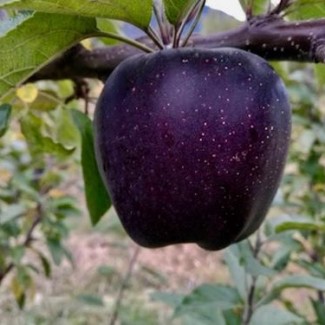
 This unusual, dark purple apple thrills most lovers of exclusive fruits. It truly looks like it came straight out of a fairy tale about Sleeping Beauty and her seven faithful dwarf friends, along with a witch. Add to this its high yield, long life, low maintenance, and enviable frost resistance, and the tree will become a welcome addition to any garden.
Apples: What they look like
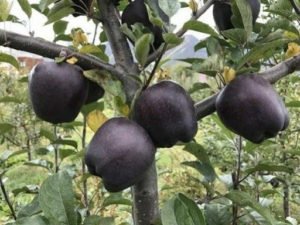 The fruits are very large, larger than average. They can weigh 250-300 grams, sometimes even more. They are round, sometimes slightly elongated, uniform, and have distinct ribbing. The skin is smooth, glossy, and very shiny, with no oily or waxy coating. It is dense, making the fruit easy to transport. It has an unusual, deep purple hue, sometimes even shading to a dark, plum-like hue. There is no blush. Subcutaneous spots are numerous, gray or greenish-gray, and clearly visible on the surface.
According to experts, the unusual pigmentation of the fruit may be caused by high levels of ultraviolet radiation during the day, as well as sharp and noticeable temperature fluctuations at different times of the day. Therefore, in other regions, the skin may not develop such a rich, dark purple hue.
The fruit's flesh is snow-white, fine-grained, very juicy, aromatic, and prickly. The skin may have a network of dark red or reddish-purple veins. The flavor is considered balanced, dessert-like, and harmonious. It is tart and sweet, leaning heavily toward sweetness with a distinctive hint of tartness. According to expert tasters, the apples score 4.9 for flavor and 5 out of 5 possible points for appearance.
Apple tree Black Diamond: characteristics
Crown and root system
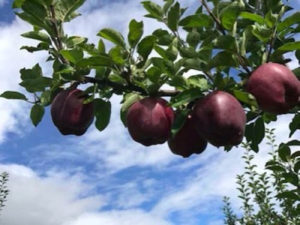 The tree is considered medium-sized, as it grows to a height of approximately 3-4 meters, no more. Moreover, Chinese gardeners believe that pruning them, limiting their growth to 2.5-3 meters, is absolutely necessary. This greatly simplifies maintenance and harvesting. Crown Most often oval or broadly oval, it becomes spreading and sometimes weeping over the years. The tree's shoots are straight, not very long, and covered with greenish-brown or brownish-steel bark.
The leaves densely cover the branches; they are medium-sized, oval, and have a short, pointed tip. They are matte, leathery, and dense, with coarse ribbing. The leaf margins are heavily serrated, crenate, and wavy, and can fold into a boat-like shape. The root system is highly branched and deeply buried, adapted to seeking moisture at great depths and growing in mountainous terrain.
Productivity and pollination
This tree is considered a high-yielding fruit tree. Chinese experts say that one mature tree can easily yield up to 150-180 kilograms of unusual black-purple apples during the growing season. However, official information on this matter from our professional gardeners is not yet available. Moreover, the tree is not known for its early fruiting, so there is no news yet from amateurs who already have these unusual apple trees in their gardens.
This variety is self-fertile and doesn't require any other apple trees for pollination. In the Tibetan mountains, they grow at altitudes where there are no other varieties of these or any other fruit trees for miles. This is considered a unique feature of the Black Diamond. It requires plenty of ultraviolet light and pollinating insects, which it attracts with its powerful, pleasant aroma, and nothing else.
Winter hardiness and disease resistance
Mountain-grown apple trees tolerate temperatures as low as -35°C to -39°C, requiring minimal shelter. They tolerate strong winds and are even tolerant of drafts, although they can become diseased if the wind is constant. The key is to provide them with plenty of light throughout the growing season, and the trees will thrive.
It's believed that the Brilliant apple tree isn't very susceptible to the apple fungal infections common in our region and is rarely affected, if ever. While there's no definitive and reliable information yet, there's hope that the situation will be rectified soon. Pests also seem to avoid these apple trees, but it's still a good idea to take preventative measures.
Rootstocks and subspecies
This variety is grown on a clonal standard rootstock; our gardeners do not have any other experience yet.
Features of growing Black Diamond
 Landing
 Landing
Basic conditions
- The main requirement for planting this variety is open, sunny spaces. Only with good light for most of the day will you be able to achieve good yields. Moreover, this light should be provided from the first years of growth.
- There's no significant difference in soil type, but it's best if it's loose and well-drained. Trees may refuse to flower and bear fruit in overly fertile soil, so it's best to dilute the black soil with river sand and loam.
- Pay attention to the groundwater level; it shouldn't be too high. Apple trees have extensive root systems that tend to extend deep into the soil. This can cause rot, which will kill the tree.
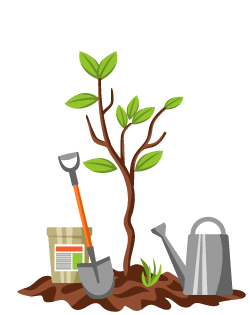
- Planting holes for apple trees are prepared well in advance of the planting season, but 2-4 weeks is sufficient. Dig holes approximately 60-80 centimeters deep and up to 1 meter in diameter. Next, fill the holes with a mixture of half a bucket of fertile topsoil and 1 cup of superphosphate. Then, lay a layer of coarse drainage material on top, such as gravel, rocks, or broken brick. The entire area is filled with 45-60 liters of water and left outdoors until planting time.
- Root collar leave above the surface approximately 5-9 centimeters.
- The seedling is placed in the hole, covered with soil, then compacted by hand, and a small earthen bank is created around the hole's perimeter. Approximately 25-40 liters of water are poured inside, and the surface mulch suitable materials (compost, manure, chopped grass).
If the area around the trunk subsides over time, you can add fertile soil. Just be sure not to mound up the tree, as this can encourage rooting higher up. root collar.
Landing dates
Black Diamond seedlings are currently only available in closed-root varieties. This means they are stored with a root ball in pots or bags that require no further disposal. Therefore, they can be planted at any point during the growing season. Experts recommend postponing planting until fall, when the leaves have already fallen, but there are at least 2-3 weeks left before frost.
Protection from frost and rodents
The variety is considered very resistant to low temperatures and can easily withstand temperatures as low as -35-40°C. However, it is still worth covering apple trees for the winter, especially in the harsh conditions of the central zone, the Leningrad region, and Moscow regionIt's enough to cover the root zone with mats of dry grass, and wrap the trunk with burlap, agrofibre, or old women's tights.
Rodents usually do not damage trees of this variety and insects avoid it, but you still should not forget about precautions. Therefore whiten The trunks need to be pruned at least twice a year to a height of 1-1.3 meters. It wouldn't hurt to coat them with lard or grease for the winter.
Tree care
 Tree care
Loosening the soil, watering: proper agricultural technology
It never hurts to loosen the soil around the root zone to allow oxygen to enter. Digging the area around the trunk is only necessary once a year. Hoeing the soil more frequently is acceptable, while also removing weeds, shoots from other plants, and root suckers.
Watering Plants don't require critical watering under normal rainfall conditions. However, if the weather is excessively hot and dry, watering can be applied approximately 4-6 times per season. 35-45 liters per tree, applied twice (morning and evening), is sufficient.
Pruning: simple crown shaping
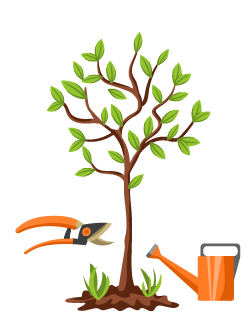
Young trees from nurseries already have formed skeletal branches and a central conductor. All that remains is to maintain the desired shape, while removing inward-growing shoots and spinning tops, sticking out vertically.
Despite the tree's low maintenance, sanitary pruning is still essential. Dry, damaged, or diseased branches need to be trimmed regularly.
The trees do not require pollinators to produce a harvest, are not susceptible to diseases, and are propagated only in specialized nurseries.
Ripening and fruiting of the Black Diamond
The beginning of fruiting
 The beginning of fruiting
It's a long wait for these apple trees to bear fruit; they're not exactly early-bearing. Fruiting begins around 8-10 years, depending on climate and weather conditions. Furthermore, don't expect all the fruits to be uniformly dark; they can be crimson or purple, and sometimes even purplish.
Flowering time
Like most apple trees, the Brilliant blooms in May, but the exact timing will have to be determined experimentally. This will largely depend on the climate and weather conditions of the growing region. The flowers are usually very large, pink, and fragrant.
Fruiting and growth
Apple trees grow quite quickly, especially before they begin bearing fruit. They can reach 35-55 centimeters in a year. However, their active growth then slows slightly, to about 25-30 centimeters per season. Fruiting increases rapidly, and by the 12th to 14th year, they can harvest a full crop of unusual, delicious fruit.
In our climate, harvesting should begin around mid- to late September, with the latest harvest date being early October. The fruits should be picked as soon as they reach technical maturity, becoming crisp, sweet and sour, pleasantly juicy, and pleasantly tender. They can be stored for 2-3 months under suitable conditions, transport well even over long distances, and are recommended for fresh consumption.
Top dressing
- Superphosphate.
- Mineral complexes.
- Ammonium nitrate.
- Compost.
- Manure.
What to do if it doesn't bloom or bear fruit
- Check for pests and diseases.
- Transplant to a sunnier location.
- Limit watering.
Why do apples fall?
- Overripe.
- Natural factors.
- Pests.
- Diseases.
Leave your feedback on the unusual Black Diamond variety to share your experience with others and knowledge.

Comments
An excellent variety, and most importantly, not fussy. I remember there was a very hot and dry summer. The apple tree survived it without a problem and produced a good harvest... And the way it blooms... words cannot describe! The aroma fills the whole area...
It's wonderful that there's an apple variety like Black Diamond, and it's probably quite rare considering the fruit. The apple tree's coloring is fascinating. I also like that it's resistant to gusty winds, and a single mature tree can yield up to 180 kg of these unusual fruits.
A perfect variety. I only hear about it more often under the name "Black Diamond." I know that in China, for its unique color, large size, and flavor, they sell the apples individually in gift packaging. It's a shame I haven't been able to find these seedlings in our region.
What's so perfect about it if it has such demanding planting and weather conditions that we don't have, and fruiting takes more than 10 years? And we won't get that color without sun!!!
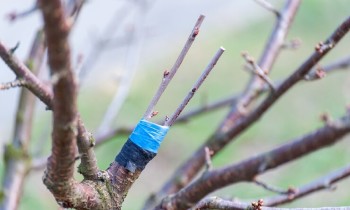
Undoubtedly, one of the Black Diamond's advantages is that it's self-pollinating, which is very important. A major drawback of this variety is its late fruiting, and the apple's color is still somewhat unfamiliar. I'd certainly like to learn more about its flavor. Otherwise, such an apple tree would only be suitable for growing in the garden as a rare and unusual specimen. For example, I'd like to graft it onto a dwarf Sapper, as I prefer low-growing apple trees in the garden.
Nowadays, people have actually grafted different varieties together, but this one just won't let me rest with its coloring; I've simply fallen in love with it. They're considered the most expensive now, but they're large and delicious.
This is a fantastic variety. The first fruiting yielded large, healthy apples, maybe not black, but weighing around 200 grams each. And this is in the Leningrad region!
Can you tell me where I can buy this variety without being cheated?
Could you please tell me what year the tree produced its first apples? I'm from the Leningrad region, too, and I planted a tree like that.
Hello, could you please tell me something? I planted this tree about four years ago. It's very beautiful, the leaves and flowers are all fantastic, but the apples on it are the size of a thumbnail. I don't understand why. I live in Crimea, where it gets plenty of sun, and the apples are indeed purple. But they're tiny. I'm already kicking myself and the seller for lying about the apple size. If they'd said it was decorative, I would have bought it anyway. But I would have planted it somewhere else. Otherwise, the tree is very beautiful. I just want bigger apples 🙁