Apple tree Skala: characteristics of the variety and care
| Color | Reds |
|---|---|
| Ripening season | Autumn |
| Size of apples | Large |
| Taste | Sweet and sour |
| Crown type | Average tree height |
| Shelf life | Average shelf life |
| Application | For recycling , Fresh |
| Winter hardiness | High winter hardiness |
| Fruiting age | From 5 years old |
 History of origin and regions of growth
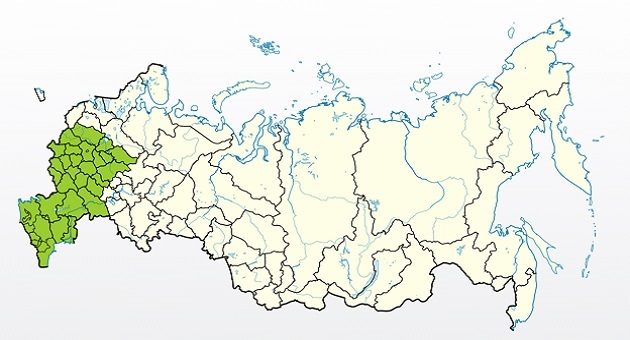
Growing regions
- Middle zone.
- North Caucasus.
- Crimea.
- Some northern regions.
Origin
This relatively new apple variety was bred specifically to delight gourmets and fruit connoisseurs with a completely new and unusual taste. Research on it began at the I.V. Michurin Federal Research Center in the late twentieth century, and the Skala variety was developed by Nikolai Ivanovich Savelyev, a renowned Russian plant breeder. Prima and the famous Michurin Bessemyanka were used as parent varieties.
In 1994, the first seedling was sent to various farms across the country for field trials. The apple tree, with its distinctive fruit flavor, was a hit with many, and it was soon considered an elite variety. In 2001, the Skala variety was zoned for the Central Black Earth Region and included in the State Register of Breeding Achievements. In fact, it is grown throughout the central part of the country, in the Moscow and Leningrad regions, in Crimea, and in the Caucasus.
Content
Description of the apple tree variety Skala
 New apple varieties, including this one, usually possess some unique characteristic that makes them popular among gardeners worldwide. The Skala variety has several such characteristics. Firstly, the plants are winter-hardy enough to withstand the harsh and variable weather of our country; secondly, the apple trees produce very high yields, and the fruit boasts truly record-breaking levels of vitamin C (ascorbic acid). Furthermore, the apple trees possess the Vf gene embedded in their DNA, which gives them disease resistance and immunity to all five races. scabiesRecommended for growing in small garden plots, as well as in intensive commercial gardens.
Apples: What they look like
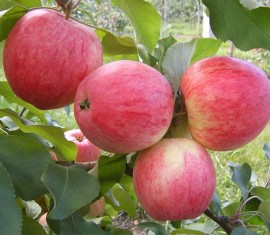
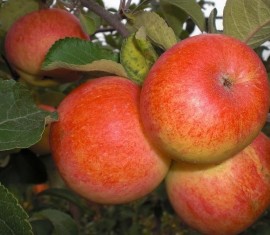
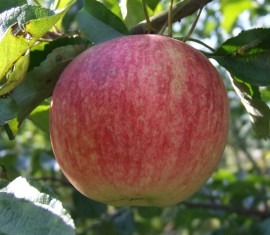
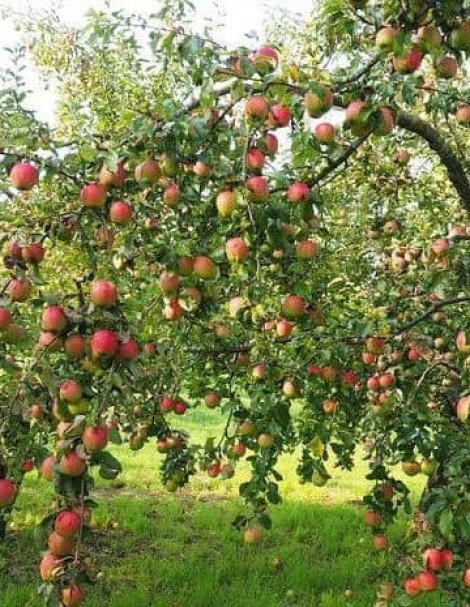
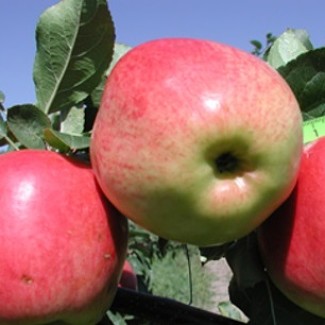
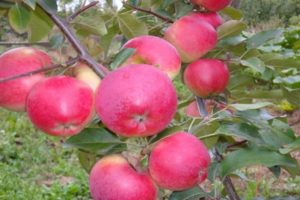 The fruits of this variety are large to very large, averaging 200-220 grams and reaching 280-300 grams. They are regular, elongated and rounded in shape, mostly uniform in size, with a smooth surface and slight ribbing, which is almost imperceptible to the naked eye.
The skin of unripe fruits is green, becoming greenish-yellow or even lemon-colored as they ripen. It is smooth, glossy, and dry, with no signs of an oily or waxy coating. The underlying blush is carmine-red or bright scarlet, diffusely dotted and streaky, and covers approximately 75-90% of the surface. Subcutaneous punctures are small, numerous, light, light gray, or greenish in color, and clearly visible. The original chemical composition is best characterized by the following indicators per 100 grams:
- P-active substances (catechins) – 201 milligrams.
- Ascorbic acid (vitamin C) – 8 milligrams.
- Total sugars (fructose) – 12.4%.
- Pectins (fiber) – 14.7%.
- Titratable acids – 0.63%.
The flesh is crisp, medium-dense, tender, and pleasantly sweet, with a characteristic tartness, a light white-lemon or slightly creamy hue. The flavor is considered dessert-like, harmonious, and balanced. According to professional tasting reviews, Skala received 4.8 points for appearance and 4.2 points for taste out of a possible 5.
Apple tree Skala: characteristics
Crown and root system
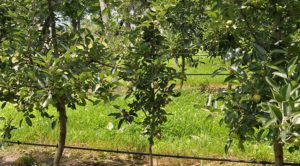 The tree of this variety is considered to be of medium height, although in fact it can reach 6-7 meters in height without pruning.However, gardeners, by shaping the crown, limit it to just 3-3.5 meters, as this makes harvesting and maintaining the standard much easier. When young, the crown is oval or rounded-oval, but with age it becomes spreading, possibly even weeping. It has a moderate degree of density, and most shoots branch off from the main stem at an acute angle, which is considered a disadvantage of the variety. The shoots are long, straight, covered with grayish or grayish-brown smooth bark with slight pubescence. Fruiting is concentrated on the spears, as well as long and medium-sized fruiting branches.
The leaves are medium-sized, rounded-elongated, or slightly oblong, with a long, pointed tip. They are green or light green, leathery, glossy, shiny, and dense, with delicate ribbing. The leaf margins are finely serrated, serrate, and may be raised, as if folded into a boat. The root system is medium-deep, branched, and may or may not have a central taproot.
Productivity and pollination
The variety is considered high-yielding, although with such “dinosaurs” as Antonovka there is no comparison to him.
In a single season, a mature tree can yield approximately 105-120 kilograms of fragrant and delicious fruit. The current record is 180 kilograms, harvested in 2014 at a farm in the Lipetsk region..
Skala is considered a completely self-sterile variety. Therefore, if there are no other apple trees within 50-100 meters of the area that bloom at the appropriate time, no fruit will be produced. For this reason, it is common to interplant them with different varieties to ensure cross-pollination. It's a good idea to locate orchards near bee farms or to bring mobile apiaries to the plantings during the blooming period.
Winter hardiness and disease resistance
Rock can be considered very resistant to low temperatures. It can easily withstand temperatures as low as -42-45°C if properly prepared for the cold season. In southern regions, such as Crimea or the Caucasus, standard trees require no shelter at all, but they do not tolerate drafts and sudden temperature changes. In harsher conditions, proper frost protection is essential to avoid damaging young seedlings.
As mentioned earlier, the variety has a genetic immunity to scab, and to all its varieties. Therefore, it's completely immune to this disease, as are many other fungal apple diseases. However, the apple tree also has dangerous "enemies," such as bitter pit and fruit rot, which can frequently and extensively affect trees. Therefore, it's a good idea to treat them with fungicides in a timely manner, as well as insecticides against insects that can damage not only the leaves and fruit, but also the bark and wood.
Rootstocks and subspecies
This variety is considered new and is most often grown on the clonal rootstock hybrid seedling 54-118. Semi-dwarf and even dwarf varieties can also be used. Yield, winter hardiness, and growth are generally identical to the parent plant. There is no columnar subvariety of the Skala variety.
Features of growing Rocks
 Landing
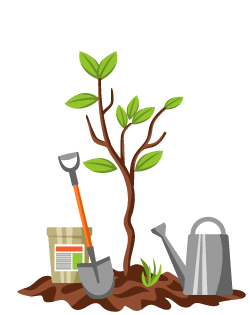 Landing
Basic conditions
- Apple trees prefer open spaces that are well-lit throughout the day, so avoid choosing a planting site in the shade of taller plants, building walls, or fences.
- Drafts can be fatal for young trees, so it's important to ensure the area is protected from them.
- The variety doesn't have any special soil requirements, but it should be neither too acidic nor too salty. Black soil mixed with river sand, loam, and sandy loam are suitable.
- It's not recommended to plant apple trees where the groundwater level is excessively high, a maximum of 2.5-2 meters. Avoid planting Skala near open bodies of water (ponds, rivers, lakes), wells, marshy areas, or low-lying areas where meltwater accumulates in the spring. Otherwise, the root system of the plants may begin to rot, resulting in their death.
- When planting, keep in mind that the tree has a long active lifespan and, over time, becomes spreading and even weeping. Therefore, the distance between trees should be at least 4.5-5 meters, otherwise, their crowns and rhizomes will clash in the future.
- It's customary to prepare the holes in advance, preferably in spring or fall. To do this, dig them 80-90 centimeters deep and 1 meter in diameter. A layer of fertile soil, mixed with a small amount of organic or mineral fertilizer, is placed on the bottom. A drainage layer is added on top, the entire thing is filled with water, and left outdoors.
- Staking stakes made of metal or wood are immediately dug in or driven into the ground. The seedlings are tied to these stakes and left there until approximately 2-4 years after they begin bearing fruit.
- Before planting, the trees themselves are inspected; all dry, damaged, or diseased root shoots are cut off with garden pruning shears and soaked in warm water for 4-6 hours.
- Place the seedlings vertically in the holes directly on the drainage surface, supporting them with your hand. Cover with soil, compacting it gently. Water with 35-45 liters of water, and mulch the surface with compost or humus.
Landing dates
Rock trees are usually planted in the fall, when their survival rate is best. Around late September or early October, when the leaves have already fallen but there are still at least 3-4 weeks before frost, is the most suitable time. However, planting can also begin in the spring, around March or April, before the buds begin to open. Trees with closed root systems can be transplanted into open ground at any time during the growing season.
Protection from frost and rodents
In regions with a mild climate and generally good weather, there's no need to cover trees. However, with other options, you'll need to take care to prevent the trees from dying, especially until they're fully established. Place mats of straw or dry grass around the root zone, and wrap the trunks with roofing felt, burlap, or agrofibre. Young trees can be covered using a tent-like method.
To repel insects from the bark or root zone, trees are whitewashed with lime to a height of approximately 1.2-1.5 meters. To repel rodent pests that chew young, tender bark in winter, the bark is coated with grease or lard. Commercially available products available at gardening stores can also be used.
Tree care
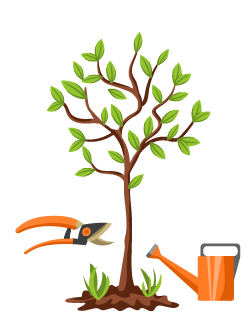 Tree care
Loosening the soil, watering: proper agricultural technology
You don't need to loosen the soil around the Skala tree's trunk often. It's enough to dig the area once a year and hoe it a few times, removing weeds, root suckers, and other plant shoots. In the future, the entire root area can be covered with turf, which will prevent such problems, and then you won't need to do anything at all.
Apple trees don't require much watering, and only when the weather is truly dry and hot without precipitation. However, applying water about 5-6 times per season is sufficient, and you can also fertilize and nourish the soil.
Pruning: simple crown shaping
Although this variety is considered a medium-dense cultivar, crown formation plays a significant role. This directly impacts the quality and quantity of the resulting fruit, so pruning is crucial. In the first year, all branches are shortened by a third, including the central conductor. Subsequently, all shoots growing inward or protruding vertically should be removed.
Regular sanitary pruning is necessary, during which dry, diseased, or damaged shoots are removed. Around the 10th to 15th year, rejuvenation treatments can begin. Then, remove 2-3 mature branches every one or two years, allowing the new shoots to develop.
Pollinator varieties
Reproduction
- Rooting cuttings.
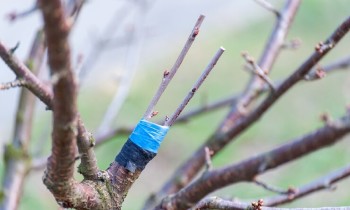
- Grafting by buds and cuttings.
- Growing from seeds.
- Clones (layering).
Diseases and pests
- Moniliosis.
- Pit bitterness.
- Fruit rot.
- Cytosporosis.
- Tinder fungus.
- Scale insect.
- Green aphid.
- Codling moth.
- Hawthorn.
Ripening and fruiting of the Rock
The beginning of fruiting
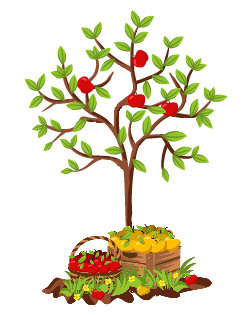 The beginning of fruiting
The tree can be considered relatively early-bearing, as it usually doesn't produce fruit until it's five years old, but by the fifth or sixth year, it produces a very good harvest. Approximately 5-15 kilograms of unusual, tasty, and aromatic fruit can be harvested in the first few years of fruiting. Of course, such a harvest isn't exactly a full-fledged one, but it's quite sufficient for getting acquainted with the variety.
Flowering time
Like most apple trees, Skala blooms in May, but more precise dates will have to be determined experimentally. This is directly influenced by climate, as well as the prevailing weather conditions in a given year. Flowers may appear on the tree approximately two to three years after planting in open ground; they should be completely plucked, preventing them from developing into apples. The flowers themselves are finely scaled, fragrant, pink or white with a slight pink tint, abundant, and bloom uniformly across the entire tree.
Fruiting and growth
The tree grows at a moderate rate, gaining approximately 15-35 centimeters per season. Therefore, it reaches its peak quite quickly. Yields also increase quite rapidly. By the age of 12-16, you can harvest up to 150 kilograms or more of aromatic apples.
Technical, or harvestable, maturity occurs around mid-September in warm and temperate climates. In more northern regions, it's best to pick apples a little later, in early October. They cling firmly to the branches, so there's no need to worry about them falling to the ground when overripe. Consumer maturity, when the sugars in the fruit caramelize and they become more flavorful, occurs approximately 2-3 weeks after cellaring. Apples have an average shelf life; they can be stored for approximately 2-3 months without losing their marketability or flavor.
Top dressing
- Superphosphate.
- Compost.
- Nitrogen fertilizers.
- Humus.
- Potassium complexes.
- Ammonium nitrate.
- Manure.
What to do if it doesn't bloom or bear fruit
- Check for pests and diseases.
- Transplant.
- Limit or increase watering.
Why do apples fall?
- Natural factors.
- Pests.
- Diseases.
Leave your feedback on the winter-hardy Skala variety to share your experience with others.