Apple tree Izbrannitsa: characteristics of the variety and care
| Color | Reds , Striped |
|---|---|
| Ripening season | Autumn |
| Size of apples | Large |
| Taste | Sweet and sour |
| Crown type | Average tree height |
| Shelf life | Low shelf life |
| Application | For recycling , Fresh |
| Winter hardiness | High winter hardiness |
| Fruiting age | From 5 years old |


 History of origin and regions of growth
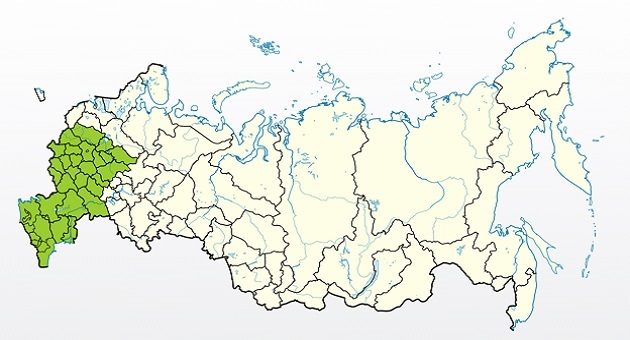
Growing regions
- Middle zone.
- Some northern regions.
- South of Russia.
- Crimea.
Origin
In the 1950s, during the post-war recovery period, our country's horticultural sector needed varieties that were resistant to low temperatures and harsh growing conditions while still producing good yields. The main research in this area was conducted at one of the many experimental stations at Moscow State University named after M.A. Lomonosov. In 1951, three renowned Soviet breeders (G.E. Limberger, S.I. Isaev, and V.V. Vartapetyan) obtained a new hybrid seedling, created by open pollination of the Bellefleur-Kitayka and Antonovka Obyknovennaya varieties.
It was decided to give the new variety the beautiful name "Izbrannitsa." New seedlings were immediately sent to various farms across the country for field trials, and the tree performed exceptionally well. It took many years for the variety to be included in the State Register, which only occurred in 1999. At that time, it was officially zoned for the Lower Volga, Northwestern, and Central regions. In fact, "Izbrannitsa" grows well throughout the central part of the country, as well as in the southern and even some northern regions.
Content
Description of the apple tree variety Izbrannitsa
 A strong, stable crown, high winter hardiness, productivity, and regular fruiting are the main requirements for apple trees in our country. Add to this the attractive appearance of the fruit and its dessert-like flavor, and you have the Izbrannitsa variety, which has long been popular in the central regions of our country. It is easy to care for, responds well to timely feeding and fertilization, and has a compact crown that simplifies maintenance. Therefore, it is recommended for growing in both small backyards and large, intensive commercial orchards.
Apples: What they look like
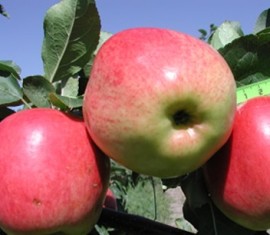
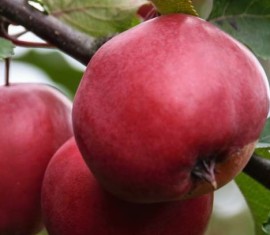
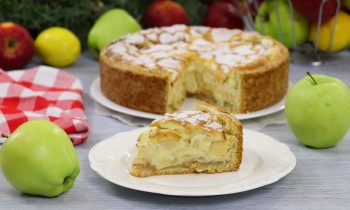
 The fruits of this variety are medium to larger in size, and are considered large. They grow to approximately 170-250 grams, but larger specimens are also available. The fruits are predominantly round, flattened, and generally uniform in size and smooth, with subtle ribbing.
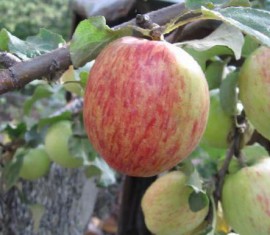
The skin is dense, elastic, strong, smooth, glossy, green or light green when unripe, without an oily or waxy coating, and dry. The blush is bright red, vaguely streaked, and covers no more than 45-55% of the surface. Subcutaneous dots are light gray or slightly light green, numerous, small, and moderately visible. The chemical composition is characterized by the following indicators per 100 grams:
- P-active substances (catechins) – 154 milligrams.
- Ascorbic acid (vitamin C) – 6.5 milligrams.
- Total sugars (fructose) – 13.5%.
- Pectins (fiber) – 8.4%.
- Titratable acids – 0.6%.
The fruit's medium-dense flesh is tender, fine-grained, and very juicy. It has a white or creamy hue and a balanced, harmonious sweet-and-sour taste suitable for table and desserts. According to a professional tasting, it scores 4.7 out of 5 for taste and appearance.
Apple tree Izbrannitsa: characteristics
Crown and root system
 The apple tree is considered medium-sized, although it can easily reach a height of 5-7 meters.However, most owners prefer to limit its growth by pruning it to 3-5 meters to simplify maintenance and harvesting. The crown of the Izbrannitsa is not prone to thickening, usually oval or broadly oval, and can be pyramidal when young. The branches grow predominantly at a 90-degree angle to the trunk, which prevents them from breaking off during fruiting. They are thick, short, and covered in brown or greenish-brown bark.
The leaves are dense, large, long-arched, elongated, leathery, matte, heavily pubescent on the back, with delicate, fine nervation. They are green or dark green and can fold into a boat-shaped form. The root system is branched, medium-deep, and well adapted to seeking moisture. Depending on the rootstock, it may or may not have a central taproot.
Productivity and pollination
The tree is considered to have a high yield and medium early maturity.
A single mature tree can yield approximately 85-110 kilograms of juicy, aromatic fruit in a single season. In some cases, under favorable conditions in the Tambov region, a single tree has yielded approximately 150 kilograms.
The variety is considered completely self-sterile. Therefore, to obtain fruit, it will need to be interspersed with other trees that bloom at the appropriate time. Ideally, they should be no further than 50-100 meters from the Izbrannitsa, otherwise the pollinating insects may fail. It's a good idea to plant the garden near beekeeping or use mobile apiaries.
Winter hardiness and disease resistance
Apple trees are well adapted to low temperatures. They easily tolerate temperatures down to -32-35°C, even with sudden changes. They are also resilient to high humidity and thaws, as well as sudden, severe frosts. However, proper preparation of the garden for winter should never be forgotten.
To all races scabies The Chosen One has a high degree of resistance, but it lacks genetic immunity. Other diseases, such as powdery mildew or fruit rot, can attack it rapidly and extensively, as can insect pests. Therefore, it is necessary to treat the trunks with fungicides and insecticides promptly and regularly.
Rootstocks and subspecies
The variety is considered relatively young, having been added to the State Register for no more than two decades. However, several subspecies, grown on different rootstocks, already thrive in the gardens of our compatriots.
| Subspecies | Description |
| Early | This subspecies is most often grown on clonal standard rootstock. This results in a rounded or pyramidal crown, occupying a much smaller diameter. These trees are beautiful and are often used as ornamentals. The fruits grow much larger, weighing up to 250-330 grams. They ripen in early to mid-August. |
| Dwarf | This subspecies is distinguished by its much more compact size, barely reaching 2-2.5 meters. This significantly simplifies winter frost protection. This feature allows Izbrannitsa to be grown in more northern regions, as it can be covered with a tent-like shelter. The fruit on this tree is slightly smaller than that of the parent variety, weighing only 120-150 grams, but otherwise the characteristics remain unchanged. |
Features of growing the Chosen One
 Landing
 Landing
Basic conditions
- The variety should be grown in a location that receives full sun throughout the day. In the shade, the trees will grow weak and the fruit will be small.
- It's best to choose fertile soil. Black soil is ideal, but fertilized sandy loam or clay loam will also work.
- Trees should not be planted near open water bodies, rivers, lakes, ponds, or shallow wells. In floodplain lowlands or marshy areas, they are likely to die, as their roots can reach into the moisture and rot.
- Planting holes are dug in advance, in the fall or spring, but 2-3 weeks before planting is sufficient. Dig holes approximately 65-80 centimeters deep and 1 meter in diameter. Add a small amount of topsoil mixed with fertilizer to the bottom, place drainage on top, and fill with 35-45 liters of water. Leave the holes outdoors.
- Leave at least 5-5.5 meters between trees in a row, and 4.5-5 meters between rows. This will prevent mature apple trees from clashing with their roots or crowns.
- Stakes are driven into the holes immediately, and the trees are tied to them. They can be removed no earlier than four or five years after planting.
- The root collar of the seedling should remain at least 8-12 centimeters above the soil surface when planted. Otherwise, the tree may root higher, completely losing all the properties of the rootstock.
- The root system of the seedlings is inspected, all dry, diseased or damaged shoots are removed, and then they are placed in warm water for 4-8 hours.
- Place the tree vertically in the hole, supporting it by the trunk. Fill it with soil and compact it by hand. Create an earthen bank around the perimeter, adding 15-35 liters of water. Mulch the surface with sawdust, manure, compost, or chopped grass.
Landing dates
Trees can be planted in the fall, after the leaves have fallen and the sap flow in the trunks has ceased. The appropriate time is around late September or early October. It's important to allow at least 3-4 weeks before the first frost. However, experienced specialists recommend postponing planting until spring, when the ground has completely thawed and the threat of frost has passed (March-April).
Protection from frost and rodents
The variety is quite tolerant of low temperatures, but they still need to be prepared for winter. First of all, apple trees should not be watered after mid-September, otherwise the trees will not have time to stop sap flowing. The root zone is lined with mats of dry grass or covered with soil, and the trunks are wrapped with roofing felt, burlap, agrofibre, or old women's tights.
To repel insects, it's advisable to whitewash the trunks for about a meter with ordinary lime. To repel hungry rodents in winter, which love to gnaw on tender bark and young shoots, trees are coated with melted lard or grease.
Tree care
 Tree care
Loosening the soil, watering: proper agricultural technology
Apple trees rarely require special care, and Izbrannitsa is no exception. It's enough to dig up the area around the trunk once a year and hoe it a few times to remove weeds and root suckers. This should be done carefully and gently to avoid damaging the roots, some of which may be close to the surface.
Trees should be watered only during dry and hot periods, when no precipitation has occurred for more than 14-16 days. For a mature apple tree, 15-25 liters of water, applied twice, morning and evening, is sufficient. Watering can be combined with fertilizing.
Pruning: simple crown shaping
This variety quickly develops foliage and additional branches, so pruning begins in the first year of planting and then continues continuously. First, the central trunk is trimmed by one-third, and the branches are shortened by another 5-8 centimeters. Only 2-4 main branches are left, spaced widely apart at different heights. Subsequently, all suckers (upward-growing shoots) are removed, as well as shoots growing inward.
Sanitary pruning will also be necessary annually, and it's even better to inspect the trees in spring and fall. All dry, damaged, or diseased shoots should be removed so they don't interfere with strong, healthy growth. Rejuvenation can begin around the 10th to 12th year, removing several older shoots at a time.
Pollinator varieties
- Borovinka.
- Folder.
- White filling.
- Silver Hoof.
- Antonovka.
- Bellefleur the Chinese.
- Grushovka.
- Simirenko.
Reproduction
- Rooting cuttings.
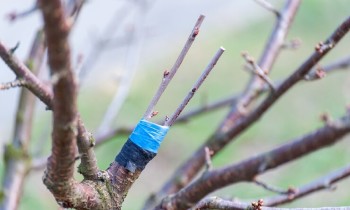
- Grafting by buds and cuttings.
- Clones (layering).
- Growing from seeds.
Diseases and pests
- Moniliosis.
- Scab.
- Powdery mildew.
- Fruit rot.
- Tinder fungus.
- Green aphid.
- Codling moth.
Ripening and fruiting of the Chosen One
The beginning of fruiting
 The beginning of fruiting
It's hard to call this variety early-bearing. It begins to bloom for the first time around the fourth or fifth year, but at that point, it's best to deadhead all the buds before they develop into ovaries. The first harvests are best in the sixth or eighth year, when the branches can yield approximately 5-15 kilograms of apples.
Flowering time
The chosen one begins to produce buds as early as the end of the second ten days of May, and by the beginning of the third, they usually open, exuding a powerful, pleasant, distinctive aroma. However, the exact timing directly depends on the climate and weather conditions of the particular year. The tree's flowers are snow-white, slightly elongated, large, and gathered in small inflorescences.
Fruiting and growth
The tree grows very vigorously, so owners usually have to do a lot of pruning and crown clearing. In a single season, the tree can grow at least 25-45 centimeters. Fruiting increases gradually, but quite quickly. A full harvest can be harvested no later than 3-5 years after the onset of fruiting. A harvest of over 80-90 kilograms of aromatic fruit is guaranteed.
Apples are considered late summer or early fall apples because they begin to ripen as early as late August or early September. This will largely depend on the growing region and the prevailing weather conditions in a given year. The fruit's shelf life is very poor, and even under ideal conditions, they can retain their marketable and consumer qualities for no more than 20-35 days. After that, they begin to wilt, becoming loose, sour, and tasteless.
Top dressing
- Superphosphate.
- Compost.
- Humus.
- Ammonium nitrate.
- Manure.
What to do if it doesn't bloom or bear fruit
- Check for pests and diseases.
- Transplant.
- Limit or increase watering.
Why do apples fall?
- Overripe.
- Natural factors.
- Pests.
- Diseases.
Leave your feedback on the winter-hardy Izbrannitsa variety to share your experience with others.