Uspenskoye apple tree: characteristics of the variety and care
| Color | Reds |
|---|---|
| Ripening season | Winter |
| Size of apples | Large |
| Taste | Sweet and sour |
| Crown type | Average tree height |
| Shelf life | Low shelf life |
| Application | For recycling , Fresh |
| Winter hardiness | High winter hardiness |
| Fruiting age | From 5 years old |
 History of origin and regions of growth
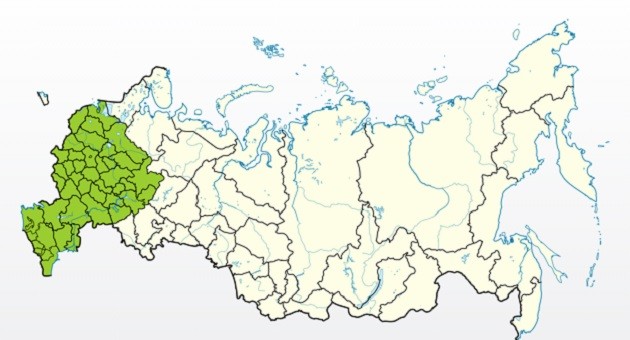
Growing regions
- Middle zone.
- North Caucasus.
- Crimea.
- Some northern regions.
Origin
This new variety was developed at the experimental station of the I.V. Michurin All-Russian Research Institute of Genetics and Breeding of Fruit Plants in the late 1990s. Work on it was conducted under the guidance of the distinguished Russian breeder Nikolai Ivanovich Savelyev. The American Prima variety and the Bessemyanka Michurinskaya apple tree were used as mother plants.
In 1999, the new hybrid was sent out for field trials, and just five years later, it was classified as an elite variety, included in the State Register, and zoned for the Central Black Earth Region. However, a few years later, it became clear that this apple tree grows and bears fruit successfully throughout virtually the entire central zone and even in the harsher conditions of the Leningrad Region, not to mention the mild climate of Crimea and the North Caucasus.
Content
Description of the Uspenskoe apple tree variety
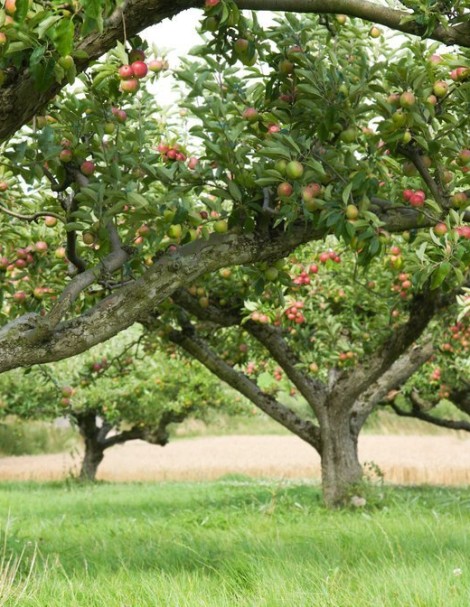
 Many gardeners desire apple trees resistant to scab and other fungal infections. Uspenskoe is precisely this. It boasts enviable frost resistance, produces abundant fruit without resting, and its fruits are beautiful, tasty, and store well. This variety is recommended for both small home gardens and intensive commercial orchards.
Apples: What they look like
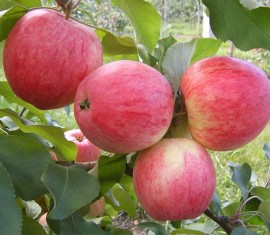
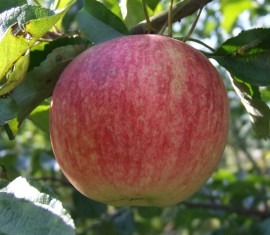
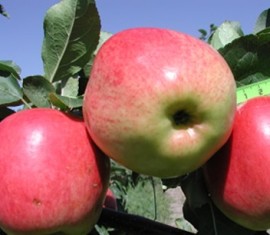
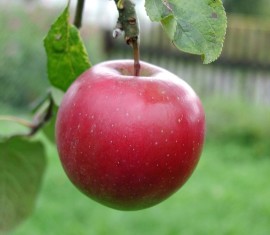
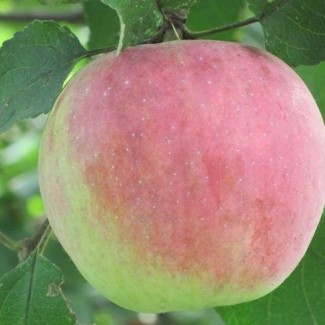
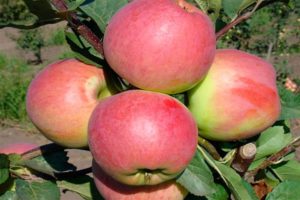 The fruits grow to a large size, weighing approximately 220-250 grams. They are round or round-oval, sometimes irregular in shape, with a smooth surface and faintly visible ribbing. The skin is smooth, shiny, dense, glossy, greenish or yellow-green, 75-90% hidden under a diffuse blush of a red-pink or red-raspberry hue. No waxy or oily coating is observed. Subcutaneous dots are light, grayish or light green, numerous, small, and clearly visible from close range. The chemical composition is characterized by the following indicators per 100 grams:
- P-active substances (catechins) – 396 milligrams.
- Ascorbic acid (vitamin C) – 4 milligrams.
- Total sugars (fructose) – 11.6%.
- Pectins (fiber) – 12.1%.
- Titratable acids – 0.47%.
The fruit's flesh is tender, medium-firm, crisp, fine-grained, and very juicy, with a snow-white or slightly creamy hue. The sweet and sour flavor is considered a dessert-like, harmonious, and balanced. Professional tasting scores are 4.2 for flavor and 4.6 for appearance on a 5-point scale.
Uspenskoe apple tree: characteristics
Crown and root system
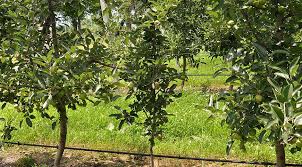 The tree is considered to be of medium height, but to be more precise, it is a natural semi-dwarf. When mature, it can reach a height of no more than 2.5-3 meters. Experienced gardeners use pruning to limit its growth to 2 meters, which significantly simplifies care and harvesting. When young, the crown is oval and compact, but with age it becomes broadly oval, spreading, and may even be slightly weeping. The shoots are medium-length, straight, and covered with smooth, slightly drooping brown or brownish-brown bark. Fruiting occurs on fruiting twigs, spears, and simple rings.
The leaves are fairly long, elongated oval in shape, with a long, pointed, often spirally curled tip. They are leathery, dense, and glossy, with delicate, thin nervation, green or light green in color. They have a slightly wavy, finely serrated edge. The root system is superficial, branched, and adapted to seeking moisture.
Productivity and pollination
The tree's compact size does not prevent it from being highly productive and early-bearing.
In intensive orchards, a single mature apple tree can produce at least 70-90 kilograms of tasty and healthy fruit per season. In private gardens, harvests are typically somewhat more modest, only 50-65 kilograms..
Uspenskoe is self-sterile, so if there aren't any other apple trees within 50-150 meters, it will definitely not produce any fruit. Therefore, it's traditional to interplant it with other apple varieties. To increase yields, experts recommend planting orchards near bee farms or at least moving mobile apiaries to them during the flowering period.
Winter hardiness and disease resistance
Apple trees have a very high winter hardiness rating. In tests in special chambers, they easily withstood temperatures as low as -38-40°C without sustaining any significant damage. In the wild, they retain their properties, although they can be somewhat sensitive to sudden temperature fluctuations. However, they recover very quickly and produce maximum yields again within a year.
To all the five existing races scabies Uspenskoe is completely immune to fungal infections, as it possesses the Vf gene. It is also resistant to other fungal infections. However, some other diseases can cause minor damage to the trees. Insects rarely attack the trunks, but preventative measures are a good idea.
Rootstocks and subspecies
Uspenskoye is most often grown on a clonal standard rootstock. However, experts say dwarf or semi-dwarf rootstocks can also be used. They retain the main characteristics of the parent plant, but yield and, most importantly, winter hardiness of the apple trees are slightly reduced.
Features of growing Uspensky
 Landing
 Landing
Basic conditions
- This variety requires a location that receives full sun for most of the day. Therefore, this compact tree should be planted away from taller plants, not near building walls or fences.
- Apple trees will thrive in loamy or sandy loam soil. If only black soil is available, it can be slightly diluted with clay and river sand. It's also worth monitoring the soil's pH, and if it's too high, use lime to neutralize it.
- High groundwater levels are an unsuitable location for any apple tree variety. They should not be planted near open bodies of water, such as ponds, lakes, rivers, or wells.
- The holes can be prepared in advance, for example, in the fall, or they can be dug 3-4 weeks before planting. Dig a hole 70-85 centimeters deep, fill the bottom with half a bucket of topsoil mixed with fertilizer, line the hole with drainage, then water it generously and leave it outdoors.
- To prevent future conflicts between trees due to crowns or roots, at least 3.5-4 meters should be left between them.
- Before planting, inspect the apple tree's rootstock, removing any damaged, dry, or broken shoots. You can soak the plants in warm water for 5-7 hours.
- It's customary to leave the root collar above the soil surface. For Uspensky, 5-7 centimeters is sufficient.
- Place the seedling on a drainage platform, spread the roots, and cover the rhizome with soil, gently compacting it by hand. Avoid overpacking the root ball, as this will make the tree uncomfortable. Create a mound of soil around the perimeter of the hole, water it with 25-40 liters of water, and mulch with manure or compost.
Landing dates
The optimal time for planting almost any fruit crop is when they are dormant. However, it's important to choose a period when young, tender seedlings are not at risk of frost. In spring, it's best to choose a sunny day in late March or early April, and in autumn, late September or early October.
Protection from frost and rodents
Despite their high winter hardiness, it's best to properly cover apple trees for the winter, especially young and fragile ones. If the climate is very harsh and changeable, it's best to pile a 10-15 centimeter layer of soil onto the root zone. You can cover it with straw or hay mats, and wrap the trunks in burlap or old tights.
To prevent rodent pests from eating the bark during the winter, trees are coated with lard or grease. Commercially available products, available at gardening stores, can be used. Whitewashing the trunks with lime twice a year to a height of approximately 1.2-1.5 meters will also help repel insects.
Tree care
 Tree care
Loosening the soil, watering: proper agricultural technology
Oxygen-rich soils are ideal for Uspensky's rhizome, so it's worth digging the area around the tree's trunk at least twice a year. This should be done very carefully, as the roots are often located just beneath the surface and should not be damaged. You can hoe the soil more frequently, about once every month or two, while also removing weeds and root suckers. In the future, you can lay sod or seed the root zone with lawn grass.
Under normal rainfall conditions, apple trees won't require watering. However, if the weather is extremely dry and hot, and there has been no rain for more than 2-3 weeks, water will need to be applied approximately once every 15 days. 35-40 liters, applied twice (morning and evening), is sufficient. Various fertilizers and fertilizers are usually added along with the water, as this ensures better absorption.
Pruning: simple crown shaping
The tree is prone to self-thickening, so pruning begins the first year and continues annually to maintain its healthy condition. In the first year, a central conductor, no more than 70-90 centimeters long, and 2-4 scaffold branches, 6-8 centimeters shorter, are formed. It is recommended to shape the Uspensky tree's crown into a spreading form for ease of harvesting, so stretching and bending the shoots is essential.
Don't forget about tree maintenance in spring and fall. At this time, remove dead, damaged, or diseased branches. All cut areas should be treated with garden pitch to reduce stress on the plant. Around the age of ten, you can begin rejuvenation pruning, removing two to three mature shoots.
Pollinator varieties
- Borovinka.
- Saffron pepin.
- Bellefleur the Chinese.
- Folder.
- Uralsk resident.
- Idared.
- Welsey.
Reproduction
- Rooting cuttings.
- Grafting by buds and cuttings.
- Growing from seeds.
- Clones (layering).
Diseases and pests
- Moniliosis.
- Cytosporosis.
- Tinder fungus.
- Scale insect.
- Green aphid.
- Codling moth.
Ripening and fruiting of Uspensky
The beginning of fruiting
 The beginning of fruiting
Uspenskoe apples aren't particularly early-fruiting, but by the third or fourth year, a few inflorescences may already be visible on the eyelids. It's recommended to pluck them immediately to allow the crown and root system to develop. The first harvest can be collected as early as the fifth year after planting in open ground. It won't be large, approximately 5-10 kilograms of aromatic apples, but this is enough to taste and evaluate their quality.
Flowering time
Abundant and abundant flowering begins around mid-May and continues until the end of the month. However, timing can vary significantly depending on climate and zone. In warm weather, trees bloom earlier, and later in cold weather. The flowers of the Assumption lily are large, pale pink, gathered in small inflorescences with fleshy, large, saucer-shaped petals. They have a powerful fragrance, attracting pollinating insects from afar.
Fruiting and growth
Trees increase their yield quite quickly. While yields may only reach 15-40 kilograms in the first few years, after 10-12 years, they can harvest full-fledged crops of 200-250 centners per hectare. Annual tree growth is approximately 25-40 centimeters. Initially, the trees grow very rapidly, but this process slows somewhat as fruiting begins.
Apple harvesting can begin around mid-September in mild climates, and from early October to mid-October in harsher conditions. The main drawback of this variety is the tendency for the fruit to fall to the ground when overripe, so it's important to carefully monitor the harvesting time. It's better to pick the fruit slightly unripe and let it ripen in the cellar than to lose the entire harvest. However, storing the fruit for very long isn't possible; they can only last 45-80 days in suitable conditions, after which they must be fully processed.
Top dressing
- Superphosphate.
- Compost.
- Nitrogen fertilizers.
- Humus.
- Potassium complexes.
- Ammonium nitrate.
- Manure.
What to do if it doesn't bloom or bear fruit
- Check for pests and diseases.
- Transplant.
- Limit or increase watering.
Why do apples fall?
- Overripe.
- Natural factors.
- Pests.
- Diseases.
Leave your feedback on the winter-hardy Uspenskoe variety to share your experience with others.