Apple tree Shtrifel (Streifling): characteristics of the variety and care
| Color | Reds |
|---|---|
| Ripening season | Winter |
| Size of apples | Large |
| Crown type | Average tree height |
| Shelf life | Average shelf life |
| Winter hardiness | High winter hardiness |
| Fruiting age | From 5 years old |


 History of origin and regions of growth
Growing regions
This is one of the most common "folk" apple varieties, which is included in the State Register for the following regions:
- Central Russia.
- Leningrad region.
- Vologda Oblast.
- Pskov region.
- Novgorod region.
- Southern regions of the Black Earth Region.
- Tatarstan.
- Udmurtia.
Origin
The origin of the Shtrifel variety is unknown, but it was listed in various Pomogolichi reference books no more than a hundred years ago. It is believed to be the result of so-called folk selection. Russian breeder Lev Platonovich Simirenko believed the variety's origin to be Holland. Shtrifel arrived in Russia from the Baltics in the early twentieth century.
This variety has many popular names that are widely used in our country: Autumn Striped, Autumn Streifling, Starostino, Obrezkovoe, Grafensteinskoe, Livonskoe.
Content
Description of the Shtrifel apple variety
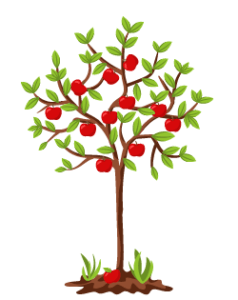 This apple tree has become a favorite among gardeners for its high yield and the unique, spicy flavor of its fruit. Originating from the harsh Baltic region, the variety easily spread throughout the central part of the country. It also adapted well to more northern regions. Therefore, it can now be found in many smallholdings and large orchards producing apples on a commercial scale.
Apples: color, size, weight
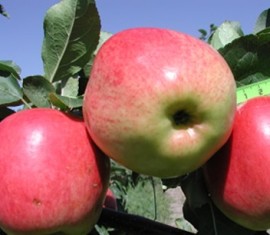
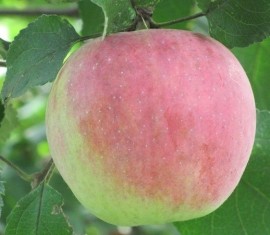
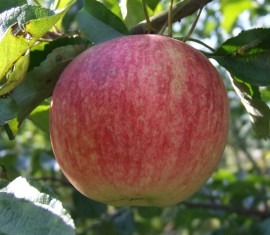
 The fruits of this variety are conical or round-conical in shape. They are often unevenly shaped, medium to medium-large, and can weigh from 80 to 110-120 grams. Their surface is smooth and waxy, and the apples may be ribbed at the base. The dense skin is greenish-yellow when young, becoming golden when ripe, and covered with a streaky red-orange blush that can cover approximately 50-85% of the surface. Some varieties may turn brown or bright red after ripening. Strifel is characterized by the following chemical properties per 100 grams:
- P-active substances – 280 grams.
- Vitamin C (ascorbic acid) – 8.3 milligrams.
- The amount of sugars (fructose) is 10-10.1%.
- Titratable acids – 0.57%.
- Pectins 11-12%.
The fruit's flesh is slightly loose and quite juicy, and can be yellow, pink, or slightly greenish in color. According to tasting reviews, the apples score 4.4-4.5 out of 5.
Apple tree Shtrifel: characteristics
Crown and root system
 This is a large classic apple tree that can easily reach a height of 7-8 meters.However, for ease of maintenance and harvesting, most gardeners limit its growth to 4-5 meters. The Striefel's crown occupies a very large area and is spreading, so it is generally recommended to leave a space of 7-9 meters in diameter between trees. The skeletal branches extend from the trunk at a ninety-degree angle, sagging at the edges, causing the entire crown to resemble an inverted cauldron.
The bark of the shoots is brown and slightly glossy. The foliage is round-oval, leathery, and jagged-edged. It grows very densely, even forming a sort of "cap" at the top of the branches. The root system of a mature apple tree is extensive and extensive, reaching several tens of meters in diameter.
Productivity and pollination
The yield of this variety is considered to be very high.
A young tree 5-8 years after planting is already capable of producing 95-100 kilograms of fresh, aromatic fruits.
However, the tree only reaches full maturity at 15-20 years of age. The maximum recorded yield is up to 300 kilograms of fruit per apple tree. The overall lifespan can reach 50-70 years with proper care and timely pruning.
This variety is considered self-fertile, meaning that other varieties don't need to be available for cross-pollination to produce apples. However, if other varieties are available, the yield increases significantly, so experienced gardeners alternate Shtrifel with other varieties when planting. Preference is given to those whose flowering periods overlap.
Winter hardiness and disease resistance
The apple tree easily withstands frosts down to -23-27°C. That's why it is sometimes grown even in Siberia and in the Far East, but only on dwarf or creeping rootstocks. Only young first-year seedlings require protection.
The variety is well protected from scabies and other apple diseases, such as fruit rot. However, when affected, the disease is severe and profuse. Therefore, a combination of preventative measures is recommended: treatment with special preparations and prompt removal of fallen leaves or rotting fruit from under the apple tree.
Subspecies and rootstocks
To mitigate any shortcomings and enhance its strengths, breeders from around the world are constantly working to improve the variety. Consequently, many subvarieties of Strifel have emerged, of which only two are the most popular.
Subspecies
| Subspecies | Description |
| Strifel-column | In reality, there's no such apple tree species, but scientists have managed to create trees with similar characteristics. These apple trees lack lateral scaffold branches entirely, and the fruit grows from rings formed directly on the trunk. This type of tree is highly winter-hardy, which is why it's widespread throughout the country. |
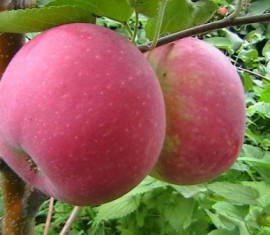
| Red | A distinctive feature of the fruit is its rich red blush when ripe, which covers up to 90% of the fruit. An additional advantage is the tight attachment of the stalks to the branches, allowing them to remain attached even when overripe. Red Strifel is most widely cultivated in Moscow region, the Volga region, Oryol region, Belarus and Urals. |
Rootstocks
| Rootstocks | Peculiarities |
| Dwarf | Most often, apple trees are grafted using a rootstock that enhances all the variety's positive attributes. This significantly simplifies harvesting and tree care, as the tree doesn't grow more than 2-2.5 meters tall. However, this does reduce yield slightly compared to taller trees, as does frost resistance. It requires black soil or other fertile soil, otherwise it produces small apples weighing 40-60 grams. |
| Semi-dwarf | These trees are taller, reaching 2.5-3 meters, but the first apples can be picked as early as late August, even though this variety is considered a winter variety. The average apple size is 70-90 grams. |
| Columnar | On this rootstock, the tree produces few skeletal branches, but its yield is extremely low—18-20 kilograms per tree. However, the fruits are large, weighing up to 120 grams. |
Features of growing Shtrifel
All popular varieties are distinguished by their high hardiness and low maintenance requirements. This also applies to the Autumn Striped. By paying attention to a few key aspects, you can quickly and inexpensively achieve very good harvests.
Landing
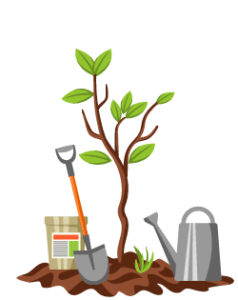
Basic conditions
This variety doesn't like sandy soils or lack of water. Therefore, it's best to choose a planting site in a hollow or lowland. Trees grown near natural or artificial bodies of water grow and bear fruit well.
- Soil warmth is an important factor, so it's best to avoid excessive shade on young trees. Sunny areas are ideal for growing them.
- Planting holes are prepared 5-7 days in advance. Ideally, they should be 60-80 centimeters deep and 1 meter or more in diameter. When digging, set aside the bottom layer of soil and replace it with a top layer containing 2-3 buckets of rotted manure, ideally horse manure. You can also add potassium sulfate (4 tablespoons), superphosphate (100-150 grams), and wood ash. Add 2-3 buckets of water and leave the mixture outdoors.
- On the day of planting, drive a stake into the north side of the seedling to secure it. It's best to remove it after 2-3 years of growth.
- Root collar should protrude above the ground surface by 5-8 centimeters.
It's believed that trees don't require any protection from the leeward side, but they view close proximity with hostility. Therefore, the distance between them should be at least 5-6 meters.
Proper planting can ensure good seedling survival and subsequent maximum yields. Therefore, it makes sense to devote sufficient attention to this.
Landing dates
Strifel responds well to both spring and fall planting. The former is used for young seedlings no older than two years, while the latter is used for older trees. In spring, trees are planted in the ground in March or early April, before the buds begin to open.
In autumn, it's best to choose sunny days in late September or early October, when frost is still at least a month away. The tree needs time to establish roots before the first frost, otherwise it may get burned, although death from such damage is rare.
Protection from frost and rodents
No frost protection is required for trees once they're fully established, but first-year seedlings can benefit from being wrapped in burlap, roofing felt, or roofing felt. You can also cover the root zone with spruce branches or grass straw.
Standard measures can be used to control rodents and pests, which are typically attracted by frost protection measures. The easiest way is to whitewash trees in the fall with lime and coat the trunks with grease or lard.
 Tree care
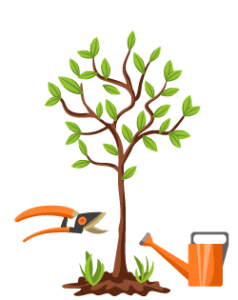 Tree care
Loosening the soil, watering: proper agricultural technology
Soil permeability isn't as crucial for the Shtrifel as moisture. Even in hard, compacted soil, the tree thrives quite well. However, regularly digging around the trunk in spring or fall won't hurt.
Watering this variety depends directly on climate conditions, as well as the age and size of the tree itself. It should begin as early as May, regularly 1-3 times a month. If there is natural precipitation, watering can be postponed until later. One mature tree requires 4 to 8 buckets of water. Experienced gardeners place a hose with a sprayer at the rootstock, apply a gentle pressure, and then leave it for 30-45 minutes. Watering should be stopped in mid-October to allow the Strifel to prepare for winter.
Pruning: simple crown shaping
- FormativeThis variety tends to produce numerous secondary shoots, so this type of pruning is recommended regularly every year. To do this, remove all inward-facing shoots, and trim the remaining shoots and the central trunk by one-third.
- SanitaryPruning is done in the fall and spring, when sap flow has slowed. Damaged, diseased, and dead branches are removed.
- RejuvenatingRecommended only for mature trees 12-15 years old. Two to three mature branches are pruned to allow room for new shoots.
Pollinator varieties
- Slav.
- Welsey.
- Folder.
- Antonovka.
- Rossoshanskoe striped.
- Anise.
- White filling.
Reproduction
- Growing from seeds.
- Grafting (rootstock) by buds or cuttings.
- Layers (clones).
Diseases and pests
- Scab.
- Fruit rot.
- Sawfly.
- Codling moth.
- Green aphid.
Although the variety is self-fertile, it is recommended to plant it no more than 200 meters from suitable pollinators to obtain maximum yields.
Ripening and fruiting of Shtrifel apple trees
The beginning of fruiting
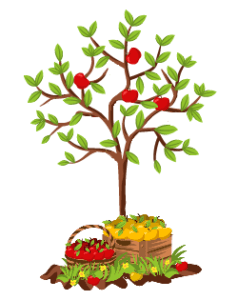 The beginning of fruiting
Waiting for a full harvest from Shtrifel requires considerable patience. The tree begins to bear its first fruit only 4-7 years after planting in open ground. With dwarf rootstocks, the first harvest period can be reduced to 3-5 years.
Flowering time
The autumn striped lily blooms from early to the last ten days of May, depending on the region. Its large, saucer-shaped flowers densely cover the branches. When they open, they are snow-white, later taking on a slightly pinkish hue.
Fruiting and growth
The apple tree is considered a winter tree, but the fruit is usually picked from the branches as early as September. They don't fall off when they're overripe, but their shelf life, even then, is minimal.
Keeping Shtrifel apples fresh until spring isn't possible. They may not rot and may even look quite presentable, but by December they lose their pleasant flavor and aroma. After that, they become grassy and less juicy, so the harvest is most often used for juice, preserves, jellies, and compotes.
A young tree produces between 10 and 40 kilograms of apples, reaching full maturity in its 10th to 12th year. This is when the maximum yield can be achieved. Some have achieved up to half a ton of apples from a single tree, but these results are one-off and have not been recorded anywhere.
Top dressing
- In spring (May) it consists of watering with a urea solution in the proportion of 0.5 glass per 1 bucket (10 liters) of water.
- Summer (June) is the addition of a complex of microelements.
- Pre-autumn (late August, early September) – 30 grams of calcium chloride and 20 grams of superphosphate per square meter of trunk area.
What to do if it doesn't bloom or bear fruit
- Apply fertilizer.
- Prune old, diseased or damaged branches.
- Check for diseases or pests.
- Water regularly.
- Transplant to a more humid or fertile area.
Why do apples fall?
- Natural phenomena.
- Pests.
- Diseases.
- Lack of moisture.
Please leave your feedback on Shtrifel in the comments to share your growing experience with other users.