Pale, light-colored apple tree leaves: what are the causes and what to do
Lightening of apple tree leaves is an alarming sign, signaling the onset of disease or pest infestation. One thing is certain: the tree's photosynthesis process is impaired and requires assistance. It's important to recognize the causes of pale green leaves promptly and apply the correct treatment to restore the orchard's vitality.
Content
Insect pest damage
Spider mite
 The common spider mite is a species of mite that parasitizes the leaves of trees, shrubs, and vegetable crops. It feeds on leaf sap. The pest ranges in size from 0.3 to 0.6 mm and is light green to light brown in color. It is impossible to visually distinguish the mite on the surface of leaf blades.
It is characterized by a high rate of reproduction and rapid adaptation to insecticides. In conditions of high humidity, reproduction and damage are reduced, but quickly resume with improving weather conditions. The pest's egg clutch overwinters in fallen leaves or tree bark.
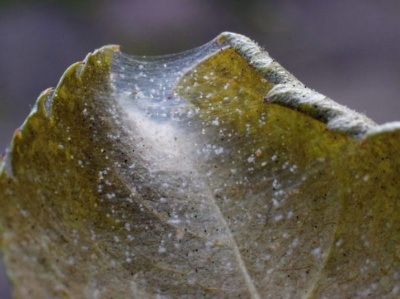
Signs of apple tree infestation by spider mites:
- Leaf lesions appear in fine-point lighteningAs the colony grows, the number of spots increases, and eventually the leaf takes on a pale green color. Already at this stage, cellular synthesis processes are disrupted, tree growth slows, and young shoots cease to develop.
- Affected branches are covered with a very fine web Silvery hue. Leaves turn yellow, young shoots dry up. Apple trees fail to bloom, or the ovaries die.
- The web covers most of the crownSmall dark brown or black dots—the waste products of spider mites—can be seen on the underside of the leaf. The fruits stop growing and ripening and fall off.
The danger of spider mites is as follows:
- sucking the sap from the leaves leads to the gradual death of the tree tissue;
- the tick carries viral and fungal diseases;
- spread by wind, on clothing or with untreated tools;
- tolerates low temperatures well.
Pest control
Spider mite colonies can be destroyed not only with the help of aggressive chemicals, but also with folk methods.
Traditional methods
Effective at the initial stage of tree damage. Spray the crown in the morning or evening with one of the following infusions:
- Dandelion decoctionPour boiling water over a liter of crushed leaves and let steep for an hour. Bring the solution to 10 liters and spray the affected areas. Repeat the treatment after 5 days.
- Garlic infusionChop 2 medium-sized heads of garlic, add 1 liter of room-temperature water, and place in a warm place for 5-7 days. Strain, bring the volume to 5 liters, and spray the tree. To completely eliminate pests, three treatments are required, separated by 7-10 days.
- Birch tarDissolve 10 ml of tar in 10 liters of warm water.
- Onion peel infusionPour 3 liters of boiling water over 3 thick handfuls of husks, cool and spray on the affected leaves.
- A decoction of calendula, yarrow, or celandine. Pour boiling water over a liter jar of one of the flowers, let steep for an hour, bring the volume up to 5 liters, spray the leaves, and wash the trunk and skeletal branches of the apple tree.
- Wormwood infusionPour boiling water over a bucket of the herb, cover with a thick blanket, and let steep for 8-12 hours. Strain and spray the tree's crown. Spread the strained herb around the tree's trunk and leave for 3-5 days.
Calendula and marigolds planted between trees significantly reduce the risk of pest infestation.
Treatment with drugs
To get rid of spider mites at the initial stage of development, use the biological preparation "Fitoverm", and you can also spray neighboring trees as a preventative measure.
The presence of webbing indicates an expanding pest colony. In this case, treat the trees with chemicals prepared according to the included instructions:
- "Aktara";
- "Akarin";
- "Actellic";
- "Demitan";
- "Omayt";
- Fufanon;
- Anti-tick;
- "Spark"
- Inta-C;
- "Alatar".
Spider mites adapt well to the effects of preparations, so during the final treatment, the insecticide should be changed.
False spider mite
The false spider mite (Phalaenopsis spider mite) is a pest, 0.2–0.3 mm in size, light green in color. It reproduces significantly more slowly than the spider mite, parasitizes singly rather than in colonies, and does not form webs. It does not tolerate dry weather; in high humidity, it becomes active, increasing the damage it causes.
The appearance of light-colored leaves on apple trees is often not associated with this pest because it is impossible to detect visually, so the initial stage of development is often missed. For this reason, treating the tree with folk remedies is ineffective.
What to do if apple tree leaves have turned light-colored due to false spider mites can be found in the section above on the real pest—the treatments are identical.
Thrips
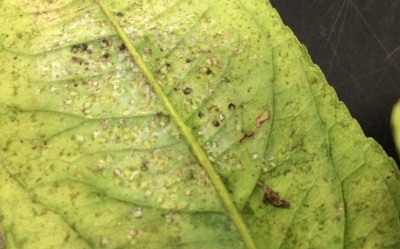 Thrips are small insects of the order Puseripoda, ranging in size from 0.6 to 18 mm, with piercing and sucking appendages. They have two pairs of wings but are poor fliers, using their legs to move around trees. They reproduce rapidly, producing up to 15 generations of pests per season. They prefer dry, warm weather and develop immunity to insecticides.
They feed on leaf and flower sap and are a vector of viral diseases. Some species of thrips feed on spider mites.
Signs of thrips infestation:
- The apple tree leaf turns light green.
- Flowers dry up and fall off, ovaries do not form.
- Leaves turn yellow and fall off. Young shoots stop developing.
Pest control
When thrips are first detected, fumigate the tree with a smoke bomb containing nicotine to kill the larvae and adults. After three days, treat the apple tree with the biological product Fitoverm to destroy the eggs and place sticky traps on the branches.
Traditional methods
Effective at the initial stage of tree damage. Spray the crown with one of the following infusions:
- Garlic infusion with dandelion. Chop 3-4 medium-sized heads of garlic, add 1 liter of room-temperature water, and place in a warm place for 5-7 days. Pour boiling water over a liter of crushed dandelion leaves and let steep for an hour. Mix the solutions, bring the volume to 10 liters, and spray the apple tree.
- A decoction of calendula, yarrow, creeping bitterweed, or celandine. Pour boiling water over 200 g of the flowers of one of the plants, let steep for an hour, and bring the volume up to 5 liters.
- Tobacco infusion. Pour boiling water over 100 g of chopped tobacco, then dilute with warm water to a volume of 5 liters after 40–50 minutes. Apply to the crown, trunk, skeletal branches, and the surrounding area of the apple tree.
Treatment with chemical drugs
Treating trees three times will completely eliminate thrips, but the control spray should be replaced with a different one:
- "Aktara";
- "Actellic";
- "Alatar";
- "Golden Spark";
- Inta-C;
- Biotlin.
Aphid
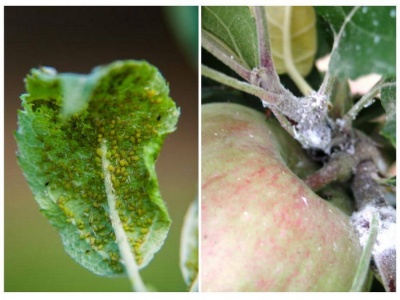 Aphids are tiny insects, no more than a few millimeters in size. They have a proboscis capable of piercing the surface of shoots or leaves and feeding on their sap, which gives them a light color. Wingless aphids facilitate mass reproduction, while winged ones facilitate their spread throughout the garden. They transmit fungal and viral diseases. Up to 18 generations of the pest develop in a season.
Signs of aphids:
- Light leaves on an apple tree that are starting to curl.
- The appearance of honeydew, which attracts ants and is the cause of the development of sooty mold.
- Tree growth slows, leaves turn yellow and fall off, and the fruit loses its flavor.
A tree affected by aphids loses up to 50% of its resistance to frost!
Pest control
First, it's necessary to destroy all anthills located in close proximity to the trees. Then, treat the tree with one of the following products:
- Fitoverm
- "Biostop";
- "Biotlin";
- "Golden Spark";
- "Aktara";
- "Ratibor".
As a folk remedy for aphids, you can treat the tree with a tobacco infusion mixed with 50 grams of laundry soap. The tobacco can kill the insect colony, and the soap coats the leaves with a thin film, preventing the pests from re-infesting. Apply the infusion morning and evening for three days.
Ladybugs actively destroy aphids.
Viral and fungal diseases
Mosaic
Mosaic is a viral disease that develops in living tree cells.
Signs and course of the disease: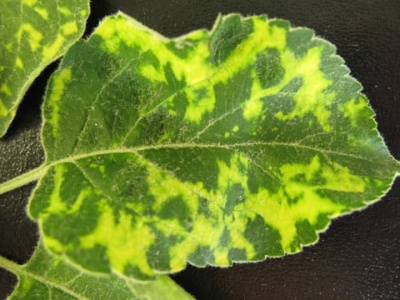
- First, a white, light green or pale yellow pattern forms along the veins of the leaves.
- As the virus develops, the leaves become completely light in color, but do not dry out or fall off.
- The virus spreads quickly through the bloodstream, the apple tree stops developing, new leaves do not grow, and fruiting does not occur.
There is no cure for the mosaic virus. Affected leaves and young shoots should be removed as soon as they are detected and burned, thereby preventing the virus from reproducing. Otherwise, the apple tree will die.
Causes of infection:
- planting material infected with a virus;
- presence of pests;
- unprocessed tool for pruning branches.
Milky shine
Milky shine – a fairly rare fungal disease caused by an acute lack of minerals.
Signs and course of the disease: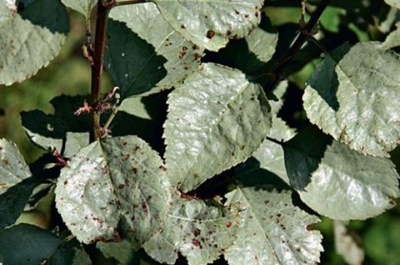
- Fungus, which attacks the tree trunk, settles in the bark, penetrates the wood and is carried along the conducting channels.
- Visually, the onset of the disease is characterized by lightening of the leaves of the entire crown or a separate branch, as well as the presence of black or dark brown spots on the trunk and affected branches.
- After 5–7 days, the leaves acquire a light-gray pearlescent hue.
- The entire crown acquires a silvery color due to the delamination of the leaf platinum and the formation of an air space in it.
- The tips of the leaves turn yellow and dry out, and they begin to die off.
- The leaves are falling off, and brown rings of dead tissue are visible on the cut branches.
The disease reduces the apple tree's resistance to frost and can lead to death within 2–3 years.
Causes of infection:
- lack of necessary agricultural measures;
- freezing of the tree, resulting in a nutritional deficiency.
- last year's fallen fruits or leaves that have not been collected.
Methods of control
The fight against the disease consists of the following:
- Affected leaves and branches should be removed and burned. Treat the cuts with Bordeaux mixture prepared according to the instructions and seal with garden pitch.
- Loosen the soil and clear the tree trunk circle of weeds.
- Treat the trunk and skeletal branches with Bordeaux mixture, Topaz, Fitosporin or Prognoz.
- Fertilize the apple tree with phosphorus-potassium fertilizer and water with warm water.
- Provide protection from freezing and sunburn for next year.
Violations of agricultural practices are the cause of pale leaves on an apple tree.
Chlorosis
Chlorosis While not a disease, this term is applied to all manifestations of mineral deficiency in fruit trees. Leaf lightening is the result of low chlorophyll production and is characteristic of a deficiency of the following substances: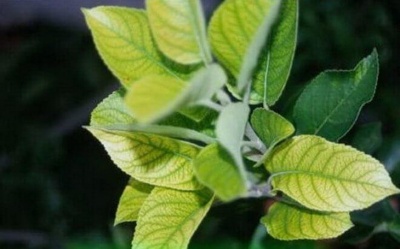
- IronThe leaves turn light green, sometimes even white, and fall off significantly prematurely. The necessary substance is iron chelate or iron-based products such as Ferovit, Brexil, or Agricola.
- NitrogenThe leaves lighten in color, starting with the lower branches, while young shoots take on a red tint. The best solution to eliminate this problem is urea (carbamide).
- Magnesium and manganeseA whitish discoloration of the leaf between the veins and a black border along the edges of the leaf blades. Treatment: applying magnesium sulfate or nitrate in combination with watering with a pale pink solution of potassium permanganate.
- PotassiumLightening of the central part of the leaf, followed by tissue death from the edges toward the center. To correct the deficiency, mix 10 g of potassium sulfate and 20 g of double superphosphate, dilute in 5 liters of hot water, and let steep for 2–3 hours. Bring the solution to 10 liters and spray the crown.
- Calcium. Lightening of leaf tips. Also leads to disruptions in root system development. Adding slaked lime and chalk to the soil. dolomite flour or charcoal not only eliminates chlorosis, but also reduces acidity.
- SulfurLeaf veins turn white or yellow, then the entire leaf blade. The upper, younger leaves are primarily affected. Products based on ammonium sulfate, potassium sulfate, or magnesium sulfate are recommended.
Only the first signs of lightening of apple tree leaves signal a deficiency of a particular mineral. Severe and prolonged deficiency typically produces the same symptoms: yellowing, drying, and leaf fall.
Nutrient deficiency, indicated by chlorosis, can lead to reduced yields, frost resistance, and the death of young shoots, bark, or roots of the apple tree. This can be remedied quickly by applying fertilizer to the tree's trunk or spraying the crown.
Drought
Lack of watering is the most common reason for apple tree leaf blades to become lighter. It also leads to the development of chlorosis due to the lack of timely supply of minerals from the soil. The basic principles of tree moisture regime are as follows: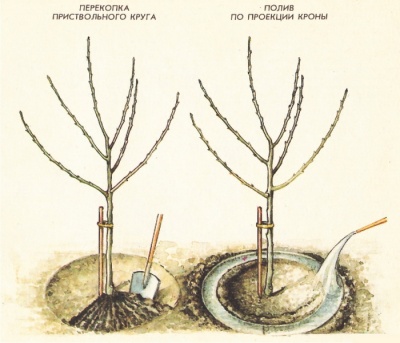
- Surface irrigation It is carried out along the edges of the tree trunk circle in a volume of 40–50 liters per adult tree in dry and hot weather.
- Sprinkler irrigation - diffuse and uniform soil moistening, while it is important to ensure that the depth of wetting is at least 60 cm. Do not carry out at air temperatures above +30 OTo avoid burns.
- Drip irrigation – continuous moistening of the tree trunk area. Suitable for all weather conditions, it's the best solution for preventing drought.
- First watering It is carried out with the onset of the sap flow period before bud break, the last one – 14–20 days before the start of harvest.
It is recommended to combine watering the apple tree with fertilizing.
If the autumn is dry and long, additional watering can be carried out in October to prevent the tree from drying out and to increase its frost resistance.
Preventive measures
To prevent insects from appearing on an apple tree, the following measures must be taken:
- clean the tree trunk circle in the fall from fallen leaves and fruits;
- destroy weeds in the tree trunk circle in a timely manner;
- carry out formative and sanitary pruning of the apple tree to avoid thickening of the crown;
- destroy anthills;
- fertilize trees in a timely manner;
- Conduct three treatments with the biological preparation Fitoverm in the spring, before the sap begins to flow, and in the fall, after harvesting the fruits, with mandatory irrigation of the tree trunk circle.
Conclusion
Leaf lightening is the first sign of a problem with the healthy development of an apple tree. A timely inspection of the tree will help quickly eliminate the cause of the problem. And annual agronomic and preventative measures will allow you to enjoy a blooming garden and a bountiful harvest.