How to Graft an Apple Tree onto a Wilding Root: A Step-by-Step Guide for Beginner Gardeners
Grafting varietal apple trees onto wilding stock can solve many problems. This method is especially useful for gardeners who have clearly defined their plots and want to conserve planting space while still achieving a greater variety of apple varieties. Furthermore, grafting onto wilding stock can help save old apple trees, those damaged by frost, or those infested by rodents.
Content
- Why not propagate cultivated apple trees by sowing seeds?
- When is it most effective to graft onto wild stock?
- How to grow a wild apple tree for grafting
- The nuances of the procedure in different seasons
- Methods of grafting
- For young cuttings
- For an adult tree
- Method of grafting a columnar tree
- What is needed for the grafting process?
- What care do grafted trees need?
- Conclusion
Why not propagate cultivated apple trees by sowing seeds?
It would seem that sowing seeds is the easiest way to propagate apple trees. Just sow and wait for the tree to sprout and bear fruit. But the wait is a very long one: apple trees produce their first harvest approximately five years after growth, and only if the tree has been replanted at least three times beforehand.
If the apple tree has not been replanted during its entire growth period, expect the first harvest in the 15th year of growth.
This raises another question: what's so special about this? You replant an apple tree three times, and that's it—expect the first apples in the fifth year. But even here, things aren't so simple. Any seed-producing fruit crop doesn't inherit its parent's traits. This applies to apple trees as well. So, growing a crop this way always leaves you with a huge amount of intrigue, since you never know what you'll get. You can spend countless hours growing it, only to end up with completely inedible fruit, even if it's very attractive.
There are exceptions to every rule, however. This exception is a group of old, yet perfectly edible, folk apple varieties. They are now planted much less frequently than newly bred varieties, but that doesn't make them any less nutritious. The advantages of these varieties include longevity and excellent adaptability to any growing conditions, but the disadvantages include the large height of the trees (difficult to care for) and the late fruiting period.
So, to make the job easier, experienced gardeners recommend the shortest route to an apple harvest – grafting onto a wild apple tree.
When is it most effective to graft onto wild stock?
For this procedure, you need a strong and good wild plant, which will absorb all the nutrients from the soil through its root system:
- Spring grafting is done when the buds have not yet begun to open, but frosts have definitely passed and will not return. This usually occurs in March. The second time is when the rootstock begins to actively flow (approximately April - May). This time is considered the most favorable, as the grafts take root and adapt well.
- If, for some reason, a grafted tree in the spring fails to take root, another graft can be performed in the summer. The scion should be prepared either in late autumn or early spring (it will still be dormant at the time of grafting). The procedure is carried out from mid- to late summer (late July to late spring). August), when the trees begin their second period of active sap flow. For grafting, you need to take branches and buds that have developed during the current season.
- In the fall, grafting should be done so that the apple tree still has time to properly prepare for winter. The best time to perform the procedure is early September, as sap flow will slow after that, ending with leaf fall and, consequently, dormancy. The scion must have time to adapt to the new conditions during this time, or it will die.
For autumn grafting you need to cut off cutting from a shoot that will reach 40 cm in length and be one year old.
How to grow a wild apple tree for grafting
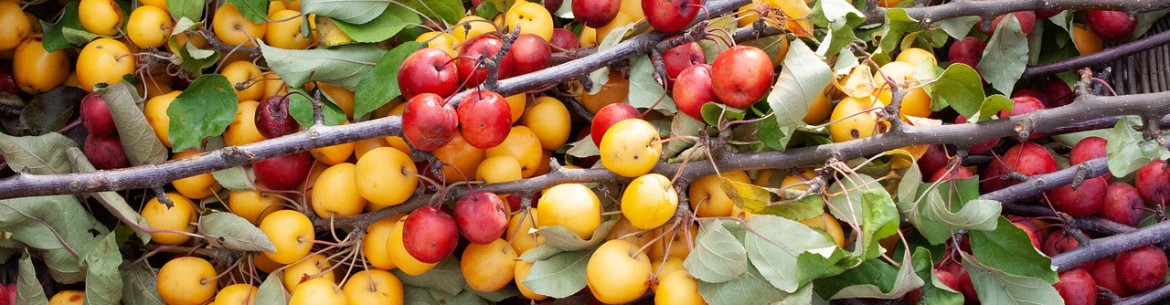
If you already have a wild fruit tree somewhere on your property, you can safely use it. However, if you don't have such a resource, you'll have to grow one yourself.
Growing wild plants from seeds yourself
For this growing method you will need seeds frost-resistant apple trees that grow in your area (this is important!).
- Seeds should be collected in the fall, choosing the largest fruits for collecting seed material.
- Wash the seed material and dry it.
- Between January 15th and 25th, you need to stratify the seeds. Cover them with sand and place them in the refrigerator.
- You can also sow the seeds in the garden in the fall at a depth of 30–40 mm. This way, they'll be covered by snow all winter and will sprout in the spring. By fall, you'll have healthy, strong seedlings.
The nuances of the procedure in different seasons
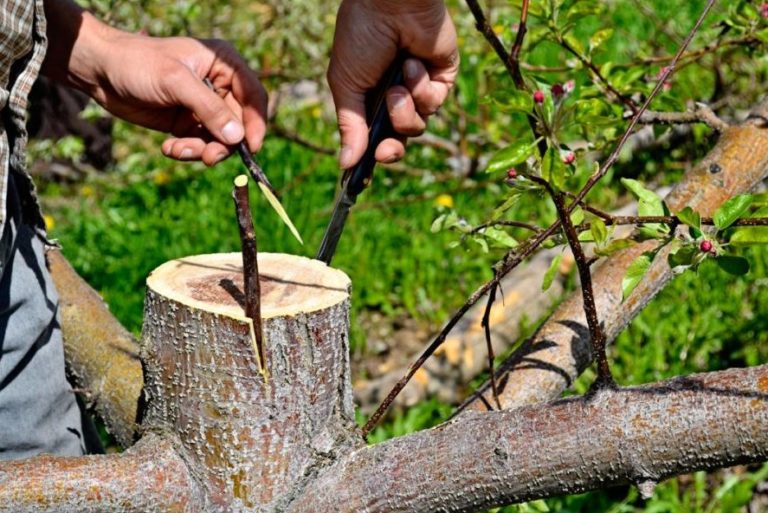
The scion should be prepared in the fall, by cutting branches after the first frost and cutting them into segments. In such cuttings, sap flow is slow, so they experience virtually no stress from pruning.
For grafting, select branches 20–30 cm long with at least 5–6 buds. Store such cuttings They should be kept indoors at 0 degrees Celsius, placed in damp sand. The sand should be moistened periodically as it dries out.
Spring grafting
 This time is considered the most effective for vaccination:
1. The vaccination procedure "into the cleft» is carried out before the active movement of sap in the tree tissues begins.
2. The method of grafting "behind the bark", as well as budding with a germinating eye, improved copulation and "in the butt" is best suited for grafting at the beginning of sap flow.
Summer grafting
In summer, the second period of active sap flow begins, so it is possible to graft a cultivated variety onto a wild apple tree using “behind the bark”, “in a cleft”, dormant bud budding, improved copulation and “on the butt”.
In the central part of the country it is best to carry out budding in the middle of summer (around the end of July), and for southern regions, mid- to late August is suitable.
Autumn procedure
In autumn, grafting is not as effective as in spring or summer. However, if warm weather in the region lingers, budding can be attempted in early to mid-September. Alternatively, you can use the butt-on-the-bud method or perform an improved copulation (not for beginners).
It's best to complete grafting by budding approximately 14–21 days before the outdoor temperature reaches a stable 15°C (59°F). Adult plants should not be grafted during this time.
In the southern regions, grafting is possible in October.
Methods of grafting
There are several effective methods for grafting apple trees.
Grafting to the bark (behind the bark)
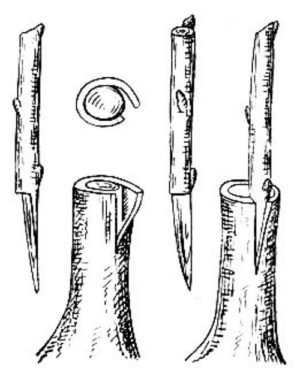
This method is used when grafting small, thin cuttings onto a large branch:
- Thoroughly wipe off all dust and dirt from the bark of the branch.
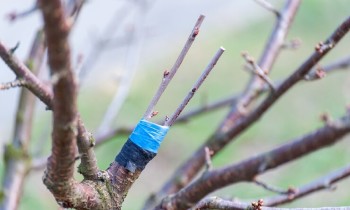
- Using a sharp tool, cut the bark vertically. The grafting should be done through a 20–50 mm long cut in the bark. You can, of course, graft 5–6 cuttings, but make sure they are spaced 40 mm apart.
- Cut the lower half of the selected cutting at an angle and insert it as tightly as possible into the cut in the bark.
- Grease everything garden pitch and wrap it with elastic material (for example, a bandage).
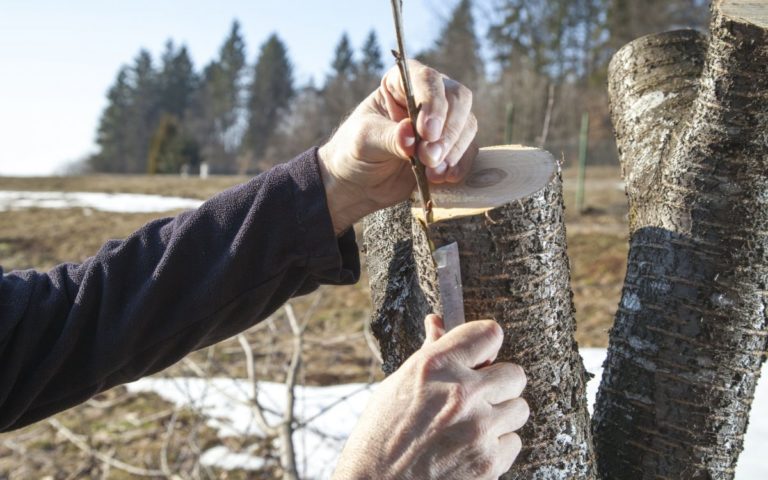
This method has a significant drawback: the scions take root poorly compared to those cleft-grafted. The cuttings do not fuse securely with the branch, reducing the effectiveness.
Splitting method
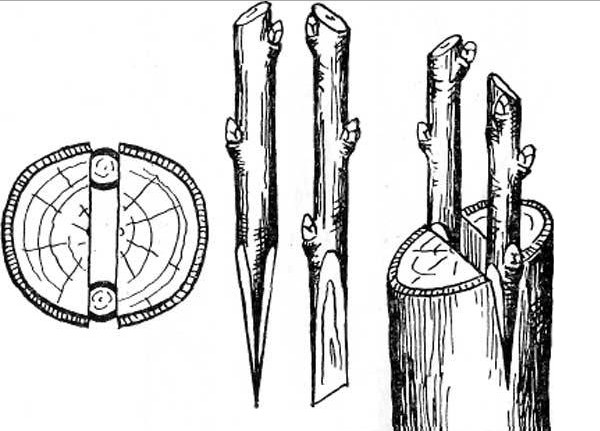
The method is used both when the thickness of the rootstock is equal to the thickness of the scion, and when their thicknesses are different.
- The rootstock should be trimmed back slightly and then split down the center.
- A wooden wedge is driven into the split.
- Then, cuttings 25 mm long are prepared, which have 2 or 4 buds.
- The cutting is cut from below with a double-sided wedge.
- If the half of the crab apple tree you plan to graft the scion onto is larger in diameter than the scion itself, insert the scion and try to push it deeper into the stump. When you remove the wedge, the scion will be firmly clamped.
- Wrap the scion with tape, securing it to the rootstock. Coat everything with garden pitch.
- Place a plastic bag over the cutting.
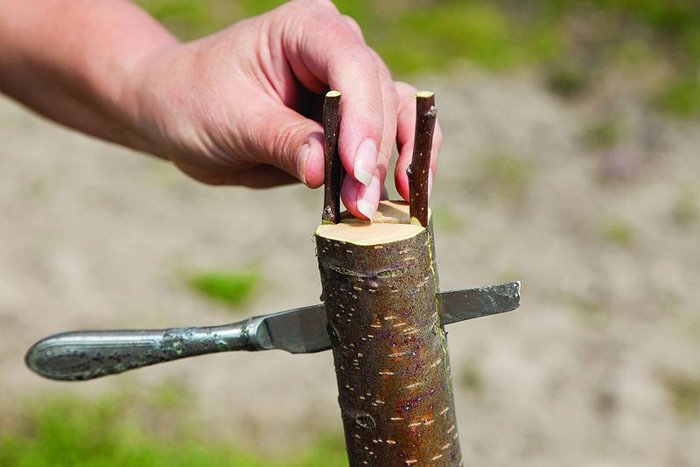
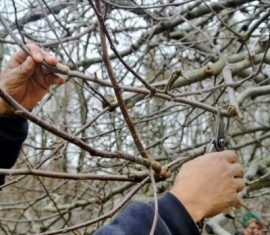
Using a specialized tool (grafting shears)
A grafting shear is a special tool used for grafting. It's suitable for those who don't have much experience grafting plants.
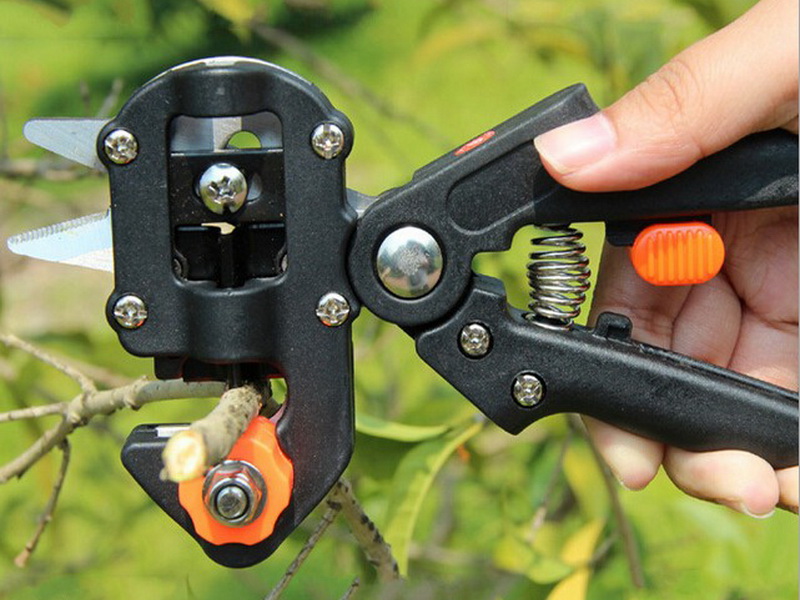
The pruning shears are designed so that the cut on the scion fits perfectly with the cut on the rootstock.
This tool also has its drawbacks. For example, many types of pruning shears can only be used on shoots no thicker than 12 mm.
Budding
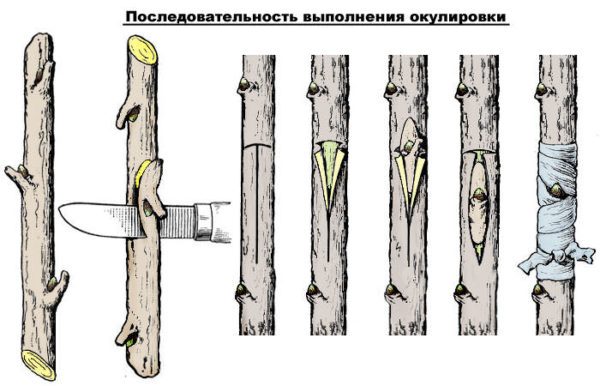
This method is considered the most popular. The scion in this case is a single bud (eye). The cuttings should be prepared in the fall or early spring:
- In the spring, the largest bud that formed last year is cut from the cutting. It will grow into a new branch this season. This process is called bud budding.
- In the summer, a bud that has already matured this season is cut off. It will have time to adapt before the onset of frost and will germinate in the spring of the following season. This process is called dormant bud budding.
This method of grafting has many advantages:
- since the rootstock uses a small area, it is practically not damaged;
- If you don’t manage to vaccinate everything the first time, there is time to repeat the procedure;
- The process requires a minimum of grafting material.
If you have purchased one cutting of a valuable variety, then you can graft 3-4 rootstocks using 3-4 buds.
The procedure takes little time. For budding Branches with a diameter ranging from 0.7 to 1.5 cm should be used. They should have flexible bark that can be easily cut.
The method of application ("in the butt")
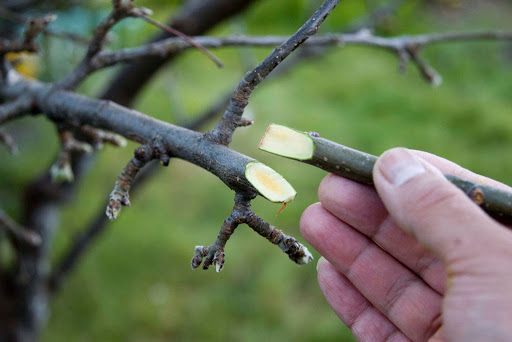
This procedure is carried out when the rootstock matches the scion in diameter.
- Choose a smooth spot on the trunk of the wild apple tree where the diameter will match the cutting.
- Using a "towards you" motion, make an oblique cut.
- Take a branch from a cultivated apple tree and cut out a stalk. Make an oblique cut in it as well.
- When applying the scion and rootstock at oblique cuts to each other, make sure that the cuts match exactly.
- Do not touch the cut areas with your hands!
- Place the rootstock and scion together and wrap them tightly with insulation, making sure the non-stick side is against the bark. Coat the top layer with garden pitch.
- If you carry out the procedure in the spring, place a plastic bag on the apple tree so that it does not touch the top cut.
Grafting by improved copulation
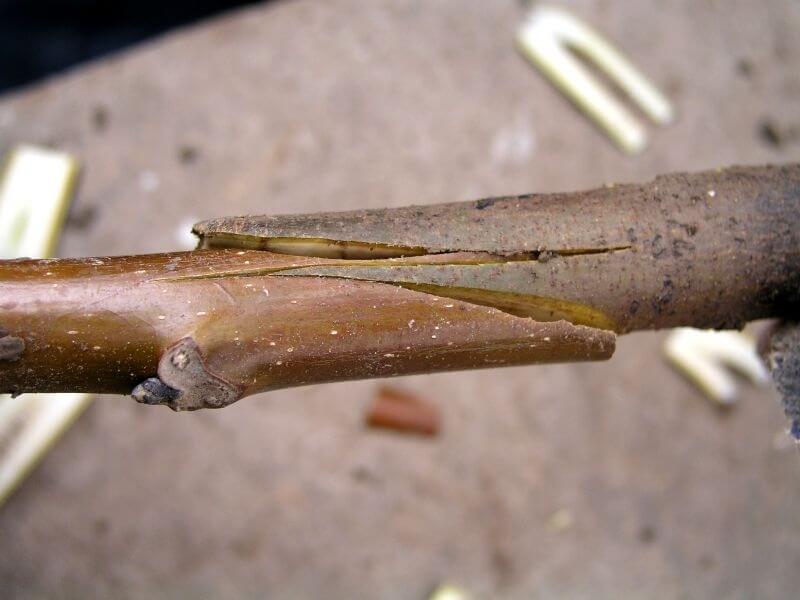
This method of grafting is more difficult than others.
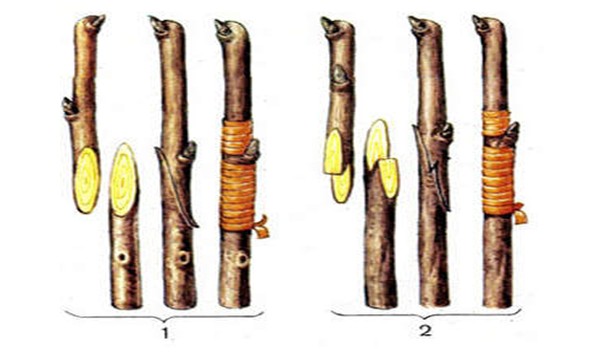
- First you need to make oblique cuts both on the cuttings of the varietal apple tree and on the wild one.
- After this, you need to cut out "tongues" on them. This means that on cut A small longitudinal incision is made on the scion. A similar incision should be made on the rootstock.
- Using perfectly fitting "tongues", you need to fasten the apple tree together.
For young cuttings
In this case, there are no specific recommendations. There's no exact age limit for grafting seedlings onto a young wild apple tree. Everything will depend on the size of the rootstock and scion.
The main requirement for cleft grafting (for example, cleft grafting) is the difference in diameter between the rootstock and scion. The rootstock diameter must be larger than the scion diameter.
For an adult tree
There are no significant differences in the grafting procedure using this method. A mature tree can be grafted using virtually any method, as it's always possible to select a suitable site for different types of scions.
It is best to graft several different apple varieties onto mature trees used as rootstock.
Method of grafting a columnar tree
The key feature of this type of grafting is the choice of rootstock. This can only be a one-year-old seedling. The graft itself should be made as close to the root collar as possible.
What is needed for the grafting process?
To perform this procedure, you will need a whole set of tools that any self-respecting gardener should have:
- a knife with a short but sharp blade;
- grafting knife;
- budding knife;
- pruning shears (or wood saw).
It's also advisable to purchase a special grafting pruner. Grafting pruners come in different configurations, numbers of blades, and cutting methods. Advantages of grafting pruners:
- much lower level of injury compared to conventional tools;
- allows you to make shaped cuts so that the coincidence of the cut parts is absolute;
- allows you to make the most precise and thin cuts for budding.
What care do grafted trees need?
The graft, wrapped in elastic material, should be inspected and checked every 14 days. If necessary, the bandage can be loosened slightly to prevent it from growing into the tree bark. Protect the graft site from birds and pinch off shoots throughout the summer.
For apple trees grafted in spring or summer, the bandage is removed after 60 days, but for wild apple trees grafted in autumn, the bandage is removed in spring, when all the snow has melted.
Once the graft has adapted, the buds will awaken and shoots will begin to form. Don't leave all of them; select only the strongest (usually the one at the top).
In late July or early August, remove the shoot tips from the scion. This will help stop the scion from growing too long and encourage wider growth. This will also speed up the fusion of the scion and rootstock. Shoots growing below the graft should be cut off (they only rob the scion of nutrients).
It is also necessary to tie the grown shoots to the support:
- the first time this should be done is when they grow to 20–25 cm;
- The second time the procedure is carried out when they reach 40–50 cm in length.
The grafted wild plant needs regular watering and feeding in the summer.
Conclusion
If you plan to graft, take varietal cuttings from your apple tree in the fall immediately after the frost. Store them in moist sand in a room where the temperature is below freezing. Use pruning shears if you're concerned about achieving perfect cuts with other tools. Grafting will not only save space in your garden and preserve the diversity of your apple varieties, but also save trees that have been damaged by frost or rodents.