Apple tree budding: a detailed guide for beginners
To restore a fruit tree or develop a new variety, gardeners resort to grafting. There are several variations of this procedure, each dependent on the season and the specific technique. One of them is bud grafting, which is used for various purposes.
Content
- Definition of procedure
- Rules for implementation in summer
- Obtained results
- Technique of budding
- Features of preparation for the procedure
- Grafting options
- Obtaining planting material
- Growing dwarf apple trees for two years
- Peculiarities of growing seedlings in a nursery
- Timing of budding
- Dependence of vaccination timing on climatic conditions
Definition of procedure
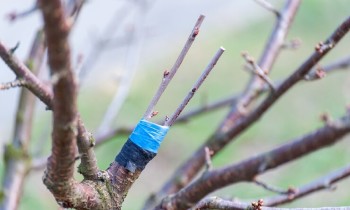
 Budding is a method of grafting using a single bud (eye) taken from a fruit tree cutting. In horticulture, budding is particularly widely used for propagating fruit trees and shrubs, as well as ornamental plants. Young specimens are usually grafted in root collar Or slightly higher. The grafted bud begins to grow the following spring. The resulting shoot is formed into a bush or tree and then planted in its permanent location.
Budding is applicable for re-grafting not only young but also mature crops that have undergone preliminary rejuvenation before the procedure, which consists of several steps:
- a cut is made in the bark of the rootstock without damaging the cambium;
- the kidney is inserted into the resulting slot;
- putty or putty is applied to the joint garden var.
Rules for implementation in summer
Grafting apple trees in summer is considered optimal, as the trees tolerate this procedure very well at this time. Summer grafting can be performed using any technique, including dormant bud grafting, which is recommended after young shoots have ceased growing. At this time, mature axillary buds can be used as grafting material.
The readiness of an apple tree for grafting is usually indicated by a reduction in the distance between the nodes located at the top of a one-year-old cutting.
When performing the operation, it is important to follow several rules:
- graft only healthy material;
- To make the incision, use a sharp, pre-disinfected instrument;
- When making a cut on the rootstock, keep in mind that its length should correspond to the size of the grafted bud;
- the combination of the rootstock cambium and the bud must be ideal: excluding any displacement or bending of the bark inwards;
- Even the slightest contamination of the connection points is unacceptable;
- the winding that fixes the alignment must not be made too tight or too loose;
- The scion and rootstock varieties must be genetically compatible.
Obtained results
The budding method is used for the following purposes:
- Rejuvenating old apple trees and enhancing their vegetative performance. This is especially important for orchards with rare varieties whose yields decline with age.
- Crown shaping allows taller growth to become shorter. This technique facilitates harvesting from the top.
- Growing several varieties on one apple tree, which is especially important for small garden plots.
- The possibility of harvesting in several stages, due to the different fruiting periods of grafted varieties.
- Rescue of trees damaged by harmful insects and rodents.
Proper budding allows you to expand the capabilities of your fruit orchard.
Technique of budding
There are several methods of budding, differing in the degree of complexity and time required.
For the bark
For grafting, you'll need a high-quality, large bud taken from a young apple tree shoot. Bark budding is a rather complex process, requiring precise movements. This procedure can only be performed in the spring, when the bark peels off easily. Up to four scions are placed on the rootstock at a time.
Two nuances can ruin the operation:
- incorrect placement of the growth direction of the buds by the gardener (they should be facing upwards);
- slow speed of procedure execution.
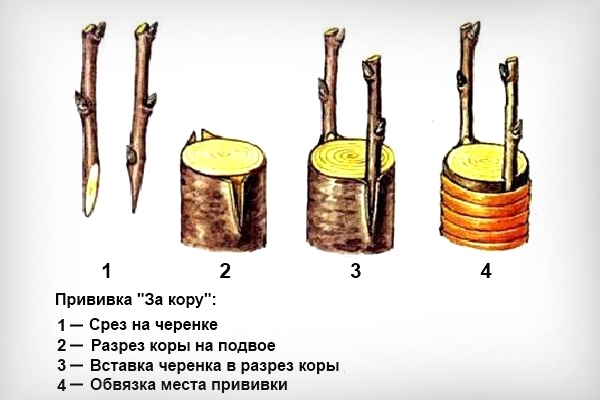
Execution algorithm:
- form the correct one cut trunk;
- make a vertical cut into the bark, capturing a small part of the wood, and then separate it;
- make a 4 cm oblique cut on the cutting;
- tuck the tip of the cutting behind the bark and insert it into the prepared hole;
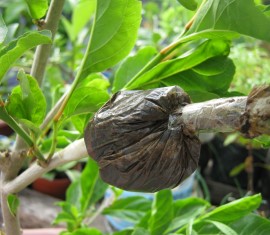
- wrap the grafting site with suitable material and leave it until the sprout appears.
If the grafting fails, as indicated by the bud turning black, the procedure is repeated.
With a sleeping eye
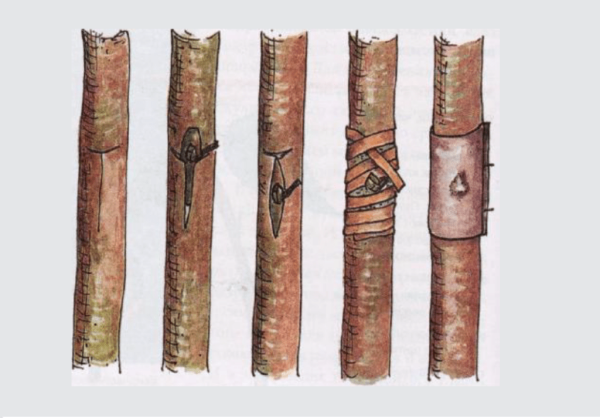 Dormant bud grafting involves using a dormant, mature bud and is performed using the same technique as bark budding. The recommended time for this procedure is summer. The bud, placed in the rootstock tissue, will begin to sprout in the spring of the following season, so the grafted bud should be completely covered with wrapping.
Dormant bud grafting requires strict adherence to the timing, otherwise the bud may sprout in the fall or early winter.
As a rule, the optimal time falls between the end of July and the middle August.
In addition
This simple grafting technique involves replacing one fragment (taken from the rootstock) with another (containing a bud). For the scion and rootstock to fuse perfectly, the two fragments must match as closely as possible. The graft is made on the north side of the rootstock, protecting it from excessive sun exposure and drying out. Immediately before the procedure, the scion and rootstock are wiped with a soft cloth to remove any dirt.
The butt-on-butt option is performed as follows:
- A shield with an eye is cut from the scion - a thin woody layer with bark on which a bud is present.
- A cut of approximately 2.5 cm is made from top to bottom at the rootstock's internode, capturing some wood and bark. The resulting tongue is trimmed off by about a third of the top.
- The shield is inserted into the tongue so that its edges are aligned as closely as possible with the edges of the rootstock.
- The graft is tightly wrapped with a strip of cloth, without touching the bud.
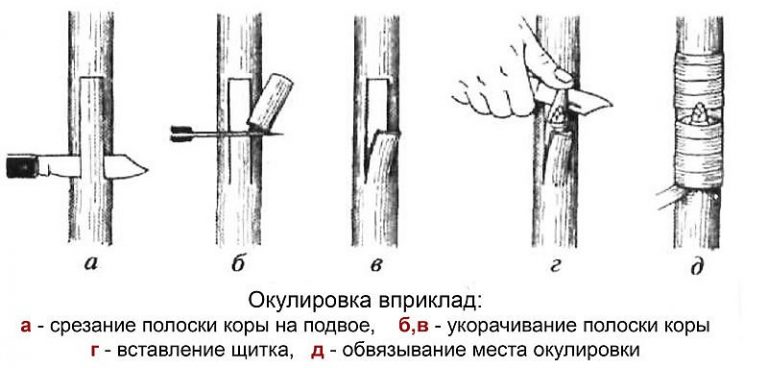
The results of the procedure can be seen in 10-14 days. Successful completion will be indicated by a fused cambium and a healthy bud.
Features of preparation for the procedure
The effectiveness of grafting largely depends on how well the material was prepared.
Rootstocks
 Two weeks before grafting, loosen the soil around the rootstock to increase air flow to the roots and remove weeds. Water only when the soil dries out. Immediately before grafting, remove excess shoots from the trunk, and then clean it of dust and other debris.
Only varieties with excellent characteristics are used as rootstock.
cuttings
For grafting, select cuttings at least 30 cm long, no older than one year, with mature wood, and fully leafed. If the work is carried out in summer or spring, the branches are cut the same day. Before the procedure, the leaf petioles are shortened to 1 cm.
Kidneys
The bud and rootstock must be of the same size. If the rootstock is thicker than the scion, a bud from the lower part of the shoot can be taken. Using the upper buds is only possible for summer manipulations, as it is difficult to determine their maturity in the spring. Otherwise, buds are taken from the middle parts.
Grafting options
There are several options for budding, each of which is determined by the characteristics of the grafting material, the timing of the procedure, and the personal preferences of the gardener.
With or without bark
Bark grafting involves taking a bud along with a small piece of wood. Many gardeners prefer to remove the bark, believing that removing it will improve the graft's survival rate.
The bark budding takes root well with part of the wood, so there is no need to remove it.
At the same time, dormant bud grafting does not involve the presence of wood. The procedure can be challenging, with the bud slipping and drying out quickly. Therefore, it's important to place it correctly and quickly, which requires a certain amount of skill.
Inside or outside
To be on the safe side in case one of the options fails, it is recommended to graft the tree in two places at once. This technique is especially important when using a limited number of cuttings for budding to preserve the variety or to rejuvenate old apple trees.
Two buds are placed one above the other on opposite sides of the rootstock. If both buds take root, one is removed, leaving the strongest one.
If the graft was made into the crown, then the side of the branch facing the outside is left.
Low or high
The grafting of a young scion is performed above the location root collar Apple trees are grafted to a height of 5–7 cm. When using identical rootstocks, a height increase of 10–12 cm is required. For medium-sized and dwarf trees, the height is 30 to 60 cm. Fruiting of highly grafted seedlings begins quite quickly; the disadvantage of this method is the risk of reduced yield.
Obtaining planting material
Budding allows you to grow your own apple tree. This process begins with obtaining the rootstock.
Seed rootstock
When deciding to grow a fruit crop from seed, it's recommended to use proven varieties that thrive in a specific region. Their key qualities should include:
- winter hardiness;
- resistance to various infections and pest attacks.
Many gardeners prefer to use the Antonovka variety for growing seed rootstock, as it has proven itself to be an excellent choice. Apple rootstock budding can be performed throughout the growing season, especially if no more than two trees are being grafted.
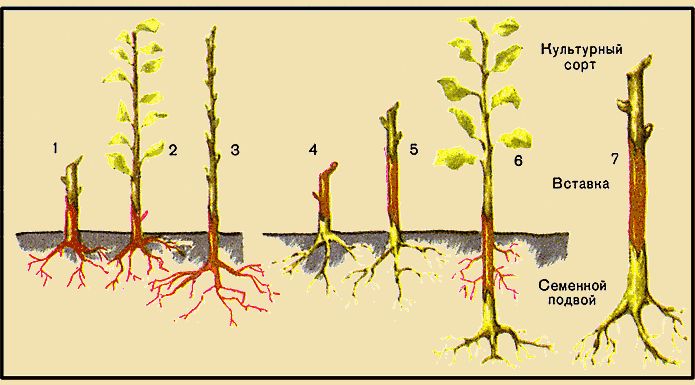
Similar work with large quantities of planting material is recommended in the summer.
Clonal rootstock
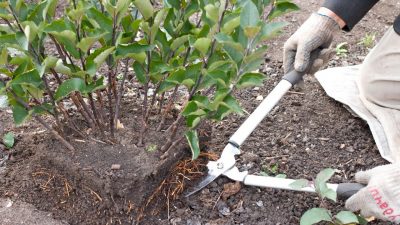 These are artificially bred apple varieties used for grafting edible apple varieties. To preserve the beneficial properties of the crop, clonal rootstocks are propagated. layering, root shoots or cuttings, which allows you to obtain clones.
The cultivation of clonal rootstocks themselves is carried out only for decorative purposes due to the inedibility of their fruits.
Growing dwarf apple trees for two years
To reduce tree growth on a seedling rootstock, budding is performed on a one-year-old rootstock. In this case, the seedling grows over a two-year period:
- In the first year, a one-year-old rootstock is used to graft a dwarf variety. The procedure is performed at a height of 7–10 cm from the ground.
- In the second year, cultivated varieties are grafted onto the resulting scion. The distance between the first and second grafts is 15–18 cm. This portion of the rootstock is responsible for the apple tree's growth.
In regions with a warm climate, the grafting site is left above the soil, and in areas with harsh winters, when planting an apple tree, the trunk is buried down to the grafting site, which allows for insulation and hilling.
Peculiarities of growing seedlings in a nursery
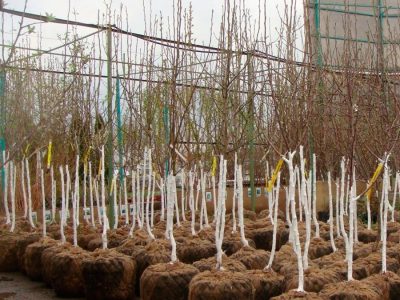 A gardener who has mastered the technique of budding has the opportunity to develop in the following areas:
- production of planting material;
- growing a garden with intensive fruiting;
- organization of a nursery.
The advantage of a nursery is that seedlings can be grafted in any quantity and at any time of the year.
Winter grafting frees up time for spring, summer, and fall gardening. To achieve this, scions and rootstocks are harvested in the fall and stored until winter.
Winter manipulations indoors make it possible to obtain material for sale within one year:
- spring – growing rootstock;
- winter – budding;
- spring next season – receiving ready seedlings.
Creating a fruit nursery is an optimal type of business.
Timing of budding
The timing of grafting depends on the phase of the apple tree's growing season. In most cases, this procedure is performed during the sap flow, when regeneration processes are activated.
Spring
In spring, budding is done through the bark using a vegetative bud. This usually occurs when the ground has not yet fully thawed after the snow melts, and the buds have not yet begun to grow.
Winter
The best time for winter grafting is from mid-December to mid-March. The rootstock and scion are prepared in advance.
Summer
Trees tolerate grafting particularly well in summer. While any method and technique can be used, bud grafting is considered the most suitable for August.
Dependence of vaccination timing on climatic conditions
The principles of grafting vary in regions with different climates, for example:
- in the spring in the southern regions the procedure is carried out approximately 2 weeks earlier than in the northern regions;
- autumn budding is not permitted in the North;
- In summer, in the northern territories, the procedure begins 14 days earlier than in the southern ones.
Grafting is a relatively simple procedure, quick and painless for the tree. It's worth remembering that grafted apple trees require the same care as regular ones: timely watering, fertilizing, protection from diseases and pests, and other agricultural practices.