Grafting a pear onto an apple tree: optimal timing and technology
Pear and apple trees are closely related crops, so grafting them yields a bountiful harvest. A single tree produces twice as much fruit, significantly saving space in the garden. By following the basic rules of grafting and choosing the right time for the procedure, you can reap a harvest of pears and apples of exceptional flavor.
Content
Is it possible to graft a pear onto an apple tree and why do it?
Both crops can be freely crossed with each other. With the right approach, fruits of a different species with improved flavor are produced. Gardeners' experiments with grafting these trees show that subsequent harvests differ from previous ones not only in the appearance of the fruit, but also in its aroma and overall yield.
The list of reasons for crossing an apple tree with a pear tree may be as follows:
- Obtaining assorted fruitsExperimenting with different combinations of adjacent fruit trees yields new flavors and allows for greater diversification of existing crops.
- Motivating a weak tree to bear fruitWhen the bark is damaged, the crop becomes vulnerable and increases its yield through a rich harvest.
- Strengthening the tree's immunityBy crossing apple and pear trees, the plant's internal resources are activated, increasing its resistance to various diseases.
- Increasing yield per bushThis can occur both quantitatively and qualitatively (fruit size, pleasant aroma and improved appearance).
- Saving space in a small garden areaWhen planting several crops in a given space is not feasible, crossbreeding is used. The result is a single healthy and strong tree producing a variety of fruits.
When to graft a pear tree?
Spring procedure
Spring is the best time of year for cross-breeding crops. During this period, sap actively flows and moves along the plant stem, accelerating the interbreeding process.
The procedure should be carried out in the most comfortable weather conditions possible. Daytime temperatures should be no lower than +10°C, and nighttime temperatures no lower than 0°C. Active swelling of buds on the branches also indicates that the cambium layer and bark of the tree are ready for grafting.
The advantage of spring grafting of pears is that the tree begins to develop actively, giving it ample strength for regeneration. The cambium layer, if damaged, quickly heals. If the grafting is unsuccessful, the procedure can be repeated after 2-3 months, once the negative outcome of the grafting is known for certain.
The only downside to choosing spring for crossbreeding is the uncertain weather. Gardeners risk working in completely unpredictable conditions, such as slush, rain, cold, and even snow.
Summer crossing
Summer grafting is performed if the spring grafting deadline is missed or if the previous procedure was unsuccessful. During hot weather, plants experience a second period of revitalization. Sap begins to actively circulate through the branches, and the bark noticeably softens and becomes more elastic.
The best time for crossbreeding is July or August. During this period, there's no need to prepare or store scions, and the rootstock's condition can be assessed at the end of the season. The only drawback of summer grafting is that the scorching sun can damage the fresh scion and prevent it from fully growing. It's best to carry out the work early in the morning or in the evening, when the heat subsides.
Summer crossbreeding is best done on a young plant. This should be done before the tree begins to bear fruit. If the tree is already producing fruit, grafting should be done after the harvest.
Autumn and winter grafting
The best time for crossbreeding is early to mid-September. During this period, the results of spring or summer grafting can be significantly improved. However, the inconstant autumn weather and the short time allotted for the procedure can lead to poor grafting results. Furthermore, damage to the rootstock heals very slowly due to the slow sap flow. The grafted area may become frozen after a harsh winter, resulting in virtually zero results.
Fall grafting of pear trees onto apple trees is an unfavorable time of year. Experienced gardeners try to avoid this period and perform this type of work at a more convenient time (spring or summer).
In practice, there have been successful cases of winter grafting. Even in harsh weather conditions, with the right approach and attention to all the nuances, it's possible to obtain a strong, varietal seedling. The best period for crossbreeding is from December to March. A special grafting method called improved copulation is used. Other techniques can be used, but grafting onto bark is not recommended.
The following conditions must be met when using the winter method of grafting trees:
- cold-hardened grafts should be used cuttings pears;
- one-year-old seedlings dug up in autumn or the root system of a wild plant are used as rootstock;
- the grafted plant should be stored in a cool place until the spring thaw;
- When the soil warms up to positive temperatures, it is planted in the ground.
Variants of grafting technology
Grafting pruner
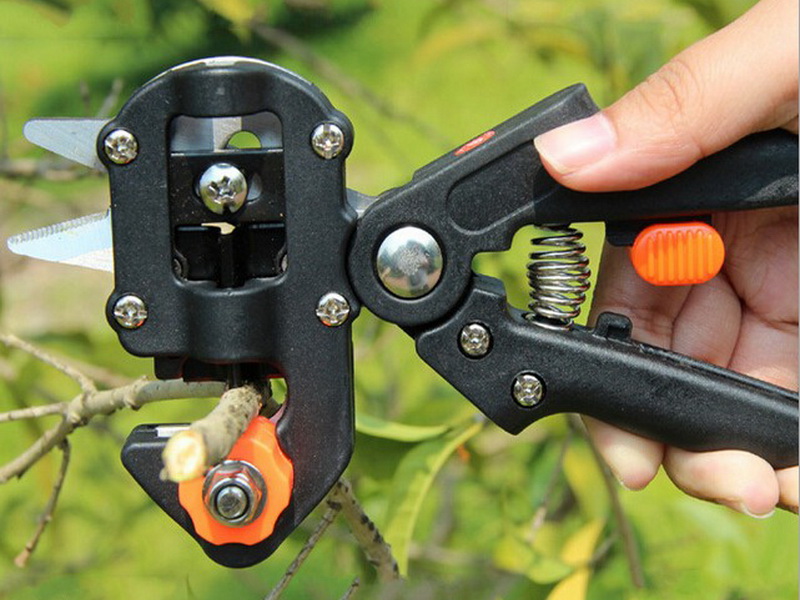
These convenient garden shears can be used for any specific grafting situation. They can cut scions and rootstocks of various sizes and configurations. The cutting section of the grafting shears has several interchangeable profiles that make grafting cuts in different planes. No adjustment is required when using them, as the shaped cuts on the rootstock and scion are perfectly aligned. This ensures complete fusion of the wood and cambium layers.
Using pruning shears when crossing plants makes the operation easier. It speeds up the crossing process and allows for multiple grafts to be performed simultaneously.
There are also some negative aspects that a gardener may encounter when using grafting shears:
- The choice of scions and rootstocks is limited by thickness. The tool ensures shoots are of uniform thickness. Some gardeners prefer to use a regular knife instead of pruning shears.
- Tissue closure. The cut surfaces become clogged, which impedes further fusion of the shoots.
- Bacterial contamination. Properly disinfecting the cutting parts of pruning shears is challenging due to their complex design. As a result, cases of infection occur.
Budding
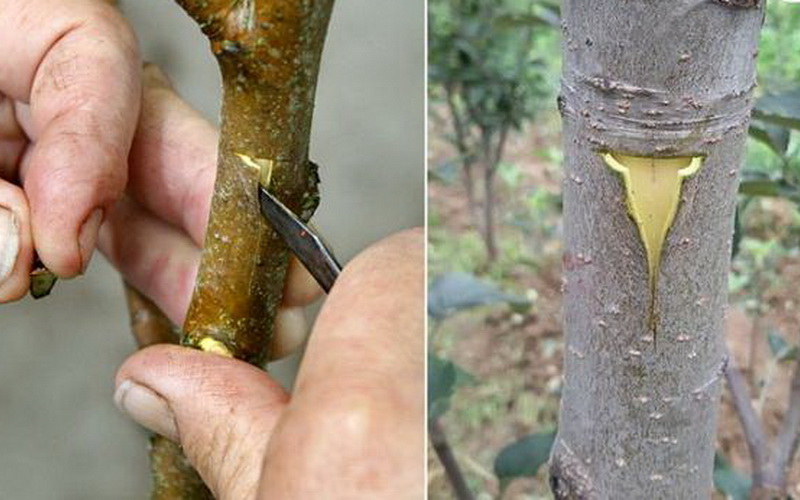
By budding This is called bud grafting. Only freshly prepared cuttings are used. The procedure is carried out in mid-summer (July 10th–15th or early August). There are two types budding:
- Dormant bud. By mid-July, the grafted bud should sprout in the spring. Don't delay this step, otherwise the bud may not have time to take root due to the low amount of circulating sap.
- Using a bud. This procedure is suitable for regions with warm climates. It's performed in the spring, when the buds begin to swell and the first leaves become visible in some places. The cutting is done on the day of grafting or immediately before the procedure.
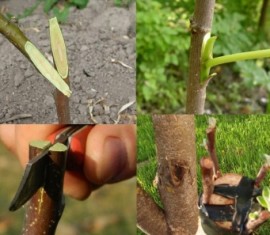
Budding is performed in the following sequence:
- To ensure better bark removal, water the rootstock 5–7 days beforehand. This should be done in warm, dry weather.
- Remove dirt from the barrel using a damp cloth.
- They choose a place on the trunk that is located 6 cm above ground level and make a T-shaped cut on it.
- The leaves are removed from the scion cutting without touching the scion itself. cuttingA formed bud is selected from it and cut off with a budding knife.
The bud should be removed along with the adjacent tissues 1.5 cm above and below. The scutellum (bark and cambium) should also be removed.
- On the rootstock, the cut bark is pulled back with a knife, and a bud with a bud is inserted into the resulting cut. It is pressed firmly in place by holding it by the petiole.
- The grafting site is wrapped in polyethylene so as to leave the bud visible.
After 14 days, green tissue from the scion will be visible, and the petiole will fall off easily when touched. In the fall, the emerging buds will need to be pinched out when the first 3 or 4 true leaves form.
Bark grafting
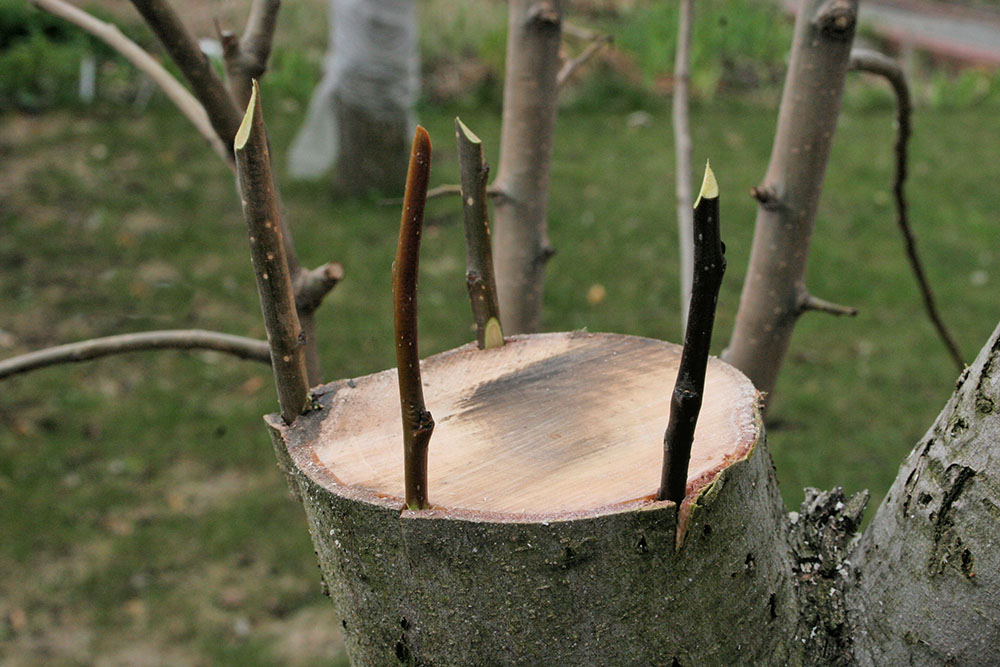
Bark grafting is performed in the spring, from early April to May, when sap begins to actively flow. At this point, the rootstock bark separates easily from the wood. The principle and sequence of steps are as follows:
- A hacksaw is used to make neat cuts saw cut, which is then cleaned with a knife;
- the thickness of the rootstock should be about 4 cm;
- if the trunk is more than 2 cm, then it is grafted with two cuttings at once;
- a vertical cut of about 3 cm is made on the bark, a little more is possible;
- bend the edges of the bark to the sides and make it oblique cut on a scion-cutting with 3-4 buds;
- insert the resulting cutting into the cut so that the cut fits tightly to the core, but 2–3 mm of it remains open for callus formation;
- open cuts are wrapped with grafting tape and coated with pitch.
If the rootstock is thicker than the scion itself, the graft is made through the bark and thorn. To do this, make a cut on the branch and remove the bark down to the wood (about 4–5 cm). The resulting scion is then cut at an angle and wrapped with grafting tape.
Copulation
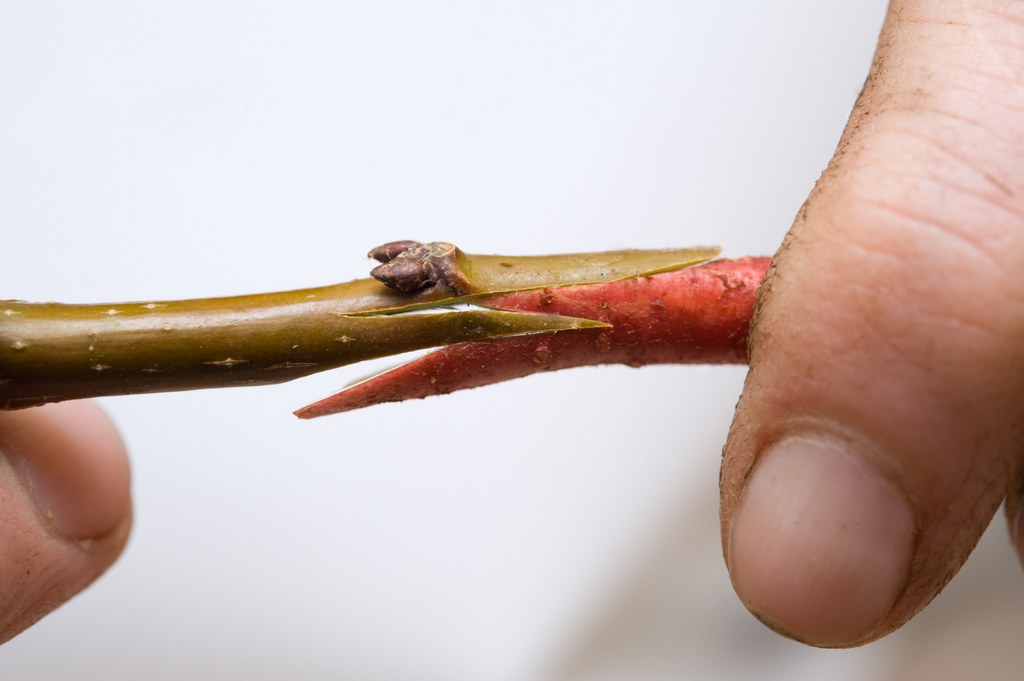
The procedure is performed with cuttings that already have developed buds. Copulation is performed both in spring and summer. A cutting is taken from the mother plant when the current year's growth is visible at approximately 20 cm or more. The most successful copulation grafts have been observed with an established rootstock—an apple tree grown from seed.
The procedure is similar to the standard one, the only difference being that cuttings of the same thickness are taken and cut at a 30° angle. The prepared material is placed tightly against each other, cut surfaces aligned and pressed together.
Improved copulation
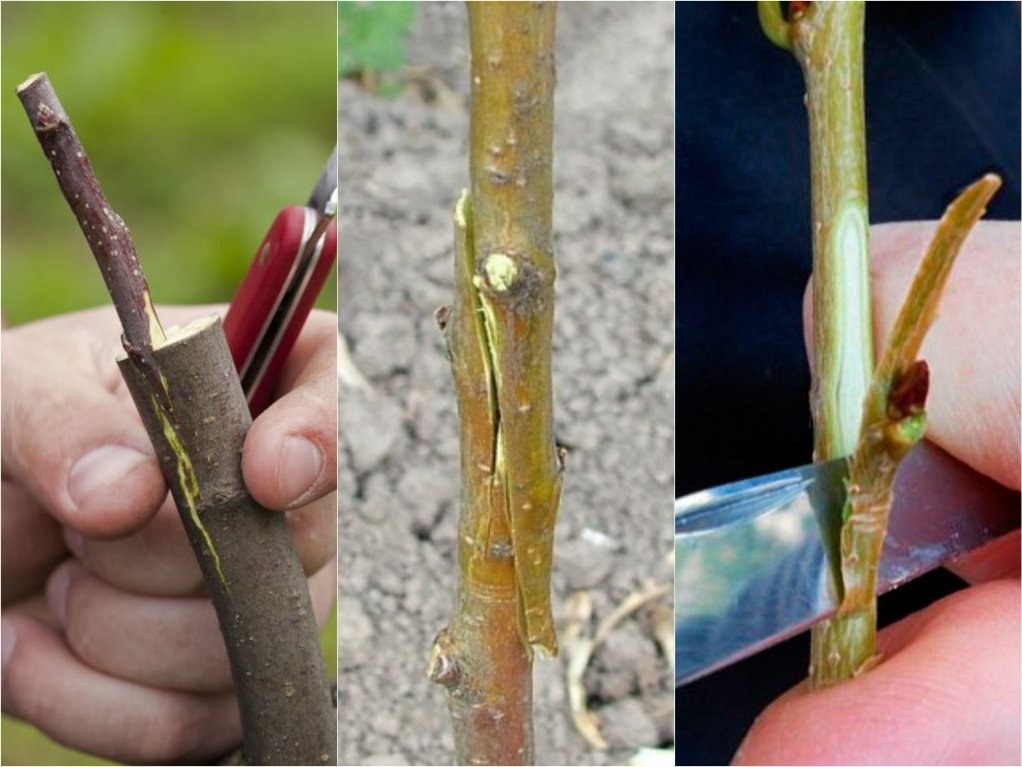
The most practical and reliable method of crossing requires a complete match of cutting diameters. They are prepared in advance between November and March and stored in a cool, dark place at a temperature of 2–4°C. Grafting should be done during the period of active sap flow.
The oblique cuts should be equal to 3-4 diameters. The ligule is also cut, but in the opposite direction. Its thickness should be no more than 2.5 mm, and care should be taken to ensure it is in the same plane. The prepared cuts are aligned with the ligules so that the bark and scion are aligned when placed. The junction is wrapped with grafting tape, and the scion is trimmed back to 2-3 buds. The upper cut of the scion is coated with varnish. The grafting site is capped to protect it from the scorching sun, and this protects the plant from frost during the winter.
Into the cleft
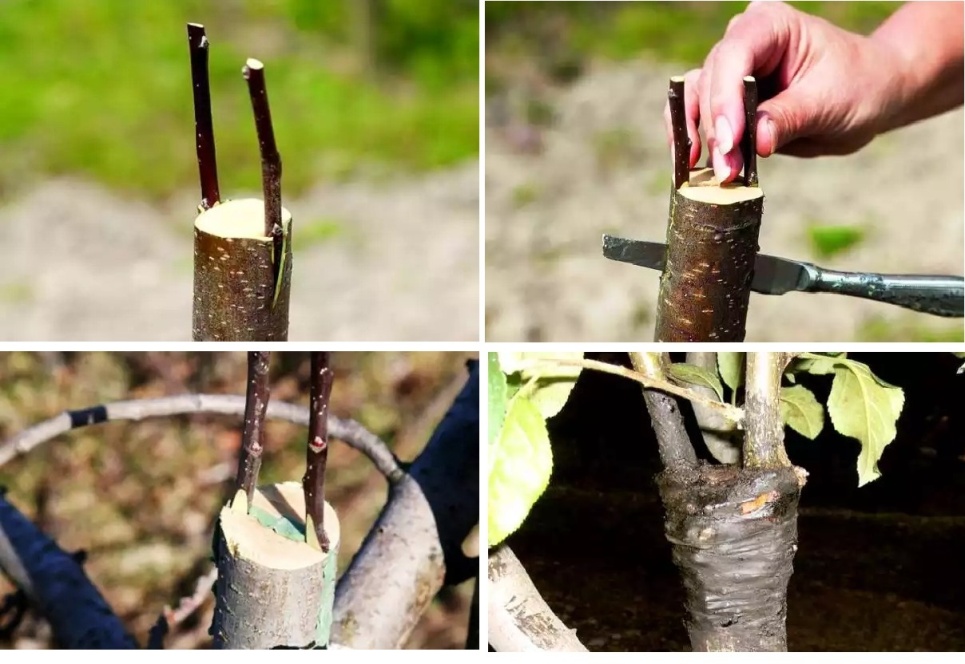
This is a convenient method for crossing pears with apples, as scion and rootstock of different thicknesses can be used. The procedure is performed in the spring before the plants enter the vegetative phase. The buds should just begin to swell (early to mid-April).
Vaccination is done in the following sequence:
- The rootstock is prepared. The branch is cleared of dirt and peeling bark. A thin wilding shoot is taken and cut at least 10 cm above ground level. The cut is cleaned with a knife.
- The rootstock is split. The depth should be 3-4 times the rootstock's diameter. A wooden wedge is inserted into the resulting gap.
- The scion is prepared. Take a one-year-old scion with 3-5 buds and cut its lower part into a wedge.
- The cutting is cleaned and inserted into the cleft so that the cambium layers of the rootstock and scion are aligned. A space is left slightly above the cleft to facilitate the fusion process.
If the rootstock is thick, two scions are inserted into it on opposite sides. The joints are secured with electrical tape, film, or grafting tape. The exposed areas are sealed with varnish.
In the side slit
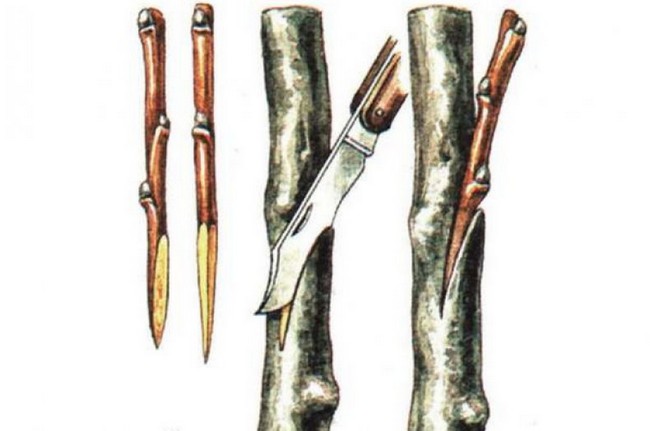
This method is used to correct a lopsided crown. As a result, the scion and rootstock are firmly and quickly bonded. Grafting can be done in early spring or summer. The rootstock scion should have 2-3 buds. A diagonal cut is made on it, equal in length to three times its diameter. The knife should be at a right angle to the scion's axis.
When the scion is rotated 180°, the knife tip is adjusted to 45° and a second cut is made. The oblique cut on the rootstock should match the cut on the scion. The knife enters the crown at a 20° angle, and the depth cut The length of the scion is equal to the cut length. It is inserted into the cut by aligning the cambium. The grafting site is wrapped with tape, and the scion is covered with varnish.
By bridge
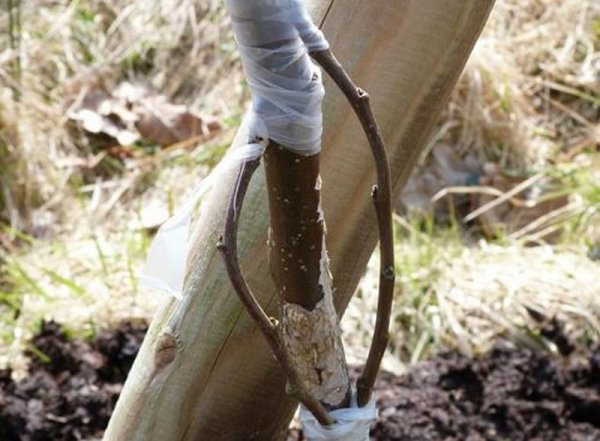
When a tree has ring-shaped damage to the bark, a bridge graft is used. This is done in winter, when rodents cause severe damage to the tree's crown. The upper bark is separated from the lower bark by grafting several cuttings. The damaged area is trimmed and scraped down to the healthy layers.
Buds are cut from the cuttings and diagonal holes are made at the ends. The prepared branches are inserted into the cuts through the bark using the lower and upper cuts. The distance is slightly above and below the injured part of the cutting. This allows the bark to connect to the bridge. The result should be a smooth arch, which is reinforced at the grafting points with ties and tape. The damaged area is sealed with garden putty and covered with damp moss and burlap.
Grafting onto a columnar apple tree
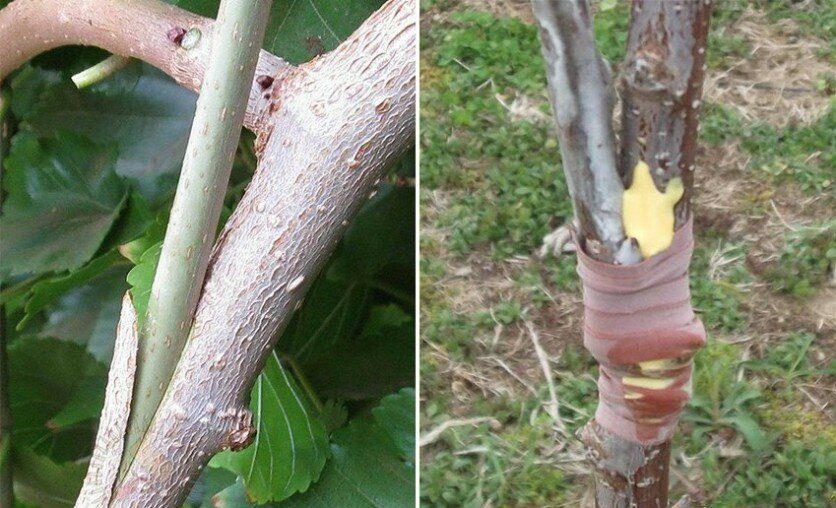
If an apple tree is damaged, you can graft a scion from another tree onto it. This will replace the broken branch or trunk with a healthy, strong scion. Columnar varieties don't require pruning and produce a tasty and abundant harvest. Dwarf plants are often considered such varieties.
This procedure is necessary and is carried out when a dead part of the tree needs to be restored. It is usually successful, allowing the original crown shape to be preserved.
Grafting onto a wild apple tree
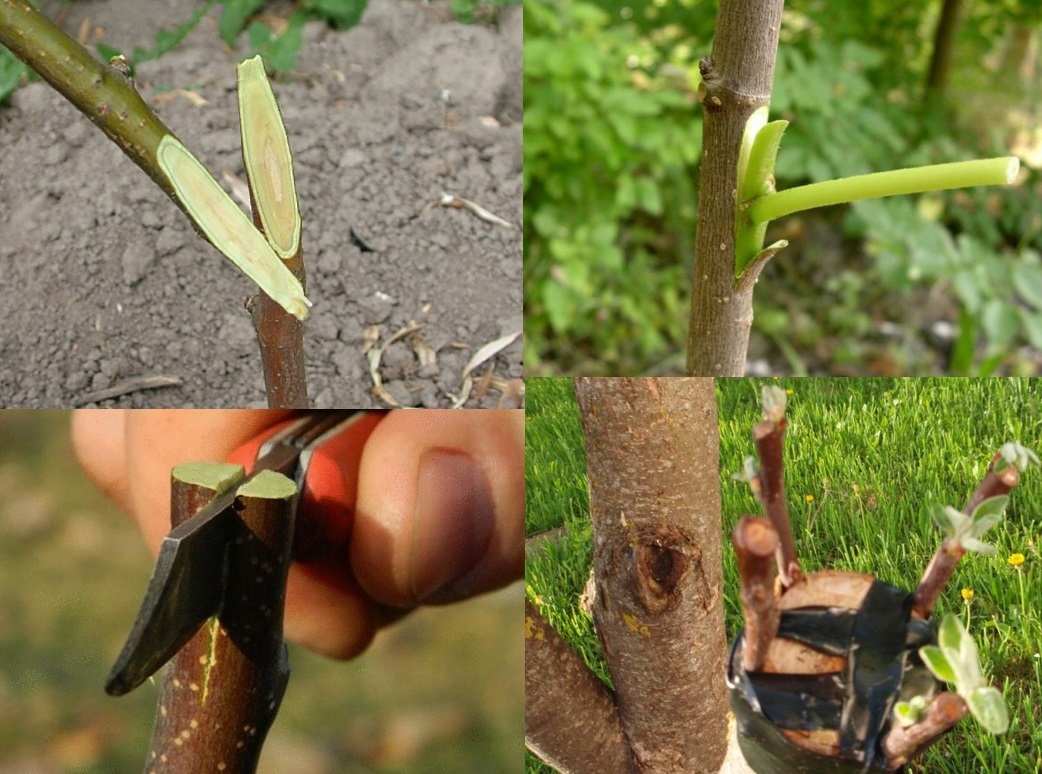
A simple and fairly quick procedure is performed on wild trees, which have enhanced immunity. You can grow an apple tree yourself from seedIt's also possible to uproot the shoot in a nearby forest. If the apple tree produces little fruit during cultivation, then grafting onto a wilding in this case it is more appropriate than ever.
This method of crossing has many nuances:
- Cuttings from home-grown trees often don't take root well. They require careful care during the grafting process, including constant monitoring of the ambient temperature. During cold snaps and intense heat, the plant should be covered.
- Crossbreeding rarely produces fruits with improved flavor characteristics, and yields can actually decrease.
- Sometimes the wild plant cannot cope with winter weather conditions and dies in the first season.
Grafting a pear onto an apple tree doesn't require any special knowledge. When crossing these crops, simply follow the step-by-step instructions for the chosen method. Grafting can be done at any time of year, but it's best to avoid it in winter, as cold temperatures negatively impact the survival rate.