Apple leaf roller: effective control methods and tree treatment instructions
Pests cause significant damage to fruit trees, destroying up to 60–70% of the harvest. Among them is the leaf roller. This moth belongs to the Lepidoptera family and damages buds, leaves, and fruits of apple trees. To successfully combat this pest, we need to study its life cycle, its behavior, and methods of control and prevention. Our article will provide you with useful information for a bountiful harvest.
Content
- Signs and characteristics of the pest
- Which apple tree varieties are not affected by leaf rollers?
- Leaf roller on an apple tree – what to do
- What medications should be used?
- Conditions for treating trees against pests
- When and how to treat apple trees
- Folk methods of pest control
- Preventive measures
- Helpful tips
Signs and characteristics of the pest
The leaf roller is a butterfly, but its larvae cause damage to trees, caterpillarsThey emerge from eggs laid by the butterfly on tree canopies. The butterflies are active in the morning and evening. The degree of activity depends on climatic factors:
- importance;
- illumination;
- temperature.
Signs of apple tree damage caterpillars leaf rollers depend on the period:
- In spring: young leaves, buds and flowers are covered with cobwebs and eaten away.
- Late spring – early summer: leaves are twisted into tubes or collected in bunches, cocoons are visible.
- End of summer: caterpillars move to the fruits, gnaw through them, there is a dense growth on the foliage web, many flying butterflies.
- Early autumn: dark spots with oviposition on the upper surface of the leaves.
- Mid-autumn: the leaves are twisted into tubes or collected in bunches, the greenery is eaten away, a lot cobwebs.
A massive pest invasion destroys more than 50% of the crop.
Description of the pest
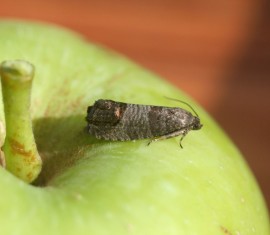
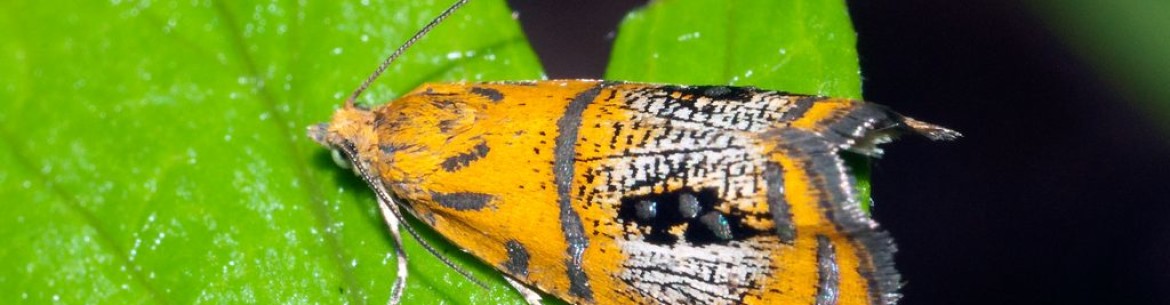
There are many species of leaf rollers. The rose leaf roller is the most damaging to apple trees. The moth has the following characteristics:
 size – up to 3 cm, resembles a moth;
- wingspan – up to 30 mm;
- body with a dense covering of hairs;
- wings of grey or various shades of brown, with a pattern in the form of stripes or ornaments;
- wing folds are horizontal.
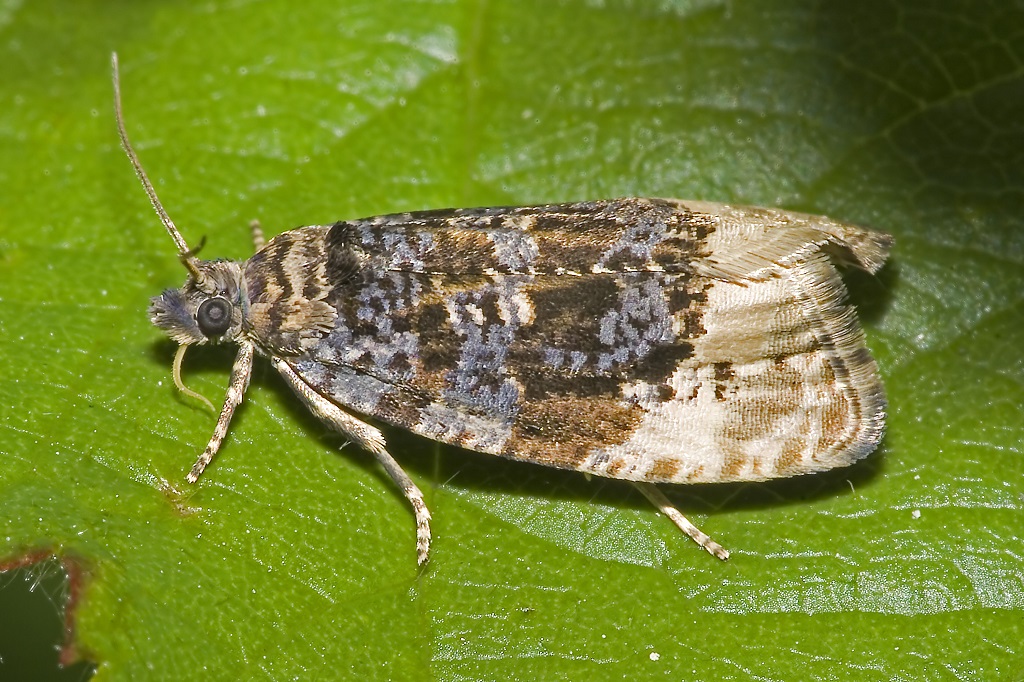 size – up to 3 cm, resembles a moth;
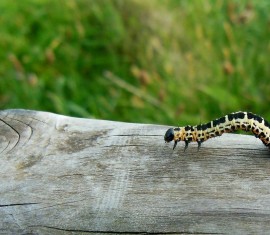
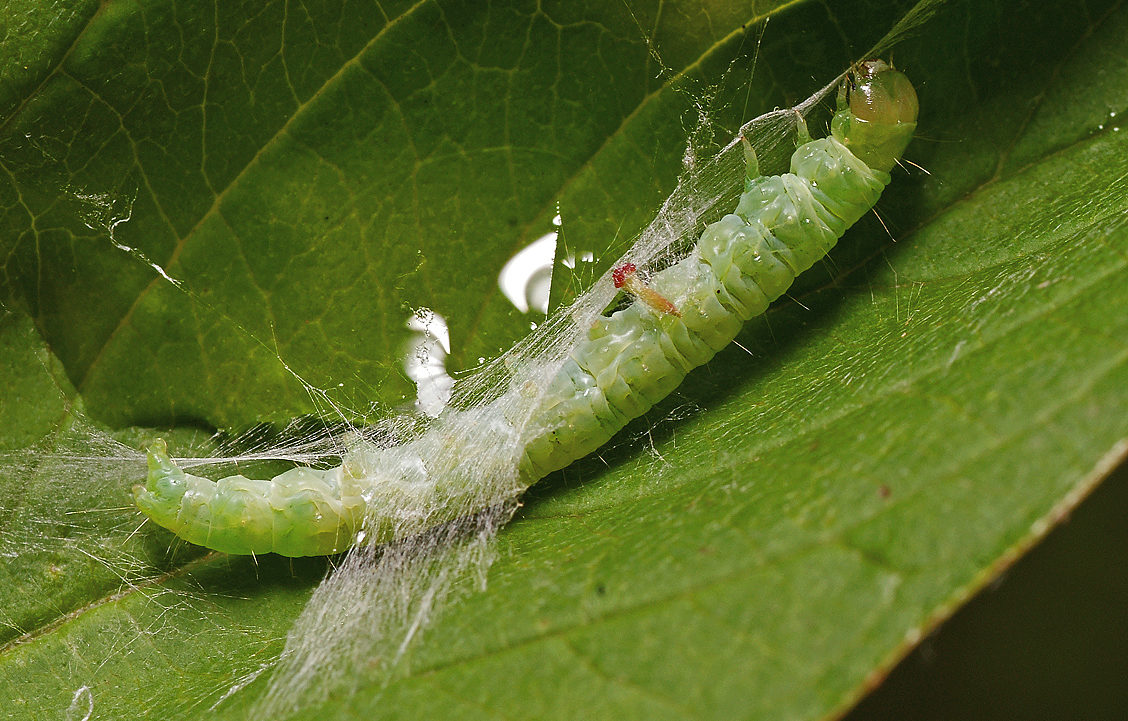
The caterpillars have the following appearance:
- green-yellow body with dots on the back, length – from 10 to 12 mm;
- there are hooks on the abdomen;
- 8 pairs of legs;
- the head is brown or black.
Geographic distribution
The leaf roller is common on all continents except Antarctica. In Russia, 2,500 species are known, 100 of which are the most dangerous. The following are observed in large numbers:
- in mixed and broadleaf forests of the northern hemisphere;
- in the subtropical and tropical forests of Asia.
Reproduction is bisexual.
Stages of development
The developmental stage is determined by the species. The leaf roller emerges in April-May and goes through the following life cycle:
- mates 2-3 days after emerging from the pupa:
- in the spring after fertilization, it lays up to 150 eggs up to 1 mm in size per clutch on leaves, on the bark of trees and branches;
- eggs overwinter on the tree;
- in spring, caterpillars emerge from the eggs and eat buds, leaves, and fruits;
- in summer the larvae pupate;
- after 2 weeks the adult insect emerges;
- mates, lays new eggs.
Second generation caterpillars born in late summer:
- in the fall, they prepare a cocoon from the web for wintering;
- they overwinter in a cocoon on branches;
- in early spring they move on to young buds and leaves;
- continue to feed and develop.
Under favorable conditions, the pest produces several generations. caterpillars.
In early spring, it is necessary to inspect fruit crops to identify caterpillars.
Which apple tree varieties are not affected by leaf rollers?
Apple tree leaf roller infestations are not variety-specific. All varieties are susceptible to attack by pests, including leaf rollers. These pests avoid healthy and vigorous plants. They prefer sick and weak trees that are not properly maintained. To protect against these insects, follow proper agricultural practices.
Highly resistant varieties require fewer pest control treatments. This reduces treatment time and pest control costs. The resulting crops are environmentally friendly.
Leaf roller on an apple tree – what to do
The following methods are used to combat leaf rollers:
- chemical;
- biological;
- mechanical.
Special insecticides are used when more than five caterpillars are found on a single branch or when other control methods are ineffective. The toxins are harmful to human health and accumulate in the fruit.
Chemical
 Chemical control is the most effective. Spraying with special products kills butterflies and caterpillars. The pest quickly adapts to the product's toxins, so several products are used, rotating or alternating them.
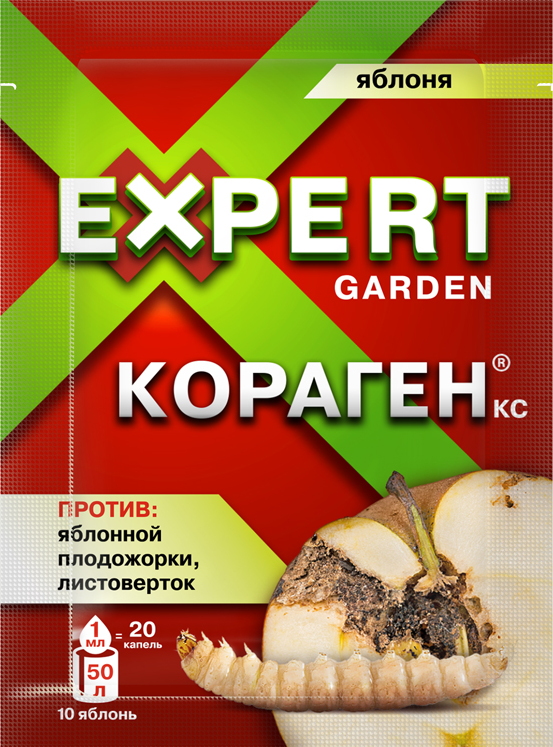
However, if you want guaranteed, long-term protection from leaf rollers, we recommend using Coragen Expert Garden insecticide—a cutting-edge product with a unique active ingredient. Coragen's advantage over other products is that it effectively kills egg masses, larvae of various ages, and adult insects. The protection period is three weeks. It completely eliminates resistance (habituation) in pests.
Biological
The biological method attracts the leaf rollers' main enemies—tits. The birds destroy butterflies and caterpillars, pecking pests out of the bark. To attract the titmice, feeders filled with unroasted sunflower seeds or unsalted lard are hung around the site in the fall.
Don't overfill the feeder. Birds need to be hungry to hunt pests.
Mechanical
Mechanical pest control is used if the damage to the plant is minor.
It includes:
- removing curled leaves;
- shaking caterpillars off trees;
- usage hunting belts, traps for collecting and destroying leaf rollers.
Trapping belts Up to 20 cm wide, they are made of thick paper or burlap. Several belts are placed on a tree trunk and coated with slow-drying garden glue. They are hung in the spring and taken down in late fall. The belts containing the insects are burned.
Traps are containers with fermented drinks. This could be kvass, compote, or juice. The trap is hung on night on a tree, removed in the morning. The smell attracts insects to the dishes.
Not only the damaged plants are treated, but also others located up to 10 meters away. Leaf rollers quickly move from one tree to another. Control of the pest is both protective and preventative.
The mechanical method does not have a harmful effect on animals and people and does not pollute the environment.
What medications should be used?
Insecticides for chemical control are divided into two groups:
- contact – destroy the pest upon contact;
- Systemic – destroy the pest through the treated plant.
Contact medications are low-toxic and therefore have low effectiveness. Systemic medications are more toxic and therefore more effective. The choice of medication is influenced by:
- weather conditions;
- degree of damage;
- vegetation stage.
For prevention and with a small number of pests, gardeners note broad-spectrum insecticides:
- Alatar,
- Karbofos,
- "Atom",
- "Ditox".
*Chemicals are used only before and after flowering, and also after harvesting.
During fruit formation treated with biologically active preparations:
- "Dendrobazzelin";
- Fitoverm
- "Lepidocid".
In case of a massive pest infestation trees are sprayed with stronger agents:
- synthetic pyrethroids: "Ivanhoe", "Fatrin", "Fastak", "Accord";
- pesticides: “Inta-Vir”, “Avant”, “Dimilin”, “Kinmiks”.
*These agents are highly toxic and therefore dangerous to humans. Their use is justified when other methods are ineffective.
Conditions for treating trees against pests
 The leaf roller moves quickly across the area. Neighboring fruit bushes and trees are treated simultaneously with the damaged plants. Spraying begins before apple trees bloom, at temperatures above 10°C. At lower temperatures, the caterpillars hide in the foliage. The maximum spraying temperature is 22°C. Higher temperatures reduce the effectiveness of the chemicals.
When and how to treat apple trees
Gardeners decide for themselves how to treat their trees. A wide range of products are available.
If there were no pest problems last season, preventative treatment is carried out in early spring. If severe damage is detected, plants are sprayed with chemicals throughout the growing season. This requires the number of leaf rollers to be above the pest threshold, or there must be more than five pests on a branch. Minimal amounts of pesticides are used to preserve the trees and avoid damaging the fruit.
The first treatment can be done in March (before bud break) or in the fall, and the last in November. Do not apply during flowering or a month before harvest. Toxins are harmful to bees. Biological preparations are used during fruit set and ripening. They are non-toxic and will not affect the future harvest.
In spring before flowering
In spring, in March, before the buds open, apple trees are inspected. Overwintering pests are eliminated from the wood.
In April, spray the green cone (bud break). The bark may contain white cocoons containing larvae. Spraying kills first-generation caterpillars.
In May, when the flower buds turn pink, the egg clutches are sprayed with the preparations "Avant", "Decis", "Kinmiks", "Inta-Vir".
During the period of fruit ripening
In July, biological pesticides such as Fitoverm and Lepidocin are used against the second generation of leaf rollers. Malathion, Iskra, Kemifos, and Decis are also used. Treatment with strong pesticides is discontinued. Mechanical and biological pesticides are used.
After flowering
In June, the fruits begin to grow. The larvae hide in curled leaves. Insecticides such as Alfacin, Ivanhoe, and Accord are used, as well as Lepidocin treatments. Belts are placed on the trunk to prevent pests from climbing up it.
Deadlines in autumn
In August, fallen leaves are collected. Late-ripening apple varieties are protected.
In September, they collect fallen leaves and carrion. They make trapping belts and snares.
Regarding frequency of treatment. Getting rid of leaf rollers is difficult; pest control requires constant intervention. It's essential to protect your plants from pests and engage in preventative measures.
Folk methods of pest control
For small pest infestations, traditional, non-chemical methods are used. The most effective remedy is wormwood. The herb repels butterflies and is planted in garden plots. The following compounds are also helpful.
A decoction of wormwood and potato tops
Repels butterflies. To prepare:
- a third of the bucket is filled with chopped herbs;
- pour water into the container and boil for 30 minutes;
- insist for 3-4 hours;
- strain and add water to make 10 liters;
- add 100 grams of liquid soap.
The plant is treated in the morning or evening in calm, dry weather.
Tobacco infusion
Protects against caterpillars. Recipe:
- boil a bucket of water;
- half a kilo of tobacco dust or shag is poured into the water;
- insist for 3 days;
- the mixture is filtered;
- add water to twice the original volume;
- add liquid soap.
The solution is not suitable for storage.
Tomato tops decoction
For preparation:
- 4 kg of finely chopped tops are infused in a bucket of water for about 4 hours;
- boil for 30 minutes;
- strain the mixture;
- poured into bottles;
- Store in a cool place for 12 months.
Before use, dilute with water 1:1. For stickiness, add 40 g of soap to 10 liters of the product.
Preventive measures
Leaf rollers primarily damage diseased and weakened plantings. To reduce damage to the garden, boost its immunity and follow these fruit tree care guidelines:
- Leaves under trees are regularly cleared and burned. This destroys overwintering larvae, butterflies, and pupae.
- In winter or early spring, remove dead bark, moss and other debris from the trunks with a stiff brush. lichensThey may contain pest eggs.
- Before flowering, dry and diseased branches are cut off and the crown is thinned out.
- In autumn, tree trunks are coated with a thick lime solution or special garden paint.
- They water and feed the plant.
- Remove weeds and loosen the soil under the tree.
- After the final leaf removal, the soil is sprayed with copper sulfate. This enriches the soil with microelements.
- In autumn and early spring, trees are treated with 3% Bordeaux mixture.
 Leaves under trees are regularly cleared and burned. This destroys overwintering larvae, butterflies, and pupae.
Helpful tips
Warm and humid weather favors pests. They become more active. Increased attention is paid to fruit trees.
Insecticides are classified as toxicity class III. They accumulate in fruits. Consider this when choosing a product. Choose safer methods. The biologically active product "Lepidocid" is also used for preventative measures.
A healthy garden is every gardener's pride. By taking preventative measures and adhering to proper agricultural practices, you can avoid any attacks from harmful insects, fungal infections, and viruses. For effectiveness, it's important to implement all measures in a comprehensive manner.