Royalty apple tree: characteristics of the variety and care
| Color | Reds |
|---|---|
| Ripening season | Autumn |
| Size of apples | Small ones |
| Taste | Astringent |
| Crown type | Tall tree |
| Shelf life | Low shelf life |
| Application | Ornamental tree |
| Winter hardiness | High winter hardiness |
| Fruiting age | Up to 5 years |
 History of origin and regions of growth
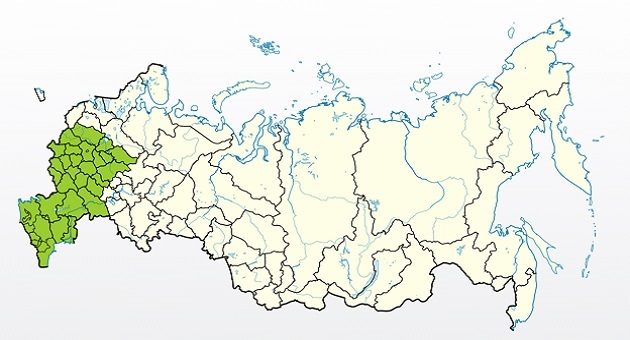
Growing regions
- Middle zone.
- Crimea.
- North Caucasus.
- Some northern regions.
Origin
The history of the apple tree dates back only a few decades. It was developed by Russian breeders as an ornamental tree for landscaping and creating a unique garden or patio design. The apple tree was based on the Ndzvetsky apple, which the renowned French horticulturist L. Tillier called unrivaled in European horticulture.
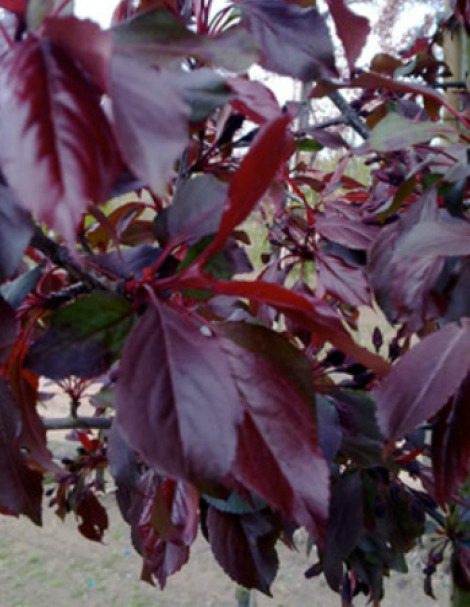
The Royalty variety has several names, all of which are accurate. It's called red-leaved or purple-leaved for its beautiful dark-red foliage with a slight purple or even bluish tint.
Content
Description of the Royalty apple variety
 Apple trees are primarily planted in home gardens or commercial orchards to produce tasty and healthy fruit. However, Royalty doesn't fit this definition at all, as it's grown not for fruit harvesting, but to decorate the plot and create a unique landscape design. The apple tree is resistant to low temperatures, tolerates cold winds and dry periods, requires little care, and closely resembles the Japanese cherry tree, which cannot withstand harsh growing conditions.
Apples: What they look like
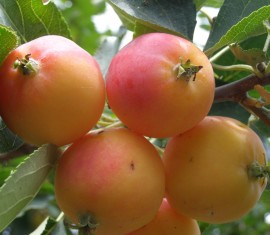
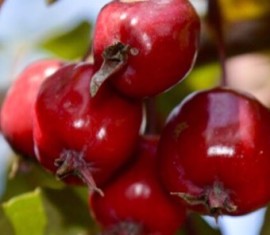
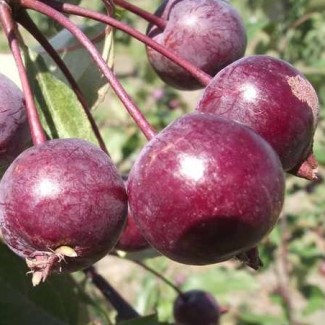
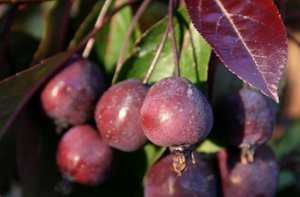 The fruits of this tree are predominantly small and very small, never growing larger than a typical Lutovka cherry. Approximately 15-35 grams is the absolute maximum. They are round, oblong, and elongated, with long, thin stalks. The skin is smooth and glossy, dark red with a bluish or purple tint, covered with a uniform, dense waxy coating.
Anyone who decides to grow Royalty in their garden for decoration should be aware that its fruits are completely inedible. Moreover, in some cases, they can cause severe poisoning and intoxication when consumed fresh. However, experienced growers do not let the harvest go to waste, but rather make a delicious and healthy light cider from it..
The fruit's flesh is dense, white with reddish veins, crisp when bitten, and has a very astringent, sweet-sour flavor with distinct notes of bitterness, causing profuse salivation. If you have this tree in your yard, pay special attention to children who might eat the fruit. This should be avoided.
Royalty apple tree: characteristics
Crown and root system
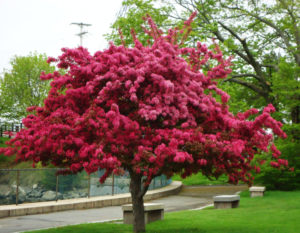 The tree is considered tall because without formative pruning it can stretch to 6-7 meters or moreSome specimens can reach 9-10 meters. However, in most cases, gardeners limit it to a more compact size of 3-4 meters, which is understandable and justified, especially considering the purpose for which such trees are planted. In the first years, the crown is compact, pyramidal or oval. From the second or third year, it expands, becoming wider and spreading, covering an area of up to 4-5 meters. There are weeping varieties, which have long, thin, drooping branches.
Royalty's leaves are elongated, oval, and leathery. They are glossy and shiny, thick, and up to 8-10 centimeters long, with a long, pointed, spirally curled tip. Their color can change several times during the growing season. Initially, in early spring, they are greenish-brown, eventually acquiring a vibrant purple hue that fades in the summer sun. During the height of the heat, they typically display a variegated array of reds, and by autumn, they turn crimson or brownish-red. Firmly attached to the branches, they are the last to fall, around October or even early November, adding to the trees' ornamental appeal.
Productivity and pollination
This indicator isn't monitored by gardeners, as no one grows this variety for its fruit. However, it's worth noting that in a single season, it can produce approximately 10-15 kilograms of inedible fruit. It's best to remove them from the tree, even if they don't fall to the ground, to prevent insect pests from finding a home in them.
This variety is self-fertile, so even if you only have these apple trees in your area, the fruit will still ripen. However, pollinating varieties do exist, primarily all the existing Renet subspecies.
Winter hardiness and disease resistance
Royalty's frost resistance is quite high, it easily tolerates harsh and changeable conditions. weather conditions in the Moscow region and even the Leningrad Region. Temperatures down to -22-25°C are easily tolerated even by young trees 1-3 years old without additional insulation. However, strong winds and sudden changes from severe frost to thaw can lead to freezing of buds and young shoots.
Immunity at the gene level from scabies, powdery mildew The tree is free of fungal or other infectious diseases. However, it's safe to say it exhibits a moderate level of resistance. Even in years with heavy rainfall, the variety is rarely attacked, and quickly recovers. Pests generally avoid Royalty. However, to fully protect the plants from threats, it's best to carry out all necessary preventative measures promptly.
Rootstocks and subspecies
This ornamental apple variety is most often grown on standard vegetative rootstock. However, some prefer to graft it onto dwarf, columnar, and semi-dwarf varieties. This results in more compact plants, but their frost and disease resistance decreases. Several subspecies of this apple variety are also recognized.
| Subspecies | Description |
| Weeping (Royal Beauty) | It has long, elastic, flexible, and slender branches that cascade downwards. They form a kind of waterfall of foliage and fruit, which range in color from bright scarlet to deep purple, beetroot, and even violet. |
| Royalty pendula | This columnar variety is also distinguished by its drooping shoots. Its foliage is typically green, with just a slight reddish tint, and its flowers are abundant, numerous, large, and fragrant, a bright pink hue. |
| Purple Hybrid (Royalty hybridus рurpurea) | This hybrid was obtained by pollinating blood-red and apple trees NedzvetskyIt also has long, drooping branches, but the crimson-red hue, with a purple tint, is found not only in the leaves, but also in the bark of the shoots and even the flowers. All this greatly enhances the apple tree's decorative value in landscape design. |
Features of growing Royalty
 Landing
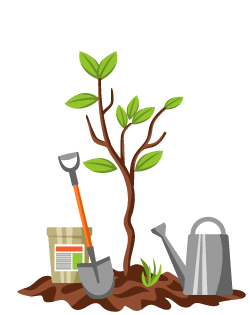 Landing
Key Features
- To plant apple trees of this variety, choose sites that receive full sun for most of the day. They dislike crowded spaces and shade, and this must be carefully considered, otherwise, a beautiful result will not be achieved. Furthermore, due to insufficient light, the skeletal shoots tend to lean to one side, resulting in irregular shapes that are rarely desirable in design solutions. However, this is all a matter of individual preference.
- Soil quality doesn't matter much, as long as it's not overly acidic. Black soil, sandy loam, and loam are suitable for Royalty, but if the acidity is too high, you'll need to leach the soil with lime.
- In areas with high groundwater levels, it's best to avoid planting apple trees altogether, and ornamental varieties in particular. The extensive root system will inevitably reach a moisture source and begin to rot, leading to the death of the plant.
- Planting holes should be dug in advance, at least 2-4 weeks in advance, or better yet, in the fall or spring, depending on the expected planting time. Dig holes 60-70 centimeters deep and 80-90 centimeters in diameter. Add topsoil mixed with fertilizer to the bottom, followed by a 10-15 centimeter layer of drainage (vermiculite, gravel, or broken brick). Top this with 20-30 liters of water and leave it outdoors.
- Stake stakes are immediately dug or driven into the hole for support. They can be metal or wooden, and it's best to position them on the north side of the tree trunk.
- You need to leave about 3.5-4 meters between trees, and three meters between rows will be enough.
- Before planting, apple trees are inspected, the root system is cleared of dried, diseased or damaged shoots, and the plant is immersed in warm water for 2-4 hours.
- Root collar The tree's rootstock must remain above the soil surface by at least 5-7 centimeters, otherwise all the properties of the rootstock will be lost.
- Place the seedling directly on the drainage layer, spreading its roots, then cover with soil and compact it by hand. Create a small earthen ridge around the hole's perimeter and add 20-30 liters of water. Mulch the surface with compost.
Some time after planting, you'll notice the soil around the tree has settled, creating a depression near the trunk. This can't be left untreated; you'll need to add soil to level the ground. Otherwise, moisture will accumulate near the rootstock, causing it to rot.
Landing dates
Trees can be planted in either spring or fall. In the former case, it's best to do so in late March or early April, before the sap begins to flow in the trunks. In the fall, it's best to wait until the leaves have fallen before planting. It's best not to add humus, manure, compost, or other organic fertilizers to the holes dug earlier, as the apple tree may begin to bud immediately, just before winter approaches.
Protection from frost and rodents
Plants are quite frost-resistant, so in mild climates and temperate zones, they won't require much protection. However, during harsh winters, it's a good idea to wrap the trunks with felt, agrofibre, burlap, or old women's tights. Straw or dry grass mats can also be placed around the roots.
To drive away insects, the trunks must be shaved in autumn or spring. whitewash Lime should be applied approximately 1-1.2 meters above the soil surface. To repel rodents, which love to feast on the delicate bark, it's a good idea to coat the trunks with grease or lard.
Tree care
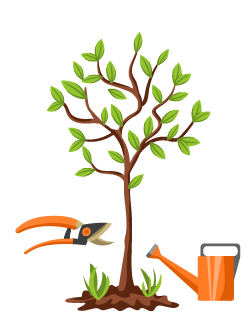 Tree care
Loosening the soil, watering: proper agricultural technology
Like all other trees, Royalty apple trees prefer oxygen-rich, fluffy soil. Therefore, the soil should be regularly loosened. Twice a year, you can carefully dig around the trunk with a shovel to avoid damaging the roots located close to the surface. During the growing season, you can hoe the soil, simultaneously removing weeds that rob the tree of nutrients, shoots from other plants, and root suckers.
Apple trees can be watered in any order, but the key is not to overdo it. Royalty is a drought-resistant variety, so it won't tolerate excessive watering. Ideally, water approximately 4-6 times per season if the weather is dry and hot. With normal rainfall, only 3-4 waterings per season are sufficient. Mineral complexes and other fertilizers are usually added along with water.
Pruning: simple crown shaping
Pruning ornamental apple trees is a uniquely individual endeavor. The plants themselves are very tame, so they can be transformed into anything from hedges to bonsai-like structures. They look great as hedges, planted in avenues, and as freestanding specimens.
Sanitary pruning is a must for healthy Royalty cultivation. Every fall and spring, inspect the crowns and prune away any dead, diseased, or damaged branches. If necessary, rejuvenate the trunks by removing 2-3 older branches, starting approximately 10-12 years after planting.
Pollinator varieties
Reproduction
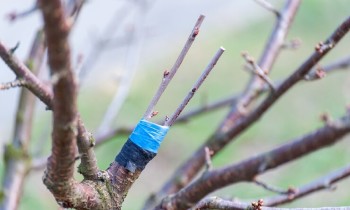
- Grafting by cuttings and buds.
- Growing from seeds.
Diseases and pests
- Scab.
- Powdery mildew.
- Hawthorn.
- Leaf roller.
Ripening and fruiting Royalty
The beginning of fruiting
 The beginning of fruiting
The variety is considered early-bearing, although the fruit is not usually harvested from the tree due to its inedibility. However, they begin to appear as early as 2-3 years after planting in open ground.
Flowering time
Flowering begins around early to mid-May, though its duration can vary depending on weather and climate conditions. For approximately 12-16 days, the tree delights with very large and fragrant inflorescences, after which they quickly fade and fall like rain. The flowers are large, predominantly pink or purple-pink, with fleshy petals, which cover the branches abundantly, making the apple tree in bloom a unique sight.
Fruiting and growth
The variety is considered to grow quite slowly, gaining no more than 15-25 centimeters of green mass per year. However, by the 10th to 12th year, it reaches its peak. This is also the period when peak fruiting occurs, when at least 15 kilograms of small, cherry-like, inedible fruits can be harvested.
They ripen around early to mid-September, making them considered autumnal. They look very impressive on the branches, can be used to create autumn arrangements, and even make a rather pleasant cider. They can be stored for about 2-4 weeks, no more.
Top dressing
- Superphosphate.
- Mineral complexes.
- Manure.
What to do if it doesn't bloom or bear fruit
- Check for pests and diseases.
- Transplant.
- Limit or increase watering.
Why do apples fall?
- Overripe.
- Natural factors.
- Pests.
- Diseases.
Leave your feedback on the winter-hardy Royalty variety to share your experience and knowledge with others.