
Baltika apple tree: characteristics of the variety and care
| Color | Reds |
|---|---|
| Ripening season | Autumn |
| Size of apples | Large |
| Taste | Sweet and sour |
| Crown type | Tall tree |
| Shelf life | Low shelf life |
| Application | For recycling , Fresh |
| Winter hardiness | High winter hardiness |
| Fruiting age | Up to 5 years |
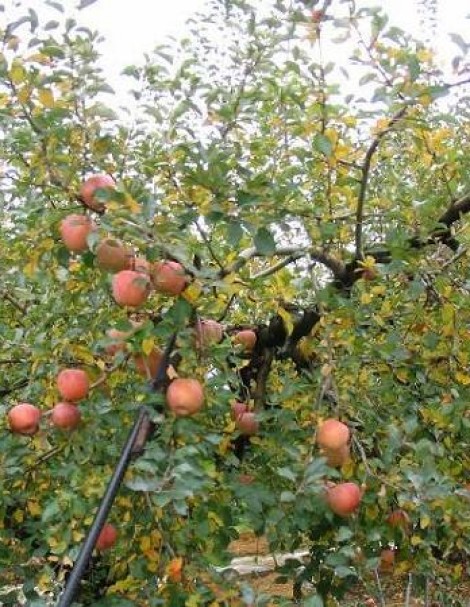
 History of origin and regions of growth
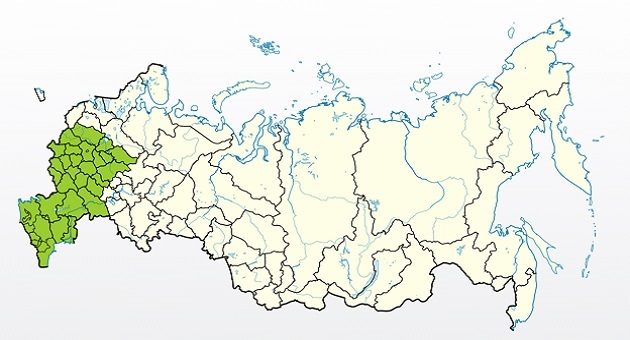
Growing regions
- Some northern regions.
- Middle zone.
- South of Russia.
Origin
A new variety, called Baltika, began to be developed in the mid-twentieth century at the Leningrad experimental station, which later became the Federal State Budgetary Scientific Institution "Institute of Agroengineering and Environmental Problems of Agricultural Production." The primary goal pursued by breeders P. I. Lavrikov and P. A. Zhmurko was adaptability to the variable weather conditions of the Baltic coast, Leningrad Oblast, and Moscow region, while also being hardy and adaptable to virtually any growing conditions.
The basis was the ancient Russian Borovinka variety, which was freely pollinated by various winter apple trees. Around the mid-1960s, the new hybrids were sent to various farms for field trials. They performed quite well and were considered elite. An application for regionalization and inclusion of the Baltika variety in the state register was submitted around the late 1990s, but approval was not received until 2002. At the same time, the apple tree was zoned for the aforementioned regions.
Content
Description of the Baltika apple variety
 Apple trees grow throughout almost all of our country. However, in the northernmost regions or where the climate is particularly unstable, with the weather changing overnight from bitter frosts to thaws accompanied by piercing sea winds, not every plant can survive, let alone bear fruit. The Baltika apple variety is one that easily overcomes these challenges, boasting enviable winter hardiness, high yields, and unusually tasty, distinctive fruits. Add to this resistance to scab and other fungal infections, and these trees are confidently recommended for small private plots and even intensive commercial orchards.
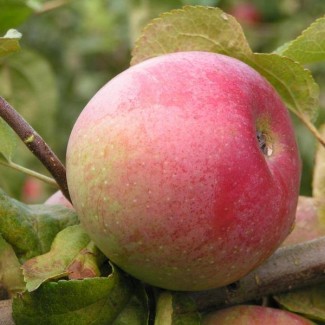
Apples: What they look like
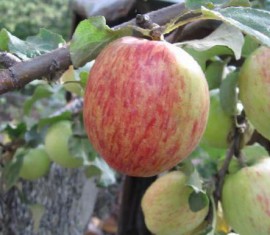
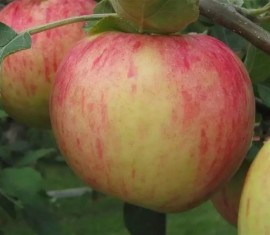
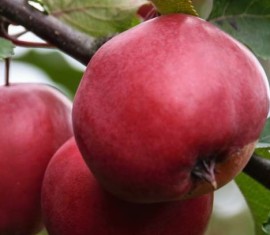
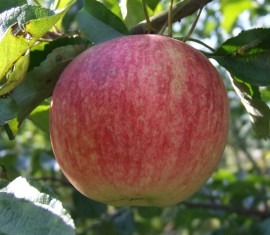
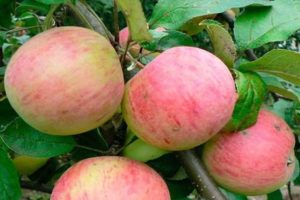 Baltika fruits are considered medium to medium-large, reaching a maximum weight of 130-140 grams. They are generally uniform in size, round, slightly flattened, and can be slightly turnip-shaped. They are smooth, with little ribbing.
The skin is fairly dense, strong, elastic, smooth, and glossy, with a slight waxy coating during ripening. It initially has a green base color, later turning yellowish-green or even lemon. The blush covers approximately 65-80% of the surface and is blurred, streaked, spotted, pink, or carmine-pink. Numerous subcutaneous dots are light gray with a light green hue, poorly visible against the spotted and striped surface. The chemical composition is characterized by the following indicators per 100 grams:
- P-active substances (catechins) – 243 milligrams.
- Ascorbic acid (vitamin C) – 9 milligrams.
- Total sugars (fructose) – 12.1%.
- Pectins (fiber) – 9.9%.
- Titratable acids – 0.87%.
The medium-dense, very juicy flesh is white or slightly creamy, crisp, and has a distinctive aroma. The flavor is considered harmonious, dessert-like, and balanced, leaning heavily toward sweetness with a subtle, characteristic tartness. A professional taster awarded it a 4.5 out of 5 possible points for appearance and flavor.
Apple tree Baltika: characteristics
Crown and root system
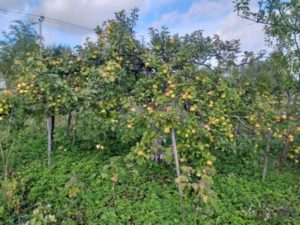 This tree is considered vigorous, as without formative pruning it can easily exceed 8-9 meters.However, in most cases, garden trunks are limited to 4.5-5 meters to facilitate harvesting and various maintenance procedures. In the early years, the crown is most often broom-shaped or inverted pyramidal, but over the years it rounds out, becoming increasingly oval, and sometimes even broadly oval. Branches extend from the trunk at an angle of approximately ninety degrees; they are strong, medium-thick, straight, and covered with brown or greenish-brown bark with a light pubescence.
The leaves do not cover the branches very densely. They are large, rounded, with a short, pointed tip. They are leathery, glossy, and dense, green or light green, sometimes with a slight yellowish tint, and have a coarse nervation. The leaf margins are wavy, with a finely serrated, crenate carina. The root system is deeply buried, penetrating, vigorous, and branched, often with a central branch.
Productivity and pollination
Baltika is a high-yielding fruit tree variety that can easily meet one person's needs for microelements and minerals for the entire winter.
One mature tree can produce approximately 170-200 kilograms of delicious fruit per season..
The variety is considered conditionally self-pollinating. This means that to produce apples, it's not necessary to have trees of different varieties in the orchard for cross-pollination. However, yields in this scenario will be no higher than 45-65%. Therefore, it's a good idea to plant nearby apple trees that bloom at the appropriate time to ensure a 100% yield. It's also a good idea to locate orchards near bee farms or use mobile apiaries.
Winter hardiness and disease resistance
This variety can withstand even the harshest winters and sudden temperature fluctuations. Frosts down to -32-37°C are practically unaffected, especially if the trees are properly and thoughtfully protected. Sudden changes in temperature, from extreme cold to thaw, strong, damp sea winds, and even drafts will be unaffected with proper care.
Resistance to various types of fungal infections is another advantage of the Baltika. It almost never gets sick. scab, powdery mildew, and other diseases, although it has no genetic immunity. Even if trees become infected, they quickly recover and recover after treatment. Most often, foliage is only slightly affected during years of severe epiphytotics, and the fruit remains fit for consumption.
Rootstocks and subspecies
Although the variety is over half a century old, only one subspecies is known: Baltika Zhigulevskaya. This hybrid generally matches all the characteristics of its parent variety, but has a much longer fruiting period. This means the fruits ripen gradually, rather than all at once. This allows you to enjoy fresh fruit for longer or simply spread out the harvest, making the task easier.
Peculiarities of growing Baltika
 Landing
 Landing
Basic conditions
- As with all apple trees, choose a sunny location for this variety. Trees grow poorly in the shade, and the fruit will be small, sour, and tasteless.
- Apple trees are highly resistant to cold and wind, but don't expect them to thrive in constant drafts. Therefore, it's best to choose a sheltered, preferably quiet, location, preferably on a southern or at least southeastern slope.
- The groundwater level plays a major role. It should be no higher than 2.5-3 meters, otherwise the tree's roots will inevitably reach it and rot. Some manage to protect against this by burying a sheet of slate or several layers of roofing felt or tar paper at a slightly higher depth.
- Baltika has no particular soil requirements; it grows well in black soil, loam, and even sandy loam. The main thing is to keep the acidity and salinity within the normal range; proper fertilization and feeding will help with the rest.
- It's best to prepare planting holes in advance, in the fall or spring, but at least 3-4 weeks before planting. Dig holes 1 meter in diameter and approximately 75-85 centimeters deep. Add a small amount of topsoil, mixed with fertilizer, to the bottom of the hole. Add drainage, and fill with 35-50 liters of water. Leave the entire area outdoors.
- The rhizome of the seedlings is inspected, all dry or damaged shoots are cut off, and it is placed in warm water for 4-6 hours.
- The distance between trees should be sufficient to prevent the crowns and extensive, powerful root systems from clashing. Ideally, the distance between rows should be at least 5.5-6 meters, and between plants within a row, 5-5.5 meters.
- Stake stakes are driven into the hole immediately for tying. Wooden stakes are preferred, but metal ones will do. They should be placed on the north side of the tree trunk and should not be removed until two or three years after planting.
- The prepared seedling is placed vertically in the hole, supported by the trunk. It is filled with soil, compacted gently. A small mound of soil, possibly dug from deep within, is created around the perimeter of the hole. The tree is watered with 35-45 liters of water, and the surface is mulched with straw, chopped grass, sawdust, and compost.
Landing dates
Baltika can be planted outdoors in both fall and spring. For the first option, wait until the leaves have fallen and the sap has frozen in the trunks. However, it's important not to wait for frost—at least 2-3 weeks should pass beforehand, around late September or early October. In the spring, make sure the threat of frost has passed (late March or early April) before planting. Experienced gardeners recommend the first option, as the trees take root better this way.
Protection from frost and rodents
Although this variety is resistant to various weather extremes, it will still need to be covered for the winter. A 15-20 centimeter layer of soil should be piled onto the root zone, which will need to be removed in the spring. You can also surround the trees with straw mats, wrap the trunks with roofing felt, tar paper, or burlap. Young seedlings are tall enough to be covered with a tent, which is not the case with mature trees.
To protect tree trunks from rodents, they can be coated with commercially available products, or with regular lard or grease. Whitewashing the trunks with regular lime to a height of up to 1.5 meters in spring and fall is effective against insects.
Tree care
 Tree care
Loosening the soil, watering: proper agricultural technology
Any plant loves fluffy, oxygen-rich soil, and apple trees are no exception. Therefore, the root zone should be dug up twice a year to allow the roots to "breathe." In between, you can hoe the soil, removing root shoots, weeds, and other shoots.
Watering the Baltic is not at all critical and is often unnecessary. However, if the weather is extremely hot and dry, and there has been no precipitation for 4-6 weeks, then approximately 15-20 liters of water can be applied twice, in the morning and evening; this will be sufficient.
Pruning: simple crown shaping
The tree isn't prone to excessive crown thickening, so the first crown shaping work usually begins around the 2nd to 4th year after planting. Two to four skeletal branches are left, and the rest are removed. Everything, including the central conductor, is shortened by one-third.
Be sure not to remove more than a third of the entire green mass, otherwise the apple tree may become diseased. Seal the cut areas with garden varnish or water-based paint. Dry or broken shoots protruding inward or upward should also be regularly pruned in the fall and spring.
Pollinator varieties
- Borovinka.
- White filling
- Idared.
- Sparan.
- Antonovka.
- Simirenko.
- Glory to the winner.
- Silver Hoof.
Reproduction
- Rooting cuttings.
- Grafting by buds and cuttings.
- Growing from seeds.
- Clones (layering).
Diseases and pests
- Moniliosis.
- Scab.
- Powdery mildew.
- Fruit rot.
- Cytosporosis.
- Tinder fungus.
- Scale insect.
- Green aphid.
- Codling moth.
Ripening and fruiting of the Baltic
The beginning of fruiting
 The beginning of fruiting
The variety isn't particularly early-bearing, but by the fourth or fifth year, it begins to produce a consistent harvest. True, you'll only be able to harvest 5-15 kilograms of delicious apples at this time, but you'll be able to experience it. Until then, it's recommended to remove any buds or ovaries that appear.
Flowering time
The tree blooms in May, but the exact timing can vary slightly depending on the region. For example, in the south, they may produce buds as early as the beginning of the second ten-day period, while in more northern regions, they don't appear until the end of the month. The process lasts approximately 10-15 days, giving the bees time to do their work. The tree's flowers themselves are beautiful, medium-sized, gathered in clusters, snow-white or with a slight pink tint.
Fruiting and growth
The apple tree grows fruit at a moderate rate; by the 8th or 9th year, a good, full-fledged harvest of 160 kilograms or more of fruit can be achieved. The tree itself also grows at a moderate rate, gaining approximately 20-45 centimeters during the growing season. Before fruiting begins, growth is much more vigorous, but afterward, it slows down significantly.
Baltika apples ripen uniformly, so you can set aside 1-2 days in mid- to late September to harvest. However, their shelf life leaves much to be desired. Under suitable conditions with the right humidity and temperature, they can be stored for no more than 30-45 days, and even then, only very limited. It's best to eat or process the fruit completely within a month; after that, they will lose their texture, become loose, sour, and tasteless.
Top dressing
- Superphosphate.
- Compost.
- Nitrogen fertilizers.
- Humus.
- Potassium complexes.
- Ammonium nitrate.
- Manure.
What to do if it doesn't bloom or bear fruit
- Check for pests and diseases.
- Transplant.
- Limit or increase watering.
Why do apples fall?
- Overripe.
- Natural factors.
- Pests.
- Diseases.
Leave your feedback on the winter-hardy Baltika variety to share your experience with others.




Comments
I want to use this variety for growing and selling apples. I have one question: is there a way to speed up the ripening process? Are there any methods?