All apple leaf diseases: causes, symptoms, consequences
Apple tree leaves are an indicator of disease or nutritional problems. Poor agricultural practices, weather conditions, and viruses can cause significant damage to an apple orchard. It's important to recognize signs of damage early to preserve the harvest and a healthy tree.
Content
Rust
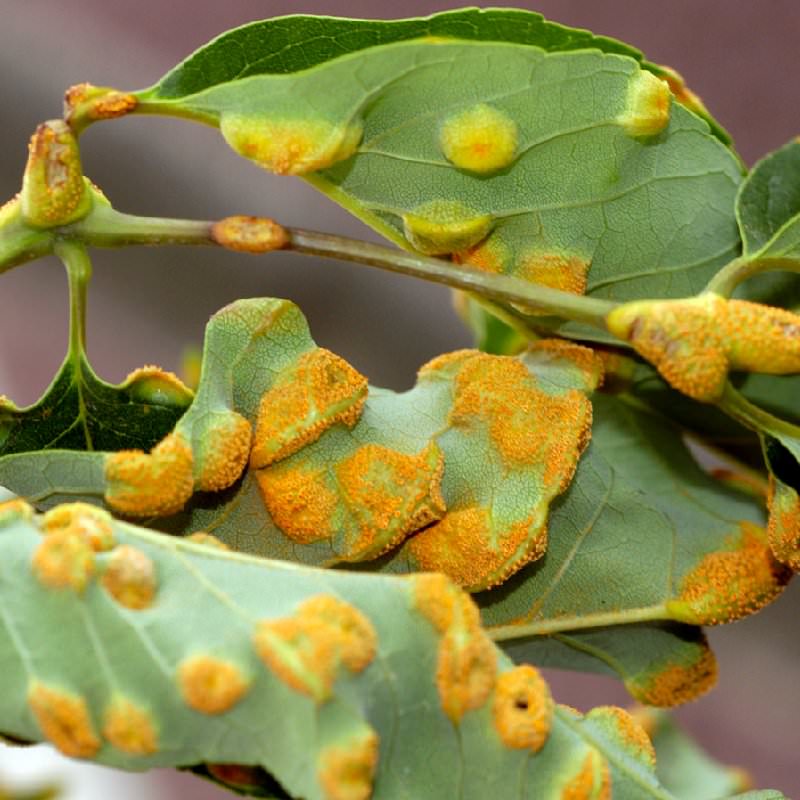
Columnar rust is a disease caused by a rust fungus that attacks apple tree leaves. The mycelium varies in color, from yellow and bright orange to red and brown.
Signs and course of the disease:
- In the initial stage of the disease on the upper dark Small yellow or orange spots appear on the side of the leaf.
- As the disease progresses, the mycelium grows through the leaf, and brightly colored convex columns form on the underside, which quickly spread over the surface.
- The spores of the fungus, which have matured in the columns, disperse throughout the tree within 24 hours; the affected leaves stop producing chlorophyll and fall off.
- Lack of nutrition in apple trees leads to fruit shedding.
- Without timely treatment, spores penetrate the tree trunk, leading to the death of young shoots and cracking of the bark.
The disease does not lead to the death of the apple tree, but significantly reduces frost resistance and yield.
Causes of infection:
- weeds in the tree trunk circle;
- the presence of a source of infection within a radius of 50 m.
Mosaic
Mosaic is a disease caused by a virus that multiplies in living tree cells.
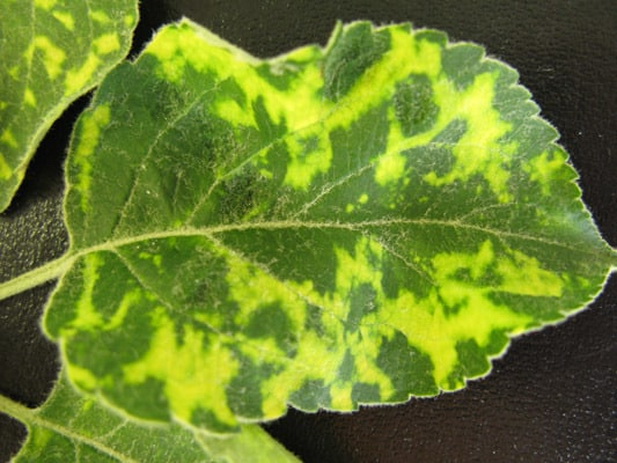 Signs and course of the disease:
- The initial stage is characterized by the appearance of a yellow or whitish pattern along the veins of the leaves.
- As the disease progresses, the leaves become completely lighter in color but do not fall off.
- The apple tree stops developing, new leaves do not grow, and fruiting does not occur.
There is no cure for the mosaic virus. Affected leaves and young shoots should be removed as soon as they are detected and burned, thereby preventing the virus from reproducing. Otherwise, the apple tree will die.
Causes of infection:
- planting material infected with a virus;
- presence of pests;
- unprocessed tool for pruning branches.
Scab
Apple scab is a disease caused by ascomycetes that infect all above-ground parts of the apple tree. Mature spores overwinter in fallen leaves and fruits or in the topsoil.
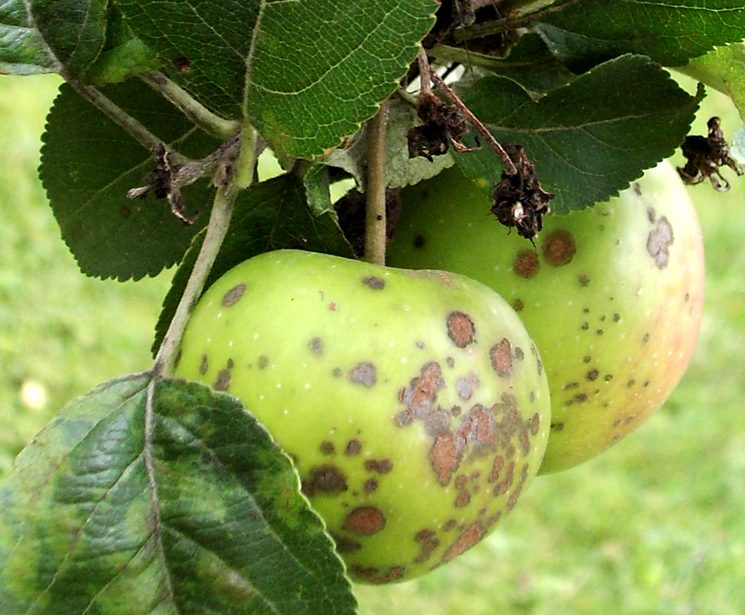 Signs and course of the disease:
- The initial stage is characterized by the appearance of dark yellowish-green spots on the upper leaves of young shoots.
- Within 14 days, the spots grow, their center darkens and cracks, and the spores spread and affect all the leaves of the apple tree.
- Within 21 days, scab affects young shoots, ovaries and fruits.
- The leaves harden and fall off, the fruits become deformed, brown or black velvety spots appear on them, and the flesh cracks.
- If left untreated, the fruits fall off and spores penetrate the tree trunk, causing the bark to crack.
The disease most often does not lead to the death of the apple tree, but it significantly reduces frost resistance and yield, and also degrades the taste of the fruit.
Causes of infection:
- high humidity (more than 90%) at low temperature (less than +15 °C);
- dense plantings;
- lack of formative pruning;
- last year's fallen fruits or leaves that have not been collected.
Black crayfish
Black crayfish – a fungal disease that affects the tissues of the tree trunk, but its first signs can be found on the leaves of the apple tree.
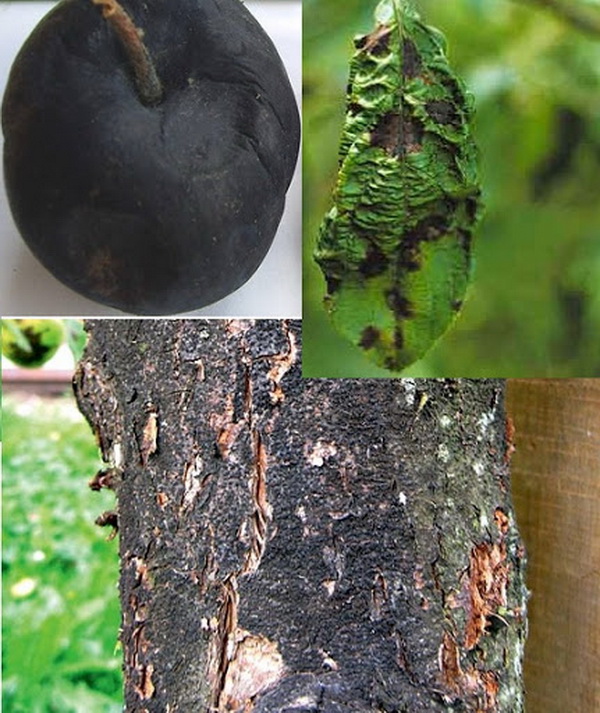 Signs and course of the disease:
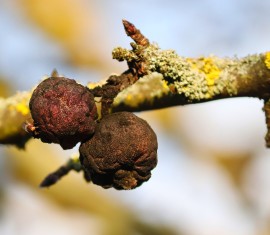
- Fungal spores penetrate into cracks in the bark caused by thermal or mechanical damage.
- In the initial stages of the disease, small spots (1–3 mm) of dark red or brown color appear on the leaves. The bark of young shoots peels off, flower petals darken, and dark, rotting lesions appear on the fruit.
- The spots on the leaves expand and turn gray. The bark of the tree trunk becomes bumpy, developing sunken spots of dark red or purple hue. Young shoots die. Fruit buds that appear on the apple tree at this stage of the disease dry up but do not fall off. Fruits of varying degrees of ripeness turn completely dark gray.
- The leaves turn black and fall off, the bark peels off, revealing dark gray or dark brown wood.
- The black color of a skeletal branch, part of the crown, or the entire tree indicates its death.
The disease leads to the death of the apple tree within 1–2 years.
Causes of infection:
- thermal or chemical burns of the bark;
- age of the tree (apple trees older than 18 years are most susceptible to the disease);
- Violation of formative pruning technology, mechanical damage.
Fungal spores black crayfish are capable of developing not only on living wood, but also on dead tissue.
Powdery mildew
Powdery mildew (white, ash) is a disease caused by powdery mildew fungi.
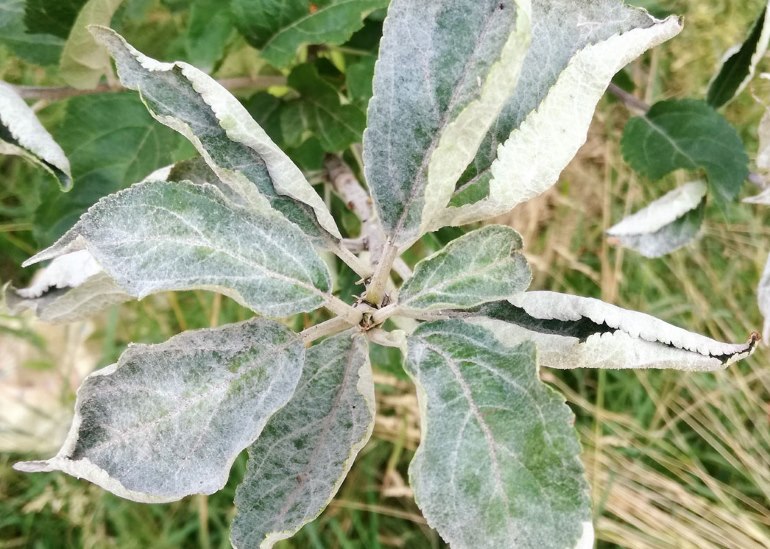 Signs and course of the disease:
- White fungal mycelium develops primarily on the leaves at the base of the tree. The upper surface of the leaf blade becomes covered with a powdery coating that can be easily wiped off by hand but reappears within a few minutes.
- After the spores mature, drops of liquid (dew) appear on the surface of the leaf.
- The plaque darkens, acquiring a yellow, gray or light brown tint, while the spores affect all the leaves of the tree crown and young shoots.
- Leaves curl and fall off, young shoots dry up. Fruit ovaries fail to form or become coated and die. Fruits stop developing, turn pale, become covered in a brownish net, and fall off.
Powdery mildew spreads quickly, reducing the apple tree's resistance to frost and pest damage.
Causes of infection:
- dense plantings;
- lack of formative pruning;
- the presence of weeds in the tree trunk circle;
- last year's fallen fruits or leaves that have not been removed;
- availability aphids or ants.
Moniliosis
Moniliosis – a fungal disease that has two forms, caused by different pathogens. The first, early form is called molinial burn, as it exhibits similar symptoms to various types of burns. The second form is fruit rot.
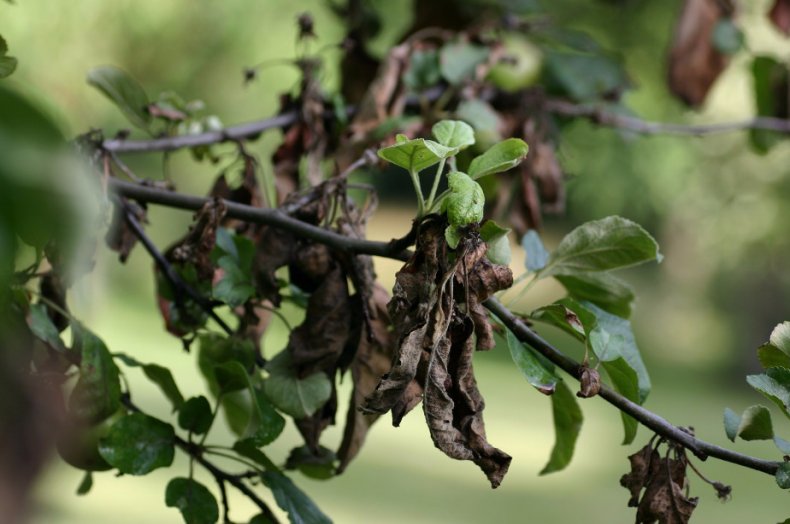 Signs and course of a molinial burn:
- It appears during flowering, the spores are spread by insects, mainly bees.
- First of all, the apical leaves of the branches and young shoots turn black.
- As the disease progresses, young branches dry out and die. Similar symptoms are characteristic of chemical burn of the tree.
- The ovaries darken, die, but do not fall off, which is also typical of thermal burn.
Signs and course fruit rot:
- Brown putrefactive spots form on the fruit skin, which quickly affect the entire pulp.
- The danger of the disease is that it cannot be detected at an early stage. Affected fruits moniliosis, are subject to destruction.
The disease is characterized by a rapid progression and can lead to the death of the tree within 1–3 years.
Causes of infection:
- last year's fallen fruits or leaves that have not been removed;
- presence of pests.
Bacteriosis
Bacteriosis (bacterial blight, necrosis) is a disease caused by gram-negative bacteria. A characteristic feature of necrosis is that it often occurs in conjunction with the early form. moniliosis and has a similar disease progression. Through leaves and shoots damaged by fungi, bacteria penetrate the trunk and spread throughout the tree through sap-carrying vessels.
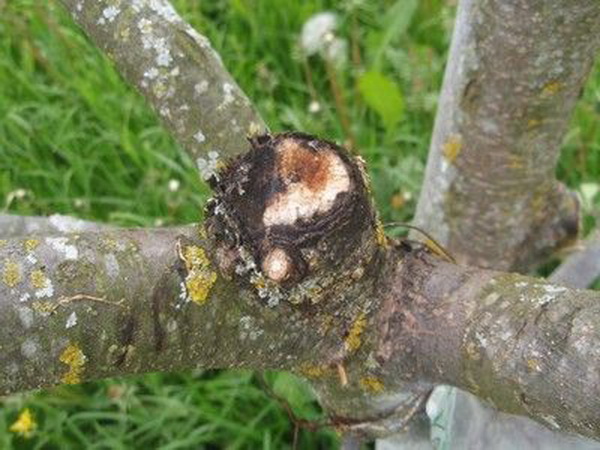
Signs and course of the disease:
- Pink or reddish spots form between the veins of the leaves.
- Young shoots dry out within 24 hours.
- The dying off of leaves and shoots begins from the upper part of the crown.
- The tree bark becomes covered with a white sticky coating, which subsequently darkens.
- Leaves, ovaries and flowers dry up, die, but do not fall off.
Bacteriosis is dangerous and can lead to death within a year. Moreover, it reduces the chances of an apple tree surviving frosts to 5%.
Causes of infection:
- infected planting material;
- moniliosis;
- high air temperature (more than +30°C) combined with high humidity (more than 90%);
- last year's fallen fruits or leaves that have not been removed;
- lack of preventive treatment;
- presence of aphids or ants.
Bacterial wilt is a deadly disease for apple trees. To prevent it from developing during moniliosis, the affected branch should be cut back to the ring and inspected for any affected internal tissue.
Milky shine
Milky shine is a fungal disease that occurs quite rarely.
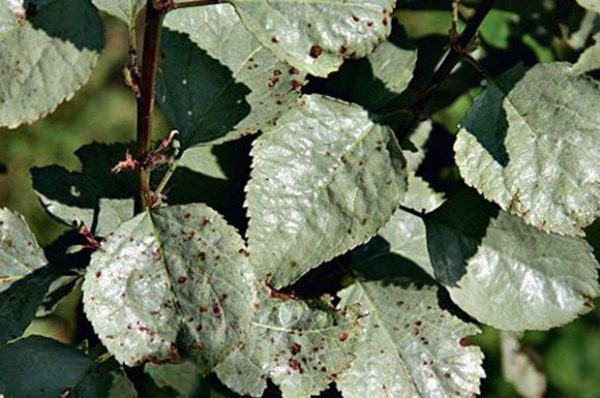 Signs and course of the disease:
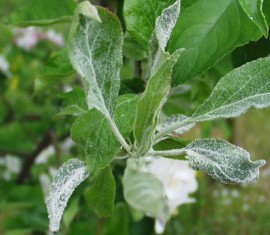
- In the initial stage of the disease, the leaves become covered with a light-grey pearlescent coating that does not rub off with mechanical action.
- The leaf blade delaminates, creating an air space in the cavity, causing the crown to acquire a silvery color.
- Affected leaves turn yellow and become covered with dark brown spots.
- Complete leaf death begins at the tip, which turns black and dries out first. At this stage of the disease, dark spots appear on the bark, indicating a fungal attack on the trunk and skeletal branches of the apple tree.
- The leaves fall off completely, cut Brown rings of dead tissue are visible on the branches.
The disease reduces the apple tree's resistance to frost and can lead to death within 2–3 years.
Causes of infection:
- the presence of weeds in the tree trunk circle;
- last year's fallen fruits or leaves that have not been removed;
- presence of aphids or ants.
Phyllostictosis
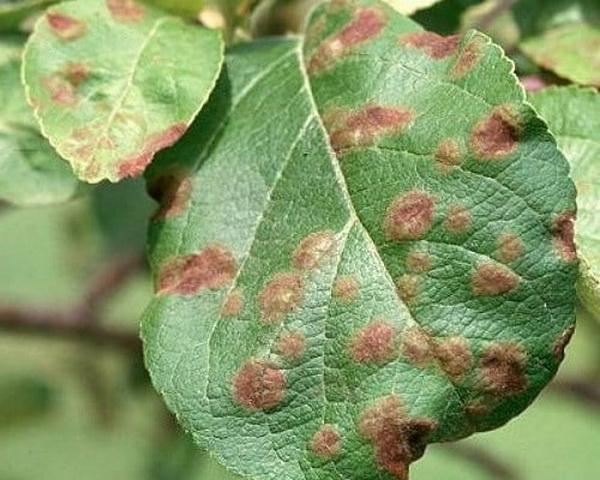 Phyllostictosis (brown spot) is a fungal disease that primarily affects tree leaves.
Signs and course of the disease:
- Spots of varying colors—from yellow and brown to brown and black—form on the leaves. The spots are round or elongated, with a diameter of up to 5–7 mm, with or without a black border.
- Within 10–12 days, the fungal spores mature and the spots become covered with a transparent film.
- The leaf dries up, dies and falls off.
- The fruits stop developing, and the fungus causes brown spots on their skin. Their flavor is significantly impaired, and they don't ripen fully.
The disease does not lead to the death of the tree, but it significantly reduces the frost resistance of the apple tree and leads to crop loss.
Causes of infection:
- dense plantings;
- lack of formative pruning;
- the presence of weeds in the tree trunk circle;
- last year's fallen fruits or leaves that have not been removed;
- presence of aphids or ants.
Sooty mold
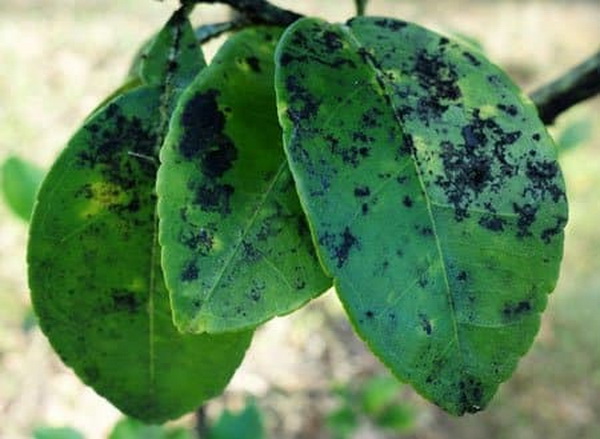
Sooty mold – apple tree leaf infection by fungal mycelium, which can only develop in honeydew. This fluid is the byproduct of aphids, scale insects, or leafhoppers.
 Signs and course of the disease:
- A sticky, clear liquid appears on the leaves, indicating the presence of pests.
- The surface of the leaves turns grey – this is the first sign of fungal development.
- The maturation of spores produces a black sooty coating that is difficult to remove mechanically.
- The leaves harden, die and fall off.
Sooty mold does not kill the apple tree, but it significantly reduces its frost resistance. Even if the pests causing the fungus are completely eradicated, the tree, deprived of some leaves, suffers from a lack of nutrients, and consequently, the quality of the fruit is significantly reduced.
Causes of infection:
- the presence of aphids, ants, scale insects or leafhoppers.
Chlorosis
Chlorosis is a mineral deficiency. Certain leaf color changes indicate fertilization errors:
- NitrogenIf there's a deficiency, the leaves turn yellow, and young shoots take on a red tint. If there's an excess, young leaves and shoots grow faster, and the crown takes on a dark green color.
- PhosphorusSmall young leaves and the absence of young shoots, as well as reddening of the leaf veins and petioles in cases of deficiency, and in cases of excess, are signs of rosetting.
- PotassiumA deficiency of this mineral leads to the death of leaf tissue from the edges to the center, while an excess leads to the drying out of individual shoots.
- CalciumA deficiency manifests itself as lightening of leaf tips and leads to disruptions in root development. Oversupply results in yellowing of leaf blades, and fruit development that fails and becomes smaller.
- IronIf there is a shortage, the leaves turn light yellow, sometimes even white, and fall prematurely, 30–45 days later. The apple tree doesn't have time to develop frost resistance and may die.
Chlorosis is not a disease, but the nutrient deficiency it signals can lead to reduced yields, frost resistance, and death of young shoots, bark, or roots of the apple tree.
Rosetteness
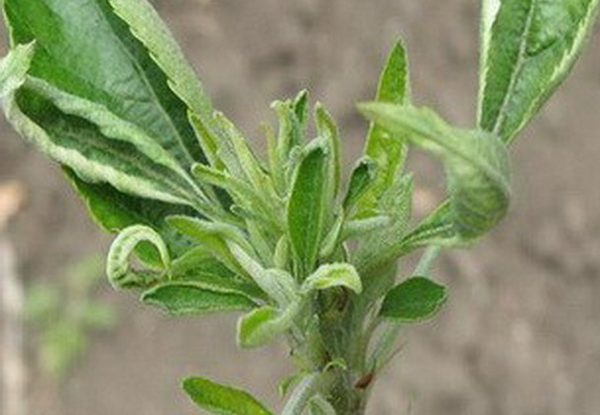 Rosette disease (small leaf disease) is a non-infectious disease caused by inadequate zinc fertilization of apple trees. It appears in early to mid-summer.
Characterized by:
- the growth of small leaves, while their color is significantly paler than that of a healthy tree;
- upward-curved edges of leaf blades;
- the shape of a leaf twisted into a tube.
The fruits of such a tree do not form or grow small and tasteless.
Conclusion
Apple tree leaf diseases can be caused not only by fungal mycelium or viral strains, but also by adverse weather conditions or lack of proper care. Recognizing the first signs will help promptly identify the cause, initiate treatment, and preserve the orchard.