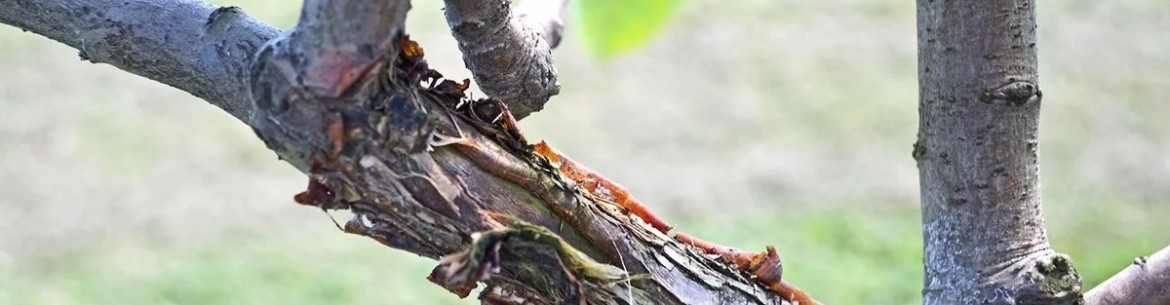
Black apple tree cancer: photos, symptoms, and treatment
Apple canker is a dangerous disease that most often affects fruit crops in regions characterized by constant temperature fluctuations. Immediate treatment and preventative measures are necessary when the first signs of the disease are detected; otherwise, the infection will spread throughout the orchard and destroy it within 2-3 years.
Content
Description of the disease
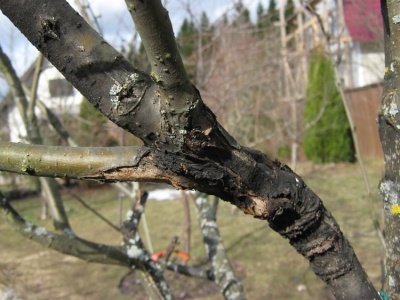
The causative agent of black cancer is a marsupial mushroom (Sphaeropsis malorum Peck), a member of the Botryosphaeriaceae family. Spores of the pathogenic fungus penetrate the tree through various surface wounds, infesting not only living but also dead tissue. Old apple trees over 20 years old are most susceptible to this infection.
The fungal mycelium overwinters in tree bark, and in early spring, wind, rain, and insects spread it throughout the garden.
The disease received the name "black cancer" due to the characteristics of its progression, similar to the formation and development of a cancerous tumor, that is, the intensive division of pathogenic cells, which contributes to the death of living tissues of any organism.
Favorable conditions for infection
Optimal conditions for the activation of fungal spores are elevated temperatures and humidity. Potentially dangerous months for apple trees are April and May, as the soil, still damp after the snow melts, provides a favorable environment for fungal infection.
Air temperature
 Maximum viability of pathogens fungus It manifests itself at temperatures ranging from +22 to +28°C and humidity levels up to 80%. Under such conditions, harmful microorganisms will need no more than 6 hours to fully mature.
Due to its high vitality, the causative agent of black cancer does not die even at temperatures up to +40 °C.
Low immunity
Old apple trees, as well as those weakened by inadequate care, are almost unable to resist infection, so they are the first to be attacked. Having penetrated the woody tissue of older trees, the mycelium actively reproduces, quickly spreading throughout the orchard.
Young, vigorous trees are more resistant to the disease, and their rapid tissue regeneration prevents fungal spores from penetrating the wood. Young trees and adherence to basic agricultural practices do not guarantee 100% protection against black canker, but they significantly reduce its likelihood.
Failure to comply with agricultural principles
Improper pruning, neglecting wound treatment, and allowing the crown to become overly dense all contribute to the spread of black canker to trees. The disease also poses a high risk to crops affected by pests, fungal, and bacterial diseases: powdery mildew, scab etc. Settled on trees lichens and mosses stimulate the development of infection by providing it with warm and moist conditions.
Consequences of over-grooming
Excessive use of fertilizers leads to their excessive accumulation in the soil, which creates a breeding ground for fungal infections.
Landing errors
Insufficient spacing between apple trees accelerates infestation in the orchard. Due to limited space, many gardeners prefer dense plantings. In this case, regular inspection and enhanced care will reduce the likelihood of infection.
It is unacceptable to grow fruit trees near toilets and compost pits, as these are places where organic matter actively decomposes. The optimal distance from them is 3 meters or more.
The following factors also increase the risk of developing black cancer:
- too deep planting (deepening of the root collar);
- stagnant water in an area caused by insufficient drainage.
Signs of infection
Black canker is difficult to recognize in its early stages, so it's recommended to inspect apple trees frequently for any signs of damage. If the first signs are detected, treatment should begin immediately.
On the bark
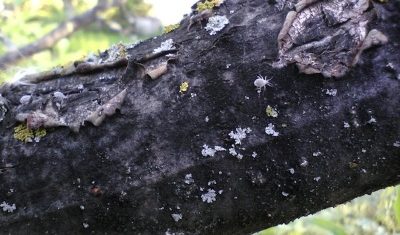
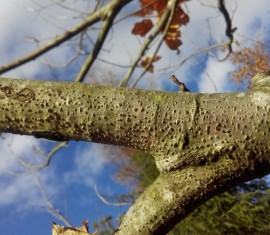
Infected bark causes the tree to die within three years. The incubation period after infection is two to three weeks. Typically, infection is indicated by a wound surrounded by purple-brown spots (pycnidia), which gradually expand across the surface and turn black.
As the disease progresses, the spots transform into deep dents. The bark begins to deteriorate and peel, and the damaged areas appear charred.
Flowers
Flowers affected by black canker turn brown, become deformed, and dry out. The pistil and stamens turn black.
Fruit
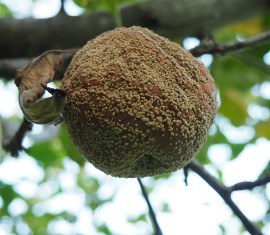
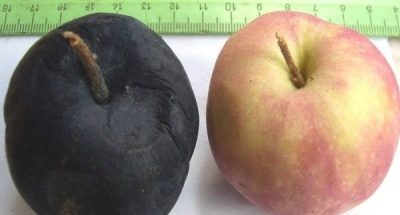 The infection typically affects ripe fruit. The incubation period lasts 6–9 days. After this, dark spots appear on the surface, gradually expanding. The apples begin to shrivel, mummify, and turn a distinct black color.
Leaves
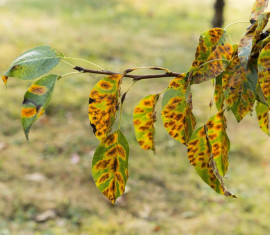
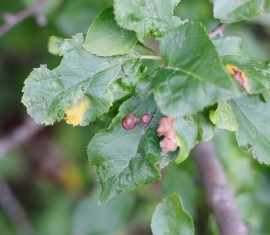
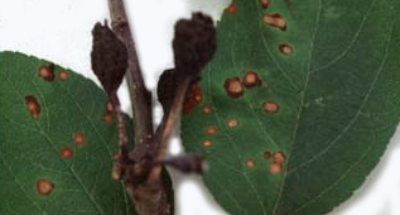 The disease appears on leaf blades as reddish-brown specks, which gradually turn gray and form rings around them. As the disease progresses, the number of spots increases, leading to leaf wilting and death. The affected apple tree loses all its leaves within two months.
Similarities with other diseases
Black cancer can be confused with other conditions with similar symptoms. To avoid misdiagnosis and choose the right treatment, it's important to understand the key differences between these conditions:
- Cytosporosis – the appearance of gray spots on the bark that do not subsequently turn black and do not resemble charring. The bark does not peel, but due to structural changes, it takes on a frayed appearance.
- Common cancer is the formation of growths with dark red bumps on the surface of the bark.
- Moniliosis – the fruits acquire a black color with a blue tint.
Often, along with black cancer, apple trees are also affected by other infections.
Danger to humans
Black cancer is not dangerous to humans; however, eating affected fruits is unacceptable.
Treatment method
If the disease affects the trunk or skeletal branches and is in its final stages, the tree is uprooted and destroyed. In other cases, the disease is treatable with a comprehensive approach.
Cleaning procedure
First of all, the entire garden is subjected to sanitary treatment, which includes:
- collection of infected fruits and leaves;
- pruning of affected tree fragments;
- destruction of all plant debris in a fire (this procedure is only permissible outside the garden plot).
Processing of the bark of skeletal branches and trunk
Skeletal branches completely affected by black canker are pruned just below the area bordering healthy tissue. Partially damaged branches are removed, including a small portion of healthy tissue.
Treatment can only begin after all infected parts have been removed.
Disinfection operations
After pruning, all cut areas are treated with antibacterial agents; the following are well suited for this purpose:
- copper sulfate solution (1–3%);
- concentrated solution of potassium permanganate.
After the wound has dried, a layer of special oil paint or garden pitch is applied to it to prevent moisture and air from getting in, which could cause a relapse.
Further treatment
 Since black canker spores are easily carried throughout the garden, treating only the affected tree is not sufficient. In this case, all growing crops should be treated preventatively.
Principles of garden cultivation
Preventative measures include spraying all vegetation in the garden with fungicides. The soil around tree trunks is liberally irrigated with antifungal agents.
Use of folk remedies
In addition to chemical preparations, it is permissible to use compositions prepared according to folk recipes as disinfectants, for example:
- solution of salt and iodine;
- laundry soap shavings dissolved in water (72%);
- gruel of sorrel leaves (for application to wounds);
- washing powder diluted in water.
Clay and mullein
To obtain a working solution using this recipe, cow manure is mixed with clay in a 1:1 ratio, then water is added. The consistency should be easy to apply to the affected areas, without clumping or dripping. The solution is applied to pre-treated and disinfected wounds, covered with a bandage, and then another healing layer is applied on top.
During the growing season, the coating must be periodically moistened with water and coated with the mixture.
Rosin, nigrol and wax
The drug is prepared as follows:
- separately from each other, heat up rosin, nigrol and wax in equal parts (paraffin can be used as a substitute);
- The hot ingredients are combined and mixed thoroughly.
The putty is stored in a glass container and applied using the same principle as garden varnish.
Garden soil
In this case, the sealant is a fungicide-treated soil that's lightly moistened with water. Since this sealant is easily washed off, reapplication is required after rain.
Apple bark
To treat black cancer, experienced gardeners recommend the following:
- cut a piece of bark from a healthy apple tree;
- give it the same shape as the wound;
- apply to the damaged area and bandage;
- coat all joints with garden pitch.
Additional ways to combat the disease
 A strong solution of potassium permanganate, which has antibacterial properties, is often used to treat black canker. For this purpose, potassium permanganate is diluted with water at a ratio of 5 g per 10 liters. The solution is used not only to treat wounds but also to treat the entire tree.
Antibiotics
The most common antibiotics used to treat black cancer are:
- tetracycline;
- streptomycin.
The garden is treated in the following sequence: first, streptomycin is used, and the following season, tetracycline.
Stem injections
This method doesn't require pre-treatment; a single spray with fungicides is sufficient. Injections involve injecting streptomycin into the wood. The procedure is carried out as follows:
- at a height of 1 m from the ground, a small hole is made in the trunk into which the antibiotic will be introduced;
- after the procedure, the injection site is sealed with any object in the form of a cork;
- The operation is repeated up to 5 times with a frequency of 1 time per week.
Each skeletal branch that is more than 15 cm thick is subject to injection treatment.
Drugs used
All means used to combat black cancer in fruit crops are conventionally divided into 3 groups:
- antiseptics – RanNet paste, ZSP anticancer putty, Robin Green biological balm;
- to destroy spores - Topaz, Fitosporin, Horus and others;
- to strengthen the immune system - "Humate P", "Baikal M", "Obereg", "Zircon".
Copper-containing preparations
These agents are used to disinfect wounds and kill fungal spores, while copper sulfate also enriches the soil with beneficial microelements. The most common ones are:
- "CHOIR";
- Bordeaux mixture;
- "Oxychom".
Top dressing
To speed up the recovery process, fruit crops are fed with mineral supplements. In cases of black canker, the use of organic fertilizers is unacceptable due to the risk of relapse.
Use of antifungal compounds intended for human use
It is impossible to eradicate black canker on trees using drugs made for human treatment due to the different etiologies of the disease in humans and plants.
Duration of treatment of the disease
 Operations to combat black cancer are carried out in early spring or late autumn:
- In spring, perform sanitary pruning (until mid-April). Spray with fungicides before and after bud break, and repeat the procedure after flowering.
- In the fall, infected tree sections are pruned for sanitary purposes, the wounds are cleaned, treated with an antiseptic, and sealed. The trunk and skeletal branches are whitewashed with lime mortar.
Preventive measures
Measures aimed at preventing the infestation of the garden with black cancer include a number of operations:
- timely pruning of the crown with subsequent processing of the cut areas;
- correct planting of seedlings while maintaining distance;
- adjustment of the feeding and watering regime;
- arrangement of drainage systems;
- periodic cleaning of the garden area, destruction of plant debris.
Resistance to infection
When choosing apple tree varieties for cultivation, it's best to choose those that are as tolerant of low temperatures and fluctuations as possible. This will reduce the risk of bark damage during winter.
Preventing black canker is much easier than curing it. Therefore, it's important to follow all agricultural practices and garden care recommendations.

Comments
Hello!
Our young apple tree has some damage to its trunk.
We ask for help on how to treat.
Thank you!
How much streptomycin should I inject into an apple tree? The percentage is clear, but no one writes the amount...