Apple tree Wem pink: characteristics of the variety and care
| Color | Reds |
|---|---|
| Ripening season | Autumn |
| Size of apples | Small ones , Average |
| Taste | Sweet and sour |
| Crown type | Average tree height |
| Shelf life | Average shelf life |
| Application | Fresh , For recycling |
| Winter hardiness | High winter hardiness |
| Fruiting age |
 History of origin and regions of growth
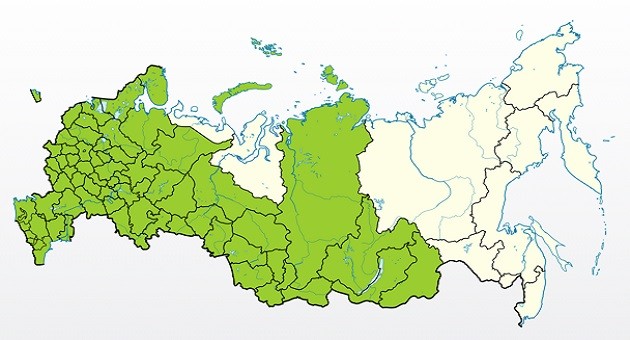
Growing regions
- Middle zone.
- Crimea.
- South of Russia.
- Siberia.
- North Caucasus.
- Ural
- Some northern regions.
- Moscow region.
- Leningrad region.
Origin
This variety was developed at the experimental farm of the Sverdlovsk Horticultural Breeding Station of the Russian Academy of Agricultural Sciences. It was invented by Russian biologist Leonid Andrianovich Kotov. The first hybrid seedling was only obtained in 2009, so the variety is considered experimental. It received its name from the presence of a special gene, VM, which can protect apple trees from four main types (races) of the common apple scab disease.
Scientists don't yet have a consensus on resistance to the fifth race, as it's common in southern regions where trees are only just beginning to be grown. No official application for inclusion of the Vem Pink variety in the State Register has yet been submitted, and the apple tree hasn't yet been zoned. However, its performance is so good that there's hope that information about it will soon appear in official sources.
Content
Description of the Wem Pink variety
 Before deciding to grow a particular apple variety in their garden, experts and amateurs evaluate and compare their unique properties and qualities. Wem Pink is attractive for its high winter hardiness, good endurance, and undemanding nature, even in fairly harsh growing conditions. The trees are medium-compact, produce large yields, and are completely resistant to northern species. scabies, are quite resistant to other infections and are rarely attacked by insects.
The fruits themselves look good and taste very pleasant. They retain their quality almost until spring. Their thick skin makes them suitable for long-distance transport. The fruit's small size is considered a major drawback, but this is more than compensated for by the large quantity of apples. They are recommended for growing in small plots near the home or in large, intensive industrial farms.
Apples: What do they look like?
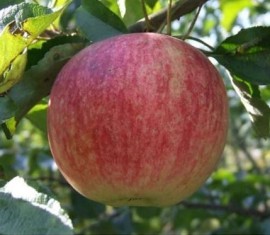
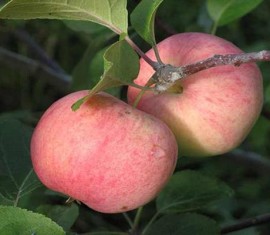
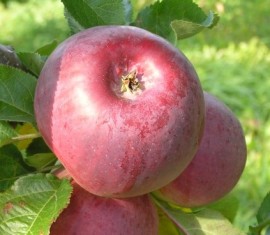
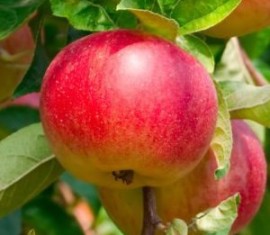
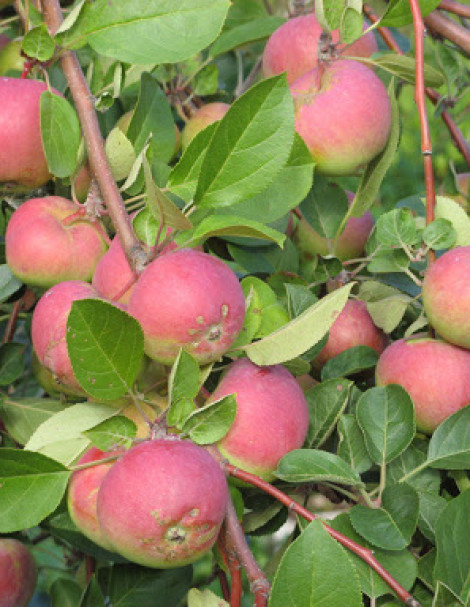
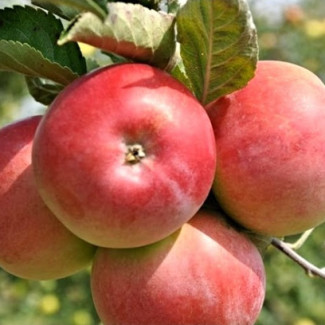
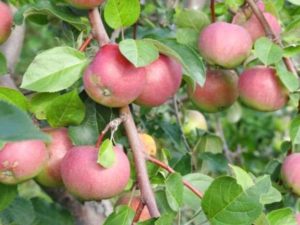 The fruits are generally uniform, medium to smaller than average in size, round or slightly round-conical. They can only grow to 80-120 grams in weight, even with truly high-quality and timely care. Occasionally, apples may have a slightly slanted shape on one side and clearly visible ribbing on the calyx side.
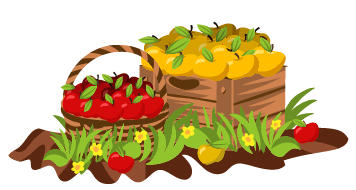
The fruit's skin is dense and thick, capable of protecting the flesh from mechanical damage. It is elastic, smooth, and more matte than shiny. When fully ripe, it becomes covered with a silvery, waxy coating. The blush is dense, diffusely mottled, rich, pinkish-red, crimson, or reddish-purple, and covers approximately 75-80% of the surface. Subcutaneous punctures are small, light, and not very visible. Chemical composition can be estimated using the following sample:
- P-active substances – 324 milligrams.
- Ascorbic acid (vitamin C) – 12.6 grams.
- Sugar (fructose) – 10.1%.
- Titratable acids – 0.75%.
- Pectins (fiber) – 13.9%.
The flesh is quite dense but coarse-grained, with a clearly visible and palpable texture. It is richly juicy, and the flavor is considered sweet and sour, harmonious and balanced, considered a dessert fruit. Professional tasting scores are no less than 4.7-4.8 out of 5.
Apple tree Wem pink: characteristics
Crown and root system
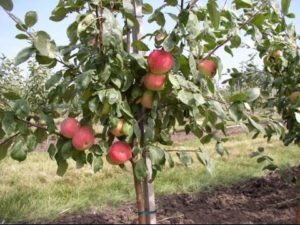 The variety is usually considered medium-sized, as its maximum height is 4.5-5 meters without formative pruning.However, most gardeners, both in commercial plantings and in private gardens, prefer not to allow the trees to reach such a large size, limiting their growth to 3.5-4 meters. The crown shape is oval, pyramidal, and neatly compact when young, but with age it can easily become broadly oval, spreading, and even weeping. The branches are mostly at right angles to the trunk, thin, long, and covered in smooth, glossy bark of a reddish-brown or cherry-brown hue.
The leaves are flattened, leathery, glossy, very dense, mostly smooth but may have slightly wavy edges, and rarely fold into a boat shape. They are green, bright green, or a very rich green. The nerves are delicate, the leaf edges are serrate-crenate, finely serrated, and the tip is short-pointed. The root system is highly branched, robust, well-dug, and adapted for searching for water in the soil.
Productivity and pollination
This apple tree is considered not only one of the earliest-fruiting, frost-resistant varieties, but also one of the most productive.
Experienced gardeners harvest at least 75-95 kilograms of beautiful, juicy apples per season from a fully developed Vem Pink shamba. However, under favorable weather and climate conditions, yields of over 110-130 kilograms can be achieved. Even the most advanced pomologists won't be able to squeeze more from an apple tree..
To obtain fruit, you won't need to plant other apple trees nearby, as it's completely self-fertile. This means that wind and bees will handle the task on their own. However, experts advise not to neglect cross-pollination with other varieties to maximize yield. It's also a good idea to spray the trees with sugar or honey syrup during flowering, or to bring a mobile apiary to the orchard.
Winter hardiness and disease resistance
A key issue for many gardeners in our country remains the tree's tolerance to low temperatures and sudden fluctuations, from thaws to severe frosts. The Vem variety is particularly well-suited for this. It can withstand frosts of -37-42°C without significant damage, and even if it does experience light frosts, it recovers almost completely within just one season.
As mentioned, the tree is immune to scab, as immunity is genetically determined. Apple trees are also quite resistant to other fungal and bacterial diseases. However, preventative treatments should still be carried out promptly, along with insect repellent sprays.
Rootstocks and subspecies
The apple tree itself is a subspecies, so it's unlikely that any varieties will be developed. However, it is grown on various rootstocks, imparting certain unique characteristics to the trees. There is no such thing as a columnar pink Wem; if you're offered something similar at the market, it's likely a scam.
Features of growing pink Wem
 Landing
 Landing
Basic conditions
- A sunny, open, well-ventilated area with a deep water table is ideal for planting this variety. Trees grow poorly in the shade, although they may sometimes even bloom and produce fruit. Drafts are best avoided, but care should be taken to ensure the air in the crowns does not stagnate. Proximity to water in the soil can damage the roots, causing them to rot. Therefore, trees should not be planted near rivers and streams, ponds and shallow wells, in swamps, or in floodplain lowlands.
- The holes can be prepared in advance, as experienced and knowledgeable gardeners do, but this is not at all necessary. Just 2-4 weeks are enough for them to "saturate" well and be ready to receive the seedlings.
- Dig holes 65-80 centimeters deep and up to a meter in diameter, depending on the size of the root system. Line the bottom with some soil mixed with humus, wood ash, chicken manure, compost, mineral fertilizers, or other fertilizers. Top with a small amount of soil or add drainage if necessary. Fill the entire hole with 45-50 liters of clean water and leave it outdoors.
- You need to leave about 4.5-5 meters between the holes so that mature trees do not interfere with each other with their crowns, but mainly with their roots, and also do not conflict due to a lack of nutrients.
- You can immediately dig special support bars or stakes into the holes and tie the seedlings to them to prevent wind damage. They will also help the trees cope with frost if they are placed on the north side.
- They rake drainage or soil into a mound in the hole, place the tree on it, straighten out its roots, sprinkle it with soil and compact it tightly with their hands.
- Root collar It is necessary to leave 4-8 centimeters above the surface.
- An earthen bank approximately 8-10 centimeters high is created around the perimeter of the planting hole, and 35-40 liters of water are poured into it. The soil surface is immediately moistened to retain moisture. mulch.
Landing dates
This variety can be planted in either spring or fall. This will depend on the growing region. The further north you plan to plant Vem and the harsher your winters, the more preferable the former option. Trees with exposed rhizomes should be planted before the sap starts to flow, while those with closed rhizomes can be transplanted at any time during the growing season.
Tree care
 Tree care
Protection from frost and pests
These trees survive the winter well, but that doesn't mean they can be left to fend for themselves. It's best to wrap their trunks with burlap, roofing felt, or other materials in a timely manner, and cover the root zone with spruce branches, straw mats, dry leaves, or grass. Young trees can be covered with burlap, tarpaulin, or agrofibre tents until their height allows.
It works well against insects that are always trying to settle in the cracks of the bark. whitewash A thick lime solution should be used. This should be done twice a year, in early spring and late fall, just before wintering. To repel rodent pests such as hares, mice, or hamsters, which gnaw at the delicate bark and young shoots, coat the lower part of the trunks with lard, fuel oil, or grease.
Loosening the soil, watering: proper agricultural technology
You can dig around the tree's trunk just once a year, or twice if desired. At the same time, you should remove root suckers, weeds, and shoots of various plants that rob the apple tree of nutrients. You can hoe the soil several times throughout the summer to improve aeration. To ensure a natural supply of oxygen, advanced gardeners sow herbs or grasses around the root zone, which will significantly reduce gardening work.
Watering It's best to water trees regularly, especially while they're still growing. Young trees need 8-10 waterings per season, while mature trees will only need 3-6. The drier and hotter the weather, the more water you'll need. If possible, set up a good drip system. wateringIt is convenient to feed and fertilize apple trees together with water.
Pruning: simple crown shaping
The optimal shape for Vem is a sparse, tiered form, with the main skeletal branches spaced widely apart at different heights. Therefore, nurseries perform this immediately, in the first year after planting, before sale. The gardener simply maintains the shape by trimming any branches that protrude inward or vertically upward. Don't forget to prune dry, diseased, and damaged shoots. The cut areas should be sealed with garden pitch.
Pollinator varieties
- William.
- Spartan.
- Velvet.
- Altai crimson.
- Idared.
- Bashkir handsome man.
- Mantet.
- Cinnamon striped.
- Folder.
Reproduction
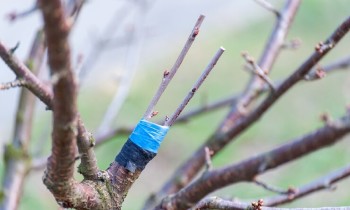
- Kidney grafting.
- Rooting cuttings.
- Grafting by cuttings.
- Growing from seeds.
- Layers.
Diseases and pests
- Powdery mildew.
- Cytosporosis.
- Pit bitterness.
- Green aphid.
- Codling moth.
- Scale insect.
- Leaf roller.
- Hawthorn.
Ripening and fruiting of the pink Wem
The beginning of fruiting
 The beginning of fruiting
You can get your first apples on this tree fairly quickly, and the first buds can be seen as early as one or two years old. However, it's best to pick them off immediately, allowing the tree to gain strength first. Harvesting begins in the third or fourth year, when you can get several kilograms of fragrant, beautiful, albeit small, fruit.
Flowering time
Like all early autumn apple trees, the Wem blooms in May. However, the exact timing will depend directly on a variety of factors, including late or early spring, humidity, wind, and the number of cloudy and sunny days. The process lasts approximately 12-14 days, during which time the tree looks very attractive. The flowers are quite large, with large, fragrant, pinkish-white petals, gathered in clusters of 4-7.
Fruiting and growth
The tree grows quite quickly, reaching 35-45 centimeters per year in the first few years, and sometimes even reaching 50-60. However, after fruiting begins, the rate of growth slows slightly, although not significantly. The tree is also capable of increasing its fruitfulness quite rapidly. By the 9th or 10th year, it produces 45-50 kilograms per block, and by the 12th or 14th year, it produces a full harvest.
Apples ripen in the first half of September, but the most experienced gardeners recommend picking them in late August, before they reach consumer maturity. This allows the fruit to be preserved somewhat longer. Their shelf life is average: in the refrigerator, they can last until late January or early February, and in the cellar, somewhat shorter, until the end of December.
Top dressing
- Ammonium nitrate.
- Mineral complexes.
- Chicken manure.
- Peat.
- Superphosphate.
- Compost.
- Manure.
- Humus.
- Humus.
What to do if it doesn't bloom or bear fruit
Why do apples fall?
- Natural weather disturbances.
- Pest damage.
- Various diseases (except scab).
- Overripe.
Please share your own experience with the Wem Pink apple variety so that everyone can learn about it and avoid potential mistakes when growing their own orchard.