Bellefleur Bashkir apple tree: characteristics of the variety and care
| Color | Reds |
|---|---|
| Ripening season | Autumn |
| Size of apples | Average |
| Taste | Sweet |
| Crown type | Average tree height |
| Shelf life | Average shelf life |
| Application | Fresh , For recycling |
| Winter hardiness | High winter hardiness |
| Fruiting age | Up to 5 years |
 History of origin and regions of growth
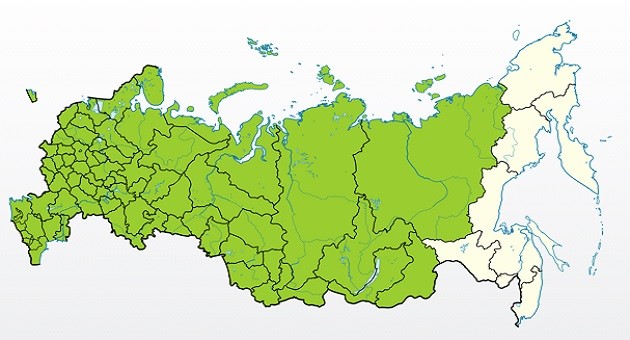
Growing regions
- Crimea.
- Bashkortostan.
- Volga-Vyatka region.
- Middle zone.
- Siberia.
- Leningrad region.
- Ural.
- North Caucasus.
- Moscow region.
Origin
This is a fairly old, forgotten variety, which, after more than half a century of oblivion, has successfully resurfaced and gained particular popularity. Pomologist and breeder Raisa Ippolitovna Bolotina and her colleagues Gizyar Akhtyamovich Mansurov and Tatyana Galeevna Demina succeeded in developing the new apple tree at the research station of the Bashkir Scientific Research Institute of Agriculture in 1938.
The new variety underwent its first trials in 1941, but the war prevented its widespread distribution at that time. The first application for inclusion in the State Register of Breeding Achievements was submitted only in 1991, and the originator was the Ufa Federal Research Center of the Russian Academy of Sciences. The decision to include the Bashkir Bellefleur apple tree in the list was made in 2008. Zoning is scheduled for the Ural region, but in reality, it can be grown practically anywhere in the country, except for the Far North.
Content
Description of the Bashkir Bellefleur variety
 The apple tree, with its thick, straight, and sturdy branches, attracts the attention of gardeners across the country. It has a beautiful, compact crown and doesn't take up excessive garden space. Furthermore, it is hardy, winter-hardy, and easily adapts to late transplants and challenging growing conditions. The trees are long-lived, producing very good harvests for a long period without resting.
The Bashkir bellefleur produces an enviable quantity of unusual fruits. They are beautiful and firmly attached to the branches, preventing them from falling off. Furthermore, their composition and slightly sweet flavor are ideal for dietary and medicinal nutrition. This variety is recommended for both commercial intensive plantings and small home gardens.
Apples: What do they look like?
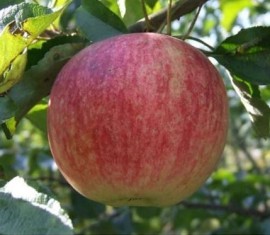
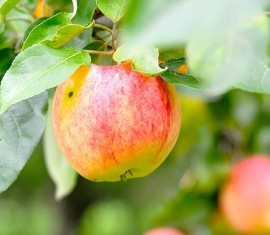
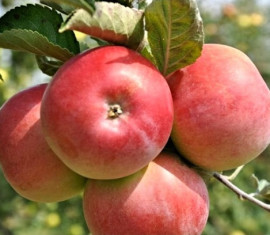
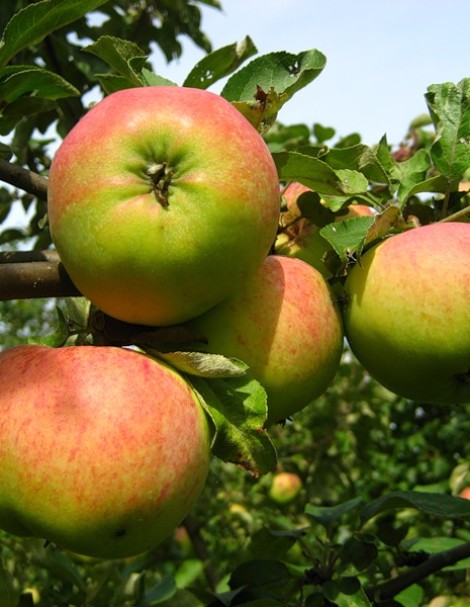
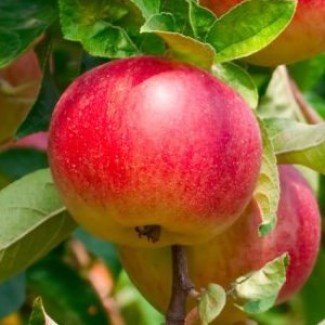
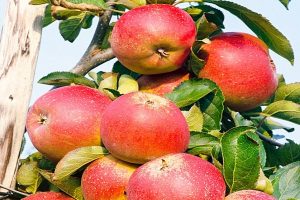 The fruits of this variety are typically medium or slightly larger in size. They can weigh 120-150 grams, and in good years, even 150-170 grams. They have a round-oval, slightly elongated shape and a smooth, even surface. The ribbing is virtually invisible, as is the side seam.
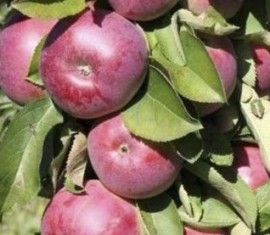
The fruit has a pleasant-to-the-touch skin, thin yet strong, elastic, and dense. It is smooth, shiny, and may have a slight grayish waxy coating. The base color is light green or yellowish-green. At full maturity, most of the surface (55-70%) is covered with a pinkish-carmine, purple, or pink-crimson streaked, speckled blush. Subcutaneous spots are few and barely noticeable, and are gray-green in color. The following chemical composition indicators are important for professionals:
- P-active substances (catechins) – 244 milligrams.
- Ascorbic acid (vitamin C) – 11.4 milligrams.
- Total sugars (fructose) – 12.8%.
- Pectins (fiber) – 18.2%.
- Titratable acids – 0.25%.
The Bashkir bellefleur has a slightly greenish, bleached, and sometimes slightly creamy flesh. It is fine-grained, medium-dense, quite juicy, crisp, tender, not sharp, but slightly refreshing. The flavor is considered bland; it's more sweet, lacking the characteristic tartness, but the aroma is powerful and distinctive.
Bellefleur Bashkir apple tree: characteristics
Crown and root system
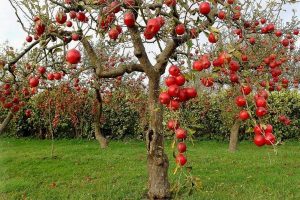 The tree is considered medium-sized, as it grows no more than 4-5 meters., and even then, without formative pruning. Its crown is moderately dense, not prone to overgrowth, compact, and rounded or broadly oval. Over the years, it can become slightly spreading and drooping. The shoots are straight, thick, and set at a nearly right angle to the tree's conductor. They are covered with greenish-brown or greenish-yellow bark, smooth, and pubescent. Fruiting is mixed.
The tree's leaf blade is oval, elongated, large, and flattened. It is smooth, shiny, and short-pointed, with serrated, serrate-crenate edges, occasionally folded into a boat shape, but not often, and lacking a pubescence on the back. The root system is fibrous on most rootstocks, but occasionally may have a central taproot. It is well-dug, branched, and has many finely branched branches, adapted to searching for water in the soil.
Productivity and pollination
It's hard to call this variety high-yielding, as there are countless apple trees that produce far more fruit. It's more logical to classify its performance as average.
From one fully formed, mature Bashkir Bellefleur apple tree, experienced growers can produce approximately 65-90 kilograms of fragrant, sweet apples per season. The average yield per hectare is 200-215 centners of fruit..
Like many other varieties, this one is completely sterile to itself. It requires suitable "neighbors" within 45-100 meters. Experienced gardeners intersperse the trees to ensure they cross-pollinate effectively.
Winter hardiness and disease resistance
The apple tree is well-adapted not only to prolonged frosts down to -27-32°C, but also to sudden temperature fluctuations. It tolerates even severe cold well after a thaw, making it a real find for gardeners in the Urals and Bashkortostan, as well as other harsh regions of our country. If properly protected and prepared for winter, it can even be grown in the Far East and Siberia.
Average resistance to diseases of various etiologies means that with regular preventative treatments, there's no need to worry about parasites, fungi, or other apple tree infections. The key is to avoid excessive moisture and stagnant water around the rhizomes, as well as air in the crowns.
Rootstocks and subspecies
Bellefleur is traditionally grown on semi-dwarf and vegetative rootstocks, though dwarf varieties are also suitable. This may slightly alter the tree's qualities, but has little or no effect on the fruit. Neither columnar nor creeping varieties of this cultivar exist in nature.
Features of growing Bashkir Bellefleur
 Landing
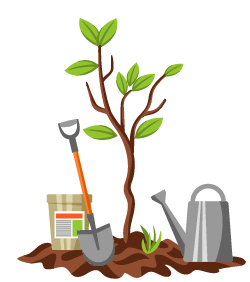 Landing
Basic conditions
- The main rule when choosing a garden site is to make sure it's sunny. Fruit trees won't thrive in the shade without receiving the necessary dose of ultraviolet light.
- It's best to select fertile, yet airy, loose, and permeable soil for apple trees. Black soil mixed with sand, sandy loam, loamy clay, podzolic soil, and rocky soil, properly fertilized and supplemented with the necessary nutrients, are ideal.
- Groundwater that is very close to the surface can damage the tree and lead to rot. It must be at least 2-2.2 meters away, otherwise the site is unsuitable for such apple trees.
- Holes are dug approximately every 4-5 meters, leaving 3.5-4 meters between rows.
- The holes should be prepared in advance, preferably 4-8 months before planting, but if there's little choice, 4-5 weeks will do. They should be dug 70-80 centimeters deep and 1 meter in diameter. Fertilizer is added to the bottom, followed by a drainage layer, and the holes are filled with water, leaving them uncovered.
- Trellis, planks, or stakes should be driven in immediately for support. Placing them on the north side of the trunks will provide adequate protection from cold winds in winter.
- It's important to leave the grafting site above the soil surface, taking into account soil settlement around the trunk. This means leaving 6-9 centimeters to allow for additional soil later.
- The drainage material in the hole is raked into a pile, the apple tree is placed on it, the roots are spread out, and soil is added. The soil is then carefully compacted, watered, and mulched to further retain moisture.
Landing dates
Both spring and fall planting options are acceptable for Bashkir Bellefleur. The key is to ensure that the sap has either already begun to flow or has not yet begun to flow. A warm day in late March or April is usually chosen, or alternatively, late September or October, when there is no risk of frost.
Tree care
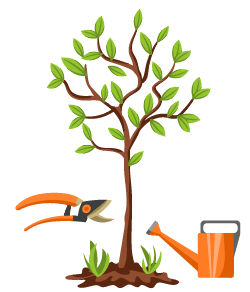 Tree care
Protection from frost and pests
Before winter, trees should be carefully covered to prevent damage, especially young trees. Straw, hay, or mats of dry leaves are good materials to cover the roots. Trunks can be wrapped in any available materials, from roofing felt to old tights. Young saplings can be wrapped using the tent method.
Timely preventative treatments are effective against pests and diseases. Commercially produced products are readily available at gardening stores. However, you can also whitewash the trunks with lime to repel insects, and treat them with lard or grease to repel rodents.
Loosening the soil, watering: proper agricultural technology
Trunks are dug twice a year, and sometimes just once is enough for older trees. It's best to do this during the period when the sap isn't flowing, to reduce stress on the apple trees. The shovel should be dug no deeper than half a spade blade, as some shoots are located right at the surface. As the trees grow, you can hoe the soil, lightly loosening it with a hoe, especially the day after. glaze.
Watering Young seedlings will need regular watering, requiring at least 15-25 liters per tree every 10-16 days, depending on the site, soil, weather, and overall climate. Mature trees can be watered 5-6 times per season, timing the application to coincide with flowering, fruit set, and fruit ripening. For convenience, you can dilute fertilizer with water and apply it along the perimeter of the crown.
Pruning: simple crown shaping
One- or two-year-old seedlings usually arrive from nurseries already formed, most often in a tiered, sparsely tiered, or oval shape. This way, the branches will be spaced far apart, creating the proper "skeleton" of the tree. In the future, you'll simply need to maintain the correct branching pattern and prevent the trees from becoming overgrown.
In the fall, all broken and dry shoots are also pruned. Diseased shoots should be removed immediately to prevent the disease from spreading to other branches. Branches that are crowding the tree, growing upward, parallel to the crown, or growing inward should be removed, as these will interfere with good fruiting.
Pollinator varieties
- Bashkir handsome man.
- Titovka seedling.
- Raika.
- Saffron pepin.
- Teremok.
- Professor Sprenger.
- Antonovka.
- Ranetki.
Diseases and pests
- Scab.
- Cytosporosis.
- Fruit rot.
- Cancer.
- Powdery mildew.
- Scale insect.
- Fruit hyacinth.
- Moth.
- Green aphid.
- Leafhopper.
- Hawthorn.
Ripening and fruiting of Bashkir Bellefleur
The beginning of fruiting
 The beginning of fruiting
This variety can be considered early-bearing. Its first buds may bloom in the second or third year, but it's best to pluck them. They're unlikely to form apples; they're likely barren. Therefore, it's best not to waste the tree's energy on flowering. The first harvests can begin in the fourth or fifth year. Don't expect many fruits at this point, but you might still be able to collect a few dozen apples for sampling.
Flowering time
Bellefleur bashkirense is considered to bloom mid-season. By early May, beautiful, deep pink buds appear, which by mid- to late May blossom into delicate, whitish-pink flowers—large, beautiful, and intensely fragrant. This process lasts approximately 12-16 days, allowing bees and wind ample time to cross-pollinate.
Fruiting and growth
The trees grow neither slowly nor incredibly quickly, adding approximately 55-70 centimeters per year. They quickly reach their maximum height and begin producing a full harvest. By the 8th or 9th year, apples will be truly abundant. Yields increase gradually and then remain stable, with minor fluctuations.
Removable maturity occurs at the end August, but it's still best to pick apples in early September to be on the safe side. Apples don't fall off, but they can become plump and translucent, at which point they can no longer be stored and require immediate processing. Fruits picked on time can be stored in the cellar until at least mid- to late February, and in a special refrigerator Until early March. They are transported very well in boxes in 2-3 layers.
Top dressing
- Superphosphate.
- Humus.
- Peat.
- Calcium.
- Manure.
- Compost.
What to do if it doesn't bloom or bear fruit
- Limit or increase watering.
- Eliminate insects.
- Cure diseases.
- Feed.
- Transplant to a sunny place.
Why do apples fall?
- Wind, frost, rain, hail.
- Overripe.
- Pests or diseases.
Leave a review of the Bashkir Bellefleur apple tree variety so that even a novice gardener can receive useful information firsthand.