Apple tree Gin: characteristics of the variety and care
| Color | Reds |
|---|---|
| Ripening season | Autumn |
| Size of apples | Average |
| Taste | Sweet and sour |
| Crown type | Columnar tree |
| Shelf life | Average shelf life |
| Application | For recycling , Fresh |
| Winter hardiness | High winter hardiness |
| Fruiting age | Up to 5 years |
 History of origin and regions of growth
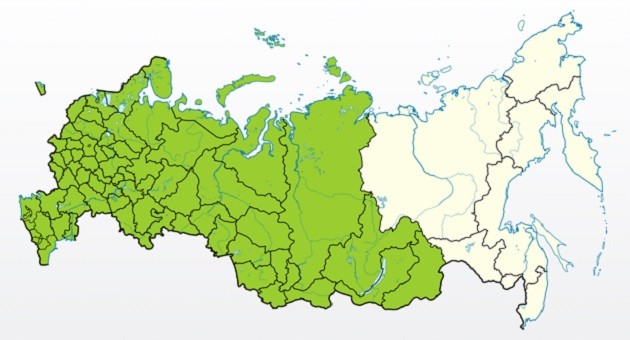
Growing regions
- Some northern regions.
- North Caucasus.
- Western Siberia.
- Crimea.
- European part of Russia.
- Ural.
Origin
It is believed that the invention of this variety is due to the great Russian botanist Viktor Valerianovich Kichina. It was developed at the breeding station of the All-Russian Institute of Horticulture and Nursery Science in the Moscow region in 1967 through open pollination and crossing of different dwarf apple varieties and carriers of the columnar gene. It is believed that one of the parent varieties may be the well-known Melba, as the fruits of the two varieties are very similar in both taste and appearance.
There are no records of applications for inclusion of Jin in the State Register of Breeding Achievements, so information about its development is unreliable. It has not yet been regionalized, although it is grown with varying success in the central part of the country, in the south, and in more northern regions, and even in the Urals, provided proper care and winter protection are observed.
Content
Description of the apple tree variety Gin
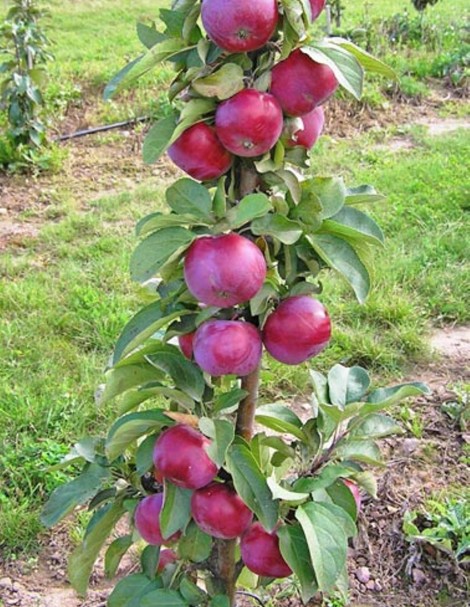
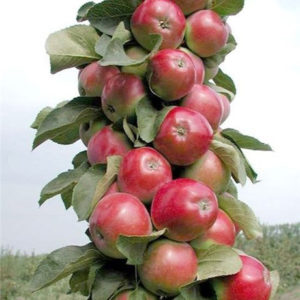
 Fruitful, early-bearing, and fairly frost-hardy apple trees, all of which are quite compact in size, are a dream for virtually any gardener. Gin fully meets virtually all these requirements. These trees take up very little space, can grow even in the harsh conditions of Siberia and the Urals, and are particularly resistant to scab and other apple fungal infections. They are recommended for cultivation in both small garden plots and large, intensive commercial orchards.
Apples: What they look like
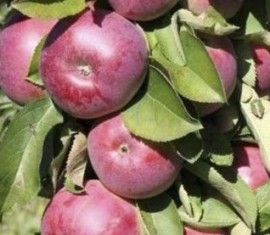
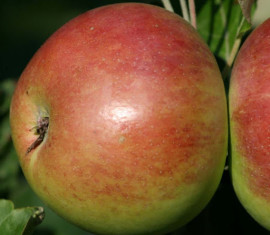
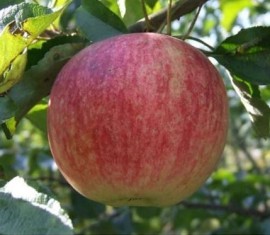
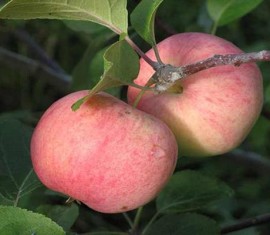
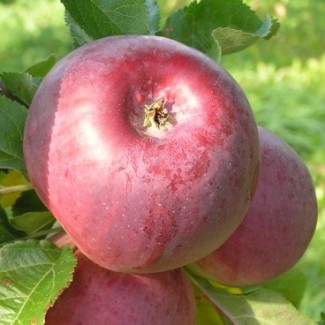
 The fruits are typically medium or slightly larger than average in size, weighing approximately 140-160 grams. However, with proper care, in particularly favorable years, they can grow to 170-200 grams. The fruits are round, often spherical, with a regular shape, almost spherical, which is rare for apples. Ribbing is very subtle, barely noticeable.
The skin is dense but not hard, elastic but fragile. It is green, and as it ripens, it usually turns yellowish or even golden. The blush can cover up to 75-90% of the surface; it is diffusely streaked, dense, and bright red with a slight crimson tint. Upon reaching technical maturity, it becomes very densely covered with a whitish-blue waxy coating. Subcutaneous spots are dark, gray or grayish-green, few in number, small, and barely visible on the surface. The chemical composition is assessed based on the following parameters:
- Sugars (fructose) – 11.5%.
- Titratable acids – 0.54%.
- Ascorbic acid (vitamin C) – 11.7 milligrams.
- Pectins (fiber) – 9.3%.
- P-active substances (catechins) – 239 milligrams.
The fruit's light-colored flesh can be lemon or creamy. It's firm, crisp but not prickly, very juicy, and fine-grained. The flavor is considered balanced, sweet and sour, leaning toward sweetness with a distinctive "cherry" tartness in the aftertaste. It's slightly spicy, dessert-like, and harmonious. There's no official tasting score for the fruit, but unofficially, experts give these apples 4.5-4.7 points.
Apple tree Gin: characteristics
Crown and root system
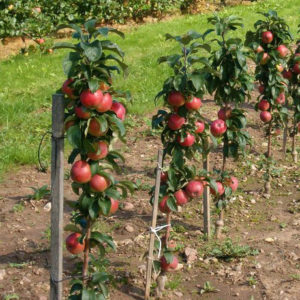 The trees are considered to be of medium height, although it would be more logical to classify them as columnar semi-dwarfs. They can grow to a maximum height of 1.8-22 meters., even without formative pruning, Jin does not grow larger. It does not produce lateral skeletal branches; the main stem is covered with greenish-brown bark. Fruiting occurs on annual fruiting twigs, spurs, and spurs growing at an acute angle to the trunk, pointing upward.
Foxtails are fairly large, elongated-oval, long-pointed, dense, and leathery. They are green or deep green, glossy but have a faint sheen. They have a serrate-crenate, slightly wavy edge, curve slightly, and can fold into a boat-like shape. The root system is moderately deep, but mostly superficial, branched, and poorly adapted to water-seeking.
Productivity and pollination
Almost all columnar apple trees are considered early-bearing and high-yielding, and Gin is no exception.
In a single season, a mature tree can yield only a small amount of fruit, just 16-20 kilograms. However, if you consider the density of the trees per hectare, the picture immediately changes. It's possible to harvest over 50 tons of apples, which is already quite a significant amount..
The variety is completely self-fertile, so it doesn't require pollinators to produce a good apple harvest. However, experienced gardeners note that harvests are even more abundant if Jean is interplanted with other apple trees that bloom at the right time.
Winter hardiness and disease resistance
Columnar apple trees aren't typically particularly resilient to low temperatures or sudden temperature fluctuations, but this variety is truly one of the few exceptions. With proper care and proper winter preparation, the trees can easily withstand temperatures as low as -27-30°C, with thaws followed by severe frosts.
Gin exhibits a high degree of resistance to scab and other apple tree infections, which is a definite plus. Even during years of severe epidemics, it rarely becomes infected, and if it does, it usually affects the leaves, while the fruit remains edible. However, timely preventative treatments with antifungal agents and insecticides should not be neglected.
Rootstocks and subspecies
Gin is typically grown on semi-dwarf and dwarf rootstocks. It also grows well on vegetative seed, but it reaches over 2.5 meters tall and produces smaller fruit. No subvarieties of this variety are currently known.
Peculiarities of Gin Growing
 Landing
 Landing
Basic conditions
- All fruit trees thrive in open, sunny spaces and with good ventilation. Choosing the right location will guarantee consistently good harvests every year for 12-15 years.
- Other than normalizing soil acidity, there are no other soil requirements. The variety grows well in loam, sandy loam, black soil, and on rocky slopes.
- There's no significant difference in the depth of the groundwater table. In fact, it's best to plant Jin where it can easily "find" moisture: near streams, rivers, ponds, in lowlands, and in floodplain meadows. Obviously, the soil shouldn't be overly wet, and establishing a garden in a swamp is unlikely.
- Prepare the holes in advance, at least 2-5 weeks before planting. Dig the holes at least half a meter to a meter apart, 60-70 centimeters deep, and the same diameter. Add soil and fertilizer to the bottom, then add drainage, and then fill with water.
- Root collar It is better to leave it at least 4-8 centimeters above the surface so that the seedling does not take root higher.
- The seedling is placed vertically, held by the trunk, and the roots are carefully spread out so they lie freely. I cover the seedling with soil, compacting it in layers to avoid air pockets that could cause the shoots to rot. I water the apple trees with 25-40 liters of water, and mulch the surface with sawdust.
Landing dates
The best time to plant Jin is in the spring. The optimal time is mid-April to early May, when the soil has been thoroughly warmed by the sun's rays and the risk of frost has passed. Transplanting seedlings in the fall is also acceptable, but they have a slightly lower survival rate, and finding the right time—at least 3-4 weeks before frost—can be challenging.
Protection from frost and pests
Covering small columnar apple trees for the winter is easy. Add 15-20 centimeters of soil to the root zone, or lay down straw bales, spruce branches, or mats of dried leaves or grass. The trunks are usually wrapped with various materials, from agrofibre to roofing felt, but the simplest method is to use a ball-shaped covering, such as tarpaulin or special film.
It's easy to repel rodents that love to feast on the tender bark of young trees: coat the trunks with lard, drying oil, or grease. This will make the animals avoid your plantings. Spring and fall spraying is effective against insects hiding in cracks and crevices in the bark. whitewash lime.
Tree care
 Tree care
Loosening the soil, watering: proper agricultural technology
Digging around the tree must be done very carefully to avoid damaging the root system, as the shoots are shallow. Twice a year, loosening the soil is ideal, and in the interim, you can hoe the soil around the apple trees, removing weeds, root suckers, and any other plant shoots.
Jin needs watering, especially in dry and hot weather. Apply 10-15 liters of water once a week or every ten days, morning and evening. If possible, drip irrigation is recommended, as it's best for apple trees.
Pruning: simple crown shaping
The variety may or may not produce lateral scaffold branches, which will need to be pruned back to two buds annually. However, it can also simply grow as a single trunk, in which case there won't be any need for formative pruning.
Sanitary pruning involves trimming away dead or damaged fruiting branches. You should also cut the branch back to the second bud if you need to renew the tree or if it has frozen despite being protected for the winter.
Pollinator varieties
- Currency.
- Arbat.
- Melba.
- Mantet.
- Delight.
- Favorite.
- Vazhak.
Reproduction
- Growing from seeds.
- Rooting.
- Kidney grafting.
- Cuttings.
Diseases and pests
- Powdery mildew.
- Black crayfish.
- Scab.
- Green aphid.
- Codling moth.
- Hawthorn.
- Scale insect.
Ripening and fruiting of Gin
The beginning of fruiting
 The beginning of fruiting
All such varieties begin bearing fruit very early, practically the same year they are planted outdoors—that is, in the first year. Several buds open on the trunk, which are best picked off immediately upon discovery. By the fourth or fifth year, you'll be able to harvest about a dozen apples, but no one would dare call such a harvest a full-fledged one, even compared to other columnar apple trees.
Flowering time
Like all autumn apple varieties, the Gin begins blooming mid-season. This means you can expect the first buds to open around the tenth of May. Blooming can last quite a long time, up to 16-18 days, but this depends largely on climate and weather. The tree's flowers are large and beautiful, densely covering the entire trunk, creating a picturesque and decorative effect. They are usually white or slightly pinkish, curly, and often multi-layered, reminiscent of the ruffles of a light summer dress.
Fruiting and growth
Trees grow quite quickly, adding approximately 12-20 centimeters in a single season. Because the overall height of the tree is not very great, they quickly reach their full potential, focusing on increasing fruitfulness. Yields increase gradually, but also quite rapidly, and by the 7th or 8th year, you can harvest a full 16-20 kilograms of aromatic and delicious apples. However, the active lifespan of an apple tree is short, a common complaint among owners, as it lasts only 15-17 years.
Technical ripeness occurs around mid-September, but if the weather is cold, gloomy, and rainy, it can be delayed until the very end of the month, and sometimes even until early October. The fruits cling firmly to the branches, so picking them can be done at a leisurely pace. The apples have an average shelf life: they will keep for about 5-6 months in any cellar without problems, but after that, they lose flavor, becoming dull and sour.
Top dressing
- Peat.
- Humus.
- Superphosphate.
- Chicken manure.
- Ammonium nitrate.
- Manure.
- Mineral complexes.
What to do if it doesn't bloom or bear fruit
- Provide additional feeding.
- Check for pests or diseases.
- Transplant into the sun.
- Fertilize.
Why do apples fall?
- Wind, hail, hurricane, rain.
- Pest damage.
- Diseases.
Please leave your feedback on the Gin variety so that other gardeners can learn something similar from it to enhance their experience.