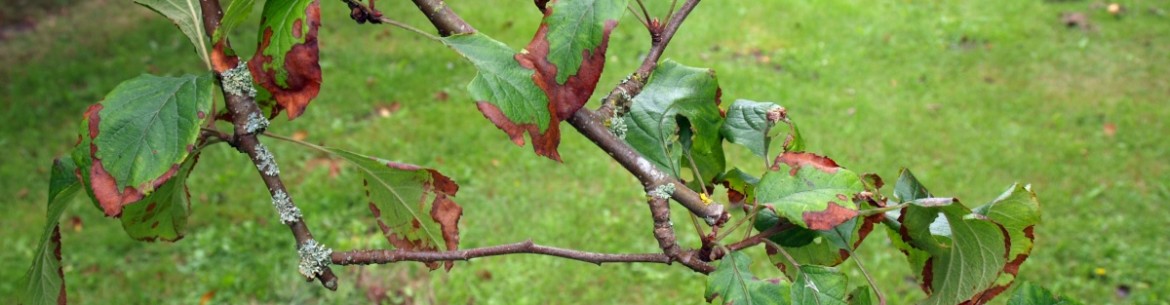
Apple tree leaves turning red: causes and diseases + treatment recommendations
The condition of an apple tree can be easily determined by its leaves. Blistering, discoloration, or color changes indicate the development of a disease. If you notice premature reddening, it's time to sound the alarm, as the tree may be suffering from a nutrient deficiency or pest infestation. Let's figure out why apple tree leaves turn red and what to do about it.
Causes of redness and swelling
Early detection of symptoms and accurate diagnosis of the disease will allow for the most effective treatment. Reddening of apple tree leaves is a serious symptom requiring immediate action. Gardeners typically consider two factors that contribute to this phenomenon.
Nutritional deficiencies
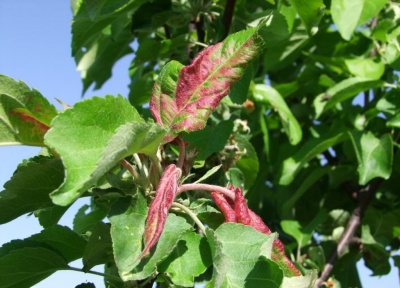
 The health of garden crops depends greatly on the soil characteristics in which they grow. For example, apple trees are unsuitable for clay soils with nearby groundwater. They also do poorly in low-lying areas with high moisture accumulation or in light sandy soils. In such conditions, trees experience a deficiency of nutrients such as magnesium. iron, nitrogen, potassium, manganese, and phosphorus. Each of these components plays a vital role in tree development. The specific element a plant is lacking can be determined by external symptoms:
- Potassium – the appearance of a red border on the edges of leaf blades.
- Magnesium – reddening of the center of the inner leaf surface, which then spreads to the entire surface. Magnesium deficiency leads to decreased immunity and frost resistance.
- Phosphorus – the leaves take on a bronze tint, followed by a reddening of all their parts, including the roots and veins. An apple tree suffering from a phosphorus deficiency blooms later, its fruit takes longer to ripen, and the tree also loses resistance to cold and various diseases.
- Manganese – leaf blades become covered with red spots, with leaves on the upper branches being particularly affected. The yield and taste of the fruit decrease (they become bland).
Watering the garden in June and July is crucial. A lack of moisture causes changes in the condition of the bark and leaves: they begin to dry out, and the leaf blades turn brown.
Red leaves can be observed after planting an apple tree in the spring, when a sudden warming occurs after a harsh winter.
If you discover such a problem, you should not immediately dig up the young tree, as it is quite possible for it to recover on its own after 1–2 seasons.
Mechanical damage
If the leaves on just one branch are discolored, the entire tree should be inspected. Most likely, the bark is tied with something—wire, strong film, or rope—that is blocking the flow of nutrients. To fix the problem, remove the tied cord and perform a grooving operation: make oblong cuts in several places above or below the damage.
Excess moisture in the soil
When growing in lowlands near groundwater, apple trees' root systems become impaired, causing the leaves to turn red. In this case, it is recommended to create a drainage ditch near each tree and strictly adhere to the drainage regime. glaze, avoiding its abuse.
Incompatibility of rootstock and scion
Simultaneous reddening of all leaves and swelling of tissue at the graft site on a seedling indicates physiological incompatibility between the rootstock and scion. This condition is incurable, so the only solution is to plant a new tree.
Diseases and pests
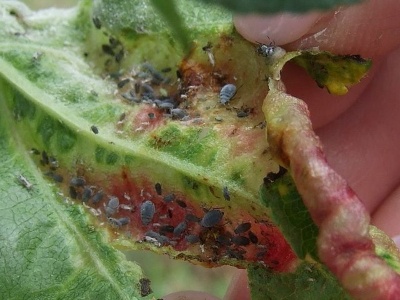 Infestations of harmful insects cause red plaque, various bumps, growths, and spots to form on apple tree leaves. Garden crops are often attacked by red gall aphids, which cause red swellings on the leaf blades. Curling of the swellings confirms the presence of this pest. Although gall aphids prefer currants, they also frequently cause damage to apple trees. Colonies of the insects suck the sap from the leaves and then attack healthy branches. This leads to discoloration and wilting of the leaf blades.
In cold and rainy summers, the red gall aphid is much less common due to the decrease in the development of its population in such conditions.
The insect lays eggs in the bark, and the larvae hatch in the spring and actively suck the tree's sap. As a result, the leaves curl, turn brown, and dry out.
Often the cause of red spots is infection of apple trees. powdery mildewThe disease negatively affects not only the leaves, but also the buds, bark, and branches.
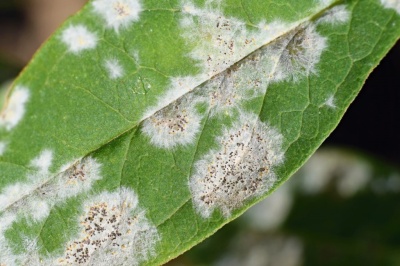
Initially, a white coating appears, quickly turning brown. Leaves dry out and fall off within a short period of time. This typically leads to the death of young apple trees. In some cases, powdery mildew subsides for a while, only to resume again.
Apple tree infection scab This disease causes changes in the color and shape of the leaves and the appearance of a brown coating. In its advanced form, it completely destroys the fruit crop.
Methods to troubleshoot the problem
After discovering red leaves on tree branches and determining the cause of the color change, the gardener should immediately begin treatment, choosing the best option.
Replenishment of nutrients
Deficiency of any component in the soil is compensated for as follows:
- Phosphorus – use fertilizers containing this element. In cases of high soil acidity, phosphate rock is preferred; in other cases, superphosphate. Additionally, complex fertilizers are used to maintain an optimal balance of micronutrients in the soil. An eggshell infusion, which neutralizes the acidic environment, is recommended for watering apple trees.
- Magnesium – spraying (once every 10 days) with a solution prepared from 20 g of magnesium and 10 liters of water. Magnesium-containing fertilizers are used; the effects of such supplements last for several years. Additionally, potassium-based fertilizers are temporarily discontinued, as they interfere with magnesium absorption.
- Manganese – treatment with a solution prepared by dissolving manganese sulfate in water (500 ml/10 l). This solution is used only until bud break; for subsequent treatments, the solution is prepared with a different ratio: (10 g/10 l).
Pest control
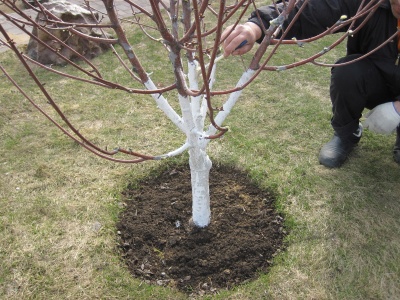 There are several known ways to get rid of harmful insects:
- During the period of unblown buds, apple trees are sprayed with insecticides;
- during the leaf opening process, treatment is carried out with a solution prepared from citrus or chamomile; tobacco is also often used for this purpose (the frequency of the procedure is once every 10 days);
- From June to October, pest control is carried out using trapping belts made of corrugated paper;
- In the tree trunk circle, the shoots in which aphids lay eggs before wintering are removed in a timely manner.
In spring and autumn, it is recommended to treat apple trees with a composition of clay and mullein.
The following insecticides are used to get rid of pests:
- "Pirimix" - against aphids and moths;
- "Fufanon" - against cherry flies and sawflies;
- "Karbofos" - against ticks, codling moths and leaf rollers;
- "Nitrafen" - from copperhead.
Common ash, liberally applied to the tree trunk area, helps kill red gall aphids. Ash dust penetrates the root system and enters the trunk and branches, altering the taste of the sap, making it bitter, which repels pest colonies.
The modern insecticide "Iskra" helps get rid of aphids. One tablet of the product is diluted with water and sprayed on the affected seedling. Repeat the procedure until the desired result is achieved. As an alternative to "Iskra," "Decis" is available, which kills the pest within 72 hours.
It is much easier and faster to destroy red gall aphids on a seedling than on an adult apple tree.
Treatment of diseases
Effective treatment of diseases is possible only with their timely detection and correct identification of the source.
Removing red spots
The appearance of red spots on the leaves of an apple tree can be one of the symptoms of a dangerous disease.black crayfish".
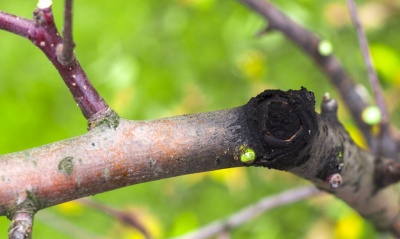
Over time, the reddish spot transforms into a spot that spreads across the entire leaf blade. Other symptoms include cracking of the bark and blackening of the wood and fruit.
Treatment of the disease requires a comprehensive approach, including several manipulations:
- removal of damaged fragments;
- treatment of cuts with an antiseptic;
- application to a wound garden var;
- Treating the entire tree with copper sulfate and an antifungal agent: generously pour the medicinal mixture over the area around the tree trunk.
For the treatment of black cancer, regular antibiotics diluted in warm water, for example, "Streptomycin", are suitable.
Getting rid of plaque
It is not uncommon to find it on the leaves of fruit crops white plaque, which resembles a web and darkens over time. Its presence negatively impacts the development of the apple tree: affected leaves and branches dry out and die. The presence of this coating indicates powdery mildew. Comprehensive treatment for the tree includes the following procedures:
- pruning to remove diseased shoots;
- chemical treatment (up to 5 times a year).
There are several of the most effective preparations used to combat powdery mildew:
- "Topaz";
- "Topsin";
- "Impak";
- colloidal sulfur;
- "Hom";
- Fitosporin;
- Horus;
- copper sulfate.
Treatment of leaf swellings
Brick stains and blisters are caused by wood damage. rustAs a result, the leaf blades become deformed and reddish or orange bumps appear on them. Rust It has no harmful effect on garden crops, but it significantly weakens their immunity. Weakened trees are easily susceptible to various diseases and lose their resistance to low temperatures.
In late autumn, the trunks of diseased trees are generously mulched with humus mixed with sawdust or peat. Part of the trunk is covered with a special material. Combating rust involves the following measures:
 pruning affected branches, removing leaves;
- treatment of trees with fungicides.
 pruning affected branches, removing leaves;
The following are well suited as medicinal preparations:
- "Topaz";
- Fitosporin M;
- Bordeaux mixture;
- products containing sulfur.
Preventive measures
A number of timely preventative measures will help protect your apple orchard from various diseases and pest attacks:
- Growing pest-repellent flowers and plants near apple trees, such as calendula, tansy, lavender, garlic and tomatoes.
- Hanging birdhouses on tree branches so that the birds that settle in them can peck at harmful insects.
- Maintaining a watering regime: many pests are unable to bite through dense and strong leaves.
- Regular and proper fertilization. In the spring, apply humus, magnesium, and potassium-phosphorus compounds. In the summer, apply nitrogen, phosphorus, and potassium; in the fall, apply potassium sulfide and superphosphate.
- Timely pruning, removing old and damaged branches from trees, preventing overcrowding.
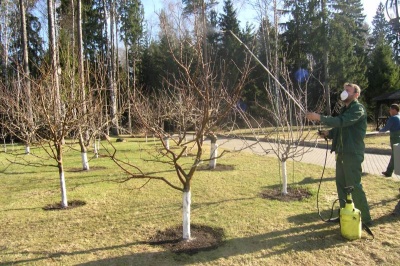
- Whitewashing the trunk and skeletal branches, attaching sticky tape to trap pests.
- Spring and autumn treatment of apple trees with Bordeaux mixture.
- Generous watering of the soil with copper sulfate.
- Systematic loosening of the soil, removal of weeds.
 Growing pest-repellent flowers and plants near apple trees, such as calendula, tansy, lavender, garlic and tomatoes.
To prevent aphids from infesting trees, it is recommended to remove anthills from the garden, as the pests are attracted to the farms created by the ants.
Reddening and curling leaves can be caused by many factors. The key is to detect the problem early, identify the source, and find the optimal solution.