What to do about mushrooms on an apple tree: how to combat the parasite and how to treat the tree
Fungi growing on apple trees are a fairly common occurrence, encountered by almost every gardener. The presence of these organisms can lead to a number of negative consequences, including crop loss. Therefore, if such a problem arises, it is important to promptly determine the cause and find a solution.
Content
Possible diseases
The appearance of fungus on an apple tree may indicate a disease that weakens the immune system, thereby creating favorable conditions for the growth and development of fungi. A weakened immune system can also be caused by a pest infestation, severe frost damage, or improper pruning.
The most common apple tree diseases caused by various types of fungi are the following:
- scab;
- mold;
- rust;
- cytosporosis;
- anthracnose;
- tuberculosis;
- milky shine;
- Alternaria;
In addition to these diseases, damage to apple trees is caused by insects that settle on them. lichens and mosses.
Classification
Not every fungal species present on a tree can have a negative impact. Several species are known to colonize apple trees and form a symbiotic relationship with them.
Parasitism
 This sponge-like species is quite common on stumps, trees, and even dead wood. The surface portion of the fungus poses no particular threat to the plant. However, the mycelium that grows within corrodes the tissue, turning it into rot.
Spores that have penetrated the wood may not show any signs of themselves and remain unnoticed for several years.
The length of time it takes for fungi to destroy an apple tree depends on their variety, each with its own characteristics and preferences: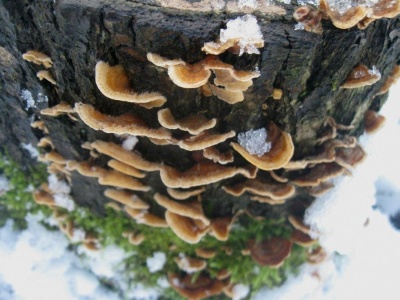
- False tinder fungus – most often found on stone fruits and is characterized by a black-gray or yellow-brown color. The fungus eats away at the wood from the inside, but only appears on the surface of the bark 2–3 years after infection.
- Red (or plum tinder fungus) In addition to apple trees, it attacks pears, hawthorn, and bird cherry. The fungus is grayish-red in color and has a velvety surface that hardens and becomes glossy over time. Wood affected by this organism turns yellow, and stripes are clearly visible. The initial stage of the disease is characterized by the drying of branches, and later, the root system is destroyed.
- Flat tinder fungus – typically inhabits old stumps, but can also attack healthy trees. Initially, its gray-white bodies settle at the base of the trunk, gradually ascending. The diseased tree dries out, breaks, and suffers from white rot.
- Sulphur-yellow tinder fungus – quickly destroys wood, filling it with its whitish films, after which it emerges from the surface. The organism is characterized by a light-yellow, fleshy body with a wavy surface. Affected trees die from brown rot.
- A real tinder fungus – penetrates branches and trunks, destroying them over the course of years. White rot of the heartwood makes the tree brittle and also causes it to split along the growth rings. As a result, the apple tree dries out. The fungus appears as a gray mass with a yellow border around the edges.
Characteristics of tinder fungi and methods of dealing with them
If left undiagnosed, tinder fungi pose a serious threat to trees. These fungi penetrate the wood through various wounds, multiply, and grow inside the trunk, forming a mycelium. The emergence of this problem is usually indicated by large branches, and sometimes even trunks, breaking for no apparent reason. The presence of the parasite is finally confirmed by the appearance of fungal bodies on the tree's surface after several years. This occurs in the summer, and by late August, the tinder fungi produce spores that are carried by rain and wind throughout the garden.
The main source of this type of infection is infected trees growing nearby. Other possible causes of tinder fungi include: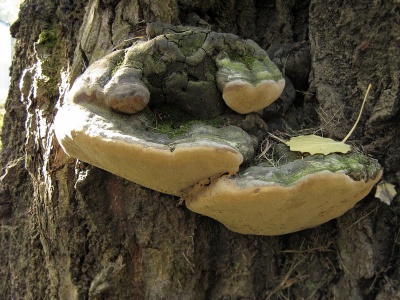
- stumps brought by gardeners from the forest to decorate the site;
- location near an old forest area;
- staking and stakes used for tying up cultivated crops;
- Uncollected piles of garbage;
- firewood prepared in woodpiles;
- contaminated garden furniture.
Mushrooms that appear on the surface are cut off and destroyed, preventing them from releasing mature spores.
What to do if this fungus has grown on an apple tree: treat the cut areas with garden pitch or copper sulfate, then seal them with a mixture made from clay, casein glue, and malathion.
Symbiosis with apple tree
Symbiosis is a close relationship between different organisms (symbionts) that benefits at least one of them and does not harm the other. This phenomenon (mycorrhiza symbiosis) can be observed between a mushroom and an apple tree. In this case, the relationship benefits both: the mushrooms receive nutrients from the tree and, in return, provide it with minerals.
Reasons for the appearance of mushrooms on apple trees
Fighting fungi on fruit trees will be much easier if you know the causes of these organisms.
Chaga, woody, yellow, white, green, dry
Most mushroom-shaped growths on the bark surface are varieties of tinder fungi, which are considered parasites. They should be removed as quickly as possible to prevent them from draining the tree of its vital energy.
Basidial
These are higher fungal organisms whose spores mature in specialized organs called basidia. In most cases, they manifest themselves as a coating on the bark, similar in appearance to rustThese organisms pose no particular danger, so control comes down to timely preventative measures. Many gardeners prefer to cultivate rust-resistant apple varieties, while also carrying out the necessary treatments.
Lichens
Lichens are a group of lower organisms whose bodies are composed of fungi and algae. While lichens themselves are considered harmless, the pests that inhabit them cause significant damage to trees. For this reason, fungus It is better not to leave it, but to remove it using a brush.
Oyster mushrooms
There are seven species of these mushrooms, five of which are edible. Only the oyster mushroom grows on apple trees without causing any harm. It is most often found on trees infected with tinder fungus.
Principles of fungal control on various parts of the apple tree
Typically, a specific type of fungus attacks a specific part of the tree. Each case requires specific treatments and control methods for apple trees.
On the root system
Fungal infection of tree roots is quite rare. Most often, this organ is susceptible to dangerous bacteria that promote the development of root cancer.
On the bark and trunk
After removing the fungi, it's important to thoroughly clean these areas and then treat them with copper-containing compounds. Afterward, apply a protective sealant to prevent bacteria from penetrating.
The condition of the tree can be easily determined by the color of the wood at the cut site: if it is light, then treatment can achieve the expected result, if it is dark, it is best to cut down the apple tree.
In the hollow
It's only possible to restore an apple tree within the first 2-3 years after the hollows form. In subsequent years, when the tree becomes brittle, it's best to uproot it and replace it with a new one. Treatment for parasitic fungi consists of several stages:
- removing the body of the mushroom with a sharp knife;
- careful cleaning of the cut area with a wire brush;
- treatment with a solution of copper sulfate (3%), and then with garden pitch;
- sealing the hollow with a mixture of fine gravel and cement; casein glue can also be used for these purposes;
- spraying the affected area with copper sulfate (1%) at least 2 times a year.
The body of the mushroom must be burned immediately; composting it is unacceptable.
Healthy and well-maintained garden crops are quite resistant to fungal attack. Therefore, various problems can be easily avoided by following all agricultural practices and regularly implementing preventative measures. It's important to remember that preventing apple tree infection is much easier than treating the disease.