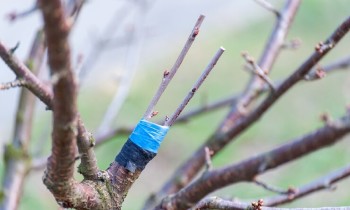
Antonovka Golden Apple Tree: Variety Features and Care
| Color | Yellow |
|---|---|
| Ripening season | Summer |
| Size of apples | Large |
| Taste | Sweet and sour |
| Crown type | Tall tree |
| Shelf life | Low shelf life |
| Application | Fresh , For recycling |
| Winter hardiness | High winter hardiness |
| Fruiting age | From 5 years old |
 History of origin and regions of growth
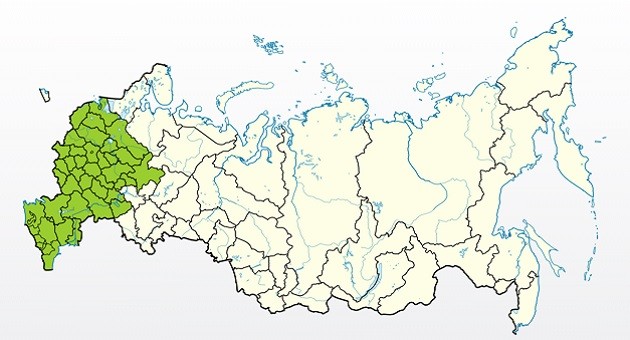
Growing regions
- Crimea.
- Middle zone.
- Leningrad region.
- North Caucasus.
- Moscow region.
Origin
The Antonovka variety is well known not only to all gardeners in our country but also far beyond its borders. Zolotaya is considered a clone, created by a random mutation. This subvariety appeared relatively recently, around the beginning of the twenty-first century, and is therefore considered new. There is currently no information about it in the State Register of Breeding Achievements, nor is there any official zoning.
Content
Description of the Antonovka Zolotaya variety
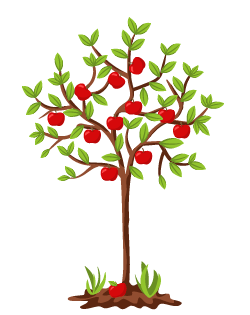 This apple tree differs little from its parent variety. It is undemanding of growing conditions, tolerates a wide range of soils, moisture insufficiency or excess, and air pollution. The trees are large, vigorous, and beautiful, taking up a considerable amount of space in the garden. They have moderate resistance to various apple tree diseases and are quite winter-hardy.
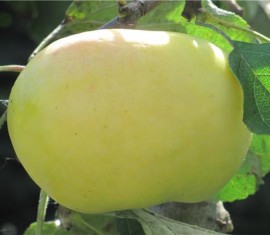
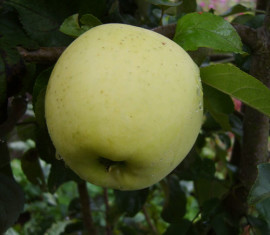
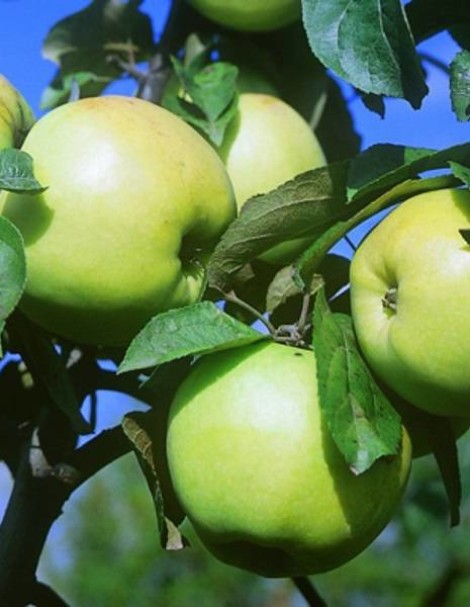
The fruits of this late-summer variety are their main difference from the Antonovka variety. They are large, beautiful, rich yellow, attractive, intensely fragrant, and delicious. However, they are difficult to transport and don't keep for long. Recommended for both home and commercial cultivation.
Apples: What do they look like?
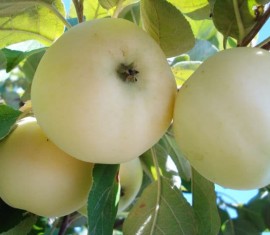
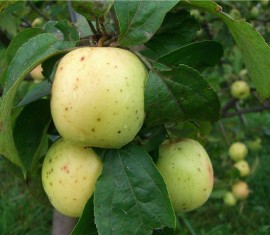
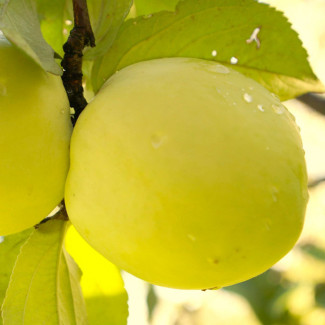
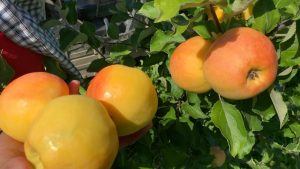 The fruits are large to very large, reaching 250-350 grams in weight under favorable climate and weather conditions and with proper care. The apples are round, broadly ribbed, sometimes spherical, sometimes slightly elongated or flattened. The side seam is not visible.
The skin, like that of the parent variety, is dense, strong, thick, elastic, and even somewhat hard. It is smooth and glossy, and may have a waxy, oily coating when fully ripe, giving the apples a greasy appearance. The skin's base color is lemon-yellow or deep yellow, becoming golden or even translucent when fully ripe. Sometimes, the seeds can be seen through the peel. There is generally no blush, but bright red or coral-colored, fuzzy, translucent spots may appear on the sunny side. There are numerous light-colored subcutaneous spots on the surface. To assess the chemical composition, you can consult the following data:
- P-active substances (catechins) – 342 milligrams.
- Ascorbic acid (vitamin C) – 6.6 milligrams.
- Total sugars (fructose) – 10.2%.
- Pectins (fiber) – 9.8%.
- Titratable acids – 0.59%.
Antonovka Zolotoy has dense, fine-grained, yet very tender and sweet flesh. It's easy to bite into, not prickle-y, very juicy, and has a strong, distinctive aroma that's hard to confuse with anything else. The flavor is considered dessert-like, sweet and sour, slightly wine-like, balanced, and harmonious. There's no official taste test rating for this apple.
Antonovka Golden Apple Tree: Characteristics
Crown and root system
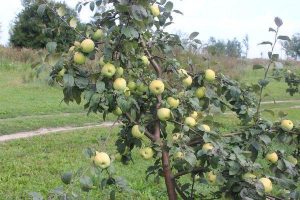 The tree is considered medium-sized, much smaller than its parent variety. Under normal conditions, it can grow up to 6 meters without pruning. The crown is oval and rounded when young, but with age it becomes more spreading, drooping, and even weeping. The branches are long, whip-like, straight or slightly curved, covered in smooth, pubescent, brownish-red or brownish bark.
The leaves are large to medium-sized, mostly flattened, with coarse nervation, leathery, dense, and glossy. Their margins are serrate-crenate, doubly serrated, and the tip is short-pointed. The color is green or emerald green, rarely deep green or even light green. The root system is very deep and adapted to seeking water. It is fibrous on most rootstocks, with numerous small branches.
Productivity and pollination
The variety is considered high-yielding and early-bearing.
One adult and fully formed tree can produce at least 200-250 kilograms of fragrant and beautiful apples per year..
The variety is considered self-sterile, but a small number of ovaries can still be produced in the absence of pollinators. Therefore, to ensure a high yield, it's necessary to interplant the trees with varieties that bloom at a suitable time, fortunately, there are many of these. It's a good idea to spray the trees with honey or sugar syrup in the spring.
Winter hardiness and disease resistance
This variety is extremely resistant to low temperatures, as well as sudden fluctuations and changes. Among common garden apple trees, Antonovka is considered one of the leading varieties, and the Golden variety is no exception. Temperatures of -28-35°C are completely unaffected, even without special shelter.
To the scab, cytosporosis The variety isn't immune to powdery mildew or powdery mildew, but they have an enviable natural resistance. They are only affected during years of severe epiphytotics, and the disease is mild and not widespread. The leaves are primarily affected, while the fruit remains perfectly edible. They can be attacked by parasites, so standard, timely treatments are unlikely to be successful.
Rootstocks and subspecies
Many pomologists believe there are over two hundred subspecies and subcultivars of Antonovka. Zolotaya is one of the summer varieties and does not yet have its own subspecies. It's unlikely that any further subspecies will be developed, but trees can be grown on various rootstocks, imparting specific properties.
Features of growing Antonovka gold
 Landing
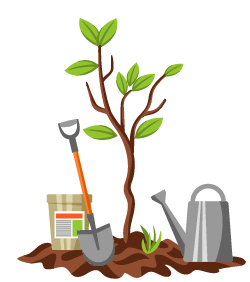 Landing
Basic conditions
- The main condition for growing Antonovka is choosing a sunny, open location where the trees will have sufficient air and ultraviolet light. The trees will not grow in the shade or in drafts.
- The groundwater table should be at least 2-2.2 meters below the surface, otherwise the apple tree's roots will simply rot. If this isn't possible, you can bury a sheet of slate or several layers of roofing felt at a depth of 1.5 meters. This will guide the rhizomes sideways and prevent them from sinking into the water.
- The trees are quite large, so it is necessary to leave at least 4-5 meters of distance between them to avoid future conflicts between crowns and rhizomes.
- The holes are prepared in advance, at least 2-5 weeks before planting, and should be well-drained. They are dug approximately 1 meter in diameter and 70-90 centimeters deep. The bottom is filled with soil mixed with fertilizer, lined with stones or broken brick, vermiculite, or even nutshells, and filled with plenty of water. The holes are left outdoors until planting time.
- Trellis or stakes are immediately dug into the holes or driven into place to support the seedlings. They are best placed on the north side, which will provide additional protection from winter frost.
- Before planting, inspect the seedlings and prune off any damaged, dry, or poorly looking shoots and suckers. You can soak them in water for 4-7 hours, or overnight, for example.
- The apple tree grafting site should always be 5-8 centimeters above the ground level to prevent the trees from rooting higher. This would negate the rootstock's properties.
- Place the seedling on a drainage trench, straighten the shoots so they don't bend, cover with soil, compact it by hand, and water. It wouldn't hurt to mulch the surface with sawdust, compost, or other available materials.
Landing dates
This easy-to-plant apple tree can be planted at any time, both in spring and fall. By then, the sap should have stopped flowing in the trunks, and the soil should remain warm and dry. It thrives equally well in both conditions. In spring, the best time to plant is late April or early May, and in fall, September or October, after the leaves have fallen.
Tree care
Protection from frost and pests
No special measures are required to cover this variety for the winter. Standard methods are quite suitable, especially since in moderate and warm climates, the Golden Antonovka requires no shelter at all. However, young trees can be covered using a tent-like method, while mature trees can be wrapped with burlap at the base of the trunk. Dry leaves, spruce branches, hay, or straw are piled onto the root zone.
To protect trees from rodents, who love to gnaw the tender bark of young shoots during lean times, the trunks are coated with grease, lard, fuel oil, or old bitter vegetable oil. Whitewashing the trunks with lime also helps repel insects, while also making the garden more aesthetically pleasing.
Loosening the soil, watering: proper agricultural technology
Young trees are dug twice a season; as they mature, digging can be reduced to once a season. Hoe the soil 4-7 times a season, removing weeds, debris, rotting fruit, and leaves. All of this can harm the apple trees and increase the incidence of diseases. Many mature trees are simply covered with sod or seeded with grasses, from lawn grasses to herbs. These plants will provide the natural aeration that Antonovka craves so much.
Watering Trees need watering once or twice a month when they're young, but later, you can limit yourself to just watering, along with fertilizer and fertilizer. The exception might be during periods of extreme heat and drought, when rainfall is prolonged. In these cases, watering is recommended once every 14-16 days.
Pruning: simple crown shaping
The Golden Antonovka tree is very pliable and docile. Therefore, it can be shaped into any desired form. A sparse or sparsely tiered form is considered the most suitable, but spindle, bowl, cordon, and broom shapes are also possible. It's best to begin shaping it from the first year after planting, unless this was previously planned by the nursery.
Once a year, the trees are also given a sanitary pruning. All broken, dry, and excess shoots are then trimmed. Those that won't bear apples should be removed: those that stick up or into the crown, those that cross, or those that are parallel.
Pollinator varieties
- Welsey.
- Shield.
- Anise.
- Gala.
- Spartan.
- Champion.
- Borovinka.
- In memory of Ulyanishchev.
- Saffron pepin.
Diseases and pests
- Cytosporosis.
- Rust.
- Pit rot.
- Powdery mildew.
- Black crayfish.
- Scab.
- Rust.
- Scale insect.
- Leafhopper.
- Green aphid.
- Hawthorn.
Ripening and fruiting of Antonovka Zolotoy
The beginning of fruiting
 The beginning of fruiting
Although apples are earlier-ripening, they don't begin bearing fruit until 5-6 years after planting in the orchard. Buds may appear earlier, but these are usually barren flowers, so it's best to remove them completely, allowing the apple tree to develop roots and branches. The first harvest won't be abundant, but it will definitely yield a couple of kilograms of fragrant apples.
Flowering time
This variety is easy to find pollinators for, as it prefers to open its buds mid-season, around mid-May. This is when most apple trees bloom. The flowers are large and fragrant, with delicate, airy petals, densely covering the branches, making the tree look beautiful. The blooming period lasts for over two weeks, giving bees plenty of time to complete the pollination process.
Fruiting and growth
Growing 35-50 centimeters per year, trees of this variety quickly reach their final height. They gain more and more green mass each year, while also increasing the rate of fruiting. By the 10th to 12th year, harvests will be full-fledged, reaching over two hundred kilograms. Given their long active lifespan, the waiting period isn't particularly long.
Antonovka Zolotoy fruits begin to ripen as early as late summer, in August. Harvesting can be scheduled for early September, but it's best not to delay, as the ripe apples can simply fall to the ground. They're difficult to transport and can only be stored for 2-3 months in a special container. refrigeratorIt is advisable to process all fruits in the cellar within 30-45 days, so that they do not completely lose their taste and aroma.
Top dressing
- Humus.
- Peat.
- Bor.
- Calcium.
- Manure.
- Compost.
- Superphosphate.
- Ammonium nitrate.
What to do if it doesn't bloom or bear fruit
- Limit or increase watering.
- Eliminate insects.
- Cure diseases.
- Feed.
- Transplant to a sunny place.
Why do apples fall?
- Wind, frost, rain, hail.
- Overripe.
- Pests or diseases.
Leave a review of the Antonovka Zolotaya apple tree variety so that even a novice gardener can receive useful information firsthand.