Golden Filling Apple Tree: Variety Features and Care
| Color | Yellow |
|---|---|
| Ripening season | Summer |
| Size of apples | Large |
| Taste | Sweet and sour |
| Crown type | Average tree height |
| Shelf life | Low shelf life |
| Application | For recycling , Fresh |
| Winter hardiness | High winter hardiness |
| Fruiting age | Up to 5 years |
 History of origin and regions of growth
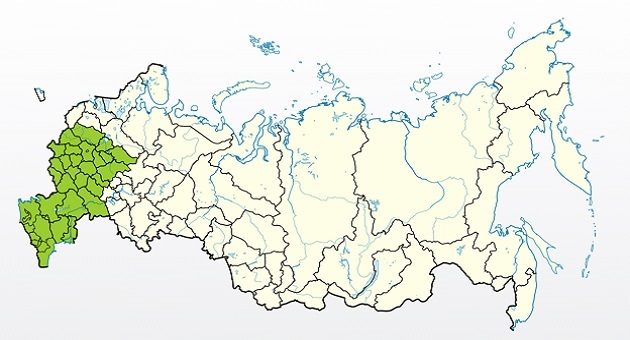
Growing regions
- Crimea.
- Middle zone.
- Leningrad region.
- North Caucasus.
- Moscow region.
Origin
Many gardeners, even those with some experience, consider apple trees belonging to the Naliv group to be directly related to the Papirovka. In fact, the latter is a clone, a seedling grown in the Baltics.
The main variety is an old apple tree, created spontaneously and widely distributed throughout Russia. The Pink and Gold varieties were developed by the Federal Scientific Center for Selection and Technology of Horticulture and Nursery of the Ministry of Science and Higher Education in the mid-1940s, when the institution was known as the Moscow Fruit and Berry Experimental Station.
An application for inclusion of Zolotoy Naliv in the State Register of Breeding Achievements was submitted back in 1947. However, it was never approved, as this variety is difficult to propagate, and cuttings taken often fail to take root, dying immediately. Therefore, the variety is rarely listed in catalogs and official lists, and is not considered promising. It has no official zoning, but is recommended for the Central Black Earth, Central, and Volga-Vyatka regions.
Content
Description of the Zolotoy Naliv variety
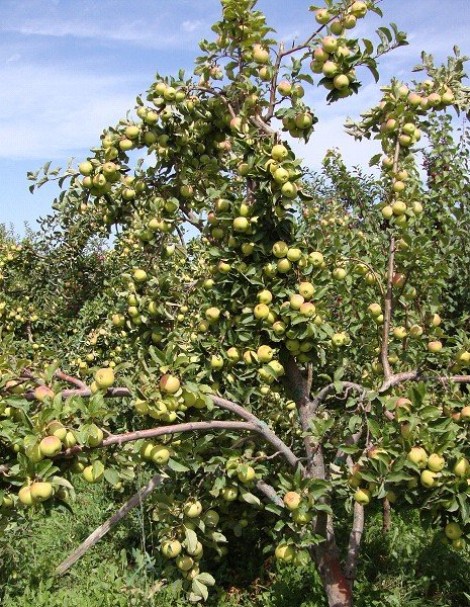
 These apple trees attract amateur gardeners because they ripen slightly later than the parent variety, approximately 2-3 weeks later. They are still considered late-season apple trees, as the entire harvest can be harvested before autumn. Zolotoy Naliv trees are compact, attractive, easy to care for and maintain, require little attention, and, most importantly, are more resistant to scab and other apple infections than the parent variety.
Beautiful, large fruits ripen on the branches with enviable regularity; the trees take rest breaks, but rarely (once every 3-5 years). They are attractive to look at, and when ripe, they become plump, almost translucent, with a sweet flavor and a strong aroma. These fruits cannot be stored, and they are also difficult to transport. Therefore, they are recommended for small private gardens or for immediate processing into juices, compotes, and jams.
Apples: What do they look like?
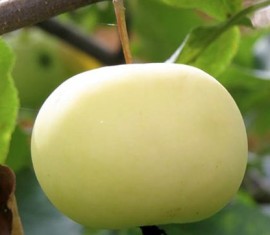
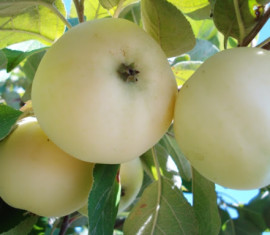
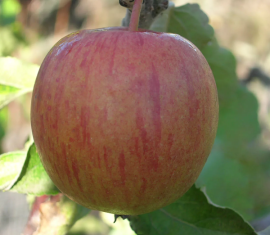
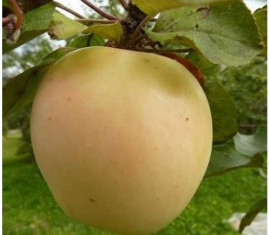
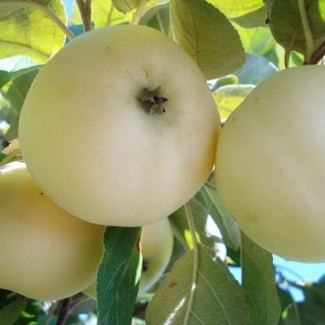
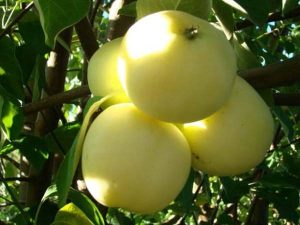 The fruits of this variety are consistently medium-sized. They grow to 140-160 grams in weight, but can be larger. They are round, broadly ribbed, flattened or slightly elongated, with no visible lateral seam on the surface.
The skin is quite dense, even somewhat thick; it is rough, hard, and somewhat elastic. Its base color is white or greenish-white, becoming golden-yellow or whitish during ripening, and covered with a bluish-silver waxy coating that is easily rubbed off. The seeds inside can sometimes be seen through the plump flesh. Subcutaneous punctures are numerous; they are small, gray-green, and sometimes rusty. The basic chemical composition is very similar to that of the parent fruit:
- P-active substances (catechins) – 429 milligrams.
- Ascorbic acid (vitamin C) – 21.6 milligrams.
- Total sugars (fructose) – 12.4%.
- Pectins (fiber) – 15%.
- Titratable acids – 0.87%.
The flesh of ripe fruits is tender, medium to low density, coarse- or medium-grained, and juicy. The base color is white or slightly creamy, and can be translucent when fully ripe. The flavor is considered overly sweet, and therefore inharmonious and unbalanced. On the official tasting scale, the fruits earn only 4.3 points out of a possible 5.
Golden filling apple tree: characteristics
Crown and root system
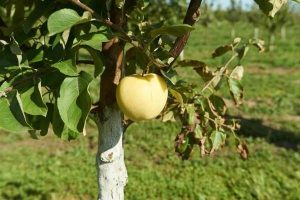 Zolotoy Naliv is usually classified as a medium-sized or medium-growing tree. Without a shaping tool, it can stretch up to 4.5-5 meters., sometimes slightly taller. The crown is most often compact, neatly pyramidal in early life, becoming increasingly broadly pyramidal with age, and in old age even broadly oval, spreading, weeping, and drooping. The branches are straight or geniculate, directed upward, long, of medium thickness, covered with gray-brown or gray-brown bark, rounded in cross-section, and set at a right angle to the trunk. Fruiting occurs primarily on the ring-shaped branches.
The leaves grow quite densely, are large, green or light green, a rich, deep shade. They are medium in size, can be oval, but are more often ovate. They have a long, pointed, curling tip, serrate-crenate, wavy margins, and a felt-like pubescence on the underside. The root system is superficial or moderately deep, and may or may not have a central taproot.
Productivity and pollination
This tree is considered a high-yielding one, although there are some nuances that should be clarified before planting so that they do not come as surprises.
A single mature tree can produce approximately 180-220 kilograms of fragrant, beautiful, plump fruit per year. However, this Naliv variety, like its relatives, has a peculiarity: the yield doesn't increase with age, but rather declines. I harvest less and less from older trees until fruiting ceases. It's worth noting, however, that this won't happen immediately; it will take 25-40 years. at least, and sometimes active fruiting continues until 65-75.
The variety is conditionally self-fertile, meaning it will set fruit and ripen even if there isn't a single apple tree nearby with suitable blooms. However, if there are suitable trees within 45-90 meters, the yield increases significantly.
Winter hardiness and disease resistance
The main advantage of Zolotoy Naliv is its exceptional resistance to prolonged low temperatures during the cold season. With proper care and protection, trees can easily withstand temperatures down to -22-27°C, even when they last for more than a few weeks. However, even when frosts are much more severe, and the transitions between cold and thaw are sharp and unpredictable, even if severely damaged, the trees can quickly recover in just one or two years.
The variety has moderate resistance to scab and fire blight, which cannot be said of its "parents." This is precisely why almost every gardener desires this apple tree. The tree is also moderately resistant to other apple diseases and is rarely affected by parasitic diseases. Timely and regular preventative measures usually ensure a virtually safe orchard.
Rootstocks and subspecies
Zolotoy Naliv is a clone of the Bely Naliv variety, obtained through open pollination, so it doesn't yet have its own subvarieties and likely never will. However, it can be grown on a variety of rootstocks, from tall standard varieties to tiny dwarfs and semi-dwarfs. There is no columnar Naliv variety, nor is there a creeping form.
Features of growing Golden filling
 Landing
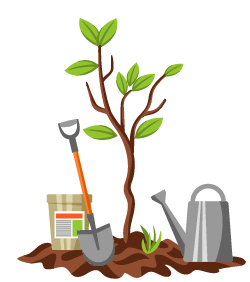 Landing
Basic conditions
- This apple tree needs plenty of space, light, and air, otherwise it will die. Trees don't thrive in the shade, becoming spindly and dying. In drafty conditions, they often become diseased and could also dry out, never producing any fruit. Therefore, it's important to choose an open, well-ventilated location where the crowns will be exposed to ultraviolet light for most of the day.
- It's important to choose the right site based on the groundwater depth. It should be no higher than 1.6-1.8 meters to prevent the apple tree roots from rotting.
- You can prepare planting holes 1-2 weeks in advance, but it's better to take care of this in the previous season, as most experienced gardeners do.
- Leave at least 3-4 meters between holes, and up to 4-5 meters between rows. This will make harvesting and maintenance much easier in the future.
- Stakes or trellises are immediately driven into the holes, to which the trees will be tied later. If they are placed on the north side, they will also serve as protection from the cold for the young seedlings.
- Dig holes 60-80 centimeters deep and approximately 1 meter in diameter. Add a small amount of fertile soil from the top layer, mixed with fertilizer, to the very bottom, then fill with stones, crushed stone, broken brick, or vermiculite. Walnut shells can also be used. Fill the holes with water and leave them to soak in the open air until planting time.
- Before planting trees, they should be carefully inspected, removing all dry or broken shoots and suckers. All rhizomes should be carefully placed in a basin of clean, warm water.
- When planting, the root collar of the seedling (the grafting site) should always be kept above the soil surface to prevent it from rooting higher, which would completely negate the rootstock's properties. It's also important to allow for soil subsidence, so it's best to raise the grafting site by 6-9 centimeters.
- Place the tree on a pile of drainage material collected in the center of the hole, spread the roots, and cover with soil, compacting it with your hands or feet, but without too much force. Water generously, and mulch the surface with compost, chopped grass, or sawdust. manure or any other materials.
Landing dates
The variety is planted either in the spring, around late March or early April, before the sap begins to flow in the trunks, or in the fall, around late September or early October. In both cases, the trees show good survival rates; the key is to time the planting correctly, to prevent early frosts or subsequent frosts from damaging the tender trunks.
Tree care
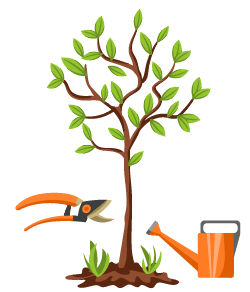 Tree care
Protection from frost and pests
Plum trees are resistant to low temperatures, but this doesn't mean they don't need to be prepared for winter or properly covered before the onset of cold weather. Therefore, it's important to first pay attention to watering; it should be stopped at the end of August, so that no additional watering is required in the fall. The trunks can be wrapped with various improvised materials, from burlap to old tights, and the roots can be covered with straw, hay, or spruce branches, and the soil can be raked.
Coating tree trunks with fuel oil or grease is effective against rodents. Commercially available products also work well. To repel insects that nest in bark chips during the winter, whitewash the trunks with thick lime in the spring and fall.
Loosening the soil, watering: proper agricultural technology
It's best to dig around the tree trunk twice a year—in early spring and late fall. This should be done carefully, without damaging the shallow roots that run close to the surface. At the same time, remove weeds and debris from under the trunk, and prune off any root suckers and other plant shoots. It's best to loosen the soil more frequently, each time after applying moisture, the following day.
It's recommended to water Naliv quite frequently, especially when young. The ten-day rule works particularly well here. This means watering should be done once every ten days, excluding days when it rains. The next watering should then be done 10 days after precipitation.
Pruning: simple crown shaping
Spring pruning is called formative pruning and begins approximately three to four years after planting, if the tree was trained in a nursery. If not, then it should begin in the first year. All branches are pruned, leaving a central conductor and two to three scaffold shoots before bud break, but after frost has passed. A sparse or sparsely layered form is best for the Golden Filling.
Sanitary pruning is most often done in the fall, after the leaves have fallen from the trees, but also before the first frost. All broken, dry, or diseased branches should be cut off. The cut areas, also known as wounds, are sealed. garden pitch or paint.
Reproduction
- Budding.
- Kidney grafting.
- Cloning.
Pollinator varieties
- White filling.
- Folder.
- Grushovka.
- Kate.
- Quinti.
- Melba.
- Arkad.
- Mantet.
- Summer striped.
- Pink filling.
Diseases and pests
- Cytosporosis.
- Powdery mildew.
- Scab.
- Rust.
- Apple moth.
- Scale insect.
- Glass-box.
- Hawthorn.
Ripening and fruiting of Golden filling
The beginning of fruiting
 The beginning of fruiting
This tree bears fruit quite early, although the first harvest will take about 3-5 years. In the early years, when flowers appear, it's best to remove them completely to allow the tree to develop foliage and rhizomes. The first harvests will be relatively small, only a few dozen apples, but they'll be enough for a sample.
Flowering time
Although the tree is an early-bearing tree, it blooms almost mid-season, beginning roughly between early and mid-May. In some cases, for example, after a very frosty winter and a prolonged cold spring, the blooming period may shift. The flowers are large, beautiful, delicate, snow-white, sometimes with a slight lemon tint, and intensely fragrant.
Fruiting and growth
The trees grow quite quickly, reaching 50-70 centimeters in a year. However, yield increases only during the initial stages of growth. By the 8th or 9th year, they reach full maturity, but then gradually decline, becoming less abundant, and the fruits themselves becoming smaller over the years.
The apples ripen somewhat later than the parent variety, around mid- to late August. It's important to understand that they ripen all at once and must be picked immediately, otherwise the slightest breeze can knock them to the ground. Apples should also be processed immediately, approximately 3-6 days in advance, as they are very susceptible to rot. They are completely unsuitable for transportation; they should be stored in a cellar. refrigerator may not last long at all.
Top dressing
- Eggshell.
- Humus.
- Bor.
- Manure.
- Compost.
- Superphosphate.
- Copper.
- Mineral and nitrogenous complexes.
- Ammonium nitrate.
What to do if it doesn't bloom or bear fruit
- Wrap up for the winter.
- Limit or activate watering.
- Eliminate insect infestation.
- Cure diseases.
Why do apples fall?
- Overripe.
- Strong wind, hail, rain.
- Pests or diseases.
- Freezing.
Leave a review based on your own experience with the Zolotoy Naliv apple tree variety, so that even novice gardeners have no questions about cultivating these trees.