Antonovka White Apple Tree: Variety Features and Care
| Color | Whites |
|---|---|
| Ripening season | Autumn |
| Size of apples | Large |
| Taste | Sweet and sour |
| Crown type | Tall tree |
| Shelf life | Low shelf life |
| Application | For recycling , Fresh |
| Winter hardiness | High winter hardiness |
| Fruiting age | From 5 years old |
 History of origin and regions of growth
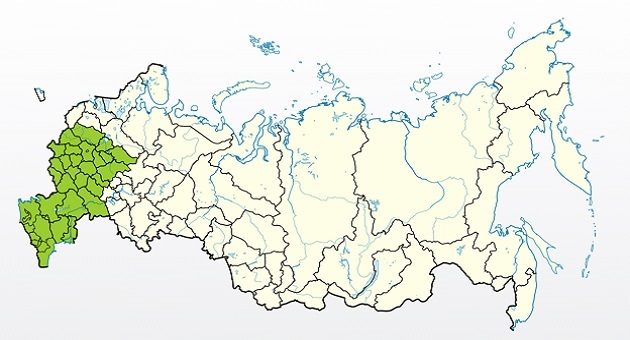
Growing regions
- Crimea.
- Middle zone.
- Leningrad region.
- North Caucasus.
- Moscow region.
Origin
This variety is considered old and rare, a product of Russian folk selection. It is found primarily in old orchards and doesn't differ much from the original parent tree, though there are differences. Scientists believe this subspecies is not a clone of the parent tree. It most likely arose as a seedling pollinated by unknown apple trees.
Ivan Vladimirovich Michurin may have developed the Antonovka White, although there is no official confirmation. It is only known for certain that he bred the Antonovka Six Hundred Gram (one and a half foot) from this subspecies, with fruits weighing over half a kilogram. This apple tree is not officially included in the State Register of Breeding Achievements and is not zoned. It can be grown in temperate and warm regions.
Content
Description of the Antonovka White variety
 Unlike its parent variety, this apple tree performs more modestly in almost all respects, although it still has many advantages. The trees have a compact, neat crown, are undemanding to soil and fertilizer, and require little maintenance, pruning, or frequent watering. They can be grown throughout almost all temperate climates and are resistant to environmental pollution or air pollution. They bear fruit regularly, with rest periods occurring only in older trees approaching the end of their lifespan. Fungi and parasites are more dangerous for this subspecies than for the parent variety.
The fruits are large, very attractive in appearance, and ripen quite early. They are juicy, aromatic, and have a pleasantly smooth flesh. They don't store well, and are only transportable in crates no more than two layers deep. This apple tree is recommended for individual cultivation in home gardens.
Apples: What do they look like?
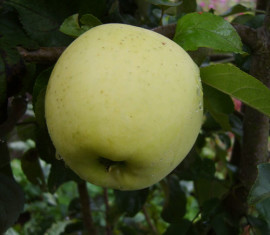
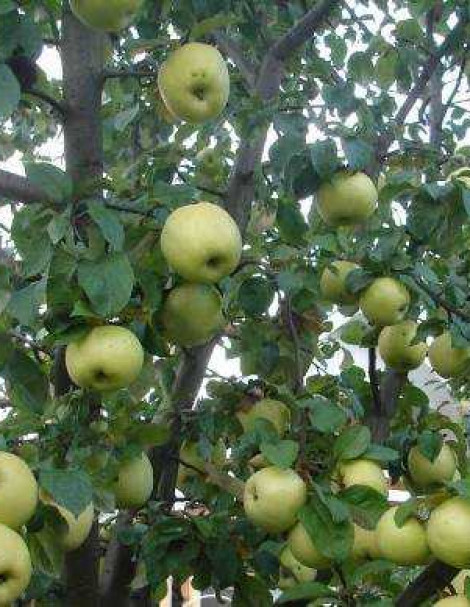
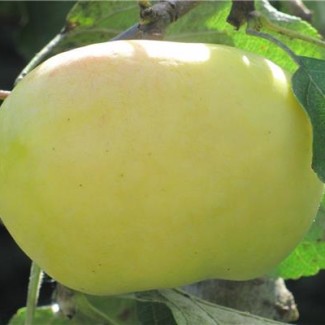
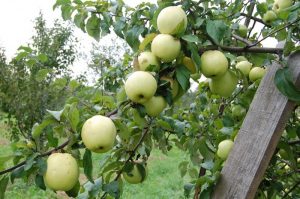 The fruits of the Antonovka white variety are large and slightly larger, typically growing to approximately 180-250 grams. On young trees, they can reach 260-300 grams. They are typically spherical, round, or turnip-shaped, with a blunt apex and a pointed tip, giving them a slightly conical appearance. Ribbing is noticeable near the calyx, but smoothed out on the rest of the fruit, with no lateral suture.
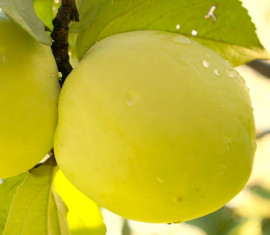
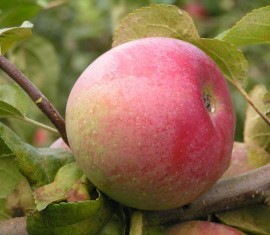
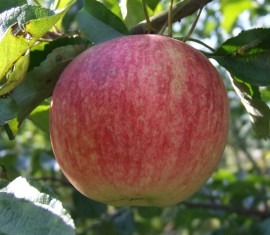
The variety has a dense, glossy, smooth skin of medium thickness and density. It is elastic and provides adequate protection against mechanical damage. During ripening, it becomes covered with a dense waxy-oily coating of a silvery-whitish hue. The skin is primarily light green-white, becoming completely whitish as it ripens, hence the name of the subvariety. A blush is usually absent, but can sometimes appear on the sunny side as light, translucent, blurred spots of a coral-pink hue. Subcutaneous spots are numerous, fairly large, but light in color, making them less visible. Experts recommend assessing the chemical composition using several indicators:
- P-active substances (catechins) – 324 milligrams.
- Ascorbic acid (vitamin C) – 16.9 milligrams.
- Total sugars (fructose) – 8.7%.
- Pectins (fiber) – 13.8%.
- Titratable acids – 1.6%.
The Belaya variety has a looser flesh than its parent variety, but it's firm enough to avoid a cottony texture. It has a pleasant texture, is tender, easy to bite into, not prickle-like, and juicy. The flavor is considered sweet and sour, although it's more sour with a sweet aftertaste. A professional taste tester gives it only 4.1-4.2 points out of a possible 5.
Antonovka White Apple Tree: Characteristics
Crown and root system
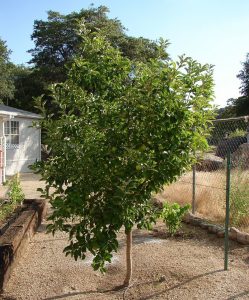 Trees of this sub-variety are considered tall, but it is more logical to consider them medium-sized. The maximum height of the tree is 4.5-5 meters without shaping.The crown is more compact, distinctly oval when young, but can become broadly oval with age, sometimes somewhat spreading, but not excessively so. The shoots are strong, medium-thick, long, and straight, covered with brown or greenish-brown bark. Fruiting is concentrated on 3-4-year-old wood (on the rings), sometimes on 2-3-year-old wood.
The leaves of this variety are glossy, smooth, and beautiful, glistening in the sun. They are dense and leathery. The blade shape is predominantly oval and elongated, with serrated, crenate, serrated, and sometimes wavy edges. The tip is long-pointed, sometimes curling. The root system is deeply rooted, fibrous, branched, and full of small offshoots, but not as extensive as the parent variety.
Productivity and pollination
The Antonovka subspecies is not known for its high yield, which has become the main reason for the variety being pushed aside by more advanced and promising ones.
A fully grown tree can yield approximately 110-125 kilograms of aromatic fruit per season under favorable weather conditions. In some years, the tree may yield as little as 45-50 kilograms, or as much as 130-140 kilograms, but this is its absolute maximum..
For pollination, apple trees require other trees with identical flowering times. Otherwise, some fruit may set, but they will represent no more than 12-15% of the potential harvest. Therefore, it is essential to interplant Antonovka White with other varieties.
Winter hardiness and disease resistance
Its parent variety has almost no equal in terms of low-temperature resistance, but Belaya is significantly inferior in this regard. It can withstand fairly severe frosts if properly and promptly covered, but if the frost drops below -25-27°C or lasts longer than 2-3 weeks, the tree can suffer significant damage.
To powdery mildew, scab, black crayfish, cytosporosis Antonovka White has absolutely no immunity to other apple tree diseases. Its resistance is below average. Therefore, if it does become infected, it is severely and rapidly affected. Trees need to be regularly treated with commercially available compounds, insecticides, and fungicides. Prevention is the best option to avoid losing both the harvest and the entire tree.
Rootstocks and subspecies
Antonovka White has no subspecies of its own. It can be grown on different rootstocks, which will only slightly alter the tree's qualities. In most varieties, this will have no effect on the fruit, including its size, flavor, or appearance.
Features of growing Antonovka white
 Landing
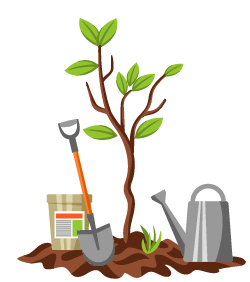 Landing
Basic conditions
- The planting site for this subvariety must be well-ventilated, as stagnant air in the crowns leads to fungal growth. However, it should not be planted in a drafty area, as this will inevitably lead to disease.
- A sunny, open space will help apple trees grow faster and produce maximum fruit. In the shade, they can become spindly, stunted, weak, fail to bloom or bear fruit, and even die.
- The most advanced gardeners dig holes for planting apple trees the season beforehand. They then make holes 80-90 centimeters deep, add fertilizer, lay down a drainage layer (rocks, vermiculite, nut shells), fill with plenty of water, and leave the holes uncovered.
- It's customary to leave at least 4-5 meters between trees to ensure mature trees don't interfere with each other with roots or branches. The optimal distance between rows is approximately 3-4 meters.
- Stakeouts, trellises, or stakes are driven into the holes to support the young trees. If placed on the north side of the trunk, they will also provide protection from the winter cold.
- The seedlings are dug in so that the grafting point remains above the soil surface even after the soil settles after planting and watering. Therefore, it is desirable for the grafting point to initially protrude above the soil by at least 6-9 centimeters.
- Inspect the seedlings beforehand to remove any dry, broken, or diseased shoots and branches. Soaking the rhizomes in warm water for 5-8 hours before planting will improve the planting process.
- The seedling is placed on a mound of drainage material, and the roots are carefully spread out by hand so that they are separated and not bent. They are covered with soil, but compacted only by hand to avoid compressing the soil around the rhizome too much. The surface is watered with 25-40 liters of water, and then mulched to retain moisture for longer.
Landing dates
In warm and temperate regions, you can plant White rhododendron in spring or fall, depending on your preference. However, in areas where frosts can arrive suddenly and last for a long time, spring is best. A sunny, dry, and warm day around the end of March or April is an excellent choice.
Tree care
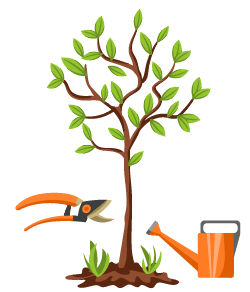 Tree care
Protection from frost and pests
All standard, generally accepted preventative measures are ideal for this subvariety. Before wintering, stop watering the trees as early as early September, or even better, by late August. After the leaves fall, wrap the trunks with burlap, spongebond, or other suitable materials, and pile soil or pile spruce branches, straw, or hay around the root zone. Young seedlings can be carefully covered with a tent-like covering.
In spring and fall, tree trunks are whitewashed with a thick solution of lime and water to repel pesky insects from chips and cracks. Otherwise, they can settle there for the winter, and then, in early spring, the larvae begin to damage leaves, bark, and even the wood. You can repel rodent pests with lard, fuel oil, or grease.
Loosening the soil, watering: proper agricultural technology
Fruit trees prefer aerated soil that easily absorbs nutrients, oxygen, and moisture. Therefore, digging can be done twice a year, in spring and fall. As the years go by, you can switch to autumn digging only, and then sow the area with herbs or grasses. During summer growth, you can gently loosen the soil with a hoe to prevent it from compacting, for example, after adding moisture in hot, dry weather.
Only young trees are usually watered, while older trees are watered only in exceptional cases—during drought or extreme heat. A watering schedule of 4-7 times a year is optimal for the Antonovka White variety. Fertilizers and fertilizers are added immediately, but not earlier than 3-4 years after planting. Until then, the nutrients added during planting will suffice.
Pruning: simple crown shaping
The variety isn't particularly prone to becoming overly dense. However, shaping and pruning are still unlikely to be successful. When growing it yourself, it's best to create a sparse or sparsely tiered form, perhaps a broom-shaped or spindle-shaped form, which will eventually develop into a broad oval shape.
In the fall, carry out preventative sanitary pruning, removing all excess growth that thickens the crown, such as shoots growing inward or sticking out vertically. Dry, diseased, and broken shoots are also removed. All cut areas (wounds) must be sealed with paint, mud, or clay, but it's best to use garden pitch.
Diseases and pests
- Cytosporosis.
- Rust.
- Pit rot.
- Powdery mildew.
- Black crayfish.
- Scab.
- Rust.
- Scale insect.
- Leafhopper.
- Green aphid.
- Hawthorn.
Pollinator varieties
- Saffron pepin.
- Autumn striped.
- Anise.
- Borovinka.
- Korobovka.
- Champion.
- Welsey.
- Antonovka.
Ripening and fruiting of Antonovka white
The beginning of fruiting
 The beginning of fruiting
Trees begin to produce buds and fruit only six to seven years after planting in open ground. The harvest becomes commercially viable after another year or two. The initial fruiting will not be abundant; you'll only be able to harvest a few dozen fruits, and even then, at best.
Flowering time
This variety blooms slightly earlier than its parent. It begins producing buds in April, and by early May, they open into fragrant, snow-white, and sometimes slightly pinkish, flowers. They have fleshy, delicate petals and a pleasant, medium-strength fragrance. The process lasts approximately 14-16 days, so there will be plenty of pollinators, as many varieties bloom at the same time.
Fruiting and growth
The trees grow quite rapidly, gaining 35-50 centimeters per year. After fruiting begins, growth may slow slightly, but not significantly. Fruiting gradually increases, reaching full, abundant fruiting by the 12th to 15th year. There is a noticeable regularity in fruiting, occurring every other year or two, which is considered a drawback of the apple tree.
Apples ripen in September. Depending on growing conditions, this may be early, mid, or late in the month. The harvest should be collected immediately to prevent it from falling to the ground. Transporting apples long distances is not recommended, as they are easily damaged. Store in a special container. refrigerator They can be stored in a cellar until about November, no longer. After that, they become loose, sour, and tasteless, but they make excellent jams, juices, dried fruits, and other processed products.
Top dressing
- Peat.
- Superphosphate.
- Humus.
- Bor.
- Calcium.
- Manure.
- Compost.
- Ammonium nitrate.
Why do apples fall?
- Wind, frost, rain, hail.
- Overripe.
- Pests or diseases.
What to do if it doesn't bloom or bear fruit
- Limit or increase watering.
- Eliminate insects.
- Cure diseases.
- Feed.
- Transplant to a sunny place.
Leave a review of the Antonovka White apple tree variety so that even a novice gardener can receive useful information firsthand.