Lavrika Memory Apple Tree: Variety Features and Care
| Color | Whites , Greens |
|---|---|
| Ripening season | Summer |
| Size of apples | Large |
| Taste | Sweet and sour |
| Crown type | Tall tree |
| Shelf life | Low shelf life |
| Application | Fresh , For recycling |
| Winter hardiness | High winter hardiness |
| Fruiting age | From 5 years old |


 History of origin and regions of growth
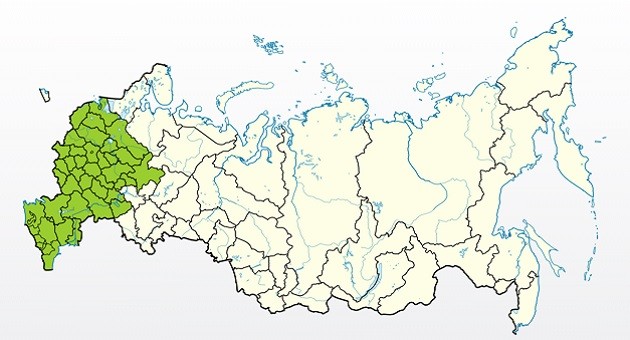
Growing regions
- Middle zone.
- North Caucasus.
- Moscow region.
- Leningrad region.
- Crimea.
- Northern regions (selective).
Origin
This variety was developed by the renowned Soviet breeder Lavrik P. I at the Leningrad Fruit and Vegetable Experimental Station, which he directed for many years. He was the first to obtain an original hybrid by crossing the Chinese Bellefleur and the well-known Papirovka.
However, he was unable to complete the work due to his untimely death. It was left to another breeder, L.A. Zhmurko, a follower of Lavrik, to complete the project, which was accomplished with great success. Currently, there is no information about the "Memory of Lavrik" variety in the state registry, nor is it officially zoned, but many gardeners across the country grow it.
Content
Description of the Lavrik Memory variety
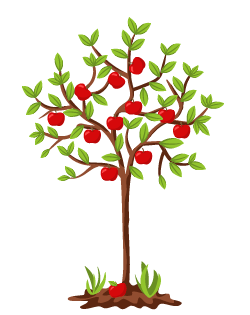 This tree, with a large yet neat and compact crown, is favored by many gardeners for incorporating the best qualities of its parent varieties, and in some cases even surpassing them. For example, Pamyat Lavrik is much more winter-hardy than Papirovka, it bears fruit early, grows fairly quickly, requires little care, and produces fruit regularly without resting.
The hybrid's fruits are beautiful and have very high commercial and consumer qualities. They are large, attractive, have a strong, pleasant aroma, and are ideal for making preserves, jams, juices, and compotes. Despite the short shelf life of the fruits, the trees are recommended for commercial plantings and for small garden plots.
Apples: What do they look like?
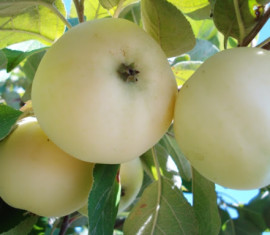
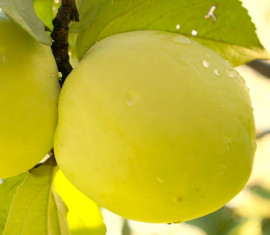
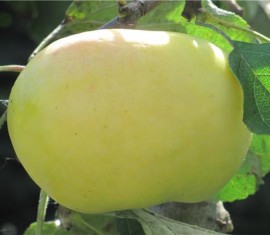
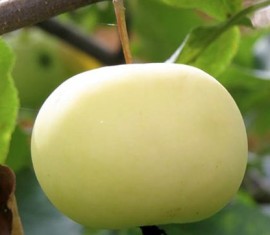
 The fruits are large or larger than large. On average, they weigh 170-200 grams, but can easily reach 230-250 grams. They are most often round or round-conical, slightly turnip-shaped, and elongated. The ribbing is clearly visible near the calyx, smoothed out over the rest of the fruit, and sometimes a lateral suture is clearly visible.
The skin is dense, even slightly hard, smooth, matte, and thick. It is durable and protects the apples well from mechanical damage. The base color is initially light green, but as it ripens, it becomes pale yellow or golden, and may develop a thick waxy coating. The blush is almost always absent, but on the sunny side, it sometimes appears as blurred, translucent orange or carmine spots. Subcutaneous spots are light, greenish, and therefore not very visible; they are numerous and large. The chemical composition is characterized by the following data:
- P-active substances – 423 milligrams.
- Ascorbic acid (vitamin C) – 17.6 grams.
- Sugar (fructose) – 13.1%.
- Titratable acids – 0.49%.
- Pectins (fiber) – 14.3%.
The flesh is snow-white, sometimes with a slight greenish tint. It is dense, fine-grained, and juicy, with a truly pleasant, characteristic apple aroma. The flavor is easily recognizable, slightly sweet with a slight but distinct tartness in the aftertaste. It is considered a dessert-like, harmonious, and balanced fruit. A professional tasting score is 4.8-4.9 out of 5.
Apple tree 'Memory of Lavrika': characteristics
Crown and root system
 The tree is considered tall, as it can reach 5.5-6 meters.It can't compare to 12-meter giants, but it can seriously hinder harvesting, so experienced gardeners prefer to limit the variety's growth with pruning. The crown is oval or broadly oval, with branches extending from the trunk at right angles. They are geniculate, thick, and covered with smooth, brown bark with light pubescence in some areas. The hybrid produces mixed fruiting (spears, rings, and fruiting twigs).
The leaves are medium to medium-large, dense, leathery, and matte, but may exhibit a slight sheen. They are most often a soft light green or green, with rough, wrinkled ribs and short, pointed tips. The margins are serrate and crenate, often forming a boat-shaped form, wavy, and serrated. The root system is robust and highly branched, with the presence of a central shoot depending on the rootstock. It penetrates deep into the soil and is well adapted to seeking water, making the tree drought-tolerant.
Productivity and pollination
The variety is far from Antonovka, but it is still considered high-yielding.
In a favorable year and with good care, a mature Lavrik Memory tree can yield 55-70 kilograms of fragrant, juicy green fruit per year. With intensive care, the yield can be slightly increased, but not significantly..
These trees are relatively self-sterile, meaning that a maximum of 5-7 kilograms of fruit can be harvested from a tree unless suitable pollinators are planted nearby. Pollinators should be located no more than 50-100 meters away to allow insects and wind to do their job. It is recommended to spray the trees with honey or sugar syrup during flowering.
Winter hardiness and disease resistance
The apple tree has a remarkable tolerance for low temperatures, inherited from its parents. It can easily withstand temperatures as low as -30-32°C, even without extensive preparation. However, standard winterization measures are essential, as the weather in our country can be quite unpredictable.
Trees are fairly resistant to scab, powdery mildew, cytosporosis, and some other fungal diseases. However, prevention is essential, otherwise, during years of severe epidemics, diseases can simply destroy trees. If they are infected, they do so rapidly and extensively, destroying both leaves and fruit.
Rootstocks and subspecies
There's almost no information about the subspecies of the Pamyat Lavrika variety in official sources. However, it can be grown on different rootstocks, imparting slightly different qualities. Vegetative rootstocks, for example, impart frost and drought resistance, but also produce larger trees. On dwarf and semi-dwarf rootstocks, they are much more compact, producing larger apples, but their winter hardiness is significantly reduced.
Growing Lavrik's Memory
 Landing
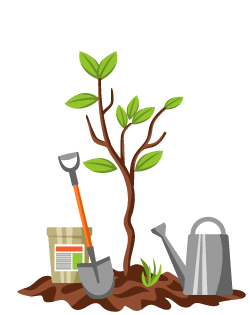 Landing
Basic conditions
- To prevent root rot, choose a sunny site with deep groundwater. The tree's rootstock is approximately twice the size of its crown, so the water table should be at least 3-3.5 meters deep. Otherwise, you'll need to dig a special "root stop"—a layer of slate or roofing felt—at a depth of 2-2.5 meters to guide the roots laterally.
- Memory doesn't like stagnant air in the crown, but it also grows poorly in drafts, sometimes even refusing to bloom or bear fruit. Therefore, choose a location protected from strong winds but still well-ventilated.
- It's best to prepare the holes 6-9 months before planting the standard trees, so the soil has time to settle. To do this, dig holes 70-90 centimeters deep and 1-1.2 meters in diameter. Add soil and fertilizer (organic and mineral) to the bottom, lay a drainage layer, add 50-70 liters of water, and leave uncovered for the remainder of the process.
- Typically, leave at least 3-3.5 meters between holes, but 4-5 meters is better. Even more space can be left between rows to prevent future tree crowns or roots from clashing. A distance of 3-4 meters between Pamyat and other plants in the garden is sufficient.
- A stake is driven directly into the hole, north of the seedling, to secure it. This stake will not only support the tree but also provide additional protection from frost in the winter.
- Root collar When planting, the rootstock should always remain above the soil horizon to prevent the tree from sending roots higher. If this happens, the rootstock's properties will be lost.
- Place the tree on a mound of drainage material, spreading the roots so they don't bend but lie freely. Cover them with soil in layers, compacting it by hand, preventing the formation of voids and air pockets, but also not compacting the soil to a granite consistency. Water the top with 50-60 liters of water, and then the surface mulch improvised materials (chopped grass, sawdust, compost, manure).
Landing dates
Trees of this variety show good survival rates when planted in both spring and fall. To simplify the choice, follow this rule: the further north the growing region and the harsher the climate, the better the former option. Choose a warm, dry day in late March - early April or September - October, ensuring the soil is well-warmed and there is no risk of frost.
Tree care
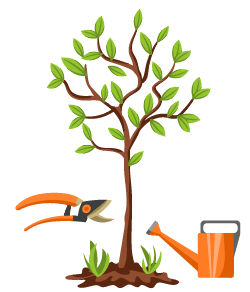 Tree care
Protection from frost and pests
Traditionally, they start cutting back in August and stop it completely by September. wateringTo allow the trees time to prepare for winter and stop the flow of sap in the trunks, the trees are carefully prepared. Just before winter, the trunks are wrapped with roofing felt, burlap, roofing felt, or old tights. Piles of well-dried leaves, spruce branches, and straw bundles are piled on the roots. Young, low-growing trunks can be covered with a tent-like covering; this can also be done with dwarf rootstocks.
To prevent rodents from chewing the bark and young branches within their reach, coat the trunk in the fall with lard, fuel oil, or grease. The smell will repel them, and they'll leave your garden alone. Whitewashing the trunks with lime is also effective against insects; this will drive them away from cracks and crevices in the bark, as well as from the root zone.
Loosening the soil, watering: proper agricultural technology
The area around the tree is dug twice a year, in spring and fall. This is necessary not only for aeration but also to remove weeds, root suckers, and shoots from various plants. In between, it's common to hoe the soil, but if you don't want to add extra work, you can sow the area with herbs. They will add air to the soil and make a great addition to salads and other dishes.
Watering Trees usually don't need water, as they find moisture themselves just fine, their roots penetrating deep into the soil. However, in the driest years, even young trees can benefit from watering 4-8 times per season. Water is also convenient for adding fertilizers and fertilizers, as they are absorbed much better.
Pruning: simple crown shaping
The most convenient form for 'Pamyat' is a sparse, tiered crown. This will allow for good ventilation and sun exposure throughout the day. It consists of a central conductor and several skeletal branches spaced widely apart at varying heights. However, a broom-shaped or other form is also possible. Approximately one-third of the length of the fruiting branches is pruned annually; this will prevent the tree from growing too large, but will also protect it from damage.
Sanitary pruning includes removing dry, diseased, and damaged shoots. It's also worth removing those that stick out inward or upward, as they will thicken the crown, preventing sun and air from penetrating. Rejuvenation can begin around 12-15 years, which is when fruiting will begin.
Pollinator varieties
- Folder.
- White filling.
- Melba.
- Wine.
- Soulful.
- Mantet.
- Korobovka.
- Granny.
Reproduction
- Rooting.
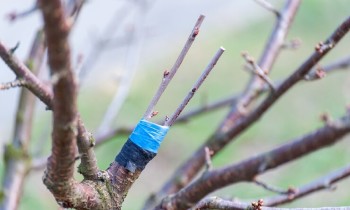
- Kidney grafting.
- Cuttings.
Diseases and pests
- Scab.
- Bacterial burn.
- Powdery mildew.
- Green aphid.
- Codling moth.
- Leaf roller.
- Hawthorn.
Ripening and fruiting of the Lavrik Memory
The beginning of fruiting
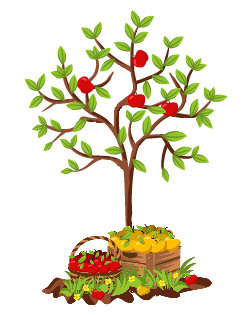 The beginning of fruiting
The tree is considered an early fruiting tree, but don't expect fruit in the second or third year. It doesn't bloom for the first time until the fifth or sixth year, after which you can harvest approximately 4-8 kilograms of fragrant, very juicy fruit. If you notice flowers earlier, it's best to pluck them ruthlessly so they don't waste the tree's energy, as they likely won't form into ovaries anyway.
Flowering time
The variety typically begins blooming in May, and the warmer the climate and weather, the earlier. In some regions, for example, Crimea or the North Caucasus, trees open their snow-white or slightly pinkish buds as early as the first to fifth of May, fully completing the process by mid-May. The tree's flowers are medium-sized, with fleshy petals and are fragrant, gathered in clusters of several, densely covered branches, making the tree very beautiful in spring.
Fruiting and growth
The apple tree quickly gains height, reaching approximately 35-45 centimeters one season before the fruiting season begins. It soon reaches its maximum height, which many prefer to limit with pruning. It also gains fruit very quickly. By the sixth to eighth year, it can produce up to 10-30 kilograms of fruit, and by the 12th to 14th year, fruiting reaches its full potential. By the 15th to 17th year, it can produce 70-90 kilograms of fruit.
Technical and consumer ripeness occur simultaneously, around mid-August. At this point, the fruits are perfect for fresh consumption and are also ideal for processing. They cannot be stored longer than 45-60 days, so it's best to process or eat them by then.
Top dressing
- Peat.
- Compost.
- Ammonium nitrate.
- Humus.
- Chicken manure.
- Superphosphate.
- Manure.
- Mineral complexes.
What to do if it doesn't bloom or bear fruit
- Check for pests or diseases.
- Transplant into the sun.
- Water.
- Fertilize.
Why do apples fall?
- Wind, hail, hurricane, rain.
- Overripe.
- Pest damage.
- Diseases.
Please leave your feedback on the Lavrika Memory variety so that other gardeners can learn from your experience and draw conclusions from it.